PODCAST. From "Serena the Dreamer" to Sober & Thriving. Unmasking ADHD with Serena Palmer.
This episode is sponsored by Littlebird. Littlebird is an AI assistant that already knows your work, so you can draft, plan, and stay on top of everything without having to catch it up on context. Get a free trial plus $20 off your first month of Littlebird Plus today at wisesquirrels.com/littlebird.
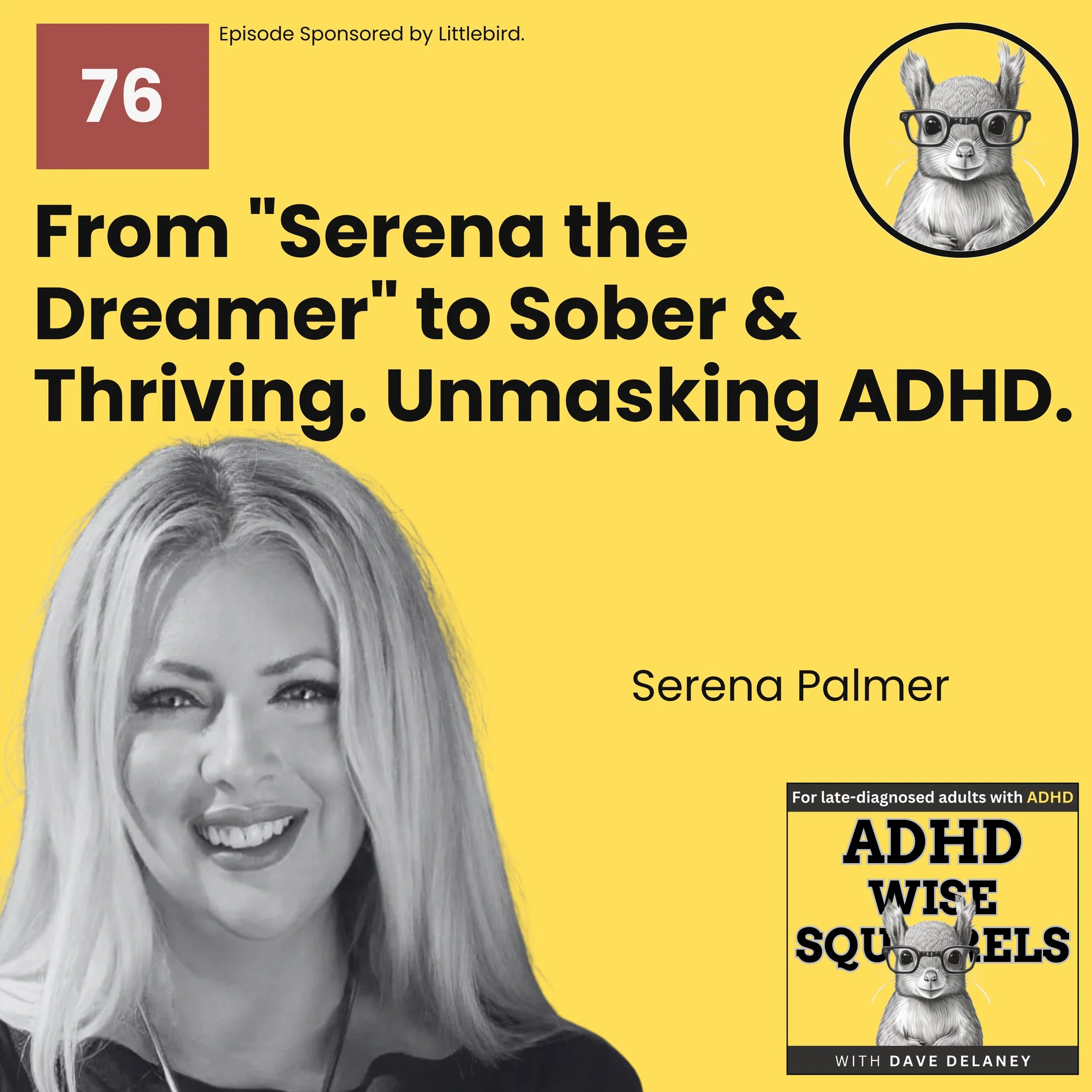
In episode 76 of the ADHD Wise Squirrels podcast, Dave sits down with Serena Palmer, an executive coach who specializes in neurodiverse leaders, a facilitator, and the author of My Two Brains Are Me and the sobriety journal Straight Out of Rehab.
Serena’s journey is a powerful testament to the twists and turns of late-diagnosed ADHD, the exhausting weight of masking, and the beautiful clarity that comes from understanding your own operating system. Whether you are navigating your own late diagnosis or untangling the coping mechanisms you built along the way, this episode is packed with relatable "aha!" moments.
Here is a breakdown of the key themes and takeaways from their conversation.
Like many women, Serena’s diagnosis came later in life, at age 42, and only after she sought professional help for her teenage daughter. This is a remarkably common pipeline for parents, particularly mothers.
During the episode, Dave and Serena discuss the societal generalizations about ADHD presentations: boys are often portrayed as the hyperactive, impulsive Bart Simpsons, while girls are often portrayed as the inattentive Lisa Simpsons. Serena was dubbed "Serena the Dreamer" in school. She wasn’t disrupting the class; she was simply drifting off. Interestingly, Serena shared recent neuroscientific theories suggesting that ADHD daydreaming might actually resemble the early stages of sleep, providing a micro-rest for an exhausted, hyperactive brain.
The Mind-Body Disconnect: When Your Body is an "Inconvenience"
One of the most fascinating (and intensely relatable) parts of the conversation was Serena’s description of her physical body as an "inconvenience."
For many Wise Squirrels, living entirely in the brain is the default state. When you are hyper-focused or overwhelmed by the constant chatter of a busy mind, basic human needs like eating, sleeping, or even using the bathroom feel like massive interruptions. Serena candidly shared how she would routinely ignore her body's signals until the absolute last possible second because tending to her physical needs threatened to break her mental flow. Learning to give herself grace and prioritize her physical health has been a vital, ongoing part of her growth.
Masking, Imposter Syndrome, and Addiction
Serena’s career path took her from a 16-year-old acting student in London to a global corporate director. However, as her responsibilities grew, so did her imposter syndrome. To cope with the pressure of her corporate mask and the undiagnosed chaos in her mind, she turned to alcohol, believing it allowed her to be her "authentic self."
Serena highlighted a sobering statistic during the episode: a conservative estimate suggests that around 60% of late-diagnosed ADHD adults have one or more established, harmful addictions.
Note: While we couldn’t find direct sources for the 60% statistic, we did learn that studies suggest that roughly half of young adults with ADHD have had a lifetime substance use disorder, and adults with ADHD are substantially more likely than peers without ADHD to have one.
Wise Squirrels are dopamine seekers, and without an understanding of our neurodivergence, we naturally self-medicate to manage the overwhelm.
Calm Yourself with Box Breathing
Now two and a half years sober, Serena credits her recovery to facing the pain head-on and discovering the life-saving power of box breathing during rehab. Just two minutes of intentional breathwork allowed her to regain control of her thoughts and anchor herself back to the planet. She even has the breathing shapes tattooed on her arm as a permanent visual anchor!
Watch the video to see Dave teaching box breathing.
Is ADHD Really a Superpower?
The "ADHD as a superpower" debate is a hot topic. Both Dave and Serena agree: ADHD itself is generally not a superpower, especially when you factor in the heavy systemic barriers and the privilege required just to get a diagnosis, let alone treatment.
However, we absolutely possess unique superpowers. Instead of slapping a toxic-positivity label on a difficult neurodevelopmental condition, Serena encourages her clients to discover their true character strengths. Using the free VIA Character Strengths Assessment, individuals can separate their ADHD struggles from their core, brilliant traits.
Serena’s Top Strengths:
Creativity
Humor
Curiosity
Leadership
By understanding that her insatiable thirst for eclectic knowledge isn't a distraction but rather a powerful form of curiosity, Serena has learned to embrace her brilliant, fast-learning mind.
What are your top strengths? Find out here.
-
0:00:00 Speaker: Oh, hi, I'm Serena. Serena Palmer and I run my own business, which is Serena consulting. So I'm an executive level coach, but I also primarily coach neurodiverse leaders and professionals. Most of my coaching clients are ADHD or Ord, ADHD. And that's probably because in the last two years, I've talked a lot about my own ADHD diagnosis. Um, and, and attract that sort of individual. I'm also a trainer, a facilitator. I do a lot of talent strategy, that sort of thing. And I've written two books. So I wrote my two brains are me, uh, that came out about eighteen months ago. Um, and that's really, I suppose a memoir, um, of my kind of unusual journey, I suppose. Um, and I've also written a recovery journal, which is called straight Out of Rehab, a bit like Straight Outta Compton. I know that I'm, I have a British accent, so it never sounds cool when you say it. Um, but yeah, straight out of rehab is a sobriety journal. Yeah. And so, yeah, speaking of your diagnosis, forty two, when you were diagnosed after your seventeen year old daughter was diagnosed, is that right? Okay. So yeah. Um, without, you know, I, I'm mindful of, of sharing too much about our kids, obviously for their own privacy. But I mean, you know, you can say what you like, but, uh, what, uh, yeah, what did that process like for you as far as how that went? You know, I, I look back at it and I'm sort of amazed at, um, how it all played out really. You know, my, my daughter in her, in her childhood and her early teens, you know, there were so many what we would now say are classic ADHD symptoms at play. But you know, the difficulty so many of us have is when you know, you're so close to somebody, you live with them. You know you've known them since they were born. You kind of package things up as well. That's personality. It's it's behavior. Um, but, you know, certainly for my daughter, she was really struggling from around sort of fourteen, fifteen. And that led me to sort of really look at things that were going on and seek professional help. And we took her to, um, an amazing, um, woman who was a psychiatrist who specializes in teenagers and adolescents. Um, and my daughter was diagnosed with ADHD and PTSD. And as a mother, my immediate reaction was to learn everything I could about her and everything had to apply to her. And because it was that sort of steep learning curve and because it's my daughter. Not once did I sort of stop and think, oh, that sounds familiar. Um, mhm, mhm. And you know, my daughter, you know, she and I laugh about this. She has so many memories of all different stages in her childhood of coming home after school and saying things like, I just don't feel the same as everyone else, or I seem to keep getting told off because of X, Y, and Z. And my response was always, well, that's not unusual or weird. I was like that, you know? Right. Yeah. Yeah, sure. We laugh at that a lot now, but, you know, it took quite a painful experience for her diagnosis. And it was as I was starting to really kind of, um, I guess completely adjust to the things that I was learning about her, that it started to sink in for me. But I think the complication from my own journey was that I had also, again, at the time, no idea, which sounds ridiculous, but I'll talk about this later that I was in fact, you know, an alcoholic and unaware of that. Um, you know, I was able to probably categorize myself as a, you know, a functioning alcoholic for such a long period of time until such point as I was not functioning. And that as a huge sort of blanket over my ADHD. Um, you know, had led me down all sorts of different therapy diagnosis. I was utterly convinced I was bipolar, I'd had hypnotherapy. You name it. I'd done everything. Um, until eventually I was in utter crisis. And that's when I booked myself with a psychiatrist for an assessment. I took ten pages of evidence to convince them that I was bipolar. I was, you know, I'd googled it to death. Um, and I don't think I looked at those notes once. Um, and in fact, the most affirming thing I think any human being has ever said to me really was at the end of that ninety minutes when he said, you know, there's no question your neurodiverse, the question is in which direction? I think it's one of two things. But the first one I think is ADHD. And I was like, you know, my daughter, I know everything about ADHD. Yeah. Right, right, right. Excuse me. Um, um, you know, so that that's the, the wiggly line to, to my diagnosis. Yeah, yeah, yeah. And it's interesting. I mean, I know there was a study that found or multivariate study, I believe that found that, um, that women typically are diagnosed about five years after men. Um, and I think that, that obviously there's, you know, sexism and misogyny and all that good stuff out there. And I say good stuff with air quotes. Uh, of course, um, I, but I also think my understanding at least, and, you know, as I always say, I'm not a doctor and I don't pretend to be one here. Um, but my understanding is that with three presentations of ADHD, you know, generally speaking, not always, but generally speaking, the boys are the, the hyperactive, impulsive Bart Simpson is the analogy I like to use. And then the women tend to be more or girls at least tend to be more inattentive, predominantly inattentive, and so more the Lisa Simpson. And so you can do very well at school or not. Um, but regardless, because ADHD has nothing to do with intelligence, but with women, because if you're daydreaming at school or just playing with your hair and you're still doing the work and all these things, or even if you're not, the teachers don't really care because you're not. I mean, some do, of course, but it doesn't matter because you're not disrupting the class like the boy. And that's just like, get this kid out of out of my class. Uh, so, um, so there's that, but I, I find them more and more. I, I learn about ADHD through my podcast and these conversations. Yeah. I mean, women, women are the most are the, like most, the highest group being diagnosed now because of, and so often it's the, it's the exact same story that you shared wear one or more of your children. You know, you take them in and they get diagnosed. And as you learn, you're like, oh, hang on a second. Um, yeah. So it's pretty, it's pretty. Yeah, it's difficult, isn't it? Because we, you know, there's so many generalizations, but I often say as a kind of rule of thumb and it never applies to everyone. But as a rule of thumb, I would say that you see ADHD in boys and men, and you hear ADHD in girls and women, and it presents in those two ways. And of course, that's not the same for everybody. Um, but you know, that's the real classic sort of tale as old as time for girls is, you know, being described as chatty, too talkative, you know, full of questions, full of, you know, just tell me, tell me, you know, needing to know a lot of things but never listening to the answer and daydreaming. And of course, you know, those were absolute classics for me. I was nicknamed Serena the Dreamer at school. Yes. You know. Yeah, yeah. Dreaming. You know, daydreaming. And, um, I just saw some research, actually, which has been studying daydreaming. And I find it fascinating that, in fact, it is sleep. This is what neuroscientists are saying now. It's short, intermittent. Your brain actually goes into the early stages of sleep state. Mhm. Interesting. Sure. You know, which is why we look like we've drifted off, because we have our eyes are open, but we have disappeared for a minute, you know? That's interesting. Yeah. Yeah. Well, it makes sense too, because of how taxed our are, especially maybe with and again, kind of a stretch here because I'm not I don't know. But like with if you're more hyper active perhaps and you're, you know, your brain's working that way too, that it could be a little more. It definitely was more exhausting. Right? So like, to your point, like if you're talking and trying to do all the things and fit in and all, you know, it is exhausting. So maybe even fatigue fits into that to where you're like, maybe daydreaming and fatigue fit in. Because if, if daydreaming, sort of like sleep in a sense, then fatigue would make sense. And thus those who are more tired perhaps are more prone to daydream, I don't know. Yeah. It's, it's, it certainly makes a lot of sense to me. Um, you know, I've always been a, I don't really seem to have that intermittent feeling sleepy. You know, it's something I've learned about myself is I don't receive the signals of sleep until I'm asleep. So I once had a Fitbit watch. You know, that tells you how long it takes for you to go to sleep. And it's twenty one seconds for me. So it's almost like somebody just pushes an off switch and I've gone from talking to fast asleep. Yeah. And that now I look back at my sort of daydreaming and how, how I process things that all fits together for me. You know, these kind of like Lights shut off moments. Yeah yeah yeah. I'm like that too. Actually, I drive my wife nuts. She she she hates it. She's out of jealousy. Just out of jealousy because she toss and turn and she's like, how do you do that? Like, I'm just like, like, just out, like out like a light. Um, yeah, it is, it is funny that way. Um that's interesting. So, um, moving to London at sixteen to become an actress. Yeah. Tell me about that. So, um, I think as a child, as a young child, sort of, um, you know, in the UK we talk about primary school, which is when you first go to school age five and you're there till about ten, eleven, that, that phase of my life. Um, I would probably describe myself as, you know, a extremely talkative, very curious and extrovert child. I was an only child. And um, That I was constantly being told to stop showing off. Showing off is, you know, a real. It's not a nice thing to say. You know, showing off is somebody who's like demanding the attention. Right. But I had a lot to just say and do. And one of those things that was very helpful was acting classes. I started that from age five. We called it speech and drama in those days. So, you know, we would do a lot of, um, poetry and, you know, prose as well as performance, and you could do qualifications. And I excelled at that when I went to secondary school, um, which age eleven, um, I chose the school because of its drama facilities and that I was completely blinkered in terms of this is going to be my career. Um, and what I, I find curious is that by the time I was at secondary school, I started, I started smoking age eleven. That was one of the first sort of really naughty things I started doing. Yeah. Um, and, you know, unlike a lot of my peers, I immediately was a smoker. Um, it wasn't just like a, if you could get hold of a cigarette or someone had stolen one from, you know, a parent or something like that, I was out there getting people to buy them. You know, that was the first thing. The second thing is that I stopped going to classes that I did not enjoy. So I would go off to the park over the road from the high school and smoke a lot with all the naughty kids. And they would, you know, we talk about skiving in, in the UK. It's it's truancy. I don't know what do you say in the US. Is it um do you say. Yeah. No I haven't even heard that term. And I should, should because my mum's British so like I know. What's that. Yeah. Uh or like you know. Yeah. Well skipping skipping class, I guess. I'm, I was I was raised in Canada in Toronto. So yeah. Um, yeah, we would just say skipping school or cutting class, that kind of thing. Yeah, yeah, yeah, yeah. Um, which also is, was that part of your story? Well, yeah. Oh yeah. The thing I find really interesting about that again, you know, looking back is that I would, if, you know, the classes I didn't go to after experiencing them maybe three or four times would be chemistry, physics, maths, geography, there are none of them I could tolerate. I would get so frustrated. I had no interest in them. And so I would head off to the park and I'd find the naughty kids and be smoking. And then they would say, right, let's head into town. And I would go, no, I've got to get back because it's drama or it's art or it's English. Yeah. And I was confusing to them. They were like, well, the whole point of being here is that we don't quit. And I was like, no, no, no, I'm going back. And I'd have to sneak back into school so that I didn't get caught going back. Um, and the other thing is that all my teachers knew I was doing that. And I think the reason why I could get away with it is because I was such a high achiever in all the classes I loved and totally dedicated and a kind of a star student. But the ones I didn't, I just somehow that behavior got tolerated. Um, and did you pass like, did you pass each year though? Yeah. So in the UK, you it's difficult to fail. We don't fail a year, but you know, you definitely fail on subjects and um, you know, I definitely failed maths. I ended up retaking my maths um when I was twenty one actually. Yeah. Purely because I wanted to, I was at the age where it was annoying that I didn't have it. Um, but my other subjects, you know, my, my grades at the end of my school schooling were sort of like a A's and B's in those subjects and then fail in everything else and just sort of a story of two halves. But I was determined to, to be an actress. And that was what was driving me and keeping me sort of really engaged in school life. Um, and then I auditioned in London for a number of drama schools, and to my utter shock and delight, I was able, I was successful. And so I headed off and I was very young, you know, sixteen when my daughter was sixteen. I remember looking at her thinking she would not survive, you know? Right. Yeah, yeah, yeah. How was so, um, where were you raised? Like, where, where are you from originally? Yeah. So, um, a small town in the south west of the UK called Newbury. Um, it's a sort of market town, um kind of real, real famous for having a race course. Uh, so it's, it's kind of it's certainly when I was growing up there, it's regenerated a lot now, but when I was there, it was, it was a very small town mentality. Everybody knew everybody. Um, everybody was dating each other's cousins, sisters, brothers. You know, we were all involved in, in everything. Um, and I found it oppressive. Um, and so for me, my escape into London was so exciting. Um, and I didn't think twice about it. You know, it was, it was it like a boarding school or like kind of setting or were you commuting? Like how far, how far are you? I started, yeah, I started off commuting, uh, so I'd catch the train and that would be like a sort of hour and a bit on the train. Then I'd have to get the London Underground across town to, to the drama school. So the total journey was over two hours in the morning and evening. I started off doing that, but very quickly I made good friends at drama school. I was one of the. In fact, I was the youngest person there. Mhm. Um, and so a lot of the other people, the students were at least eighteen and had rented little flats in London or house shares. And so I started just staying with them. So I didn't really pay any rent. I managed to get away with that, but I would basically, you know, be up there Monday to Friday and then go back, uh, to, to Newbury at the weekends. Yeah. That's cool. Yeah. My mum's from Romford. Um, so yeah. And she was an actress too, so she would. Oh yeah. So um. Yeah, born in London and then. Yeah. Spent most of her time all around London. I lived in London for a while. Um, and, uh. Yeah. That's interesting. Yeah, it's it's, uh, and it's funny. I mean, it's obviously different different times too, because yeah, I mean, yeah, I had an apartment at sixteen, um, and was paying rent. Uh, I was kicked out of five high schools, um, all for cutting class more than anything else, like a bit of a delinquent, but never like I was never like a, I maybe not a troublemaker in the sense like I wasn't violent or, or, or a jerk. I was more of a class clown and disruptive. And, but unlike you, I, I didn't really find the classes that stood out to me most. There's certainly some retrospectively that did. But. And some teachers that were great that believed in me, but um, no, I would yeah, I would just, I would cut class, I would, I would skip and we had the north doors. It was called at the high school that I went to the most where, yeah, we'd go and smoke cigarettes and hang out. And then, um, I, I met, uh, my, one of my best friends who's still one of my best friends and the two of us would walk to school together. And then we would decide at some point not to go, or we would go and cut class like really early, and then we would usually go back to his house and smoke pot and just hang out all day. And so unlike you, we just didn't go back. And so yeah, like, I would think that was kind of what most people did. If you were a class cutter, then it meant that once you've made that decision, you don't go back in. And I would sort of somehow make my life twice as hard trying to sneak out without getting caught and then sneak back in. You know, it it was kind of crazy. It's funny, though. Yeah. And it's funny. I mean, being from Toronto to like taking the subway at, you know, eleven twelve and kind of. Yeah, just exploring the city and just getting lost. It's just like I'm in Nashville, in Tennessee in the States now. And yeah, I mean, totally just yeah, that would never have been the case for my kids, who are now nineteen, I think as well, you know, things have changed. But I also just think, you know, my parents and your parents were from a different generation where they were. That was a little bit more acceptable that once your kids got to an age where you could give them a key, you kind of let you know. So I think it filters down, right? You know, and actually their sort of ability to say, well, she'll be fine. You know, that's, well, there's no way. I mean, there was no way to like, I mean, I, you know, my fam, my kids were nineteen and twenty. They're still on, on life. Three sixty app. So like we're tracking their whereabouts, making sure they got home. Even last night, my daughter had a, she's going to school in Nashville here. So she joined us for dinner and then like, yeah, I checked to make sure she got home okay, like back to the college, okay. And so on. So yeah, it is, uh, it's different times for sure. And I do, I mean, I think, I think it's, uh, I've said it on here a lot, but I do think there's just it's we live in such a great time as far as like ADHD diagnosis and treatment goes, because where our generation and the generations before us, probably not everyone, of course, but likely face some sort of trauma at the hands of. And I mean that, you know, but by, by parents or a parent who was because of the heritability aspects of ADHD, the likeliness of my having ADHD and, and one of my kids having ADHD is like, it's like eighty five percent or something like it's super high. Um, but the other side of that is that means one or both of my parents highly likely also did or do have ADHD. That's right. And yeah, knowing what I know about which one have you, have you, have you? I would honestly, I would say both. Um, I would highly suspect both. Um, my mom is still with us. She's ninety. Uh, you know, she's hilarious. She just. She got a pacemaker last year, and now she's, like, just doing everything. Like she's completely functioning. Like, I took her out for her ninetieth birthday in Toronto, and our server at the restaurant was like eighteen seventeen or something. And, and I asked the girl, I'm like, how old do you think my mom is? And she's like, uh, fifty five. And I'm like fifty five. I'm like, I'm fifty three. I was like, how is that possible? And my mom was just laughing because she looks great. And my mom looks like she's like seventy five or something and she's ninety. Um, so yeah, that's stiff, uh, British stiff upper lip. Um, yeah, yeah, yeah. Piss and vinegar and all that good stuff. Uh, yeah. Yeah. But it's funny like. Yeah, but you do realize that like you learn. Yeah. When you're diagnosed, especially as an adult, you start Easter, and you learn all these things about ADHD and certainly in your own family. Yeah. Have you thought about that too, as far as your parents? Yeah. I think, you know, it became are they still with us? Are they still around? Yeah. Both my parents are still with us. And, um, you know, they split up when I was about one and a half. So I've always known them as separate sort of entities, you know. Um, I grew up with my mom, but, you know, my dad and I have so many personality traits that are exactly the same. Um, and, you know, I remember the penny dropping with my dad. Um, he was going through a bit of a tough time, some medical stuff, some health stuff, and it was actually really getting him down. Um, all of the things, you know, that they were all treatable, but there seemed to be like lots of things that had sort of combined into one. And he had to keep going off and getting treatment and his mood and his energy was just through the floor. And that is exactly the same as me, You know, I am a self-confessed hypochondriac. I always have been. Um, you know, any little, um, ache, pain, or difference in my physical well-being. And it will be, you know, I'm imminently going to die. And, you know, it's I laugh about it. The reality is I genuinely feel like that sometimes. And, um, what I've come to learn is there is a disconnect for so many of us who have an ADHD brain where we are so busy in our brain. I live in my brain, as all of us do. You know, in the ADHD community we are. We've got a lot to talk about in our brain, and we've got a lot to think about. Question. We're never doing quite enough. There's a billion things I could do. Which one am I? You know, so much of that chat that what that can often lead to is a complete and utter disconnect to your physical body. And so the only time I'm reminded that I have a body is when it goes wrong. And the shock of that is so devastating that I suddenly might, you know, really what's happening is that's threatening my ability to use my brain. If my body doesn't work, I suddenly get reminded I need a body. And then you're like, oh no. And now it's broken. And it's this sort of fear thing. And my dad has been like this since time began. And what I was seeing is this prolonged period of sort of ill health and complications. His mood was horrendous because he was being reminded every day he requires his physical body to be able to go through life, which sounds ridiculous to a neurotypical person, maybe, or someone who doesn't experience that. But it's such a common thing. And, um, with my dad. I've gently and gradually, over the last sort of five years or so, been helping him understand ADHD because he's, you know, he's right out there. And I can clearly see that that's where it comes from. He really enjoys that now. And he does a lot of research and is able to connect the dots. But like so many of us diagnosed in adulthood, our first question is like, well, hold on, is this me or is this my ADHD? That's what I hear from every newly diagnosed coaching client that they look back at their entire life and go, well, hold on, which fits me and which is the ADHD, you know? Yeah, I've explored that. I've definitely thought about that a lot and talked about it here too. Yeah. And also the question of even and I'm still like, I don't, I haven't decided, but it's like, am I ADHD or do I have ADHD? Because when you say like, you have ADHD, it sounds like you have like a virus or like a disease of some sort, right? But you don't have ADHD. But, but, but I am ADHD almost. I mean, it sounds maybe a little better in a way, but but it's also like, I'm not just eighty, I'm Dave. Yeah. Like I'm not neurotypical. I'm not, you know, I'm not ADHD, but like, so I'm still like, haven't decided about that. It's weird, but like, tell me more about what you were saying because I, I find that really interesting about that body connection or disconnection because like, I landed on something a long time ago. Um, and I jotted it down and it's on my wall and it says overwhelm equals paralysis equals stagnation. And overwhelm is the enemy, um, in my opinion, because like when I, and I've got many examples I've talked about here before about getting overwhelmed with things and then just instead of. And it's not even necessarily big, like you're, it's not a bunch of fires to put out around me. It's like just like three different things to choose to do. And I'm overwhelmed by the process of deciding which I should do. And so instead just kind of freezing and not doing any of them and then kind of stagnating, like, you know, having not done anything. So in a sense, like with the body, are you speaking more just so I understand what you're saying? Like, are you saying more from almost like a neglect, kind of like a physical neglect, like almost you're all up in your head. And so like in a sort of preventative way or like going to see your GP or whatever, like your family doctor, like you probably like you should like that. Or is that what you're saying? So here's if I break it down, um, here's how I would describe in general terms. It's more nuanced, nuanced than this. But in general terms, my body is an inconvenience. And the reason why I would say that is my body requires to be washed. It needs feeding, it needs hydrating, it has to exercise, it has to sleep. It has to go to the toilet, right? All of these things are inconvenient and interrupting to my ability to get things done right. So one of the things that I have always done, and as a forty six year old still do, and I talk about it because it's not a shameful thing. It is really, really common is I will find that I could be sitting at my laptop working, and I've been desperate to go for a pee for about an hour and a half. And now I've probably got seconds Before. I'm literally going to pee all over the chair and on the ground, and that's when I make myself get up. Yeah. So what's happening there is that the inconvenience that my body displays is it starts to demand that I stop what I'm doing and go and do something for my body. Right? If you think about it in these terms, and that is I resent that. And it's always at a time where I'm most into something or I need to finish something. And being able to prioritize my physical body is something I have not conquered or learned yet. And it's really important to say yet because everything is a path of growth, right? And I'm better than I was. But for children, so young children, I used to wet myself a lot as a child. And the most common thing that I would find is when I was playing, I was that I was so annoying to my friends because we'd be playing engrossed in a game, you know, maybe age seven, You're when you're so in a game and it feels wonderful. And yeah, it's. But of course, the same issue. I need a week. I've got to go, but I won't go because I'm ignoring that signal from my body. Yeah. It's more important that my brain can stay in the game. And then of course, as a young child you have an accident. Right. And I was constantly being taken at school, you know, into the little cupboard where they kept a packet of clean knickers and you'd get a you know, it was always me and I had no problem with it. I wasn't embarrassed and I think because you were just interrupted, I was like, well, that's the result of having an amazing playtime, you know? Yeah. Yeah. Right, right, right. No. That's interesting. That is a really interesting thing. I don't know about. Uh, I would be, yeah, I would love to learn like, whether that is more like, that makes complete sense to me. I was going to say, I don't know whether I was, uh, had a lot of accidents or not Or if my parents would have even noticed. But that's a different story. Um, but yeah, there is something there that's, that's really fascinating. And do you. So yeah, because I think like, I, I've, I've always had sort of, I've dabbled in mindfulness and meditation and, and in twenty twenty, I began a daily meditation practice. Um, and started taking that much more seriously to the point that I go, I haven't been on like retreats, silent retreats yet or anything yet, but that is my intention. And I have been going to like a several different places around me in Nashville that are sort of Buddhist centers and things and actually meditate and sit. Um, and I study a lot of it. And I've had like incredible experts, luminaries really on mindfulness and meditation, like Ellen Langer on the podcast and Joseph Goldstein and Diana Kantor Kantor and, uh, so many people. Um, so yeah, I'm curious, like, have you, do you have any sort of, have you dabbled in this world? Because like the more philosophical you get and, and more into mindfulness and sort of this Buddhist sort of not, I'm not really religious, so I don't consider it like a religion, but more, um, but you get into sort of aspects of even philosophical aspects of like having no body and having no head and all these interesting deep things that I would say, I'll sound like an idiot trying to get into. Um, but I, I've learned, you know, you, you, you said you were, you were diagnosed with forty two and you just said you were forty six. You said, yeah, yeah, yeah. So and I was diagnosed at fifty three and, or excuse me at fifty, just before my fifty first birthday. And I just turned fifty four actually, uh, just so I, I stake earlier. Um, but I feel that looking at my life through the lens of ADHD, um, I've and, and past and present and future, I, I really have focused on giving myself grace as a big part of it to understand why I may have done something the way I did it or the, or even in a day when I get exhausted and or let. I'm hammering out writing and doing my thing and then suddenly I have to pee. To your point, because I do the exact same thing. But instead of. And I'm not suggesting you do this necessarily. Or maybe you do, but of of beating myself up in a sense of like, damn it, body, why do I have to be, you know, and, and you've thrown me off and now I'm just now I can't get back to what I was working on because I was in that flow hyperactive state. Yeah. Or hyper focused state. Um, but giving yourself grace and saying like, okay, I, you know, I love my body. I mean, pot, little pot belly and everything, uh, you know, aside, but like loving yourself in the sense and giving yourself that grace to say like, okay, like I have to pee. Yes, obviously, like in a, but I'm also stretching doing that. I'm also hydrating myself again, having done that, like I'm taking care of myself or going to my GP appointment annually, or, you know, I need to do that. That's trying to do those small things that, that benefit your physical well-being. Yeah, absolutely. Yeah. Like, like I've been going on a three mile walk most mornings. I did it today as well. And I find and exercise is something I've always been into accidental exercise. So like when I travel or when like living in Toronto, I would ride my bike and walk everywhere. I mean, London's incredible for that too. I remember when I lived in London one night, my buddy and I were out way too late many nights and the pub said or the tube had closed. And we're like, oh shit. Like, how are we going to get back? And, you know, and we were kind of broke. We didn't have money for a cab or anything, and then we just decided to walk it. And I remember I was like, wait a minute, London's not very big. Like, I mean, some places, sure, but like from one end to the other. Absolutely. But, you know, several tube stops are really only a few blocks. Uh, so you're like, oh, wait, I'm closer. So accidental exercise. But, um, so I've always had it hard to like to exercise intentionally, but going for these walks in the morning has been something really rewarding for myself. So that was a lot. Yeah. I've had some of the most magical experiences walking through London really late at night with friends and, um, just you see it as a completely different place, you know? And you're right, a lot of it is quite accessible. Um, so yeah, you know, I think that with meditation, um, I, the way I would talk about this, I have to talk about my addiction issues, right? So, um, after a brief career as an actress, I accidentally became a manager of a leisure attraction, and then I accidentally became a more senior manager, and then I accidentally went into corporate. And before I knew it, I was a global director, flying around the world, in this corporate world where I'd lost all my creativity. And along the way, from the moment I was employed as a sort of a person in charge of my peers, I was working at the London Dungeon, which is a horror attraction in in London, and I was an actress. Well, when I was backpacking back in the day, the first time I went to London, uh, this was the first time. Sorry to interrupt. First time going to London. It was like ninety six. Not the first time going to London, but the first time on my own and backpacking. It's ninety six. I'm about to leave, embark on this summertime backpacking adventure by myself and my mom's like, well, since you're going to London, I booked a flight. I'm going to go with you on the flight. I'm like, God damn it, mom. Like, I'm trying to, like, escape from you. Uh. God bless you and all. And, uh. So she came with me, and we spent a few days in London together, and, uh. And one of the things I did was I took her to the London dungeon, and she's like, why are we here? Ninety six you were just a few years earlier. I think I started there in nineteen ninety nine. So, uh, okay, you know, you miss me, but I could easily have been one of those actors that was, uh, jumping out and scaring your mother. Right. So. Right, right, right. You know, that's that's why I was there. It was a great gig as an actor because it was regular work and money, you know? And, you know, I suddenly got promoted, um, to being a sort of duty manager, if you like, and stop the acting. And it was more money. I was broke, that's why I did it. But I immediately had this confusion, which I hadn't experienced before. So I was able to perform the role very well as a manager. And I was able to do that job really great. I did not believe I deserved that job or should have had that job. And I was suddenly line managing my friends and my peers that I'd just been, you know, sleeping on their floor or whatever, you know, and suddenly I'm this person. And that was the beginning for me of an inability to be my authentic self. And that continued and escalated as my career went up and up and up, you know, which I'm eternally grateful for. But it was a great master performance. And when I was sort of, um, I guess one of the first things that I started to do was try to be myself. And one of the ways that I could do that was after work in the pub, that was probably the beginning of my alcoholism in my twenties. Up until that point, I never really drank. Um, but I remember very distinct thought processes of taking that drink in the pub after work and and thinking, now I can be the real me, you know. Yeah. Yeah. And that is a sort of. So that dual process of, I guess, a really big dose of imposter syndrome, massive mask wearing, and now using something to alter how I feel and change my mood and try to be the real me led me into this confusing path. And I would say, you know, towards the end of my drinking career, I've been, uh, I've been sober now two and two and a half years and, um. Great. Thank you. I'll be six years this June. It's. Yeah. Isn't it? You know, it's a it's a miracle. Right? It is, it is. Um, I would say my attitude towards meditation, breathwork, yoga, you know, I would be so repulsed by people who would have the audacity to say to me, hey, you should try meditation. You know, you're so stressed, why don't you? You know, I'd literally want to vomit and attack them. That's how you know, I hated people that had peace. And you see, I look back now when you're sick, like I was, you know, alcoholism is described as a threefold illness, right? So you're spiritually, physically and mentally unwell. And those things combined. People who present themselves, who have some sort of inner peace. Mhm. We are so repelled by that because of our own sickness. And combined with I, I was not yet diagnosed ADHD, but I was coming towards it, you know, and I would say things like, why would you ever suggest that to me? You know, I can't sit still. I don't. I never sit down. You know, my whole life I don't sit down, I walk everywhere. I walk around the house. I walk around the office. I walk on the phone. I never sit down. So don't talk to me about meditation, you know? Yeah yeah, yeah. Skip forward into recovery. Uh, I my recovery journey began with, uh, checking into a rehab facility for twenty eight days. And, um, I would say day four is when I realized I actually was an alcoholic. Day five is when I had to face the pain that my alcoholism has caused my daughter, to be honest. And, you know, I've been at various stages of alcoholism for most of her entire life. You know, so yeah, it I had to I buried that very deep. And that was a sort of two day, almost sort of cathartic. I had to look at it. And I don't think I've ever experienced anything as agonizing as that. but at the same time as freeing, because once that was the thing I was hiding from, once I'd done that, I could start to get better and I could start to face into things. And we had a breathwork person come into the rehab and talk to me about box breathing and all sorts of all these different breathwork things. Now, the irony here is I was marching around global businesses, teaching leaders, boxed breath, right? Mhm. Yeah. Doing it myself because I couldn't, um, but they all had to do it right. He did some, uh, one to one work with me for maybe twenty minutes. And I think that saved my life. Wow. To the point where, um. I have it tattooed on my arm. You won't see on the camera, but I. I designed a tattoo which has a symbol of a cube and a triangle. Triangle breathing is just in or hold for four, out for four, and box breath is holding for an extra one. You know, he taught that in such a way, one to one to me that, um, because I was in a constant state of overwhelm and fear. Mhm. That I have never had to deal with sober in my life. And I was facing into my biggest demons and I could not see a way that I could live. Yeah. Like that. And twenty minutes with him. And then the difference I felt in my physical body after doing just two triangle breaths, three breaths was that two minutes, you know? Yeah. Yeah. Two minutes of breath work. Suddenly, I could regain control of my thoughts. And also, I could feel back in the back in this planet. You know, I kept leaving, I kept I was in such a heightened state dealing with everything in a rehab institute. Everything was so crazy and broken. And I was looking at things for the first time. I was in such a heightened state. I didn't eat, sleep for two or three days, you know, and I couldn't continue. And of course, that doesn't make us our thoughts. Well, we start to then say, well, I can't live on this planet now, you know, or our bodies do. Yeah. Yeah, exactly. So I've tattooed it all over my arm because I'm the kind of person who needs reminding, you know, I have to physically see something to be reminded. And I try my best with meditation and what I tend to notice as I go through fits and starts with it. So I, I built myself a little meditation room in my house when I got out of rehab. Love doing that. I love to do the shiny stuff. Decorating, you know? Beautiful. Ran past it for about three weeks, you know, wouldn't go in it. Now, what I accept about myself is that when I start doing my meditation on a daily basis, I do it every day for about a month, and then something will make me stop and I acknowledge I've stopped. Yeah. And so it's never stopped forever. It's stopped for right now. And to not beat yourself up over that. Yeah, yeah, yeah. It up. You know, that's very important stuff. Yeah. That's very important. Thank you. Yeah. No, that's that's a great reminder too. And I think, yeah, you said a lot there that, uh, yeah, I mean, I think well, so with ADHD, I mean, a big part of the curse of ADHD really is this, uh, the curse of novelty or not the curse of novelty, but the curse that when novelty runs off something so like you're doing a meditation practice for a month and it's going swimmingly. And then suddenly, for whatever reason, you're like, no, I don't want to do that anymore. And it's not even like conscious, like you don't decide like, I don't want to do that anymore. It's just like, yeah, you know. Um, and then the novelty runs off. So you had a, um, I, yeah, I really encourage you to listen to my interview with Joseph Goldstein. He was one of three people responsible for like American for bringing meditation to the West. He's eighty one, almost eighty two now. And I interviewed him last year. And it was just such a he's an amazing, incredible person and just such a joy and so funny. Um, also I interviewed Linda Zalewska who, uh, also is brilliant. Um, she wrote a book which I love called the ADHD or the mind the mindfulness prescription for ADHD. Um, and she talks specifically, she's a doctor. And so she actually talks about like the medical side. And so she's done tons of research into, uh, meditation for ADHD specifically. Um, one thing I encourage everybody, including yourself too, is that like, it's not, you're never trying to stop your mind. You'll be dead when that happens or that we think. I mean, maybe not. Who knows? Maybe this is all a simulation. Uh, that's not going down that path because that's. Yeah, yeah, yeah, yeah. Um, but, uh, but, um, we know like the, the whole thing is we don't want to silence our minds. And by the way, my, my Ted talk is coming out hopefully in the next month or two. And I do box breathing in that I talk about box breathing. And I just did a video on box breathing just recently, um, that I'll include so people can check that out. Um, because I, I find it very helpful, but the thing I'm trying to say about meditation is that and Joseph Goldstein has a great way of articulating it. It's you're you're doing well. Meditating when you realize you've been distracted. Yeah. And so when you sit down and you're trying to like, focus on an anchor, like your breath, let's say, which is the most common thing, right? So you're focusing on your breath and you're just like sitting, and then you start thinking about something you need to do later today. The point that's fine. If you think about something you need to do later today and you get up and you go do it. Okay. That's more challenging. But most people don't do that. You'll you'll the first thought, you'll be like, damn it, I'm trying to meditate. But the but that moment when you realize like, damn it, I need to meditate, like, stop. Focus on the breath. The moment you do that and you start again. Yeah. Is the moment you're, you're winning and you're, and you're learning to do it better. And so every time, like he talks about begin again, just begin again, just start again. And this is this is a great rule for life when your things aren't working out, you know, just begin again. Just get back to it, get back to the breath. And so, um, yeah, I mean, I have oh, man, time is flying by here. We've got only like not too much longer. And this is, I've got so many other thoughts to, to share with you and um, but yeah, so that's, that's a big deal. Um, oh man, so many things. Um, yeah. Alcohol. I mean, yeah, so like, I dabbled with alcoholism, uh, most of my life. Um, uh, I, yeah, I quit drinking six years ago and, uh, I did it for thirty days and then I found a non-alcoholic beer, um, that I just decided I'll try that just for kicks. I decided to take thirty. I was, oh, you'll know, like kind of being British. I lived in Ireland for a couple of years in Edinburgh for a year and London for a while. And, and um, so the line, I don't know if it's a British line to, it's definitely an Irish line of being off the piss. Um. Yeah yeah, yeah. Okay. So, like getting off the piss. I always say that like. Yeah. So, you know, in Ireland, when I lived in Ireland, people would be like, you coming out tonight, Dave to the pub and I'd be like, no, I'm off the piss right now and oh, okay, we'll see you next week. Um, and, uh, so being off the piss for thirty days and I found this non-alcoholic beer at the, at the grocery store and I was like, oh, I'll just try it. And I was like, Holy crap. Like it tastes like the real thing. And now for me, like, you know, my level of alcoholism at that, at this juncture of my life, since really since having kids. I mean, I was a mess as a kid, like younger, blacking out every night and, you know, yeah, I, I, I have so many memories of getting on the tube, but not many getting off the tube, um, uh, or many getting on the tube. I don't remember either, but that's a whole different story too. Um, but learning that like non-alcoholic beer has come so far that it tastes like the real thing. And there's certainly there's stuff that has like zero point zero five percent. So that might be a no no for folks. Um, but then there's things like Beck's zero and Guinness zero now that actually have zero alcohol. But of course, I'm not encouraging people to drink this if they're an alcoholic, because that might be the trigger that pushes you over. Yeah. Um, yeah, but I, I interviewed, uh, Professor Robin Dunbar years ago on a different podcast, and Robin Dunbar is from Cambridge. And, uh, Dunbar's number is, is his thing about how many relationships you have and, and so on. And he also, he had talked, we talked about the pub, um, and of course, being British and or Irish or whatever, like in, in the UK and Ireland and Scotland, like the pub is like, and internationally in a sense, the pub is such an important place and fixture in a social way. And, and it's nowadays like I go to bars here and in Nashville with friends. And most have non-alcoholic beer. Um, yeah. And so I drink those and it's no big deal. Again, this is for me, of course. Um, but I am. Yeah. We don't have time to get into it, but I'm just so I am concerned about people, about not having common places for us, meaning humans to meet in person. Um, obviously religion, I suppose, helps the meditation center that I go to has helped. Um, but humans need humans and we need places to congregate. And, you know, obviously alcohol is not good for you. And certainly, uh, it's a good thing that less people are drinking. Um, but at the same time. Yeah. I love a pub. Yeah. You know, I know exactly what you're saying. I think, you know, the human connection that, um, you get from, you know, particularly if you have a regular pub and say, you know, when I was growing up in my in Newbury at the time, there was nothing other than pubs to do, you know. So it was a sort of. It was such a well rehearsed ritual that everyone of my age group, you know, as we started to go into pubs age fifteen, to be honest, you know, we would always go to this specific pub first and then so would all of our friends and peers, and then it would be on to this one. It was like a, you know, it was a ritual. Hub to hub to pub and then end up in a nightclub. The one nightclub with the sticky floor and, you know, and the sweaty walls. And that would that was what you had to do. That's because that's all there was. Um, and if you put the alcohol to one side, what you're gaining is these, you know, I, I could guarantee if I walked into town on a Friday, Saturday night, I could walk into any of those pubs on my own and know people. Yeah. And having the safety and security of that I think is an amazing thing. When you're younger, you kind of don't realize that. And it's something that I often look back with nostalgia on. But, you know, certainly for me, I have never drunk like a regular person. So, you know, my drinking would always have consequence. And, you know, so therefore it became tainted. I had this reputation, you know, chaos will ensue once I'd arrived. And, you know, that followed me, you know, as much as I tried to run away from it. And I've moved more times than most human beings, it followed me. You know, I couldn't. What came with me was me, you know? Yeah, yeah, yeah. So what I, I totally understand from that connection, that community point of view and in society, it's dwindling. You know, the high street is not a high street anymore. That was the other thing. We'd go into town on a Saturday to the shops, you'd maybe buy one or two things if that, but you were there to meet and, you know, you'd bump into people. It doesn't exist now. The one thing I do have, which is such a big part of my life, is the fellowship of AA, you know? So I'm. Yeah. That's great. I'm deeply. Oh, have we lost connection? No, no, we're here just for a second. Um, I'm deeply embedded in, uh, the recovery world. You know, I talk about it a lot. Um, and you know what I would say, you know, there's, there's a lot of international membership clubs that you can pay to be a member of or you have to get, you have to be a millionaire. You know, if you're in the fellowship, you have free admission to the world's biggest international membership club. And wherever I go in the world, there is an AA meeting. And yeah, you know, that's kind of and you're welcomed and understood and you have that shared connection. And to be honest, that's a very big part of my life now. And, you know, the old me would have turned their nose up and sneered and thought, what a sad existence. You know, it couldn't be further from that. It's like, um, it's a shorthand language that you have with other people who have experienced the same illness you have. Yeah. Um, and it's not that we talk about that, you know, I think one of the, you know, the well understood tropes of, of recovery is you, you go to stop drinking, but you stay for the thinking. And yeah, that's certainly what I get from that, you know? And so I guess that's now my community. Yeah, yeah. And that's a great it's a great point too. And something I didn't experience because like I started again, like I, I quit for thirty days now. I was drinking the non-alcoholic beers and still do, but again, the minimum is zero point zero five. But I, I quit drinking for thirty days and thirty became sixty became ninety, became, you know, six years And yeah. Um, and during that time too, like, you know, my friends, even my wife was like, are you going to start drinking again? And I'm like, I don't know, man, like these non-alcoholic beers taste like the real thing. I don't, I don't know if I and like, next time I go to Ireland, like it's they have Guinness zero now. So it's like, I don't, I don't know, I don't think so. And and and they're like, wow. And, and um, I remember we went to Belgium, like with my family and I drank, I decided my wife was like, are you going to drink beer again? Like not peer pressure, but like, she was just like, and I was like, I don't know, let me try non-alcoholic beer. And I'm like, Holy crap. Like, I mean, Belgium non-alcoholic beer is like legit legit what they're doing in Belgium, that's for sure. Yeah. Yeah. Right. And then so after coming back to the States, I'm like, well, I'm not going to start drinking American beer if I'm going to start drinking again. So I had my chance to start drinking again in Belgium. Didn't do it. So now it's like, well, I'm not going to start here. So yeah. So I'm still on drinking the non-alcoholic stuff. I know you got to go soon. I did want to ask you very quickly about, uh, your superpower assessment. Um, I do, I do have I should preface this by sharing sort of my opinion about this very quickly. Um, because I don't want it to like contradict or anything like where your views are or what have you to me personally, and I, I have a blog, if people go to squirrels dot com slash superpower, you can read about this. And this was all inspired by Paris Hilton's song, ADHD is my superpower. And, and I always it was inspired by her song this thought. But what I concluded and I sort of pick on Paris and I don't mean to, uh, and I know, you know, obviously she's been through her own, um, you know, life of, of, of challenges, uh, for sure. Um, so with respect to her, but I realized at the time that like, I believe everyone has a superpower one hundred percent or superpowers, possibly. And I have my own sort of not assessment, but strategies to kind of dig it out and figure it out. And so I'm curious about yours, but, um, but I don't believe that ADHD is a superpower unless, unless it is. And I, and I mean, unless it is if you have Paris Hilton level privilege. And so I have a graph actually on why squirrel's about this, which is basically the more wealth and health and access and networks and all this stuff that you have, aka privilege, the more likely ADHD, you'll consider ADHD a superpower. And in other words, like again, picking on Paris, sorry, but Paris could, you know, she could go and try all the sorts of artistic endeavors or entrepreneurial businesses that she could start and they could all fail. And it wouldn't matter because she has Hilton money and access and health and youth and all these things that she could just pick up and start again. Um, but for most of us, we don't have that. And, and for many people, it's, you know, it's, they're living paycheck to paycheck. And so in that case, and maybe you can't, especially in this bloody country, sometimes you can't afford medication or health, uh, insurance or things. And I know the NHS is kind of overwhelmed as well. And, um, so yeah, so that's kind of my theory is that like, yeah, so ADHD, I think for most of us is not a superpower. However, we do have superpowers. And, and tell me about your assessment and, and maybe you're going to tell me, Dave, you're wrong. No, no, I think you have, um, you've highlighted something that I am so passionate about. And in fact, uh, I have a, an article that's coming out any day, uh, which I've written about the privilege of being diagnosed in the first place. So, you know, and I've done it from a US and a UK perspective. I've got a lot of clients and people I work with in the US and spent a lot of time there. So I hear a lot about that and look at that. And I also experienced the UK and um, it's so screamingly obvious to me that in order to just be diagnosed, you need some level of privilege to get there. You know, my diagnosis came through private healthcare, which I had because I had a job that earned enough salary to be able to qualify. You know, the story, the money, the privilege gives you access to that. When I was first diagnosed, my medication was prescribed privately, which was three hundred pounds a month, and I was able to afford that. At the time, I couldn't. Now I run my own business, so, you know, I wouldn't be able to just. So what I'm saying is you've raised an important and vital part of understanding the spectrum of ADHD experience because it is, um, it's very easy to, like you said, if you've got a lot of backing power and privilege, you can experiment and have the time of your life and it has no consequence, you know? Right. Yeah. I think that's, that's huge. So is it a superpower? I think here's, here's what I would say. No, it isn't. Uh, because the world is not built for us. And there are in terms of the balance, there is way more sway into the things that I struggle with and that I cause me discomfort or self doubt because I'm dealing with a system or a process or simply the the unwritten rules of society, which I've. I'm always wrong about. So that is what I would say about it. However, what I think. Diagnosis gives us is the door opens for us to learn about ourselves in a different way. So that question is it me or is it my ADHD? We must remember to apply that to the things that are our strengths, as well as the things that we've messed up or that we've been bad at. You know, we're all programmed to go, well, I have terrible trouble with X, Y, and Z. Was that me or was that the ADHD? If you can force yourself to look at the things you are good at. Strengths. So one of the first things all of my coaching clients do is, um, a strengths based assessment. So a company called the via Institute, they do it for free. Yeah. You know them. Yeah. It's brilliant. It takes fifteen minutes. And it just tells you what your character strengths are not your skills, knowledge and experience your character. And once you look at the top five, you realize how they play out. And I would say in terms of superpower, what have I learned to love about myself? And I still find this difficult because I'm not good at saying I love myself. You know, I've got forty six years of not saying that. So I think I forced myself to say this because I do love that. I am interested in everything. And what I was told as a child and an adolescent is that I was not academic because the subjects I was getting great grades at held no value for anybody. You know, in particular, my stepdad who made it very clear that I was not intelligent, you know, and that that does such a disservice to us because it's taken me a lifetime to learn. I am intelligent and I learn really fast, and what I really have embraced in the last couple of years is my insatiable thirst to know things and to hear things and to learn things. And I'm so eclectic. It could be, you know, I could be looking at anything now, literally, if something catches my eye, I allow myself to learn until I don't want to know anymore. I like to know so much and move on, you know? Yeah. I think that is a superpower that makes for an interesting life that I enjoy. Yeah. And I think, I think you're absolutely brilliant. And I think the, the value you bring is, is incredible, both from like your lived experience, but also from your knowledge professionally, but also, you know, personally helping folks, I think. Yeah, to your point, like, I think once, you know, like knowledge is power and once, you know, uh, like I've learned so much about ADHD through this and my own therapy and things and reading and so on. Um, that my ADHD coach was like, you know, more than I do at this point. Dave. Like, what the hell? Like, because I'm so, so hyper focused on the topic. So I think, um, yeah, I think we all like, while we're all different, I think we all have great value to, to bring to the world. We all, as I said, like we all do have superpowers. Um, okay, before we go, and I will include a link to the via a strengths assessment so people can check out, tell me like, what are your top five? Do you remember, do you, do you know your top five, uh, strength or via or VIIa or whatever it's called? Yes. So number one is creativity. It's not a surprise. Uh, none of them are surprised, right? Because that's the point there. So yeah, you know, yeah, yeah. So creativity, uh, humor, um, now it's a real test of memory. What else is there? I had to look mine up. Yeah. So I don't know them off by heart. Curiosity is the other one. I think that's number three. Then leadership. Uh, and I forget the others, but those, those are the ones that I was just like, yes to, to all of those. And, um, you know, the best thing about via, they do it for free because they truly believe that this world is better when we know and understand our own strengths. And, you know, yeah, it's just proven. Yeah, I love it. Yeah. My, my, my top. Um, yeah. And I brought them up because I couldn't remember either. So I, I know, I know totally my, my top five. Humor is number one, which explains a lot. Uh, number two is fairness. Number three is honesty, four is forgiveness, five is kindness. And then curiosity, social intelligence, leadership, love and love of learning. So yeah, yeah, yeah, yeah. And the other thing is there in these, uh, these sort of value sets, you know, these kind of almost like moral value sets. And yeah, I like to bring those up with clients as well because it's, it's not just the quality, like curiosity that's in the value set of wisdom. And wisdom is bigger and broader than that, you know? And yeah, yeah, knowledge for the purposes of wisdom and that we help other people. You know, that's certainly something that's true for me. Yeah, yeah. And that's why I call this wise squirrels, right? Because squirrels is the, the trope that kind of, you know, squirrel. Uh, right. But I didn't want to call it just squirrels because it felt almost demeaning in a way. Um, and that kind of rubs sometimes rubs people the wrong way, but wise comes from the wisdom that we've accrued in our lives, having survived and come through to our own successes. You know, you've raised a daughter, you've had great professional success and personal success and all this stuff. So like, we've had these successes despite not knowing our operating system, as I call it, not knowing we have ADHD. and then Add and not knowing that we were masking or, you know, and developing these coping mechanisms that I think like I often say, like product, like every productivity expert is probably an ADHD or whether they know it or not, you know, because, and so, so, and, and, you know, there's like sixty to eighty percent, uh, you know, have entrepreneurial intentions and like nearly one hundred percent, uh, probably start a business at some point. So I think like ADHD contributes so much to the world, whether they know they have ADHD or not. But once you do know, you can then understand, as I said, your operating system, get the treatment and the support you need. Addiction is a big one, man. I mean, we create dopamine and and we can be impulsive. And so without the treatment and understanding, you know, like anxiety and depression are the most common comorbidities that tend to come along with ADHD. And so addictions, excess into everything from right up there. I mean, it's difficult to measure, but I think the stats are around sixty percent. Is the conservative figure of sixty percent of late diagnosed ADHD has already have one or more established and harmful addictions. So, you know, it's and it's no shock. We, we, we don't know that we are dealing with our overwhelm and all of those things by using the things that are in front of us that we're introduced to when we're very young. You know, so yeah, yeah, I was smoking and drinking. Surprise. Yeah. I mean, even at the pubs, like I, I mean, yeah, I, I, I drove my wife and best friend crazy because we would go to the pub together and then I would excuse myself to go to the toilet and then I wouldn't come back for like thirty, forty minutes because I met all these people and I was talking to people or talking to the kitchen staff, meeting them and like just making friends everywhere, but I'd be damned if I remember leaving the bar. Exactly. Or waking up in the morning feeling terrible. Um. But anyway, good for us for for quitting that business. Yeah yeah, yeah. Another big success. All right, I'm going to shut up. This has been awesome. How can people, uh, get to know you more? Uh, and then, uh, yeah, visit you, pick up your books and all that stuff. Yeah. So, um, I guess the central place is go to my website, which is just Serena dot consulting. Um, so that's got links to my social media, my books, etc. and, and all my coaching services. I'm out there on LinkedIn, Facebook, Instagram and TikTok. So yeah, you can find me lots of different places. Yeah. Great. Well, I'll make sure to include links to everything we talked about. But Serena, this has been awesome. Let me know if you ever get to Nashville. I know you mentioned coming to the States. Let me know. And, and, uh, we'll, we'll go get a coffee for for sure. So that'd be fun. Great. Thanks so much for having me. It's a real pleasure.