PODCAST. Ketamine Assisted Psychotherapy, Memory & Trauma with Amanda Johnson.
Episode Sponsored by Futureforth.com. Book your complimentary ‘good fit’ coaching call with Dave.
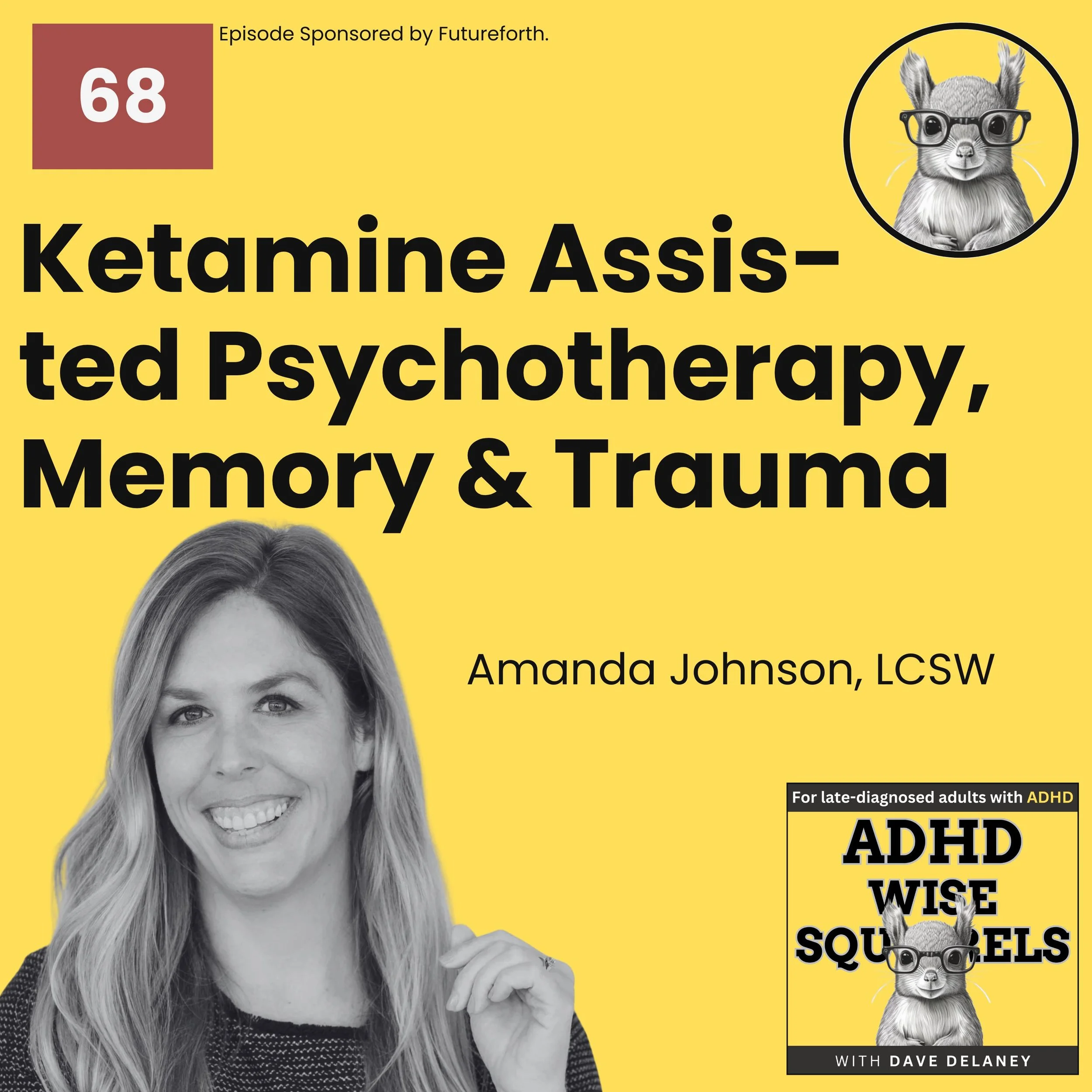
Finding clarity after a late-life diagnosis often involves unlearning a lifetime of feeling "broken" and discovering that you were simply navigating the world with a differently wired brain. Today, on the Wise Squirrels podcast, Dave interviews Amanda Johnson, LCSW, who discusses key themes for late-diagnosed adults with ADHD and offers strategies for reframing the past and thriving in the future.
ADHD and Neurodivergence
A significant portion of the conversation focuses on neurodivergence, particularly Amanda Johnson's own journey with a late-in-life ADHD and Level 1 autism diagnosis.
Discovery through Motherhood: Johnson shares that her attention was first drawn to ADHD while seeking sensory support for her child, a common path for women who are diagnosed later in life.
Diagnostic Process: She describes the rigorous, multi-faceted process of formal psych testing she underwent to ensure an objective diagnosis.
Presentations over Types: The interview explores the scientific consensus that there is one type of ADHD with three presentations (predominantly hyperactive-impulsive, predominantly inattentive, and combined).
Trauma and Memory
The themes of trauma and its deep connection to memory are central to Johnson's therapeutic work and personal philosophy.
Implicit vs. Explicit Memory: She explains how trauma is often stored in "implicit memory", bodily sensations, and procedural defaults rather than just the "explicit" stories people can verbally recount.
Trauma-Informed Care: While supportive of trauma-informed care, Johnson notes that applying it without considering a client's neurodivergent profile can sometimes "miss the mark".
Misinformation Correction: Specifically critique misinformation spread by figures like Gabor Maté, clarifying that there is no scientific consensus that childhood trauma causes ADHD.
Ketamine-Assisted Psychotherapy (KAP)
Johnson discusses Ketamine-Assisted Psychotherapy as a transformative tool for breaking through traditional therapeutic roadblocks.
Mechanisms for Healing: She describes how ketamine can bypass typical "protector defenses" in the brain, allowing clients to witness troubling experiences from a fresh vantage point.
Neuroplasticity: The treatment is highlighted for creating a "window of neuroplasticity," making it easier for patients to implement new behaviors and routines following a session.
Memory Reconsolidation: KAP is presented as a method to achieve "memory reconsolidation," where the brain reorganizes and stops predicting negative emotional states like the "Sunday scaries".
The Emotional Reckoning of a Late Diagnosis
Receiving an ADHD diagnosis in adulthood often triggers a complex wave of emotions, ranging from profound relief to deep-seated grief.
Grief for the "Lost Generation": Many adults, especially women, feel a sense of loss for the years spent struggling without support due to missed or misunderstood ADHD symptoms in childhood.
Reframing the "Bad Person" Narrative: A diagnosis provides a new lens to view perceived past "character failures"—such as being "lazy" or "too much"—as misunderstood ADHD traits like executive dysfunction or emotional dysregulation.
The Relief of Understanding: Finally having an explanation for lifelong challenges with time management, organization, and social cues can be life-changing.
Navigating Daily Challenges with New Strategies
Living successfully with ADHD after a late diagnosis requires moving beyond "trying harder" and toward "working differently".
Conquering Time Blindness: Since time can feel elusive to an ADHD brain, practical tools like time blocking, digital calendars, and visual timers are essential for staying on track.
Leveraging Technology & Environment: Turning obstacles into advantages often involves environmental adjustments, such as using noise-canceling headphones or dedicated apps to capture ideas as they come.
Embracing Micro-Steps: Shifting to "identity-based goals" achieved through micro-steps can help break the cycle of big dreams followed by quick burnout and self-blame.
Refining Relationships and Communication
ADHD traits significantly impact interpersonal dynamics, but understanding these traits can foster healthier connections.
The ADHD Love Languages: Improving communication involves understanding how symptoms like forgetfulness or impulsivity are perceived by partners and finding ADHD-friendly ways to connect.
Building Community: Connecting with others who share the late-diagnosis journey can provide the validation and support needed to reduce shame. Join the Nest.
Self-Advocacy at Work and Home: Learning to communicate specific needs effectively—whether it's asking for a quieter workspace or setting reminders for shared tasks—cultivates better professional and personal outcomes.
A Future of Growth and Self-Compassion
A diagnosis is not just about identifying a condition; it's a starting point for self-discovery and radical acceptance.
Forgiveness and Permission: Forgiving past errors and side-quests is critical for moving forward with a sense of proactive permission to be oneself.
Embracing Natural Strengths: Late-diagnosed adults are encouraged to see their non-linear thinking, creativity, and energy not as hindrances, but as unique sources of originality.
If you found this episode helpful, please follow the podcast and leave a rating and review to help others discover Wise Squirrels. Thank you.
-
Audio Transcript: Amanda Johnson Interview
Hosts: Dave, Wise Squirrels Guest: Amanda Johnson, Licensed Clinical Social Worker (LCSW)
Amanda Johnson: …So my name is Amanda Johnson. Um, I've focused a lot of my career and special interest learning on uh, deep diving into somatic and uh, somatic healing, trauma therapy. I've been really fascinated with understanding how different types of memory can really lead and drive our sense of our identity and how to best support people to take a different look at it, something that they're not used to kind of, like a different vantage point than they're used to thinking about things. So how that shows up is, um, I've been exploring both traditional therapeutic methods and psychedelic-assisted therapy to get this different vantage point that I think can help people unlock different forms of healing.
Host: Yeah, and some of your training, you were a, you're a licensed therapist, is that correct?
Amanda Johnson: Yes, Licensed Clinical Social Worker is the type of license I hold. One of the therapy licenses out there.
Host: Yeah, yeah, yeah. No, that's great. And I think uh, and and you shared, we were talking beforehand about your own diagnosis in in just January, hello, welcome light, Wise Squirrel. Um, tell me a little bit about about that journey too, about how you you discovered you have ADHD and uh, yeah, share share a little bit about that.
Amanda Johnson: Yeah. The the personal piece has been really interesting for me. I don't know if you know the little saying, "research is me-search," um, but I've found that, you know, a lot of the things that have caught my attention, there's been some sort of personal component to them. Um, ADHD has been grabbing my attention more and more, um, both through trying to uh, understand my husband's diagnosis—um, he also did a late diagnosis recently uh for ADHD—as well as some factors that were showing up in my child um that we were seeking OT and sensory support for. Um, which I think is a common reason why women later on end up exploring it for themselves is going through a process with their child, and our son doesn't have an ADHD diagnosis at this point, but in looking at some of the profiles of some of the sensory processing pieces and attention and motivation, it's been fascinating to unearth.
I think the other thing that started to um kind of have happen for me is as I've gotten older and tried to balance different roles of motherhood, working, uh marriage, entrepreneurship, being a being self-employed, I think what used to be sort of hidden within earlier systems and structures all of a sudden when it was up to me to organize things, all the cracks in the foundation started to show. You know, I went to the trouble of doing formal psych testing just because I was nervous—what if I know enough about it, I accidentally trick the assessor or the diagnostician into giving me a diagnosis that's not real?
Host: Oh, that's interesting. Yeah, yeah.
Amanda Johnson: Is that funny? I had the suspicion that I could just with my professional background like unconsciously, unintentionally…
Host: Yeah.
Amanda Johnson: …Yeah. So I went to the trouble of doing full neuro-psych testing because I wanted something that was the most objective as possible. I worked with a really lovely uh clinician, very neuro-affirming here, and um, you know, the just kind of got the information that yeah, the ADHD was valid, and then Level 1 autism.
Host: For for those who haven't maybe gone through that process of more of a sort of unbiased, deeper dive diagnosis—'cause I know ADHD diagnosis itself can be a little tricky depending on the doctor that you know, or the person that you're speaking with about it. So, you know, in my own experience it was it's a longer story, but the short version is like I saw a therapist, a psychologist, who diagnosed me and I saw him I did two like talk sessions with him and I did an ADHD kind of written assessment. But then it was years later, missing having missed that diagnosis somehow—or and that's the longer part which I won't get into, it's too boring—but then then I went to my GP because I I thought I had ADHD maybe, or to go for an assessment, and he did like a written assessment with me and just a brief sort of interview, and then kind of fired up my charts and found those those sessions from several years earlier and said, "Yeah, you know, all of this combined plus, you know, I tick a lot of boxes on um on being diagnosed." Of course, like I have like a free ADHD assessment at WiseSquirrels.com that anybody can take, I don't see the results, but I always, you know, add that you really do need to speak to a healthcare professional as well to get a proper diagnosis. So, in order to to do that deeper dive, what did that look like for your diagnosis, you know, like besides a written assessment and an interview perhaps, but like was there more to it than that, or?
Amanda Johnson: Yeah, um, so from her process, what she put together was a lot of these different standardized uh psych testing measures. And so there's ones that are more experiential—they're actually testing impulsivity and different aspects of ADHD in the moment and comparing the way you're relating to this test uh with a with a baseline. And, you know, you know, there's all these different pieces that they're trying to pull. They do IQ testing, um, they pull in different self-reports along with ones that uh the psychometrist will actually give to you. So there's pieces of it that are, you know, asking the person to sort of self-report, and parts that attempt to get closer to more objective in the moment: how is this person doing with these tests that measure some of the executive function, you know, deficits that show up in ADHD?
There's also a piece of it that is a clinical interview. And this is something that I I don't know if average consumers of mental healthcare know, but ADHD and other aspects of like autism and and some of those pieces are really true specialty. So if you go to a general practitioner, you might have the assumption this person would know how to tease this out or they'd be thinking about all the possibilities before they arrive at a conclusion around what they think is going on with me. Um, but what you don't realize is every practitioner sort of has a lot of subjectivity in the way they're diagnosing people, including blind spots and things that they've never been trained in. And because adult ADHD is such a specialty, your average mental health therapist does not have training in it. So if you're if you're thinking they're able to identify it and identify it, that assumption could be true or not true. And unfortunately, it's a blind spot for a lot of folks. So I also went the route of finding someone that was neuro-affirming. That was a big deal for me because there's a lot of folks that have bias towards adults coming into an office asking for an ADHD eval. Are they going to be open about their bias? Maybe, maybe not, but you'll feel it as they are either attempting to disqualify the diagnosis or sort of shoot down what you're saying; you'll sort of feel the idea. I don't know if any—if do you have any kind of felt sense of after seeing different people how you were like embraced when you were asking these questions? I'm curious if you felt any of that.
Host: Well, I mean, just to be clear, and and like I'm not a doctor, so I don't—so if you mean like in the conversations I've had and and the research and stuff that I've done, uh absolutely, yeah. You touched on a bunch of stuff there. Like I think one of the the big pieces of advice I give people who are undiagnosed and think they may have ADHD is to not only obviously go see your doctor—or, you know, you can do an an online like a qualified online assessment like the one on our website—but in addition to that, you have to go speak to a healthcare professional, a doctor who can diagnose you. With a caveat that I think the first question you should ask your doctor is, "What do you think about ADHD?" instead of, "I think I have ADHD," and blah, blah, blah. In instead it's ask them like openly like sort of, "What are your thoughts on ADHD?" because I always tell people that if your doctor says, "Oh, it's just a fad," or "It's overdiagnosed," or "It's not real," or whatever, then it's time to find a new doctor, immediately. Because that doctor—because that is absolutely wrong, and not only wrong but it's dangerous, because your doctor may also not believe in cancer, or or diabetes, or right? So to me, that's a big red flag if your doctor says anything contrary to ADHD is real.
Um, they may refer to it by the way, as I always say, like as ADD, and that's only because they changed the name to confuse us, right? So they so they do that, and that's been done multiple times and probably will happen again. Um, as far as—you mentioned something a while back, I didn't want to touch on, which in and which is, and I don't know like through the testing you did, I think maybe it was a more thorough kind of overall analysis to try to determine whether—and I'm putting words in your mouth, but whether—you said like, and correct me where I'm wrong, it wasn't just an ADHD test, it was more like a thorough test to see maybe there's autism, maybe there's other things involved. And I think of that, and you can correct me if I'm wrong there, but because you mentioned IQ, and I did want to point out—and first of all, I know nothing or very little about autism and I wouldn't recommend anybody listen to the show if they're looking to learn about autism because that's not what I'm doing here. I'm only one guy getting my head around ADHD, let alone something else.
So with ADHD at least, IQ has nothing to do with ADHD. So you can be like Einstein, who was believed to maybe have ADHD, but you can be brilliant and have ADHD, and you can be a complete dumbass and have ADHD. So um, just to point that out. But yeah, so in in my experiences, yeah, it I find it's very important to have that conversation first with your doctor. I think that answers your question, I can't remember now.
Amanda Johnson: Yeah. Um, yeah, no, I think that is great to sort of get the lay of the land to try to tease out what um how would this person respond to the the possibility that I'd like to move forward with an eval. And yeah, the psych testing, um, it does kind of go through the whole um kind of possibilities of different, you know, mental health diagnoses and things like that because they're trying to kind of not necessarily go in looking for evidence of one piece, but kind of get samples of symptoms across the spectrum to see what bucket of um what diagnosis bucket is filling up the most. And so it's it's a way to kind of take a really broad view. Um, the way my brain worked is I was more curious about it just being in the field and wanted to see what it felt like; there was a big curiosity too to go through the process. It's not of course required, um, and for a lot of people there's that would be out of range—it's an expensive process to go through, it's labor-intensive, it takes time. Um, so you know, I recognize some of the privilege I've had and even being able to access that level of um complex diagnostic process, yeah.
Host: Yeah. And it's a it's a great point. Yeah, I mean, it's one thing to discover you have ADHD through sort of some of the stuff we've talked about, but yeah, I mean, you know, more and more—and again, I'm I'm in no way an expert on autism—but obviously, I mean, it is now an acronym at least you see used, I don't even know if it's a medical acronym, but the AuADHD, the AU ADHD meaning autism and ADHD. So yeah, if you're lucky enough and you can get that testing, I do encourage folks to do that because, you know, if you if you didn't know you have ADHD and you still don't know you have autism, I mean, it would be great to know that too, right?
Um, and it's interesting as well how many women were missed, uh like completely because at my understanding at least is that with there's there's one there's one ADHD, there's not three types; there's one type of ADHD, but there's three presentations. And one of those presentations—I always use the analogy of like Bart Simpson being the—and a girl could also be hyperactive, inattentive, but it's mainly boys like me who was the one disrupting the class, thus thus why we were the ones diagnosed more as kids 'cause if a girl's playing with her hair, looking out the window, failing or passing or doing well, the teacher may be like, "Whatever, they're not disrupting the class, at least." So they're not even thinking about it.
But of course, with inattentive ADHD uh presentation, inattentive presentation, you know, Lisa Simpson, uh right? She's more that presentation of ADHD, I should say. And then there's the combined presentation. And that we're not actually—this is something else I've learned—is that we're not just one. We may be one presentation more so during a period of our lives, but it doesn't mean we will be that presentation throughout our lives. So we may be as we mature or we find coping mechanisms or masking, or we may become more combined or more hyperactive or whatever. So it evolves over time based on our own personalities and and how we kind of show up in the world. So it is fascinating.
Amanda Johnson: Yeah. No, and it's fun, and there's a lot of mixed emotions, but when I look back in my life, I can sort of see all the little pieces that um the data point in and of itself wasn't that noticeable, but when you add up all of it, um it was like wow, there was a there was a lot happening that was missed. And I think, yeah, we we normed a lot of the behaviors around little boys, um both with autism and ADHD. So, um you know, we didn't have as much of a a sense of how it showed up in the way uh girls are socialized as well.
So it's been fascinating to kind of look at it from all sorts of different angles. And I think, um you know, for a long time I was, you know, so curious about trauma therapy because I kept seeing myself as a person who was holding on to a lot of um unresolved trauma and was going on this deep dive incessantly to kind of figure out how to, you know, heal myself and also bring bring better healing to clients. What is interesting, though, is there's some pieces of, you know, using myself as an example, of um the autism or the ADHD that if you just keep applying a a trauma framework to them, you're just missing the mark. You have to figure out how to embrace and include some of these pieces as opposed to, you know, continue to um be on this relentless hunt for more and more trauma healing.
And I it was very helpful for me to kind of bring in that lens, um because then things like ongoing treatment, accommodations, or just general compassion for myself have helped me feel a lot more whole, as opposed to keep seeing this as like, you know, uh trauma that will just never heal. Um, so and that's a big way that a lot of therapists right now are conceptualizing things using trauma-informed care um to kind of support clients. And while I think that is really helpful, if you're not looking at the whole picture, you can you can almost be attempting to support someone but um without really seeing the full picture.
Host: And I think the the connection to trauma itself is so interesting. I like how you were talking about earlier too, and how you just mentioned in a sense like like I always joke that like every productivity expert out there—like the people that have written books and things—I know some of them, the podcasters who are productivity experts, I have no doubt they're ADHDers. You know what I mean? It's like we solve the problems—it's part of how I show up as a coach as well when I'm coaching my clients because we're trying to solve the problems we've had and we see it in other people, and from our own coping mechanisms and our own solutions on helping us in the productivity sense, like how to make sure we show up on time and how to make sure we hit our goals and hit our deadlines and so on and so forth.
To me, I believe that the people that are truly experts at this probably, without, you know, diagnosing them, of course, but probably have ADHD and they've probably been trying to solve these problems for themselves. That's why like so many um people that I know myself who have faced trauma, especially in childhood or as young adults, became social workers and therapists. It's because, you know, they want to show up and help others face what they've faced in their lives, and it makes sense. I mean, you have this empathy when you especially know what it's like to be in those shoes, right?
Um, so whether you knowingly or unknowingly are trying to solve—not necessarily solve—problems but at least serve people to help them, I think is is a noble thing. Um, the other piece I'll mention here because we're talking about trauma is to—and I've been kind of vocal about this on social media what to whatever point that that is—it's important that people follow the experts who truly know what they're talking about. I find so often online, especially, somebody who may be an expert in X and Y is adjacent to X, they may start talking about Y without being an expert in Y, and they may start either misinformation or just assumptions but in and instead not saying like, "I don't know."
And there's this fear these days it seems that people just are not saying, "I don't know." Like it's okay, like just say, "I don't know, I'd have to look into that or research it or talk to someone who knows." Like I always say, I'm not a doctor. But I say that because of uh one person in particular, a fellow Canadian, Gabor Maté, who's incredibly—I mean, obviously, I believe he's a Holocaust survivor, um I think that's right—and he's obviously he does a lot of great work and he's and he's incredibly nice to listen to; he's got the greatest voice if you want to just chill. The problem though is that he is one of the biggest sources of misinformation when it comes to the connection of—or the misinformation about the connection to ADHD and trauma, which he has uttered and written about and talked about on so many big podcasts. And then that lie gets spread so that people think, "Well, I didn't face trauma, so I don't have ADHD." There is a connection that we can talk about that I've kind of landed on as it applies to trauma and ADHD, but to be 100% clear, there's no science or research or consensus that trauma causes ADHD.
Um, have you come across this in your research or some of this stuff or or some of this kind of misinformation out there?
Amanda Johnson: Yeah, um, you know, his presence is really profound and powerful and he's a really prolific speaker and someone to listen to, and I think he has a lot of beautiful insights globally about how um trauma in general can sort of distort the way we're taking in kind of present-day information. There's a lot of value to his work, but I have over the years, you know, heard him riff on that topic and it was tempting to kind of based on his authority kind of just go with what he was saying. And I've seen some folks put out really beautiful kind of rebuttals to his his statements and show evidence, and I think it's been really profound to kind of make sure there's enough uh research-based information about um ADHD and, you know, the fact that it's not, you know, just untreated, undiagnosed trauma—it's a real thing.
And it's uh, I think it is a little dangerous sometimes when someone holds a lot of authority in the space and they're speaking, but they're not really um owning, like you said, the fact that um that's not been a major area of his kind of academic study. He has lived experience and knows about it from different angles, but he's formed more of an opinion, um which is dangerous to present like evidence.
Host: Yeah. And that's my that's my beef, that's my my point too. Like and you said that well because yeah, like I said, like he, you know, has, like you said, I mean, without reiterating everything you said 'cause you hit it. Like, you know, he does some good work, but the problem is it's not that he uh it's not that he just riffed and stated this; like he's he's saying it over and over again, he's writing about it. And I'm sure people have said like Dr. Russell Barkley, who is an authority on ADHD, has done multiple videos kind of talking about this on his YouTube channel.
And it's yeah, it's irresponsible for him—it's one thing to say it once and be corrected and then say, "You know what, retracted," and say, "You know what, I've been thinking—" like I've on this show I kept saying there's three types of ADHD and I keep trying to say remember, no, there's one type, three presentations. Now maybe that will change in the future, but that's science. But it drives me crazy when I hear him say this because then somebody with a ton of authority and respect and with good reason—like I love Mel Robbins' work, she's tons of fun and I enjoy her approach to stuff, I'm listening to her latest book and I'm enjoying that too—but she she interviewed him so she gives him a great a big audience. He, you know, misinforms her of of these assumptions and then she goes on Smartless and talks to like, you know, the number one podcast, and and then they start talking about ADHD and most of what she said was right except she reiterated some of what he said, and same with some of the cast or some of the members or the hosts of that show, and and then that spreads to millions of listeners who then continue to believe this misinformation.
And yeah, I wish Gabor Maté, who seems like a good guy, would just come out and say, "I was wrong about this specific thing," because it's irresponsible for him to do otherwise and it makes me feel like I I it makes me discredit anything he says. I'm not going to trust him because he's lying about this um and he's been saying it long enough and not retracting it, then why trust anything he says? Because, you know, so not this episode is not about beating up on Gabor Maté.
But let's talk about this and and also what I've learned—and again, I'm always open to criticism or feedback from folks—but when it comes to trauma and ADHD, head trauma can cause ADHD to a lesser degree, but that is something that it's highly heritable, it's almost as heritable as height. So that's one of the main ways one can uh you know have ADHD, really the probably the main ways. There's also pollution, uh lead in water, things like that that could cause a child in utero to develop ADHD um as well, again, this is my understanding.
But the trauma piece that I I'm I've landed on recently, and I feel the future is so bright if we keep talking about this and people keep getting diagnosed and getting treated if they have ADHD, is and and I'm curious what your take is on this idea. Um, I think that a lot—I can't say everybody, but I feel like a lot—of undiagnosed ADHDers as kids, especially our generation, as our like our generation as kids, um probably face some sort of trauma because of this undiagnosed ADHD.
Now I believe, and in my own example, I did face trauma as a result of my parents uh being one or both also being undiagnosed and untreated with ADHD back then. And understanding the connection between addiction and impulsivity and and these types of things. You know, my dad after a bunch of drinks would be a jerk um and say harmful, mean things. We became great once we uh you know, in our adulthood, we became a lot closer. But I think we're at this point right now where if adults with ADHD get diagnosed and treated for their ADHD and they have kids, and maybe they've got the kid diagnosed first and see it in themselves, which is often the case especially with women, it's amazing.
It's an amazing time because the parents are learning about it for themselves, they're approaching things way differently now understanding their kids and themselves that they can treat their kids with kindness and with empathy and with understanding. And and that kid can be raised without that trauma of an undiagnosed untreated parent. Um, and I feel like the future is really bright for for the young generation now growing up because also because of destigmatizing this and because of of embracing mental health and therapy and things like this. I feel like the future um will be will be better and brighter and there'll be less childhood trauma as a result of this. What are your thoughts on that?
Amanda Johnson: Um, that is a really beautiful opportunity to think about that because I I do think in general we're understanding neurodivergent brains more and figuring out how to adjust or create accommodations on different levels. And probably the improved detection and better focused treatment, I think, you know, I hope that makes a big shift.
And I I do think, uh you know, there is a when you think about someone who didn't have all the information about themself and couldn't contextualize why certain patterns were showing up, there's there's just a lot of probability of misattunement and uh kind of attributing uh deficits or difficulties to uh lack of will or, you know, these constant injuries in someone's self-esteem. Um, so if you have the hidden information available, you know, I I could see that making a big difference in having that in the context every time you go to interact with behavior or try to understand something in another person.
I think it makes a big difference in couples when they get that information and how to include it um in the context of how to interpret the other person's behavior. Um, I'm sure it makes a world of difference um in like parent-child dynamics. And I I think a lot about um without that piece illuminating why, um you know, how misunderstood people were. And you know, oddly enough, being misunderstood in my clinical practice is one of the most painful things for folks. We don't talk about it as much as as I think we should, but behind the scenes, I've found being misunderstood or misperceived is a huge trigger for people relationally. So just as an aside.
Host: Tell me more about that because I do know you do the Are We Done couples counseling as well. So this is this is in your wheelhouse, so tell me about that.
Amanda Johnson: Um, well, think about how many arguments go back and forth where someone is just fighting to the death to make sure the other person is aware of their intention and has so much trouble owning the fact that regardless of their intention, they did some type of behavior or action that caused harm. Like people will fight to the death to kind of not own the harmful thing they did and just reiterate um the intention or why or what was going on with them behind the scenes. So I you know, people often want to be known for being good, for being benevolent, or if they were struggling in a moment, for the person to understand they were having a hard time or they were anxious or whatever's happening behind the scenes, but have a lot of trouble kind of owning, "Regardless of what was going on with me, I did in fact yell at you," or "I did in fact try to control you," or "I did in fact criticize you." Um, so that's why I've just noticed it's um you know, such a sticking point for arguments to get stuck in that uh you know, kind of verbal back and forth of like, "Uh, you have to understand why I did it," over and over and over.
Host: Yeah, it's like the worst tennis game ever. It's like, just drop the ball, stop stop playing the tennis, come over and have a hug, um find out, you know?
Amanda Johnson: You know, I I would wonder too how much people are sensitized to that if they had ADHD or undiagnosed ADHD where they constantly were having interpersonal issues as a result of some of the difficulties, but people kind of assigning um you know, something like a really negative sense of that person as a result of what was going on with them. You know, forgetting things, losing things, not following through, not being consistent, interrupting—all the things that can sometimes create big fallouts in relationships. So,
Host: Yeah, I had Melissa Orlov on the podcast a long time ago um and who wrote a great book about ADHD couples. And uh one thing that really stuck out to me was she was talking about this parent-child dynamic when one of the partners is neurotypical and the other, you know, has ADHD or something. Um, and yeah, so obviously in her example, this doesn't always happen, but she explained how like yeah, the neurotypical person will take on this unknowingly, even will take on this sort of parenting role and the other will take on this childlike role. And and not to fault either one, but what but for the neurotypical person in in the the relationship, they're just like, "Forget it, I'll just take care of everything myself," but then they become overwhelmed and annoyed because their partner's forgetting things or what whatever the case may be.
But then the flip side of that—and it's not the neurotypical person in that couple is out of the, you know, isn't um it doesn't mean they get an get out of jail free card, like they also have to understand—and do, you know—but the the other side of it is the the child adult in that situation um becomes resentful and and also may feel rejected as well and just upset because they're constantly being sort of undermined in their authority in the relationship as well. Um, which I find interesting is that something you you see as well?
Amanda Johnson: Yeah, I think that over-functioning, under-functioning, or parent-child or like student-teacher, um you can figure out different names depending on which you like to use, but that comes up a lot and it's it's never where it happened all at once; it's this slow drift into these extreme polarizations. And each person does start to gather this um you know, core negative image of the other person um about who they are whether it be too controlling, always trying to be right, or just, you know, inept, not caring. People start to attach big uh wounds to it if they have a history of not feeling like respected or mattering, it can start to build on childhood trauma, family of origin stuff that's lingering and build up to these really painful stuck dynamics for two people. Um, but it's always just these micro-shifts, I feel like, little by little over time and then all of a sudden you wake up and there's something really imbalanced. But yeah, both people are typically suffering a lot in those polarized roles.
Um, you know what I was thinking in addition to that one, what do you think about sort of the you know, the interest-based motivation causing difficulties with sort of keeping connection going or or finding some of the you know, folks feeling like their interest waxes and wanes over time in long-term relationships? Have you heard people talking about that much?
Host: The interest in in their spouse or their partner, you mean? Like kind of their shared interest maybe that brought 'em together or?
Amanda Johnson: Shared interests, or you know how um you know for ADHD brains the motivation is often when when there's a lot of connection to like a the interest of the day, the interest of the week, or or their special interest. And I was wondering, you know, how you how you've seen that play out um in long-term relationships. Have you noticed anything or heard people talk about that much?
Host: Yeah, it's a it's a good question. Um, for me personally, like I can speak for my own experience with my wife who's neurotypical, that you know, um we're empty nesters now, this year. So um, it's interesting because yeah, I mean, suddenly we don't have the kids to manage and in some cases maybe micromanage a little um or maybe a lot sometimes. Um, and so with them kind of gone, they're not living with us anymore and they're doing their own thing, my wife and I are kind of, "Okay," like trying to figure out other other stuff. Um, so I find for us it's not a problem, um but I could see where that could become one um where the attention uh shifts maybe to the spouse as opposed to the kids 'cause they're not around anymore. So I don't know if couples might face that, um but yeah, it's a great question. I don't I don't know enough, um so but besides my own personal experiences.
But with I was going to ask you too, like with couples because you said your husband and you both have ADHD, and so and you're both late diagnosed as well. I I do find, and of course there's I don't believe there's any science or research to back this up, but I do find that there is this kind of anecdotal thing where it where it seems that ADHDers tend to find themselves um like like I this first came up when I first I joke that I came out of the mental health closet when I was diagnosed with ADHD, and uh and I put it on Facebook, "Hey everybody, guess what? I have ADHD," because I had all these friends from my youth reaching out who were like, "Dave, you wouldn't believe how many of us also have ADHD." Uh, so we we tend to kind of find each other in a in a way, and again that's more anecdotal than anything else. But I'm curious for maybe not necessarily your relationship specifically unless you want to share stuff there, but with couples that are both neurodivergent, both have ADHD, you know, how are those what what are some of the challenges that they may face maybe being late diagnosed as well? Um,
Amanda Johnson: Well, one thing that comes up, you know the stuff that tends to bother us the most can be insecurities or difficulties we have. Something I think that comes up is sort of the um you know, ADHD brains use a lot of shame, anxiety, all sorts of negative affect states to sort of manage and cope when it's not um supported well enough. And so I think some of the contempt you can have for a partner and some of the difficulties they're experiencing might be pieces that you yourself feel a lot of shame about um or are aware of and frustrate you about yourself. So you know, I think that can sometimes butt up against each other.
I also think, you know, sometimes people have very different parts of uh you know, ADHD that like might mean there's a bigger hill to climb or like burden in the family—like if both folks are really struggling to do some of the mundane, um you know, house maintenance projects or (or) avoid, you know, figuring out how to sign the kid up for sports. All that is confusing until you figure it out. Um, you know, if there's not, you know, one neurotypical brain or a community to draw from or someone to body double with, or some workaround, it's like that family potentially has a bigger kind of burden. How they're going to figure out how to do all of these mental load tasks that exist in society, especially when you have kids or accessing different sorts of healthcare. You know, the ADHD tax might sort of double in a family where there's two folks dealing with that.
All sorts of things I think could either exacerbate or somehow sink into the interpersonal dynamic where um you know, they're mad at their partner for forgetting something but they're also experiencing frustration knowing that that's something they themselves struggle with or just made a mistake about earlier that day too.
Um, you know what I like on the plus side though, there could in a neuro-affirming house where everyone's sort of getting it, they might be more open to accommodations and, "We don't mind having post-it notes by the door with our reminder of what we need to leave the house with because it's going to help everyone here and we can role model that for kids and we're going to be more successful." So they might be more open to tweaking some of the um you know, the way the house is set up or uh you know how the refrigerator's laid out or different things like that if it's going to help everyone in the family thrive.
Host: That's great. Yeah, that's a great point. And I I could imagine like a home with like, yeah, just post-it notes everywhere.
Amanda Johnson: Uh-huh.
Host: But hell, I mean, that's awesome. And especially to your point, especially if you have kids too, who also are neurodivergent, then they see the the post-it notes and they're like, "Yeah, this—" like it's a no-brainer for them later as they get older to have their walls filled with post-it note reminders and things, so um yeah, I could see that being really beneficial actually. I remember my wife—I've talked about this before—but my wife has this paper calendar, like magnetic calendar on the fridge and she writes down when the kids are going to be here or whatever, especially when they were at school here too so we could, you know, she could just keep track of stuff. And I told her like, "I'm more like I need a digital calendar, like I need to be able to see it on my calendar."
And I said like, "I'm sorry, like it's just it's not working for me, like I don't mind you writing it on the calendar, that's great, but if the kids benefit from it and you benefit from it, awesome. I just even if I look at it, I'm going to forget what's on there when I walk away with my sandwich or whatever." Um, and she finally gave in, which was God bless her—this is how we've been together for 25 years or whatever—is she finally said, "All right," so I made this shared Google Calendar which I can overlay with my work calendar so I know, and and I'll say like, "I'm out tonight at an event," or "I'm traveling for a speaking engagement," or whatever, and she can add stuff on there too so she can refer to that as well. I don't know how often she looks at the digital one or not, but she adds it on there, which is a God's—it's so great because then I know, you know, I remember, it's not even that I need to remember it, as I look at my calendar every day, I live and die by my calendar. If it wasn't for my calendar, I wouldn't be here talking to you right now, right?
So that's just like one of those ways that we've we've worked together to kind of make things work. And I don't even remember if that happened actually, if she gave in to that before I was diagnosed or after, I can't even remember now, um but yeah, and I think that's a big part of this, right? In in all we do is improving—and this is I think, you know, I mentioned like therapists who themselves have gone through trauma and become therapists because they want to help others and and social workers and so forth, or productivity experts with ADHD solving the problems.
Um, you know, for me I always kind of talk about how like I position myself as sort of a communications expert because I am, I'm a great public speaker, I love, you know, training and speaking at all all that stuff, but then I have so much background in digital and all that, I know different mediums of different ways to get messages out and to communicate effectively. But of course, when I look at it now through the lens of my ADHD I'm like, "Oh, well, of course I've always been trying to solve this problem." So and I think really like if we could take away anything from this too, I think it's communication, it's whether it's you yourself trying to improve how you show up in the world, it's getting help, it's getting professional help if, you know, need be, that's great, like like therapy and what have you. Um, but also as couples, improving the way you communicate because I think ultimately that's that's what it comes down to.
Amanda Johnson: Mm-hmm. Yeah. No, I I can very much see, you know, the path and how some of what I got so passionate about learning was really an attempt to, you know, understand or fill gaps. But I really grateful for a lot of my education 'cause I think it helped um have avenues of kind of regular access to exploring concepts and being very self-reflective and and trying to solve the puzzle. And I think it's been a big reason why um I've tended to some of the potential relational stuck points that were showing up was just the relentless trying to figure out like how do people manage this, or what makes people um you know, healthy interpersonally? So I am grateful for it. And the communication piece is another level that um makes a lot of sense why you were drawn to that to explore it.
Host: Yeah, yeah. So I would be remiss not to 'cause we've talked about it before, uh offline, about ketamine treatment, um and I'm no expert on it, um but I did want to talk a little bit about that because, you know, that's something else that you help with and advise on and so forth. And I do know, anecdotal but I do know, and again I I don't know the research here, but my understanding at least is that there is science and to back up how uh how ketamine treatment can help—I dare I wouldn't say cure, but I don't know, but certainly help with depression and anxiety and PTSD, and I expect trauma fits into that category as well. So, you know, I'm always careful with, you know, making sure that we're sharing, you know, the science out there, but um what are your thoughts on that? Obviously you're biased, this is what you do or part of what you do, so tell me tell me about how ketamine can help folks who are have experienced trauma and who are you know working on on overcoming or facing that and and healing.
Amanda Johnson: Mm-hmm. It's it's a great question and um yeah, I like to offer things in a more conservative frame because I think while there is a lot of evidence to support how useful it is, there's always, you know, each person's unique context and how that interacts with the possibility of what it may or may not do for them. Um, so it's both/and. In on the broad scale we've got some great data about it, and everyone's unique circumstances are influenced by lots of pieces. Um, which is why you might, you know, in general when people talk about mental health treatment you get uh people across the board: some really raving about what changed for them as a result of going through that process and some, you know, finding it was mostly no change and some might even report a negative experience as a result of attempting to do a process like that.
So, um but the ketamine work has been really fascinating. It was something I explored personally before bringing into my professional skill set, which is kind of the story with everything I've learned how to do; it was a personal quest first. But um what I like most about it is um people become very familiar with how they conceptualize their problems. Um, they've got, you know, an just very predictable scripts that they sort of have gotten used to kind of rationalizing or intellectualizing what's going on for them both things they things that are hard for them, why they can't change, what's going on with other people. There's a lot of ways to do this, but ketamine is a really interesting opportunity to get out of that default mode network and have an opportunity to have a fresh perspective, like witness something that's really troubling but from a a new lens, a new vantage point, which is hard in our day-to-day because most of us are very just stuck in one mode of relying on these efficient strategies the brain came up with to have default schemas for interpreting everything.
The other thing that I think is so interesting is um, you know, when trauma happens to people, we a lot of us focus on um how it affects explicit memories essentially, or the type of memory that we can, you know, share a story about. Like I could think in my brain and kind of pull up a little movie of an event and I can tell you about what happened. A lot of us think trauma is events that we can reference like that and they were overwhelming or objectively not okay, and that's the stuff that we typically are like, "Yes, I have trauma," or "No, I don't have trauma."
But the way I see it show up more is a lot more in implicit memory, which is memories of that you might have felt during an experience or even memories of um kind of how you might default in, you know, muscle memory or procedural memory, the way you engage with things. Um, so ketamine is really useful because it gives people a chance to go back and sometimes touch parts of the way we store information in our body that have nothing to do with the stories we tend to repeat about what was hard in our life. And that implicit memory tends to be a big piece of what's running the show um why we might, I guess, oh what am I thinking? Uh, have you heard the term "Sunday scaries"?
Host: No.
Amanda Johnson: Okay. That's like a little cutesy term for how some people feel just like a general malaise or like dread Sunday evening about what's coming up. Um, so that's a good example of sort of just on repeat the body's experiencing a particular mood or state. People could start to be compelled to like come up with a whole cognitive rationale about that, but um you know, it's at the base of it, it's really just sort of like a state that got stuck and it comes up in rotation. So I don't always trust what people think, not because they're trying to be misleading—I don't trust my own thoughts most of the time because they're they're these stuck stories we just get used to saying ourselves to ourselves and really don't always have anything to do with the full picture of what's going on.
Um, and they tend to keep people more stuck than anything. So you know, what I like about working with ketamine, whether people are using lower doses or higher doses, is it's just a chance to dissolve and move behind that typical script that um may or may not be helping us get to the change we want. The other piece is, you know, it'll open up a period of neuroplasticity in our brain after we're using it, and especially if we do kind of a a treatment plan of like six dosing sessions in a row. We get this really cool opportunity for a lot more neuroplasticity, and a lot of times people are able to implement new routines and new behaviors with a lot more um success if they're open to change and practice at the time they're using the medicine. So it's not a a cure-all, like you can just passively take it in and everything's going to be better. But for folks that are very motivated to get to the root cause of something and behaviorally pick a new path for managing it in the day-to-day, they get a lot of traction out of the medicine.
Host: I like how your approach to things is so thorough and and so, you know, from what you've shared, not just about this but also with your own diagnosis of ADHD and through that and autism through that process too, that you've, you know, you said at the very beginning of our conversation that you were worried that like you've seen it so much in others that you're like are you just picking it in yourself, like that that right? And so I like I appreciate the fact that you are careful to not bias yourself, I guess in a way. Um, so that's pretty cool.
And the Sunday scary thing is funny. I've worked for myself for 13 years, so every day is a work day, and then and then again every day, you know, is challenging, so it's probably why I'm not familiar with it. But right away when you explained it I was I was thinking of like that famous line from uh Office Space which is, you know, on the Monday it's "Uh oh, someone's got a case of the Mondays." Um, and so in a way, in a roundabout way, this is the best advertisement for ketamine ever, like to do this uh not just to get rid of the Sunday scaries but also to prevent a case of the Mondays.
So for people that are novices or or—and I haven't done ketamine uh or ketamine therapy like this—um what you said six sessions, like what does that look like for someone? And like is ketamine for somebody who's completely novice to this, like is ketamine a drink, is it injected, is it a tab of acid? Obviously not not something you smoke, so tell us what what is ketamine in in this format at least.
Amanda Johnson: Yeah. Well, it's a medicine that's used all the time in emergency room settings, so it's been around for ages and is a very safe medicine, um but typically used during more um you know, surgical or uh part of the anesthesia. So um, you know, in that way I think that's comforting that it's not just used for this one therapeutic purpose but really just has a long-standing kind of history and track record in medicine.
But um yeah, the way we we use it clinically most often is um dependent on the setting. So there are places that focus mostly on IV ketamine, um where sometimes an anesthesiologist has a side hustle and they've set up a ketamine clinic and they're doing it in this way. And the reason everyone says six sessions is because that's what's been studied. So when you study something you get a lot of confidence about if we do six sessions, we see some pretty big shifts before and after on some of the screening tools or um tracking tools we might use in symptom reduction. But no one has kind of studied four sessions enough and then compared the two to say four sessions isn't helpful.
So clinically you see a wide range of how people kind of create treatment plans for folks and um some of it has to do with the complexity or the acuity of folks, or if they want to be medically monitored during the experience. It can also be administered intramuscularly in an injection, and it can also be given to people in oral tablets that you can let dissolve and swish or swallow. There's all sorts of different folks trying to kind of figure out the best protocol. But often um, you know, depending on the setting that someone wants to have the opportunity, that might guide the route of administration. There is also a nasal spray of of esketamine that has been uh approved by the FDA fast-acting um treatment for depression. Um, I think it's called Spravato. That's not anything I've dealt with personally, but some people will have that almost in in an emergency room situation for suicidality or other treatment-resistant depression.
Host: So when somebody what sorry, I was just going to say when somebody receives a a this, I mean, obviously if it's in if it's through an IV or something obviously you're in an office with someone there with you, right? Like are you are you being monitored, or you just home by yourself pop take a pill or nasal spray or whatever?
Amanda Johnson: Yeah, so the the IV is completely monitored. IM is typically you're monitored because like a RN or someone has given it to you or it's done in a clinic setting. But most of the oral ketamine is done in all sorts of different settings now. A lot of times people might be at home or they might be in an office with a therapist. Um, the medical provider who prescribes it does all the workup to decide is this a person who's a good candidate for it, um you know, there's some rule-outs in terms of, you know, things that would disqualify someone from being a good candidate, like blood pressure issues. Um, and once approved for it, you know, it's dispensed by a pharmacy and then the patient or the client uh holds onto it like they would any other psychotropic medication prescription. It's a controlled substance, but it's theirs, they're holding onto it.
And if bringing it to a therapist's office is kind of the main way I've been trained, although there are companies that um, you know, people might have like a chaperone online who's not a provider, just sitting with them, being a facilitator. Um, so it's the journey's typically about 45 minutes or an hour and depending on the dose people are using sometimes it's combined like low-dose ketamine combined with therapy, um or higher-dose ketamine, you're really in more of uh kind of internal state and you wouldn't have really access to uh verbal processing at that time, so you save the integration for after the fact.
Host: Is there such thing as like a bad trip with ketamine?
Amanda Johnson: You know, I the challenging experiences can totally happen to anyone. And often the way I I believe it to be is it's someone might experience something on ketamine that they're uh they weren't ready to experience. But I I believe in kind of the organic wisdom too of what comes up; it's it's not like a bad trip is typically some terrible thing happened to someone and they experienced like a just a bad reaction, it's more like most of the time is someone went somewhere on the medicine because their innate healing intelligence knew that was something they needed to go look at, and that person, you know, didn't want to go look at that.
And the ketamine will drop a lot of our protective defenses, so we'll go places that our normal everyday psyche is sometimes blocked or not having us go look at. So yeah, it'll bypass some of those typical protector parts we have inside of ourselves that keep us defended against some of these pieces. So that's why the preparation is so important for a therapist to kind of gauge like how ready is this person to kind of, you know, drop the control and see what can happen, and then, you know, having support along the way best case scenario, and then a space to integrate what came up. Um, yeah, I think can make all the difference between someone reporting like a challenging experience or not.
Host: Yeah, that's interesting, yeah. How does somebody get started? So they want they want to try this. I imagine different states have different laws, and you know, I'm in good old-fashioned Tennessee where uh I think liquor is still legal in some counties, uh so and probably for the best actually, but uh that's a different story. Um, so yeah, how does one because obviously I imagine you need to have a like ADHD meds, like you need like any medication, you need a prescription, I assume from a RN or a doctor of some sort. So how how does that work?
Amanda Johnson: Yeah, so ketamine can be accessed in all 50 states. I've been trained to use other psychedelic medicines, but um you know, don't actively practice because they're it also living in Tennessee, it's not uh accessible here for folks without doing underground work. Um, but yeah, a a medical doctor needs to prescribe it. It's a controlled substance, but they typically want to do an eval to substantiate enough of a a diagnostic presence of depression, anxiety, PTSD, some sort of mental health concern that then they have the clinical rationale to say this person would benefit from treatment. And then with a prescription, it's dispensed often by a compounding pharmacy, they'll mail it to people. Um, then you'll be in uh you know, possession of enough for a a course of treatment. You don't get refills, you don't get like a a ton to just do whatever with, um so it's it's pretty it's pretty thoughtfully monitored.
Or, you know, like I said, there's folks that offer clinics around the country um if you felt more comfortable being monitored by a healthcare professional while you were taking it, that's always an option as well. Um, you know, how much therapy people do around taking ketamine is really up to the consumer in a lot of ways because there's ways to do it through big online telehealth companies where you don't have to do hardly any clinical support. Um, best case scenario because I'm biased, I think it's done within a lot of clinical support to both get all the benefits you could possibly get out of it um and, you know, take advantage of someone supporting you through behavior change during this open window of neuroplasticity, um helping you make sense of anything challenging that pops up, but you know, not everyone can afford or would have access to someone who's trained who could provide that type of therapy. So I'm there's also spaces online where people are trying to host integration circles or um remote or online options for people who are in more of a remote setting, so there's there's totally workarounds. Um, you know, I just I wish it was easier for people to have it within the context of a lot of their therapeutic care.
Host: Has has so like let's assume best case scenario, someone does the six doses, and and one of their biggest things is to for the sake of the conversation, like get rid of that horrible feeling, that Sunday scaries feeling, and that's sort of let's say their goal is just like obviously that's yeah pretty easy thing but uh if that's their goal going into it, let's say, when they come out on the other end is it after six doses, let's say, does it mean they're sort of cured of the thought of the Sunday scaries, or or like how 'cause I think with like trauma, you obviously it's not like Eternal Sunshine of the Spotless Mind, right? Like referencing all these '90s movies, I admit, but you're not like erasing memories.
Amanda Johnson: No, um, oh that's such a good question. Yeah, and anyone who promises a particular outcome at the end of it, like you should be very hesitant about working with that person because a lot is really unknown and I think we should be humble a lot with working with psychological or spiritual healing, how much is unknown.
But um okay, so I'll give you two scenarios in which we would get wildly different outcomes using our Sunday scaries example. Okay, so let's say someone had a long history of bullying in childhood and they didn't realize how much um this Sunday scaries thing was a holdover of just old emotional memory that was lingering with them about the dread they felt about starting school again, another week of being amongst peers that felt unsafe. They hadn't tied that together. They were just sort of going along with the trope of like, "Yeah, nobody likes a Monday," or whatever, but lo and behold they actually through the process with the intention of I want to understand why I feel this every Sunday, you know they start to understand the like grouping of memories and experiences and what maybe this 12-year-old part of them is still holding onto. They might get incredible resolution of the memory reconsolidation happening and their body understands they're not a 12-year-old anymore, so you actually don't have to dread Monday. Some
Host: So it's almost like reframing, right? Like you're reframing those those thoughts, which a lot of therapy can also help with, and meditation as well, mindfulness.
Amanda Johnson: Yeah. The the gold standard to get stuff like that to go away is memory reconsolidation where the brain reorganizes and stops predicting "this is a good way to anticipate," it's kind of a more updated schema of like we actually don't need to think about it that way. But in my other example of someone who's probably not going to get a lot of benefit, let's say this person's in a dead-end career, um or something that's really hard for them, they picked a path that maybe their parents wanted for them, they don't like. They go through the ketamine process and hope to really understand this Sunday scaries feeling, but lo and behold they're at a place in their life where they're not willing to change or not have this career, this role anymore. So in that case, it's actually quite adaptive for their body to still predict discomfort on Monday and they might not without like lifestyle changes or or being willing to make a big shift um for themselves, they might continue to feel that. But maybe they have more insight around like why that's so bad for them, but like the body won't reorganize unless it's in the moment safe to let go of those feelings. So two people could have the same goal, same intention, and get wildly different responses.
Host: And I know I'm not a sorry to interrupt—I know you're not a like a neuroscientist or a neuro-scientist or something, but um neither am I. So but um has there been any evidence, and you can say you don't know, that's fine, of course as we've already established, but with like a fMRI where so like as a I trained improviser, like I study with Second City in Toronto and I have a lot of improv background and I have found go figure a lot of ADHDers also love improv, go you know there's something to that I'm sure, and it totally—and I teach people a lot about improving the way they communicate from using tools from improv. But uh there is science behind on there there's a scientist who a doctor who studied the brains of musicians with an fMRI that studied their brain activity, and they could put it up on a screen and while in the machine they have like a keyboard and they start playing you know memorized music, sheet music or whatever, I guess not sheet but like memorized music. So they're playing a memorized song and the brain is lit up accordingly. And then they start improvising and lo and behold, way other sections of the brain are lit up now. And the same with they've also done it with like freestyle rapping uh where someone is rapping like famous, you know memorized lyrics, and then they start rapping freestyle and once again improvised their brains are lit up accordingly. Has there been any research or studies showing the brain lit up differently with ketamine?
Amanda Johnson: Well, now I have to go look after we are done talking because the I don't know in terms of what most of the research has shown for validating. I think a lot of times people will use tools—I know there's a lot of research when people are using these validated screeners and assessment tools, like a popular one most people see at their doctor is a PHQ-9, which has a bunch of the symptoms of major depression and every time we go to physicals nowadays we're all circling how often we're feeling these problems and, you know, often people will use tools like that probably just 'cause they're really easy. I see that quite a bit. But now I'm very curious to know like what else they've done to kind of illuminate these changes that can happen because they're very confident about what it's doing, like increasing BDNF (BDNF) and gluta- glutamate and all these things, but I have no idea how. And I haven't been the type of person that's I don't have enough interest to digest the research, so I can't get my brain to hook into that sort of stuff yet.
Host: Yeah. And that's fair, and thank you, uh that that is fair. Um, yeah, it's a fascinating thing and I know yeah, it's something I definitely am keen to explore. I have uh done well, I was going to say psilocybin, but let's just say shrooms. When I in my youth I did shrooms and I did acid a couple times and certainly uh you know, so I'm familiar with tripping as the kids say, or said, or whatever. Um, but so I understand that the brain can or the mind at least can certainly you know create all sorts of different visions and things. And I am a practitioner and a big believer in the power of meditation and mindfulness and and also to your point about depression and ticking those boxes. I mean, anxiety and depression are the most common comorbidities that come along with ADHD. Like when I'm speaking to people often about this, I'm like they're kind of depression or anxiety or both are sort of strange bedfellows who like to come along with ADHD. And so if you're an ADHDer, you know, there's a likeliness that you might also I know especially with women, you know we were talking about that earlier, women tend to be traditionally have been have been diagnosed with depression or anxiety or something, missing the ADHD in the diagnosis which is really often the the I use the term root cause carefully because I don't know if that's the perfect way to say it, but ADHD is often in the background that that might be part of the reason why you're experiencing uh you know clinical anxiety or depression. And so without treating that ADHD you're kind of you may be treating anxiety and depression but that may come back because hello, ADHD is still there in the background.
Anyway, brought it back to ADHD, but I'm definitely uh yeah, I'm keen to explore ketamine because um yeah, it sounds it sounds like a really rewarding experience. So if anybody wants to mail me six doses of ketamine, um let me know. Uh, no. Um, but yeah, no, this this has been great. Was there anything I didn't ask you about? I know we've gone way over, but it's been a fascinating conversation.
Amanda Johnson: No, this this feels really fun. It it had a cool chance to kind of look at all the little pieces that um are my topics of the year that I like thinking and working with myself.
Host: There you go.
Amanda Johnson: Keep my internal dopamine high.
Host: There you go. Well, that's great. I do want to say thanks again, Amanda. This has been fascinating. How can folks get a hold of you, learn more about what you do, you know, get in touch with you?
Amanda Johnson: Yeah, I appreciate that. I've kept everything just mostly as a hub on my website, um so I can share the the link with you. Um, I continue to practice here in Tennessee. I'm licensed in Colorado and California too and love working with people who are interested in this root cause, deep dive approach to things, or feel like they've done coping skills and talk therapy and they have the insight but something's still a little bit stuck—those are my favorite folks to work with.
Um, so if people ever want to reach out… I also just as a passion project of mine, sometimes I'll get people emailing me or talking to me in real life that I'm not the right fit for them, but I often love to be a referral source for people if they just have questions. I think mental health is very uh tricky for the average consumer to understand how to get care, and the social work side of my heart loves just kind of being a matchmaker almost. Sometimes I'll have people tell me what's going on and, you know, I don't work with everything, but I know a lot about who they should see for that type of issue, having done a lot of work in primary care for many years. Um, so I'm always open to that. I don't want people to feel stuck or cut off. Um, my email's on my website, it's pretty easy to get a hold of me there.
Host: Do you want to share the website address?
Amanda Johnson: Oh yeah, it's uh AmandaJohnsonLCSW.com.