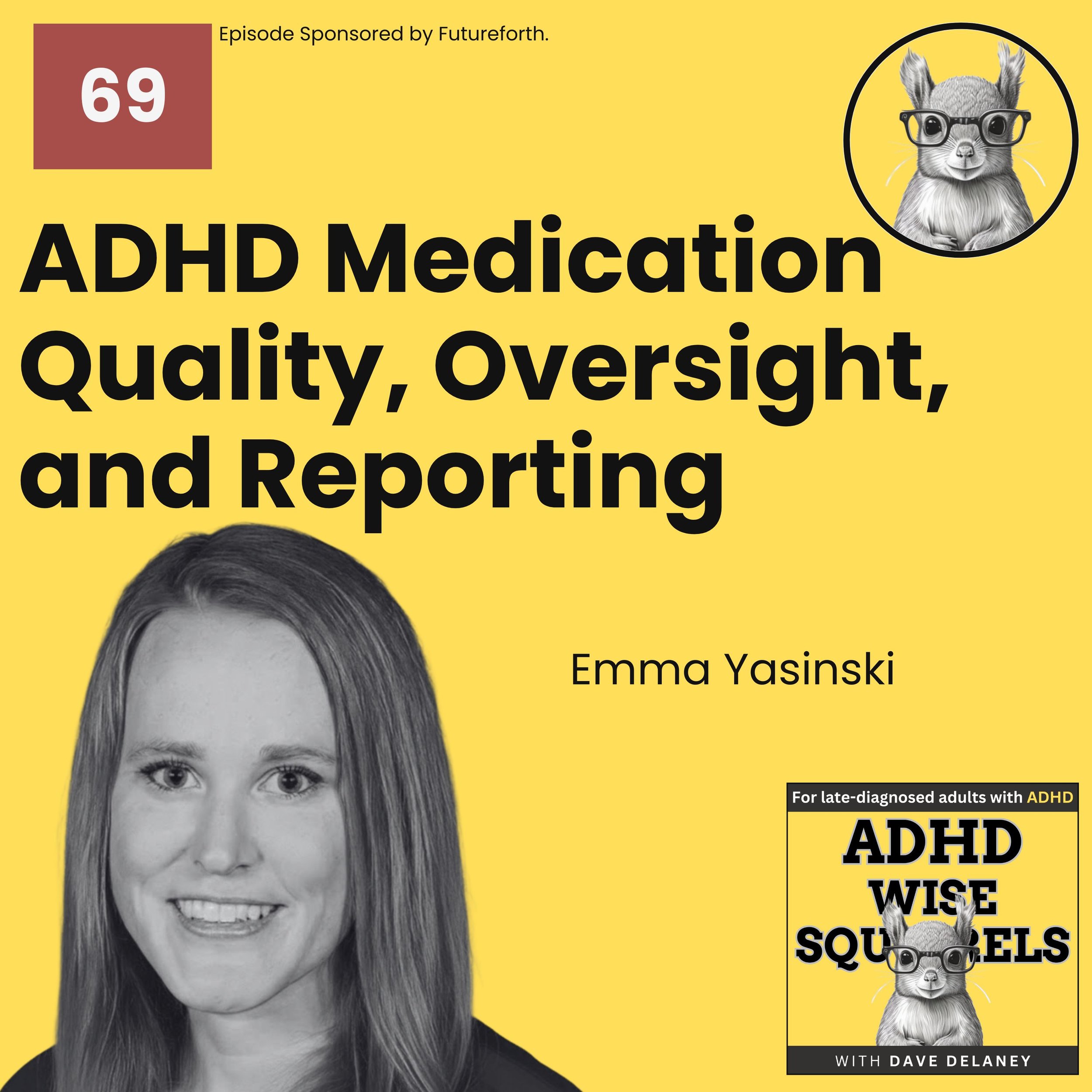
PODCAST. ADHD Medication Quality, Oversight, and Reporting with Emma Yasinski.
In this episode of the ADHD Wise Squirrels podcast, host Dave Delaney sits down with Emma Yasinski, an investigative science and medical journalist for the MedShadow Foundation. Together, they explore the hidden complexities of medication safety, the ongoing ADHD medication shortage, and the vital role patients play in drug oversight.
UPDATE: We originally recorded our conversation in December 2025. Emma recently reached out to provide the following, timely resource link to the Health Data Preservation Project.
-
…wide swaths of data related to racial and ethnic health disparities, LGBTQIA+ health, reproductive health, climate and environmental justice...
While some of the data have been restored, many remain inaccessible outside of third-party archival sites — and it’s possible any restored data could have been erased or corrupted.
These datasets have historically been freely available to the public and have helped countless journalists, researchers, students, public officials and more. Their sudden removal impairs journalists’ ability to give the public essential and timely health information — which could cost lives during natural disasters, severe weather events, pandemics and more.”
Key Discussion Points
Medication Quality and Oversight: Emma discusses the "explosion" in overseas manufacturing, which is making FDA inspections increasingly difficult. A major revelation is that the FDA primarily inspects manufacturing protocols rather than chemically testing the final drugs on the market.
The "Now What" of ADHD Meds: The current shortage has forced many to switch generic manufacturers monthly. Emma explains how this can lead to "dissolution problems," where different versions of a drug, like stimulants, are released into the bloodstream at inconsistent rates, directly impacting how an ADHDer feels and functions.
The ADHD and Addiction Overlap: The conversation dives into how untreated ADHD can drive addictive behaviors and the stigma patients face when seeking stimulants while in recovery. Dave shares his personal journey with sobriety, highlighting that treating ADHD can actually be a life-saving component of recovery.
How Stimulants Work: Emma provides a layperson's breakdown of how these meds increase the availability of dopamine and norepinephrine to support focus and motivation.
Empowering the Patient: Emma emphasizes that patients are the "post-market surveillance" for the FDA. Reporting inefficacy or side effects to MedWatch is one of the few ways to prompt the government to test specific drug batches.
Actionable Advice for ADHD Medication Oversight
Track Your Symptoms: Keep a log of your symptoms, especially when you start a new refill. Note if the pill looks different or if the manufacturer has changed.
Use the Notes App (or another app): Use a health-tracking app or a simple note to record how you feel daily. Taking a photo of your pill bottle can help you track which manufacturer provided which "batch".
Communicate Strategically: If a specific generic doesn't work, ask your doctor to write "Dispense as Written" (DAW) for a brand that does, or request that your pharmacist avoid specific manufacturers such as Camber or Mallinckrodt. Be sure medications are covered by your insurance.
Report Issues: If your medication feels like a "dud," report it to the FDA’s MedWatch database. This data is what the FDA uses to identify and investigate problematic manufacturers.
Additional Resources
Emma Yasinski’s Platforms
MedShadow Foundation: A nonprofit providing independent reporting on medication side effects.
Daily MAT Substack: Emma's newsletter focused on Medication-Assisted Treatment for opioid use disorders.
EmmaYasinski.com: Emma’s professional portfolio and freelance work.
Undark Magazine: Featuring Emma's recent op-ed on primary care and opioid treatment.
Tools and Oversight
FDA MedWatch: The portal to report adverse events or medication quality issues.
Charity Navigator: A tool mentioned by Dave to vet the quality and transparency of nonprofits like MedShadow.
Health Data Preservation Project: AHCJ is part of a growing coalition working to conserve and protect vital health data that was removed from federal websites.
Health and Research
Your Local Epidemiologist (YLE): A highly recommended resource for detailed, easy-to-understand health data.
ProPublica: Referenced for their deep-dive investigations into lab inspections.
⭐⭐⭐⭐⭐
If you found this episode helpful, please leave a rating and review in your podcast app listing of ADHD Wise Squirrels. This will help others discover the show and let us know you find our ADHD podcast for adults helpful. Thank you.
-
Emma: My name is Emma Yasinski, I am a journalist. I’ve been reporting on science and medicine for about 10 years now. I work at MedShadow Foundation, which is a nonprofit organization that reports particularly on side effects. We’re not funded by any pharmaceutical companies—that’s something very important to us—we’re independent. And, we’ve recently started doing a lot more investigative journalism, and that’s what I’ve been in charge of.
Dave: Yeah, and I’m thrilled you reached out to join me. And yeah, you know, as we were talking beforehand, being an early adopter in podcasting, and social, and digital, and all these things, you know, I know sort of the business model of podcasting now. Sadly, it’s become, you know, there’s certain podcasters who are quite well known, who I really enjoyed for a long time until maybe their ratings started slipping, or they wanted to make more money, probably maybe a bit of both, and so they started like platforming freaks—who are not you. That’s my point, is I’m careful not to bring people on to talk about topics that are questionable or anything. And so, in due diligence, I did like a little bit of research into—not so much you, but into MedShadow. I wasn’t familiar and I’m really impressed. Like MedShadow has a 96% rating on Charity Navigator. For those who are familiar, Charity Navigator’s a great source if you’re contributing money to a cause of some sort, or you’re looking to contribute money for a cause. Charity Navigator’s a great source for that because it helps to give you kind of an overview of how they operate. And then also Great Nonprofits gave MedShadow a five-star rating as well. And just reading about your journey and your work as well, I mean, I’m just really impressed. I mean, you have a bachelor’s degree in neuroscience and a master’s in science and medical journalism, which is just incredible. Plus, you have enough sense to move south from Boston in the winter.
Emma: It was a traumatizing year of grad school. As much as I loved Boston, the amount of snow we had that year, I said, “Alright, I’m ready to get out.”
Dave: As a Canarican now—born and raised in Toronto and now living in Nashville—yeah, I can understand that. Yeah, I mean, we get snow here, but I need some snow because, otherwise, it’s like part of my DNA. Like, I have to have snow. But I get it, I get it. So yeah, MedShadow looks great and your work’s been really interesting. Your journey, from my own reading and understanding at least, your sort of background started as a child getting a clinical trial for a heart condition that kind of shaped your interest. Is that right?
Emma: Yeah, that’s a big part of it. So, my mother actually worked in pharma for a small biotech for a long time. She was a head of preclinical development. So I was born with a heart defect called an atrial septal defect, which means that there’s a hole in my heart and some of the blood, you know, pumps from one atria to the other—it comes back. So you get a murmur when you’re listening. And over time, by the time I was seven or eight, one side of my heart—the left side—was starting to get a little too big. Which is, you know, if that keeps going for a long time, you could theoretically get heart failure. So, for me, I had no symptoms, but the doctor said, “Look, this heart, it’s not closing and it’s starting to get worse.” The traditional treatment at the time would’ve been to crack open my chest and sew the heart closed, which was pretty extreme for someone having no symptoms, right? But there was a clinical trial happening where they would put a catheter up your leg and put a little umbrella over the hole and then little by little your cells would grow over it. And the reason I brought up my mom’s work is because she is, as head of preclinical development, she is so well-versed in looking at the animal studies and then how they’re probably going to translate into human studies. She would design those—those first in-human studies and those animal studies. So she looked at this and she said, “You know, I think this is worth doing.” So we did, and I did the clinical trial. And, as far as I know, it’s working fine. I did a good deal of follow-up appointments until I was about 12 or 13. But one of the things that a lot of people don’t know is that clinical trials aren’t always published. Especially if the drug doesn’t get approved or the company closes or something like that. More than 50% of them are not getting published. This is something that’s been going on for a long time. And so, my very first freelance article was me trying to chase down the results of my trial. And I did discover that they were never published. I spoke to the doctor that had done it—he actually reached out after the article came out because I didn’t get—he didn’t get back to me when I was first writing. And he said, “Yeah, the device was actually approved,” despite the fact that he doesn’t think the trial was published. But when I looked up the records, it was approved for a different heart defect—a very similar one, a ventricular septal defect, you know, basically a hole in a different part of the heart. But so that was really where this, you know, deep understanding of clinical trials started. It’s just been a part of my life from my mom’s professional career and also my experience from day one.
Dave: And how old were you when you when you had the procedure done?
Emma: Eight.
Dave: Eight. So yeah, and for your own mom to say, “You know, I think there’s validity here, I think we should do this.” I mean, that’s all you need, right? Is your mom to say, “You know, yes, let’s do this.” Because I think any mom—or not any—but I’m sure with no symptoms, too, I could imagine how some parents would be like, “Eh, let’s just wait it out and see.” So, it’s great that she did that.
Emma: And it’s huge—one of the reasons I do what I do is because not everybody has a mom who is a PhD that could vouch for them when they’re talking to doctors and make those kinds of decisions. We need accessible information.
Dave: Yeah. I know that you’ve done a lot of research, and obviously for the purpose of this podcast and this conversation we’re going to be talking more about ADHD meds, but you’ve done a lot of research and work in sort of the opioid, methadone recovery space. I know I think it was two people that are close to you who struggled with addiction and were treated with methadone—and ultimately, at least my understanding is, successfully, too. Do you want to talk about that a little bit, about how that piqued your interest or kind of went into that?
Emma: Yeah, absolutely. So those people close to me—a lot of their problems started around the time that I was in high school. And I discovered neuroscience around that time too, and a part of it was just me trying to understand what was going on. So I was digging into neuroscience and I fell in love with it in all ways, not just studying addiction. But I just thought neuroscience was fascinating and that’s why, you know, I decided to go to college for neuroscience and get into journalism. But for the last maybe six months, I started a Substack about this—about the medications for opioid use disorder because I realized how much stigma there really still is about this and how many people can’t get treatment. They have doctors telling them that they should get off the treatment, which is extremely dangerous. I mean, it raises your risk of overdose by like double. And there’s just so much misinformation out there. So I started this Substack. But also, I mean to bring it back to ADHD, when I was reporting these stories I’ve spoken to at least two people who had substance use disorders as well. There is an overlap; having ADHD seems to increase your risk of developing a substance use disorder, you know, related to the dopamine processing. I spoke to one woman who said she had been on ADHD medication and then she went into recovery and the recovery houses and the treatment facilities discouraged her from taking ADHD medication. So she got off of it and it was years—maybe 10 years—until she started again and felt better. I mean, she was really struggling because they told her that, you know, “You’re not clean,” or whatever, if you’re taking ADHD medication. And then there was another fellow I spoke to just last week who said he was diagnosed after he was treated for his addiction. And he had had a substance use disorder—mostly opioids—but he had tried stimulants like cocaine earlier on and he said, “Oh, you know, I didn’t like it, it wasn’t for me.” But then when he took ADHD medication he was like, “I was playing life on hard mode, I had no idea.” He thought there was no way he would have ADHD if he didn’t like stimulants, you know, even if they’re illegal. But it turns out it really was super helpful for him. And you do hear that a lot—that when people are in treatment, if they’re seeing a psychiatrist in treatment for substance use, they may find that ADHD is a part of that.
Dave: Yeah, you’ve said a lot there and you’re spot on from my understanding. And also yeah, you know, as we mentioned before hitting record, we’re both not medical doctors. And I’m far—pretty far—from that, really far from that. But I have learned a ton about this in my own journey with ADHD and also reflecting on my own life—periods of questionable addiction to alcohol. I’m six years sober. And, and like when I smoked—I used to smoke, I mean, I haven’t smoked anything in 25 years or something, maybe longer—but I used to smoke like I would chain-smoke. Or I would drink sometimes when I was younger until I blacked out. And I understand the why and and how we’re sort of prone to addiction. And also a quote I often share is, “Your life expectancy can be up to 13 years—up to 13 years less.” Learning this actually kind of changed sort of the passion project of Wise Squirrels for me into a mission because I realized that, you know, the more we can destigmatize ADHD, the more we can encourage people to seek out a diagnosis—but then also treatment, whatever that treatment looks like and getting it. Like one thing I always tell people is like when they go see their doctor for an ADHD test—or even if you don’t have any curiosity about ADHD in you—go to your doctor and just ask, “Tell me what you think about ADHD.” Just to see what they say. Because if they say like, “Oh, that’s just a naughty boy thing,” or, “That, yeah, it ends when you’re a kid,” or whatever they say, or “It doesn’t exist.” You grow out of it, yeah. That’s a perfect time for you to say, “Okay, great,” and then go find a new doctor because they may not also believe in cancer or anything else for that matter. So.
Emma: Yeah, and it’s so pervasive. I mean, I was somewhat humbled doing this reporting as someone who doesn’t have ADHD. You know, I understood that it affected people’s lives and that it was important conceptually. But here, you know, I felt in myself a little bit of my own bias when I heard people telling me stories about how when the medications weren’t working right, it basically ruined their lives. And I was like, “Wow, this is so much more than even I had realized as someone who follows the research on this.” You know, when it—it’s one thing to read a study and it’s another thing to hear somebody’s personal story and understand how important this diagnosis can be to some people and what a big effect it can have on their lives. As you said, it’s not just naughty boys—kids that can’t, you know, take a test very well. It’s really so much more than that for a lot of people.
Dave: ADHD is so heritable—it’s almost as heritable as height. So, that means that if your parent or parents had ADHD and they may—they may not have known or they may not have been diagnosed—because of that impulsivity or addictions and things, you might’ve grown up with some trauma. And it could’ve just been that like, it’s annoying because it’s like had your parent known and been treated for ADHD and gotten into recovery and all the things that they needed—not to say anybody with ADHD is addicted to something, that’s not what I’m saying. But yeah. But now moving forward in the future, it’s pretty awesome because having conversations with smart people like you can help destigmatize things. So, also with ADHD of course I ramble, so I’ll shut up for a second and let you talk. So, yeah, tell me about some of the I know there’s some recent studies you’ve been doing and articles you’ve written about ADHD meds. What are some of the findings that you have found?
Emma: So, a lot of it is not going to be very positive for a lot of people, unfortunately. It’s not that the, you know, medications aren’t good, but we started this at MedShadow because actually our founder connected with someone who has been advocating for better oversight of medication manufacturing overall—of all medications. Because there has been this explosion of laboratories overseas, which are harder unfortunately to inspect. And the way that the FDA tries to make sure that our medications are high quality is mostly through inspecting the manufacturing labs. So they’ll send someone there, they look at the protocols that the lab is using and the documentation and things like that—whether or not there’s bacteria around that could be contaminating the medications. And the idea is that doing this would prevent problems because you’d find it before they happened. But what a lot of people don’t know is that in for most cases they’re not actually testing the drugs themselves. There’s no chemical analysis to make sure that, you know, this drug contains exactly what it’s supposed to contain and nothing else once they’re on the market. The FDA does a really limited amount of that every year, but it’s—it’s very small. It’s mostly through these inspections. So, what we’ve been finding is that there are a lot of medications that may not be made perfectly. They have dissolution problems—that means that when you take the drug, they’re not being released into your body at the right rate. And that can cause problems, particularly for like an extended-release medication, which a lot of ADHD medications are. They also can be contaminated or, you know, the mislabeled—things like that. But so we found a lot of problems with that just in general and I thought something that MedShadow could do that might be unique—so for example, ProPublica has been doing a lot of great reporting looking at the history of these lab inspections and particular labs. But they haven’t really been looking at specific medicines. And so I, at this point, had been aware that there was a large shortage of ADHD medications for quite a while. And that that had led to a lot of people having to switch manufacturers every month. So you know, one month you get one made by Camber, the next one you get one made by Mallinckrodt, something like that—you’re Teva—and it’s just constantly switching. And when that happens, even minor differences might become obvious, right? If it’s dissolving at a slightly different rate, you’re going to notice that it’s wearing off faster one month and lasting longer the next. So I thought that looking into ADHD drugs would be a good place to start to sort of demonstrate this problem and understand the effect that it could have on people’s lives. So at this point we’ve done a couple articles on it and we’re still working on more. We looked into generic Vyvanse—that one just went generic about two years ago—so that was particularly interesting going from the brand to having something like 14 generics on the market immediately. And there have already been at least two or three recalls of generic brands of Vyvanse in those two years, to particularly for problems with dissolution rate or mislabeling. And we did another article where we were looking at methylphenidate, which is Concerta or Ritalin, and their generics. There was actually a study came out on that, where the researchers found all the samples they could get in 2023—you know, whatever it was, it was February of 2023, whatever they could get on the market at that time, so they didn’t test everything, there were shortages. But half of the ones that were supposed to be extended-release were not dissolving at the right rate. The ones that were immediate-release were actually dissolving at the right rate, which is surprising because I do hear a lot of complaints even with the immediate-release. But they—a lot of them had contamination with carcinogens and things like that, which you know, you might not feel if one month—but if you’re taking this medication for years and years and years, that’s not good! So, and we’re hoping to do more and try to get more testing that’s more—more comprehensive, but that’s where we are right now.
Dave: Whenever we’re talking about anything like this, I think like pre-current administration—RFK Jr. and his band of crazies—so putting that aside for a second and the state of things where we are right now, which is insane in so many ways, is this an American problem or is this an international problem with these meds? So like, if being in Canada, if I was on meds in Canada, I mean you were saying that a lot of these are manufactured overseas. So is this a global supply problem or is this an American problem or tell me about that—what are your thoughts on that?
Emma: I would say it’s uniquely both. Especially for ADHD medication, because ADHD stimulants, they are controlled substances. So the final drug products are almost always made in the US, which is pretty uncommon for most other types of drugs. But if they’re controlled substances, the DEA has a lot of regulations so a lot of them are made here. And that unfortunately kind of proves the point that it’s not just a foreign problem. It’s not, you know, if we could bring all the labs here that wouldn’t solve it immediately. But, even when the drugs are made here, the active ingredients are typically made overseas in a lot of cases. So there is some of that going on. And the way that drugs are regulated in different countries is a little bit different. So the FDA has, you know, certain rules and they do inspections; the EU does a lot of inspections as well. Sometimes we even trade information, particularly during COVID when there was limited inspecting going on for obvious reasons. But the EU does have some additional safeguards. They have something called a “Qualified Person”—that’s a—they have to sign off on each shipment and they’re looking at the records and if they think that maybe there’s something wrong with the meds or you couldn’t necessarily guarantee the quality, they would send it back instead of signing off. And what happens is if they sign off on one and there really are serious quality problems discovered later, that individual is personally liable, criminally or civilly. And so it’s a lot of pressure, so there’s a lot of incentive for them to be very careful. We don’t have that in the US. That’s something that one of the experts I spoke to has proposed as one of the possible solutions. We’ve also talked about some other countries do a little bit more drug testing than the US does, in Europe for example. And by testing I mean that chemical analysis of different batches as they come in shipments instead of just before they’re approved. And—but I would say there was a big investigation in the Bureau of Investigative Journalism, which was really terrifying. They looked at chemotherapy drugs. And a lot of them didn’t have the right dose. All they did was look at how much of the active ingredient they were supposed to have and a lot of them didn’t have the right dose in them. And those ones, they tracked where they were shipped and they were shipped all over the world.
Dave: Hmm. That’s terrible.
Emma: Yeah, really scary stuff.
Dave: Yeah, yeah, yeah. So, it’s funny because like being Canadian, I’ve lived here for 18 years in Nashville and had a green card a couple times and then became a citizen. So now I’m a Canarican as I said earlier. But as a Canadian, I’ve always like—a lot of Americans don’t even realize that like even drug ads on television are banned in—I think—or not just banned, they’re just not even permitted in the first place. But they’re not anywhere, I think—maybe Singapore has them, but—
Emma: New Zealand—it’s US and New Zealand for direct-to-consumer ads specifically.
Dave: Okay. Yeah, so like when you’re watching Netflix or Hulu or TV and there’s, you know, some long-winded ad about the drug that will save you from everything but it may cause suicidal ideation and internal bleeding and all the hits. And it’s like the SNL sketch, if people remember this, of Happy Fun Ball—look it up after on YouTube, it’s classic. So I’ve always been like—I’ve always not—I’m not anti-medicine by any means, but I’ve always been like, even in my drinking days, if I was hungover, I would never take a Tylenol.
Emma: Really?
Dave: Because I caused the problem myself and I had to suffer myself. If I had a headache just—then I would take a Tylenol. But if I had one—a headache from a hangover, I’d be like, “Nope, sorry Dave, you screwed yourself here, suffer so I suffer, pay the price.” But I say that because I never wanted to take any meds. And then when I was diagnosed with ADHD, of course I was prescribed meds and I was really resistant to taking stimulants or anything. And along that journey was also diagnosed with anxiety and and found that I needed medication for the anxiety as well and then we had to like make sure the two played well together to kind of figure that piece out. And it’s funny because this happened like just after I was—I became an American citizen. And I’m like, “Damn it, I’ve become an American and now I’m on the drugs! They got me!” It was like, “Damn man, now all I need is buy a bunch of guns and I’m just going to tick all the boxes.”
Emma: Get some guns, take pills once a day, that’s right.
Dave: That’s right. So, but my journey was interesting because I did have some side effects, nothing terrible. But this might interest you: with Vyvanse, I had these side effects—not anything terrible, but I researched it to see if other people had—and by researched I mean, you know, read Reddit. It was a scent of like—not gasoline, it was kind of like gasoline or sort of exhaust fumes almost, but I could kind of smell it.
Emma: In your nose always, or—?
Dave: Quite not always, but like throughout the day, quite a number of times it would be—I would get this weird sensation. And so we switched. That was—that was odd. I mean, I noticed—
Emma: That you could identify it as a side effect—what made you know this must be the medication?
Dave: Well, it began after taking the medication and I checked for cars running nearby.
Emma: It’s such a unique experience, you know? It’s not like you take medication and your stomach hurts right away, you know what I mean? That’s why it’s ingenious because it’s—it can be hard to track sometimes.
Dave: Well yeah, it just kept happening. And it wasn’t like I was—when I was talking to my doctor about it, I’m like, “Well, if the stimulants are working the way they’re supposed to work then I might just live with this annoying thing, maybe I’ll get used to it or something.” But she was like, “No, no, no,” she was like, “Let’s just try something different.” Yeah. So, in part of the journey, I think I find in speaking with fellow Wise Squirrels is that they get diagnosed, they get a prescription, they get a stimulant, which is usually like a low dose at first to start to try that stimulant at certain doses, increase the doses until it either works well or they switched to a different stimulant. And you can correct me where I’m wrong, but this is my own experience and some of the conversations I’ve had with folks. And I often see that, “Oh yeah, the stimulants didn’t work,” and then they just give up. They decide, “Oh, I’m not going to take anything because they didn’t work for me.” And the flip side of that is those who take something and they’re like, “Oh my god!” Like they write like, “Oh my god, the clouds parted, I could see the sun and the world was like wonderful and I could focus.” And I’ve never experienced that for myself. And my therapist gave me this advice once to—and I wrote a blog post about this about this idea of drowning, which was basically that I took a week off—I never felt this extreme focus or anything in all the different stimulants at different doses. I just never really felt like I wasn’t even sure if they’re working well or not, I didn’t have that huge difference. But I took a week off the stimulants just to see, under her recommendation, and I was like, “Oh my god, how has my wife stayed with me for this long? Because I was—okay, now I know they were working because I’m just a hot mess right now.” So, I don’t know, I just gave you a lot of verbal diarrhea there, sorry.
Emma: Well, I think, I mean in my reporting I definitely have a skewed sample. So like, in my personal life I’ve talked to a friend or two who said, “Oh yeah, I was diagnosed, I tried stimulants, they didn’t work.” But in this reporting, when we’re talking about the drugs being inconsistent, I tend to talk to a lot of people who have that experience exactly as you described. I have heard over and over the, “I cried tears of joy the first time I took the medication, the skies opened up,” like just you said. And I think the reason for that is because those are the people who notice such a huge, dramatic difference if they’re not working. And so those are a lot of the people that I have talked to, but I can’t necessarily comment on the prevalence of each just because, like I said, I’ve got a skewed sample. Those are the people that are wanting to talk about this problem the most.
Dave: I’ve also found that like it’s annoying with stimulants because I mean with especially with ADHD-ers, I mean sometimes, you know, it’s difficult to remember to do something consistently—consistently inconsistent as Ross Ramsey said on the show. So, we might forget—and I’ve been guilty of this where I forget and I’ll go to my pharmacy but they’ll say like, “I can’t fill your prescription because it’s a Schedule 1,” is that right?
Emma: I believe it’s Schedule 2 in most cases, but I could be wrong about that.
Dave: And it’s really frustrating because then I have to call my doctor and they have to call in the prescription and it’s just thing that I have to keep doing every month or 60 days and I have to remember to do that. Because and my doctor was like, “Yeah, it’s weird because, you know, you can make drugs from methamphetamine.” But it’s annoying because it’s like for ADHD-ers it’s like, “I just—I just want to take whatever I’m supposed to take, I don’t want to make meth! I promise, I’m not doing meth! I just want my meds!” Anyway.
Emma: It’s so funny, on TikTok I’ll do a TikTok video about “There’s been a recall on this medication,” and I always get like a hundred comments that are, “Doing the ADHD thing, saving this for later and not going to check my bottle because I’m going to forget.”
Dave: Right, right. So, like what are some things that we can do as consumers? I mean, and again, there’s a big caveat of like when we lived in normal times versus where we live now. And we can talk about that too, because that’s important, but what can a consumer do besides go and take their—get their meds and hope for the best?
Emma: Yeah, the options are truly limited, I will say, but there are some. A lot of the doctors and pharmacists that I’ve spoken to are wising up to this. They say they’re seeing this. And I know a lot of people with ADHD have historically been afraid to mention something like this to their doctor because they’re afraid they’re going to be labeled as someone who’s misusing their drugs and they need to be taken off of them because as you said, they are controlled substances. But it does seem, like I said, that doctors are coming around to this and they’re seeing it more, they’re acknowledging it, at least the ones I’ve spoken to. And so it can be helpful to talk to your doctor about it. Some of the advice I’ve gotten—which I know is going to be really hard if you have ADHD—but to keep track of your symptoms as best you can, particularly and you know, note when you do get a pill that looks different. If you do see the manufacturer on the label—it doesn’t always have it, but sometimes it does—try to write that down, note when you got it, and if you know that month is really hard for you, take a note of that and you can mention that to your doctor or your pharmacist. Your doctor can put a a note on your prescription to say “dispense as written,” which means that it would be only the brand name that you would get. Now when they do that, insurance might reject it, they might have to file a prior authorization. And when they do that, insurance often covers it, but there is still a variety of results—a lot of people, insurance covers it but it’s still the out-of-pocket fees are still way too high, so it’s not always ideal. In some other cases, people have written, you know, “no Camber,” just avoid that one manufacturer that doesn’t work for me, and they’ll put that on the prescription—the doctor can write that. And that usually can work, but if that’s the only one in stock that month, you might be out of luck. Some people have told me they talk to the pharmacist directly—this seems to work best at small community pharmacies, not like a CVS or a Walgreens. But if you have a small community pharmacy, especially if you have a good relationship with your pharmacist, you say, “Hey, you know, these two manufacturers haven’t been working for me.” I heard, for one example, one pharmacist said, “Oh, you know, I’m glad you reported that, I’ve had a couple other people say that,” and they’ll try to go and see if they can order different ones in in future months. Typically, if you get one that’s not working there’s not a whole lot you can do that month, you can’t bring it back to the pharmacy and replace it. But you can try to prevent it from happening again or reduce the chance, like I said. Other than that, the experts I’ve talked to sort of long-term have said, “You should really call your senators and tell them your stories of how this is affecting you.” Because even just like me, they might not—they don’t realize how serious this is in a lot of cases. They don’t understand, you know, they understand the shortages are bad, but they don’t really get how the day-to-day life is affected. And there have been some hearings—the Senate Committee on Aging has done hearings on drug quality in general. And they have made some requests to the FDA, there’s some legislation pending that people are looking at and trying to improve our oversight of drugs in general. But the best way to move that forward is to call your senator and say that this is a serious problem for you and it’s deeply affecting your life because that’s the—they do, that’s their point, their job is to listen to us. And the more calls they get like that, the more likely they are to act.
Dave: I think you forgot I live in Tennessee.
Emma: There is actually—but actually one of the things that’s surprising is that that Senate Committee on Aging hearing was very bipartisan. It was Rick Scott and Kirsten Gillibrand were the heads of that committee and they were both on the same team 100%, you know. The only difference might be that the Republican side is a little more focused on the concept of a national security threat because China makes so many of the active pharmaceutical ingredients and there’s “well they could cut us off and then there’d be problems,” whereas Democratic side might be more focused on individual, you know, manufacturing problems. But they—it is something that regardless of sort of the where it comes from, both sides do agree that this is a problem. So I think there is a bipartisan effort here to some degree.
Dave: Well, it’s because aging affects everybody and they don’t want to age.
Emma: Very true.
Dave: So, in the current administration, which is a mess with with RFK Jr., and I mean when you have six previous Surgeons General come out and write a letter together stating how concerned they are recently—and these are Surgeons General with different blue and red color backgrounds that were agnostic to any sort of political party, but just stating just their deep concerns in sort of the state of without getting into like all the all the stuff, all the other stuff. But with ADHD especially, you know, and in this case, I’m looking at Canada and Europe, like the UK and stuff, and I’m trying to like see—I was pretty early on, I was following some smart people talking about early on about COVID, I guess January/February of 2020 before, you know, everything went to hell. I feel like now in a sense Americans need to also be watching Canada as a good example because well, it’s my home and native land, but it’s also, you know, they do a good job. But they’re also on our border. So by following what’s happening in Canada medically and also probably Mexico, you might start to get an understanding of what could be coming here. Because unfortunately, pandemics do—can return and do and it’s really a matter of when rather than if. So, are you—is that good advice or what are your thoughts on like kind of like keeping—
Emma: To watch what’s happening in Canada? Or yeah, to watch what’s happening in and obviously this is not so much ADHD of course but more just general health—like health trends, bird flu, you know, things like that, measles. Because we can’t—it seems to me and you can correct me if I’m wrong—but it seems to me that we can’t really rely on CDC data now.
Emma: So there are definitely—I mean, it could be useful to look at health agencies in neighboring countries or even overseas. I mean I think a lot of them can be helpful for providing guidance. In addition to that, there are some people, particularly former CDC-ers, that have started some good resources, some academic labs that are putting out a lot of good information. It is trickier to find to some degree now, but it is out there even in the US if you can follow the right people.
Dave: Who are some of the right people? Sorry to interrupt.
Emma: I was just thinking—so Dr. Demetre Daskalakis, he used to run the HIV arm of the CDC. There was a webinar from the Association of Healthcare Journalists a couple weeks ago where he and a couple other guests were talking about how they’re, you know, disseminating information now that they’re no longer with the CDC and other organizations. So he, I know, is a good one and he will do a lot of interviews, he’ll get in the media and he’s easy to find online. And I think from him you can also find a lot of other resources because I don’t remember who else he—on that webinar. There’s also the—there’s a Substack called Your Local Epidemiologist (YLE). It’s really big—she is phenomenal. She’s tracking diseases everywhere in the US, she’s, you know, knows when the flu trends go up way before anybody else—really detailed, really good information, that’s a great newsletter to subscribe to if this is something you’re interested in.
Dave: That’s great. I’ll include links to everything we’re talking about in the show notes so that people can visit WiseSquirrels.com and and find those resources. So tell me yeah, so we’re sort of in this weird position where we’re kind of at the mercy of the powers that be to provide us with the meds that we need.
Emma: I mean, to some degree the Trump administration has actually made a point of focusing on this a little bit. And I think a part of that is because a lot of the drugs come from overseas so they’ve made a point of saying they want to onshore drugs. Now, whether or not that’s actually going to solve the problem is debatable. A lot of people point out that most of the companies that are starting to onshore are the ones making the brand-name drugs, they’re not the ones making generics. So most drugs will still come from overseas, for example. They’ve also said they want to increase unannounced inspections of labs overseas because they do more here in the US because it’s easier to do. And that is a really nice announcement. Now whether or not they actually will do that when they—gutted most of the FDA is, you know, actions don’t necessarily match the words. But they are actually drawing attention to this issue which, you know, at—if you’re going to go for the bare minimum might be worthwhile because the government accountability office (GAO)—I think GAO—they have been noting the lack of FDA inspections, there’s been a shortage of inspectors since 2009. Like this is not new, it has been going on for years and years and years and it’s been getting worse. I mean COVID obviously was a big accelerator too because it was hard to inspect labs during that time. But this is an ongoing problem that spans multiple administrations and it’ll be interesting to see whether it gets better or worse in the next few years.
Dave: Well it would be good, I mean obviously for all the obvious reasons. But is there are there more yeah, like I right away like I always I’m trying to solve problems right? Like I, you know, and I know I can’t but I try my best in generally in life I think it’s part of the ADHD thing actually. I like—see problems everywhere. But yeah, so like besides I guess there’s not much we can do right? We’re like we’re kind of I mean besides, you know, writing to our senators or calling our senators and doing your best to track how different manufacturers affect you—which
Emma: Tracking, yeah.
Dave: Yeah.
Emma: I mean, anybody should be doing that with any med as you said—whether even if it’s not related to quality issues, just understanding as you said if it’s the right med for you, tracking how it’s working and being able to identify a new side effect to realize, “Okay, maybe this is from this drug,” or—and another thing that we kind of already talked about, right, is the clinical trials have a few thousand people in them most of the time. And that’ll get a lot of the really common side effects. But you’re not going to know really rare things until millions of people are taking it. So reporting these things is really important because that’s this post-market surveillance. We learn new things about drugs that are on the market all the time after they’ve already been on the market because there’s no way to do a clinical trial big enough to pick up all the diversity that you need.
Dave: Yeah and actually with MedShadow, I imagine that’s a good source just to if you’re feeling a side effect to maybe find out. Because I mentioned Reddit earlier and, you know, I did more research than just Reddit. But I did search around to see like, “Well, why am I getting this like smell of like fumes, car fumes, or exhaust or whatever?” And I didn’t really find much about that. But there are other side effects you can definitely find information about. So having a a reliable source to research and get those—get those answers so at least if you’re experiencing something you can have a better understanding of like, “Okay, this is something, this is a side effect,” or, you know, that other people are experiencing and then so at least understand that.
Emma: Yeah, I mean, that’s what MedShadow’s all about, helping you talk to your doctor when these things come up. Talk to your doctor about side effects. It does help, I mean people have said they’ll print out the articles and bring them in to say, “Especially with this med quality problem, like look, this is really a thing, it’s not—I didn’t make it up, people—others are saying this.”
Dave: Yeah, that’s a great point, that’s a good thing to do. So.
Emma: One thing I haven’t mentioned yet that is a big deal—so the FDA has this database called MedWatch. And if you experience a side effect or inefficacy of a medication, you can report it to them. Your doctors can also report it there—either one. You want to get as much information as you can—if you, you know, had your label, have the batch number and all of that on there—but you can report to them. And that actually back in 2014 so many people reported two brands of generic Concerta and they were—because of all those reports, the FDA did some testing and they found they were not dissolving at the right rate. Those brands were SpecGX—which is subsidiary of Mallinckrodt—and Kudco, which is now UCB Kremers Urban. Weird names. But they were actually—they weren’t taken off the market, though the FDA sort of tried to. What they did was they downgraded their bioequivalence rating from AB—which means equivalent to the name brand, means it’s working the way it’s supposed to—to BX. Which means that pharmacists aren’t supposed to automatically substitute it for the brand name. So like, if you request it specifically, it’s still on the market, they could give it to you, but they’re not supposed to substitute it just interchangeably with all the others. Now anecdotally I’ve heard a lot that they are still doing that, probably because of the shortage. But that was some action taken by the FDA, took them two years, but they did do that. And they were inspired by those MedWatch reports. Now this year the end of the summer—I don’t know if it was exactly August or September—but the FDA posted their annual report on pharmaceutical quality. That is something that comes online every year—so it was for 2024, they publish it in 2025 about 2024. And they look at all kinds of different drugs, they talk about trends and they had a specific section on ADHD stimulants where they said, “We are seeing an increase in MedWatch reports for stimulants and not for non-stimulant medications. Only for stimulants we’ve seen this big increase in reports. And we will be looking into whether we need to test more or inspect more.” So they’re aware that there is a problem. Now, I—I don’t know what actions they’ve taken yet, we’ll have to see when that next report comes out, but those reports that individuals make are getting the FDA’s attention. And that’s really important. So if you do notice a difference—and I should have said that before—absolutely report it to MedWatch, which is the FDA’s database. You could just Google MedWatch, it’ll come right up, and you should absolutely do that.
Dave: That’s helpful. Yeah, that’s a great— I mean, besides just the Notes app, I mean which I always try to think of ways to simplify things and then alternative ways to do things. So.
Emma: There are a good deal of like health apps for tracking symptoms and things like that in general and—there was one that someone told me about that she was using even just like make sure she remembered to take her medication and she would take a picture of the pill every day and it was a health app but I think she was recording a little bit about how she felt. And I’ll look back at that interview and see if I can find it and send it to you what the name of that one was. It wasn’t specific to ADHD, but she said that really helped her notice because she had the picture of the pill and she had her how she felt and that was a really big help that she knew whether or not she took it and she knew if there was a difference in efficacy or how she was feeling.
Dave: That’s helpful. Yeah, because there’s yeah, it’s one thing to keep up with like when you’re like I have reminders set on my phone that go off in the morning or at night or whatever to remind me to take whatever. But I also have like—but part of the thing with ADHD—part of the curse of ADHD really is when we find a system or something that works well, the novelty runs off and it’s like “God, I can’t do this anymore because it’s not cool!” And then you gotta find some alternative way. It’s very—it’s really—
Emma: I mean all the apps now make sound effects, maybe there’s some novelty there, you can change levels, maybe you level up and get awards, I don’t know—a little novelty.
Dave: Poke yourself or something. Yeah, yeah, yeah. Okay, so—so tell me, yeah—so we’re sort of in this weird position where we’re kind of at the mercy of the powers that be to provide us with the meds that we need. I guess—put aside the quality control or lack of quality control in some cases or supply problems. What is your understanding of how meds work in the first place? Are you familiar with like—or—like with how let’s say a stimulant works?
Emma: Yeah, the most basic explanation is that they increase dopamine or dopamine and norepinephrine in your brain. And that helps you focus. And a lot of the problem is the motivation, which can be triggered by dopamine, so there’s low motivation because of low dopamine. If you increase that, you’re a little bit more motivated to get moving. But yeah, this is at a very layman’s terms because I am not a doctor or researcher. I can’t describe it in more detail than that basically. I know it increases dopamine availability and norepinephrine availability in some cases. Some of them are just dopamine, some of them are both.
Dave: Yeah, I’m still exploring dopamine as a topic—I wrote a post about it recently of what I have learned about it but how how—yeah, because and I—
Emma: Dopamine does so many different things, that’s part of why it’s very interest—and I think we have as a society we’ve started this whole dopamine addiction concept where scrolling on your phone is causing too to—so there is this sort of discussion of dopamine that is going too far that is extrapolating in ways that we shouldn’t be doing. So we have to be very careful when we’re talking about what dopamine does because it, you know, is also involved in Parkinson’s—there’s low dopamine—or you know all kinds of other conditions depending where it is in your brain, what it is doing.
Dave: Yeah, yeah and the thing I’m still trying to figure out is yeah I’ve always I’ve always believed with ADHD you don’t have enough dopamine. But my understanding is that that may not be completely accurate—I could be wrong—and that it’s the dopamine receptors who are not behaving properly. But I don’t know.
Emma: Yeah, that I honestly don’t know. I mean even the description that I gave, but I think what other people believe—even doctors—it’s probably oversimplified. I’m sure there’s a lot we don’t understand, there’s so many phenotypes—different symptoms that people have, subtypes we probably don’t understand yet.
Dave: Yeah. So what’s next for you? What are you what are you working on these days? Are you continuing down this this path? Are you sort of yeah, tell me about the research you’re doing currently.
Emma: So, as I mentioned, we did an article specifically to Vyvanse and then we did one that covered all medications for—all stimulants for ADHD, but it really focused mostly on methylphenidate because we had that study I talked about. So now we’re trying to dive a little deeper into Adderall. And I’m doing some research on there. There’s some questions in the zeitgeist about the ratio of active ingredients—it’s supposed to have, you know, a 3:1 ratio of I believe it’s L and D amphetamine and there’s some speculation that that may not consistently be the case. So we’re trying to figure that out at MedShadow.
Dave: Interesting. And where can people learn more about like the work that you’re doing? Is it all on MedShadow or I know you have a Substack as well and—?
Emma: Yeah so there’s—I mean, the work that I’m doing on ADHD is all on MedShadow. That’s MedShadow.org. There are no paywalls so you can just get right to it—it’s great. If you’re interested in substance use disorders, there’s the Substack—https://www.google.com/search?q=DailyMAT.substack.com. And then I’m a freelancer. So if you do my first name last name.com you’ll see all my other work. I write for a variety of other magazines from time to time. But I work at MedShadow—that’s, you know, my most consistent client so to speak, I’m technically part-time—so the majority of my work is there and on the Substack. And then every now and then I publish something somewhere else.
Dave: It’s helpful. It’s great. Are there are there topics you’re working on that you’re excited about? What’s what’s coming down the line?
Emma: Yeah, um—so I actually for MedShadow also post an article on opioids and this with this same theme—the inconsistency of drug quality. And I took a different look at that one because I mentioned people with ADHD are often afraid to bring this up to their doctors for being labeled as, you know, drug seeking essentially. I think that’s—it’s that on steroids if you’re on opioids, if you have chronic pain, I think that’s—it’s that on steroids. If you have a—you know even if you have an opioid use disorder and you’re taking an opioid agonist therapy like methadone or Suboxone, they are really afraid to bring this up to their doctors because they’ll get cut off and go into withdrawal. So when I talked to some doctors they weren’t sure what to say at first, so I tried to come up with some evidence—there weren’t really any studies that I could find looking at, you know, comparing the quality of different opioid manufacturers. So what I did was I looked at the recall history over the last 20 years of different types of opioids and organized it that way and that was really interesting. I mean opioid recalls made up about 5% of all of the drug recalls in the last 20 years, which is a lot considering how many medications there are on the market. And there were certain opioids that were more prone to recall—now we don’t know if that’s because they were inspected more often or checked more often. But like fentanyl for example—we know that that’s a particularly potentially dangerous medication for certain people. And so that one, there were a lot of recalls. But the reason for the recall was often that the patches weren’t working. So people will put a patch on and they, you know, absorb the drug through their skin. And if the patches were leaking or they they’re too stuck together—that happened a lot. So the patches malfunction and people are getting the wrong dose, which could be really problematic on a drug that, you know, you’re basically supposed to be dependent on if you’re taking it for a while. Fentanyl in theory really is typically more short-term in the hospital but not always, sometimes people are using it at home and that can be, you know, particularly troublesome. So that was one that I was excited to publish recently—that one’s on MedShadow. And I just wrote an op-ed for Undark.org about primary care doctors getting on board with treating opioid use disorder, which, you know, there is so much stigma there. A lot of them—there used to be prescription rules about who could prescribe Suboxone and who couldn’t—those have actually been lifted. But a lot of people still aren’t prescribing it. And pharmacy still aren’t filling it. And even doctors are telling people, as I said before, to get off those medications because, “Oh you’re young, you shouldn’t be on this that long.” And that doubles your risk of overdose if you come off them too soon. So that one I’m excited about—that came out actually on Thanksgiving.
Dave: Nice. Is the drug you were just talking about an opioid or what?
Emma: Yeah, so Suboxone or buprenorphine, it’s a medication to treat opioid use disorders typically. It’s a partial agonist, which means it doesn’t stimulate your opioid receptors to quite the same degree as something like oxycodone. But the—the main difference is that it’s really long-lasting, so you don’t have those ups and downs that you might have, particularly, you know, if you’re using something that’s illicit that you’re—you’re not getting from the doctor to really doing a lot of ups and downs. So this evens you out—that’s what Suboxone and methadone both do in different slightly different ways—but essentially they even you out so you don’t feel withdrawal and you don’t feel cravings and you can go about your day and technically you are taking an opioid, but your life is getting better.
Dave: Well that’s the thing, yeah. And I know I mean anecdotally of what I’ve heard like doctors are definitely skittish of of prescribing anything like an opioid because of—
Emma: We hear a lot of that too, just any opioid even for pain that they are—and that’s, you know, a lot of the pain patients that I interviewed for the MedShadow article were really, really concerned about that. That they’re, you know, all getting cut off, that they, you know—they actually don’t like buprenorphine a lot of the time or Suboxone because some doctors if they are prescribing opioids, they get very skittish about, you know, if anyone says this isn’t working or something, they switch them to buprenorphine right away. And if you have a lot of chronic pain for, you know, pain is very diverse. So in some cases buprenorphine helps pain and in some cases it doesn’t, from what people have told me. So they’re very scared of being switched to that even with the doctors that do prescribe.
Dave: And with the stimulants for for ADHD, do you understand—do you know like—the difference between the results of somebody with ADHD taking a stimulant and without? Like if they’re not an ADHD-er.
Emma: I don’t know specifically. I mean I’ve heard sort of anecdotally, right, it’s like taking too much caffeine—you might be more hyper if you’re not someone with ADHD, whereas somebody with ADHD would feel calm and in control. But that’s about all I know.
Dave: Yeah, interesting. Yeah because and the thing I’m still trying to figure out is yeah I’ve always I’ve always believed with ADHD you don’t have enough dopamine. But my understanding is that that may not be completely accurate—I could be wrong—and that it’s the dopamine receptors who are not behaving properly. But I don’t know.
Emma: Yeah, that I honestly don’t know. I mean even the description that I gave, but I think what other people believe—even doctors—it’s probably oversimplified. I’m sure there’s a lot we don’t understand, there’s so many phenotypes—different symptoms that people have, subtypes we probably don’t understand yet.
Dave: Yeah. So what’s next for you? What are you what are you working on these days? Are you continuing down this this path? Are you sort of yeah, tell me about the research you’re doing currently.
Emma: So, as I mentioned, we did an article specifically to Vyvanse and then we did one that covered all medications for—all stimulants for ADHD, but it really focused mostly on methylphenidate because we had that study I talked about. So now we’re trying to dive a little deeper into Adderall. And I’m doing some research on there. There’s some questions in the zeitgeist about the ratio of active ingredients—it’s supposed to have, you know, a 3:1 ratio of I believe it’s L and D amphetamine and there’s some speculation that that may not consistently be the case. So we’re trying to figure that out at MedShadow.
Dave: Interesting. And where can people learn more about like the work that you’re doing? Is it all on MedShadow or I know you have a Substack as well and—?
Emma: Yeah so there’s—I mean, the work that I’m doing on ADHD is all on MedShadow. That’s MedShadow.org. There are no paywalls so you can just get right to it—it’s great. If you’re interested in substance use disorders, there’s the Substack—https://www.google.com/search?q=DailyMAT.substack.com. And then I’m a freelancer. So if you do my first name last name.com you’ll see all my other work. I write for a variety of other magazines from time to time. But I work at MedShadow—that’s, you know, my most consistent client so to speak, I’m technically part-time—so the majority of my work is there and on the Substack. And then every now and then I publish something somewhere else.
Dave: It’s helpful. It’s great. Are there are there topics you’re working on that you’re excited about? What’s what’s coming down the line?
Emma: Yeah, um—so I actually for MedShadow also post an article on opioids and this with this same theme—the inconsistency of drug quality. And I took a different look at that one because I mentioned people with ADHD are often afraid to bring this up to their doctors for being labeled as, you know, drug seeking essentially. I think that’s—it’s that on steroids if you’re on opioids, if you have chronic pain, I think that’s—it’s that on steroids. If you have a—you know even if you have an opioid use disorder and you’re taking an opioid agonist therapy like methadone or Suboxone, they are really afraid to bring this up to their doctors because they’ll get cut off and go into withdrawal. So when I talked to some doctors they weren’t sure what to say at first, so I tried to come up with some evidence—there weren’t really any studies that I could find looking at, you know, comparing the quality of different opioid manufacturers. So what I did was I looked at the recall history over the last 20 years of different types of opioids and organized it that way and that was really interesting. I mean opioid recalls made up about 5% of all of the drug recalls in the last 20 years, which is a lot considering how many medications there are on the market. And there were certain opioids that were more prone to recall—now we don’t know if that’s because they were inspected more often or checked more often. But like fentanyl for example—we know that that’s a particularly potentially dangerous medication for certain people. And so that one, there were a lot of recalls. But the reason for the recall was often that the patches weren’t working. So people will put a patch on and they, you know, absorb the drug through their skin. And if the patches were leaking or they they’re too stuck together—that happened a lot. So the patches malfunction and people are getting the wrong dose, which could be really problematic on a drug that, you know, you’re basically supposed to be dependent on if you’re taking it for a while. Fentanyl in theory really is typically more short-term in the hospital but not always, sometimes people are using it at home and that can be, you know, particularly troublesome. So that was one that I was excited to publish recently—that one’s on MedShadow. And I just wrote an op-ed for Undark.org about primary care doctors getting on board with treating opioid use disorder, which, you know, there is so much stigma there. A lot of them—there used to be prescription rules about who could prescribe Suboxone and who couldn’t—those have actually been lifted. But a lot of people still aren’t prescribing it. And pharmacy still aren’t filling it. And even doctors are telling people, as I said before, to get off those medications because, “Oh you’re young, you shouldn’t be on this that long.” And that doubles your risk of overdose if you come off them too soon. So that one I’m excited about—that came out actually on Thanksgiving.
Dave: Nice. Is the drug you were just talking about an opioid or what?
Emma: Yeah, so Suboxone or buprenorphine, it’s a medication to treat opioid use disorders typically. It’s a partial agonist, which means it doesn’t stimulate your opioid receptors to quite the same degree as something like oxycodone. But the—the main difference is that it’s really long-lasting, so you don’t have those ups and downs that you might have, particularly, you know, if you’re using something that’s illicit that you’re—you’re not getting from the doctor to really doing a lot of ups and downs. So this evens you out—that’s what Suboxone and methadone both do in different slightly different ways—but essentially they even you out so you don’t feel withdrawal and you don’t feel cravings and you can go about your day and technically you are taking an opioid, but your life is getting better.
Dave: Well that’s the thing, yeah. And I know I mean anecdotally of what I’ve heard like doctors are definitely skittish of of prescribing anything like an opioid because of—
Emma: We hear a lot of that too, just any opioid even for pain that they are—and that’s, you know, a lot of the pain patients that I interviewed for the MedShadow article were really, really concerned about that. That they’re, you know, all getting cut off, that they, you know—they actually don’t like buprenorphine a lot of the time or Suboxone because some doctors if they are prescribing opioids, they get very skittish about, you know, if anyone says this isn’t working or something, they switch them to buprenorphine right away. And if you have a lot of chronic pain for, you know, pain is very diverse. So in some cases buprenorphine helps pain and in some cases it doesn’t, from what people have told me. So they’re very scared of being switched to that even with the doctors that do prescribe.
Dave: And with the stimulants for for ADHD, do you understand—do you know like—the difference between the results of somebody with ADHD taking a stimulant and without? Like if they’re not an ADHD-er.
Emma: I don’t know specifically. I mean I’ve heard sort of anecdotally, right, it’s like taking too much caffeine—you might be more hyper if you’re not someone with ADHD, whereas somebody with ADHD would feel calm and in control. But that’s about all I know.
Dave: Did you—this has been great, Emma. You’re awesome and keep up the great work. We need more people like you doing this.
Emma: Oh, thank you. It’s been fun, I appreciate it.
Dave: I would actually just love to know what your initial reaction was when you were seeing the articles about the ADHD medications. I mean, was this something that was already on your radar or were you surprised?
Emma: Yeah, I mean, I wasn’t surprised, actually. Because with my own experiences, that weird side effect, I have had—and even taking a week off the stimulants as recommended by my therapist at the time to see—and and just to add that like with anxiety, depression meds and things like that, you should definitely not—well, you obviously talk to your doctor regardless of decision of taking things—but with anxiety and depression meds you shouldn’t just stop, that’s my understanding. With stimulants you can—you can take a break under, you know, talk to your doctor first. But when I did that, yeah, it was—it was interesting too. I mean I’ve struggled with finding the right mix. Putting the anxiety meds aside even, but just knowing for sure is what I’m taking is the best drug stimulant for me and the best and the right dose. And, you know, it is disheartening to hear to read the studies and hear about that because yeah, I mean what works one, you know, if I do 30 milligrams of X and 60 milligrams of Y or whatever and one works and one doesn’t and then the other one works and the other one doesn’t because of these, you know, because of these problems with the supply chain and and the quality control and stuff. I mean, it’s disheartening because it’s hard to know what—what is the secret sauce.
Emma: And it can change over time too, right? The condition evolves.
Dave: Yeah, and there’s that too, so yeah. It’s an ongoing journey. So yeah, I mean I find the articles helpful, I find the studies helpful. I’m very much a person who I like to include sort of a “what okay, so what?” Okay, now I know this or that and it doesn’t necessarily mean what you’re talking about or what we’re talking about here—it can be anything. Like “okay, I know there’s corruption in a specific political party” or whatever. “Bummer. Like what am I supposed to do? I can’t fly to China and check a lab and and test the—you know.” So it’s frustrating when you when you learn things and you’re like, “Okay, this is great to know—but now what?”
Emma: And that is, you know, we’ve been doing our best to try to give the now what, but there really isn’t a lot, that’s what’s so frustrating here. It’s, you know, advocacy is the main now what.
Dave: Yeah, advocacy, tracking—yeah, I think you’ve made some good points because yeah, I think reporting, tracking how stimulants or any meds are working or not for you, I think is a really important point and something I think I could do better.
Emma: Truly anybody should be doing that with any med as you said—whether even if it’s not related to quality issues, just understanding as you said if it’s the right med for you, tracking how it’s working and being able to identify a new side effect to realize, “Okay, maybe this is from this drug,” or—and another thing that we kind of already talked about, right, is the clinical trials have a few thousand people in them most of the time. And that’ll get a lot of the really common side effects. But you’re not going to know really rare things until millions of people are taking it. So reporting these things is really important because that’s this post-market surveillance. We learn new things about drugs that are on the market all the time after they’ve already been on the market because there’s no way to do a clinical trial big enough to pick up all the diversity that you need.
Dave: Yeah and actually with MedShadow, I imagine that’s a good source just to if you’re feeling a side effect to maybe find out. Because I mentioned Reddit earlier and, you know, I did more research than just Reddit. But I did search around to see like, “Well, why am I getting this like smell of like fumes, car fumes, or exhaust or whatever?” And I didn’t really find much about that. But there are other side effects you can definitely find information about. So having a a reliable source to research and get those—get those answers so at least if you’re experiencing something you can have a better understanding of like, “Okay, this is something, this is a side effect,” or, you know, that other people are experiencing and then so at least understand that.
Emma: Yeah, I mean, that’s what MedShadow’s all about, helping you talk to your doctor when these things come up. Talk to your doctor about side effects. It does help, I mean people have said they’ll print out the articles and bring them in to say, “Especially with this med quality problem, like look, this is really a thing, it’s not—I didn’t make it up, people—others are saying this.”
Dave: Yeah, that’s a great point, that’s a good thing to do. So.
Emma: One thing I haven’t mentioned yet that is a big deal—so the FDA has this database called MedWatch. And if you experience a side effect or inefficacy of a medication, you can report it to them. Your doctors can also report it there—either one. You want to get as much information as you can—if you, you know, had your label, have the batch number and all of that on there—but you can report to them. And that actually back in 2014 so many people reported two brands of generic Concerta and they were—because of all those reports, the FDA did some testing and they found they were not dissolving at the right rate. Those brands were SpecGX—which is subsidiary of Mallinckrodt—and Kudco, which is now UCB Kremers Urban. Weird names. But they were actually—they weren’t taken off the market, though the FDA sort of tried to. What they did was they downgraded their bioequivalence rating from AB—which means equivalent to the name brand, means it’s working the way it’s supposed to—to BX. Which means that pharmacists aren’t supposed to automatically substitute it for the brand name. So like, if you request it specifically, it’s still on the market, they could give it to you, but they’re not supposed to substitute it just interchangeably with all the others. Now anecdotally I’ve heard a lot that they are still doing that, probably because of the shortage. But that was some action taken by the FDA, took them two years, but they did do that. And they were inspired by those MedWatch reports. Now this year the end of the summer—I don’t know if it was exactly August or September—but the FDA posted their annual report on pharmaceutical quality. That is something that comes online every year—so it was for 2024, they publish it in 2025 about 2024. And they look at all kinds of different drugs, they talk about trends and they had a specific section on ADHD stimulants where they said, “We are seeing an increase in MedWatch reports for stimulants and not for non-stimulant medications. Only for stimulants we’ve seen this big increase in reports. And we will be looking into whether we need to test more or inspect more.” So they’re aware that there is a problem. Now, I—I don’t know what actions they’ve taken yet, we’ll have to see when that next report comes out, but those reports that individuals make are getting the FDA’s attention. And that’s really important. So if you do notice a difference—and I should have said that before—absolutely report it to MedWatch, which is the FDA’s database. You could just Google MedWatch, it’ll come right up, and you should absolutely do that.
Dave: That’s helpful. Yeah, that’s a great— I mean, besides just the Notes app, I mean which I always try to think of ways to simplify things and then alternative ways to do things. So.
Emma: There are a good deal of like health apps for tracking symptoms and things like that in general and—there was one that someone told me about that she was using even just like make sure she remembered to take her medication and she would take a picture of the pill every day and it was a health app but I think she was recording a little bit about how she felt. And I’ll look back at that interview and see if I can find it and send it to you what the name of that one was. It wasn’t specific to ADHD, but she said that really helped her notice because she had the picture of the pill and she had her how she felt and that was a really big help that she knew whether or not she took it and she knew if there was a difference in efficacy or how she was feeling.
Dave: That’s helpful. Yeah, because there’s yeah, it’s one thing to keep up with like when you’re like I have reminders set on my phone that go off in the morning or at night or whatever to remind me to take whatever. But I also have like—but part of the thing with ADHD—part of the curse of ADHD really is when we find a system or something that works well, the novelty runs off and it’s like “God, I can’t do this anymore because it’s not cool!” And then you gotta find some alternative way. It’s very—it’s really—
Emma: I mean all the apps now make sound effects, maybe there’s some novelty there, you can change levels, maybe you level up and get awards, I don’t know—a little novelty.
Dave: Poke yourself or something. Yeah, yeah, yeah. Okay, so—so tell me, yeah—so we’re sort of in this weird position where we’re kind of at the mercy of the powers that be to provide us with the meds that we need. I guess—put aside the quality control or lack of quality control in some cases or supply problems. What is your understanding of how meds work in the first place? Are you familiar with like—or—like with how let’s say a stimulant works?
Emma: Yeah, the most basic explanation is that they increase dopamine or dopamine and norepinephrine in your brain. And that helps you focus. And a lot of the problem is the motivation, which can be triggered by dopamine, so there’s low motivation because of low dopamine. If you increase that, you’re a little bit more motivated to get moving. But yeah, this is at a very layman’s terms because I am not a doctor or researcher. I can’t describe it in more detail than that basically. I know it increases dopamine availability and norepinephrine availability in some cases. Some of them are just dopamine, some of them are both.
Dave: Yeah, I’m still exploring dopamine as a topic—I wrote a post about it recently of what I have learned about it but how how—yeah, because and I—
Emma: Dopamine does so many different things, that’s part of why it’s very interest—and I think we have as a society we’ve started this whole dopamine addiction concept where scrolling on your phone is causing too to—so there is this sort of discussion of dopamine that is going too far that is extrapolating in ways that we shouldn’t be doing. So we have to be very careful when we’re talking about what dopamine does because it, you know, is also involved in Parkinson’s—there’s low dopamine—or you know all kinds of other conditions depending where it is in your brain, what it is doing.
Dave: Yeah, yeah and the thing I’m still trying to figure out is yeah I’ve always I’ve always believed with ADHD you don’t have enough dopamine. But my understanding is that that may not be completely accurate—I could be wrong—and that it’s the dopamine receptors who are not behaving properly. But I don’t know.
Emma: Yeah, that I honestly don’t know. I mean even the description that I gave, but I think what other people believe—even doctors—it’s probably oversimplified. I’m sure there’s a lot we don’t understand, there’s so many phenotypes—different symptoms that people have, subtypes we probably don’t understand yet.
Dave: Yeah. So what’s next for you? What are you what are you working on these days? Are you continuing down this this path? Are you sort of yeah, tell me about the research you’re doing currently.
Emma: So, as I mentioned, we did an article specifically to Vyvanse and then we did one that covered all medications for—all stimulants for ADHD, but it really focused mostly on methylphenidate because we had that study I talked about. So now we’re trying to dive a little deeper into Adderall. And I’m doing some research on there. There’s some questions in the zeitgeist about the ratio of active ingredients—it’s supposed to have, you know, a 3:1 ratio of I believe it’s L and D amphetamine and there’s some speculation that that may not consistently be the case. So we’re trying to figure that out at MedShadow.
Dave: Interesting. And where can people learn more about like the work that you’re doing? Is it all on MedShadow or I know you have a Substack as well and—?
Emma: Yeah so there’s—I mean, the work that I’m doing on ADHD is all on MedShadow. That’s MedShadow.org. There are no paywalls so you can just get right to it—it’s great. If you’re interested in substance use disorders, there’s the Substack—https://www.google.com/search?q=DailyMAT.substack.com. And then I’m a freelancer. So if you do my first name last name.com you’ll see all my other work. I write for a variety of other magazines from time to time. But I work at MedShadow—that’s, you know, my most consistent client so to speak, I’m technically part-time—so the majority of my work is there and on the Substack. And then every now and then I publish something somewhere else.
Dave: It’s helpful. It’s great. Are there are there topics you’re working on that you’re excited about? What’s what’s coming down the line?
Emma: Yeah, um—so I actually for MedShadow also post an article on opioids and this with this same theme—the inconsistency of drug quality. And I took a different look at that one because I mentioned people with ADHD are often afraid to bring this up to their doctors for being labeled as, you know, drug seeking essentially. I think that’s—it’s that on steroids if you’re on opioids, if you have chronic pain, I think that’s—it’s that on steroids. If you have a—you know even if you have an opioid use disorder and you’re taking an opioid agonist therapy like methadone or Suboxone, they are really afraid to bring this up to their doctors because they’ll get cut off and go into withdrawal. So when I talked to some doctors they weren’t sure what to say at first, so I tried to come up with some evidence—there weren’t really any studies that I could find looking at, you know, comparing the quality of different opioid manufacturers. So what I did was I looked at the recall history over the last 20 years of different types of opioids and organized it that way and that was really interesting. I mean opioid recalls made up about 5% of all of the drug recalls in the last 20 years, which is a lot considering how many medications there are on the market. And there were certain opioids that were more prone to recall—now we don’t know if that’s because they were inspected more often or checked more often. But like fentanyl for example—we know that that’s a particularly potentially dangerous medication for certain people. And so that one, there were a lot of recalls. But the reason for the recall was often that the patches weren’t working. So people will put a patch on and they, you know, absorb the drug through their skin. And if the patches were leaking or they they’re too stuck together—that happened a lot. So the patches malfunction and people are getting the wrong dose, which could be really problematic on a drug that, you know, you’re basically supposed to be dependent on if you’re taking it for a while. Fentanyl in theory really is typically more short-term in the hospital but not always, sometimes people are using it at home and that can be, you know, particularly troublesome. So that was one that I was excited to publish recently—that one’s on MedShadow. And I just wrote an op-ed for Undark.org about primary care doctors getting on board with treating opioid use disorder, which, you know, there is so much stigma there. A lot of them—there used to be prescription rules about who could prescribe Suboxone and who couldn’t—those have actually been lifted. But a lot of people still aren’t prescribing it. And pharmacy still aren’t filling it. And even doctors are telling people, as I said before, to get off those medications because, “Oh you’re young, you shouldn’t be on this that long.” And that doubles your risk of overdose if you come off them too soon. So that one I’m excited about—that came out actually on Thanksgiving.
Dave: Nice. Is the drug you were just talking about an opioid or what?
Emma: Yeah, so Suboxone or buprenorphine, it’s a medication to treat opioid use disorders typically. It’s a partial agonist, which means it doesn’t stimulate your opioid receptors to quite the same degree as something like oxycodone. But the—the main difference is that it’s really long-lasting, so you don’t have those ups and downs that you might have, particularly, you know, if you’re using something that’s illicit that you’re—you’re not getting from the doctor to really doing a lot of ups and downs. So this evens you out—that’s what Suboxone and methadone both do in different slightly different ways—but essentially they even you out so you don’t feel withdrawal and you don’t feel cravings and you can go about your day and technically you are taking an opioid, but your life is getting better.
Dave: Well that’s the thing, yeah. And I know I mean anecdotally of what I’ve heard like doctors are definitely skittish of of prescribing anything like an opioid because of—
Emma: We hear a lot of that too, just any opioid even for pain that they are—and that’s, you know, a lot of the pain patients that I interviewed for the MedShadow article were really, really concerned about that. That they’re, you know, all getting cut off, that they, you know—they actually don’t like buprenorphine a lot of the time or Suboxone because some doctors if they are prescribing opioids, they get very skittish about, you know, if anyone says this isn’t working or something, they switch them to buprenorphine right away. And if you have a lot of chronic pain for, you know, pain is very diverse. So in some cases buprenorphine helps pain and in some cases it doesn’t, from what people have told me. So they’re very scared of being switched to that even with the doctors that do prescribe.
Dave: And with the stimulants for for ADHD, do you understand—do you know like—the difference between the results of somebody with ADHD taking a stimulant and without? Like if they’re not an ADHD-er.
Emma: I don’t know specifically. I mean I’ve heard sort of anecdotally, right, it’s like taking too much caffeine—you might be more hyper if you’re not someone with ADHD, whereas somebody with ADHD would feel calm and in control. But that’s about all I know.
Dave: Did you—this has been great, Emma. You’re awesome and keep up the great work. We need more people like you doing this.
Emma: Oh, thank you. It’s been fun, I appreciate it.