Dr. Stephen Faraone: What the Evidence Actually Says About ADHD.
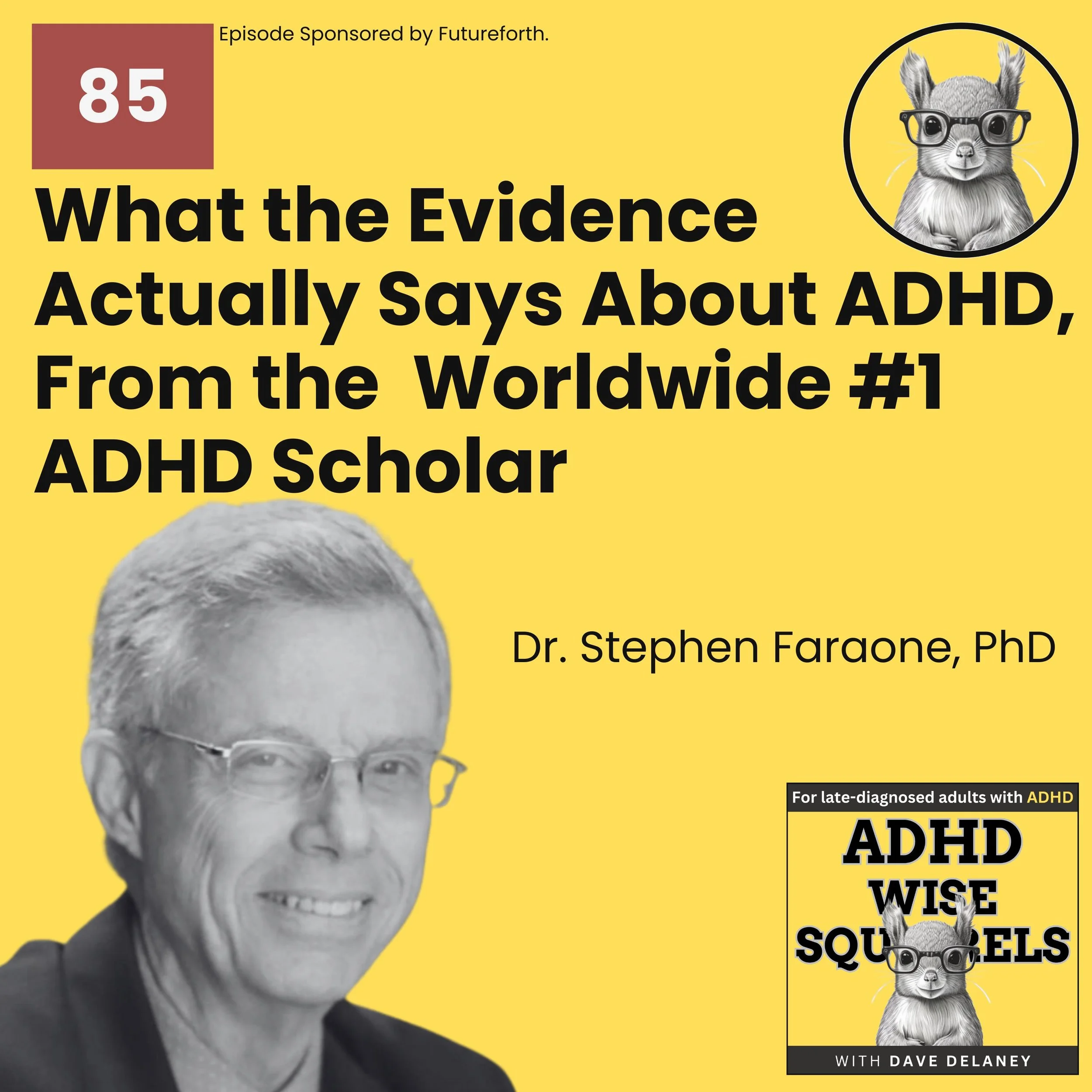
Dr. Stephen Faraone Phd is a Distinguished Professor in the Psychiatry and Neuroscience & Physiology departments at the Norton College of Medicine at SUNY Upstate Medical University, Senior Scientific Advisor to the Research Program in Pediatric Psychopharmacology at Massachusetts General Hospital, and a lecturer at Harvard Medical School. He is President of the World Federation for ADHD and Program Director of adhdinadults.com and ADHDevidence.org.
In 2025, ScholarGPS ranked him the world's number-one ADHD scholar. He's in the top 0.01% of cited scientists across all fields.
He got into ADHD by accident. While doing a postdoc in psychiatric epidemiology and genetics, he met a colleague studying ADHD who needed a geneticist — and stayed for 40 years.
This episode of Wise Squirrels covers a lot of ground, and Dr. Faraone doesn't hedge:
Adult ADHD barely existed as a diagnosis in the late 80s. The belief was that it stopped in adulthood. Then parents started turning up at the children's clinic saying, "I think I'm like my kid."
Symptoms shift, they don't vanish. Hyperactivity and impulsivity tend to diminish with age; inattention stays stable or increases. Most people move from combined presentation to inattentive, while few remain in the predominantly hyperactive presentation.
Pills don't replace skills. Medication is first-line treatment in the guidelines, and the evidence for FDA-approved ADHD medication is decades deep, but if you've been untreated for years, there are skills you still have to learn.
Drug holidays don't hold up. "If the disorder takes the holiday, the drug can take a holiday. But the disorder doesn't take a holiday." ADHD is 24/7, and people off medication have more accidents.
The trauma claim is backward. Dr. Faraone takes direct aim at the idea that ADHD is caused by childhood trauma. The genomic data suggests the opposite direction: children with higher genetic risk for ADHD are more likely to experience abuse and trauma. Genes push people into environments — which is not the same as trauma causing the condition. Don’t believe celebrity doctors who get paid for their misinformation and disinformation, like Gabor Maté.
ADHD is not an American invention. Two doctors in Germany and Scotland described what we now recognize as ADHD in the late 18th century, which was long before any pharmaceutical company existed. Tipping our hat to Dr. Melchior Adam Weikard (1775) and Dr. Sir Alexander Crichton (1798).
And it isn't an evolutionary superpower. Working with geneticists in Barcelona, Faraone's team computed ADHD genomic risk from Paleolithic DNA. Those variants have been slowly eliminated from the human genome over tens of thousands of years, which is not what you'd expect from a trait that helped hunters survive. As he puts it: if you were inattentive, the lion got you.
ADHD ISn’t A SUPERPOWER!
Dave pushes back on thinking that ADHD is a superpower from a different angle — that the people loudest about ADHD being a superpower tend to be the people with the most money and the most privilege. Faraone agrees and goes further: the myth is toxic because it leaves a struggling person feeling they've failed to find a superpower they were told they had.
Dave shares how to find your superpower in his TEDx talk about ADHD.
Also in this episode:
How a proper diagnosis is actually made (and why a free ADHD quiz online is a screening test, not a diagnosis), why sleep apnea gets misdiagnosed as ADHD, the default mode network and getting distracted by your own ideas, what stimulants actually do to the dopamine transporter, why amphetamines are illegal in Japan, and whether the FDA and CDC can still be trusted.
-
[00:00.000 --> 00:16.400] Welcome to Wise Squirrels, the podcast for late-diagnosed adults with ADHD.
[00:16.400 --> 00:19.400] I'm your host, Dave Delaney.
[00:19.400 --> 00:22.880] I have a little good news in a little, not as good news.
[00:22.880 --> 00:26.040] The good news, well, I'll tell you that in a second.
[00:26.040 --> 00:29.920] The not as good news is the interview today I have.
[00:29.920 --> 00:32.800] The quality of it isn't great.
[00:32.800 --> 00:37.880] The content is amazing, which is why I'm still going to publish this.
[00:37.880 --> 00:45.240] The quality of my microphone, on the other hand, not as good, stupid, stupid, stupid user
[00:45.240 --> 00:46.240] error.
[00:46.240 --> 00:51.960] I usually use my proper microphone and unfortunately was using my AirPods.
[00:51.960 --> 00:55.280] So while my guess sounds great, I don't.
[00:55.280 --> 01:00.520] And at the end of the day, it's the guess who have the stuff that you really need to
[01:00.520 --> 01:02.920] be paying attention to anyway.
[01:02.920 --> 01:09.120] So I decided rather than take up his time because he's a very busy person and beg him to
[01:09.120 --> 01:13.360] re-record the interview I decided I'm going to share it with you here.
[01:13.360 --> 01:15.640] So that's the not so good news.
[01:15.640 --> 01:18.440] But the good news is who I'm speaking with.
[01:18.440 --> 01:25.080] My guess today is Dr. Stephen Farone, a distinguished professor in the psychiatry and neuroscience
[01:25.080 --> 01:30.120] and physiology departments at the Norton College of Medicine at SUNY.
[01:30.120 --> 01:35.960] He's also a senior scientific advisor to the research program in pediatric psychopharmacology
[01:35.960 --> 01:41.640] at the Massachusetts General Hospital and a lecturer at some school called Harvard Medical
[01:41.640 --> 01:42.640] School.
[01:42.640 --> 01:46.040] I've never heard of it.
[01:46.040 --> 01:48.720] Oh my gosh, I'm so excited to share this with you.
[01:48.720 --> 01:54.880] Dr. Farone is also a program director for the Educational Websites ADHD in Adults.com
[01:54.880 --> 01:57.760] and ADHDevidence.org.
[01:57.760 --> 02:01.200] And he's the president of the World Federation for ADHD.
[02:01.200 --> 02:07.520] In 2025, scholar GPS listed him as the number one scholar for ADHD worldwide.
[02:07.520 --> 02:12.640] Dr. Farone is a recipient of numerous awards including the Lifetime Achievement Award
[02:12.640 --> 02:18.480] from the International Society of Psychiatric Genetics and the Paul Hawke award from the
[02:18.480 --> 02:22.120] American College of neuropsychopharmacology.
[02:22.120 --> 02:29.440] And I feel very lucky to be speaking with him today all about, you guessed it, ADHD.
[02:29.440 --> 02:35.320] And now here's Dr. Farone.
[02:35.320 --> 02:39.000] You know, I always prefaced everything by saying I'm not a doctor in order to I pretend
[02:39.000 --> 02:44.600] I'm one on the internet because there's enough of that out there.
[02:44.600 --> 02:45.600] Have you done this a while?
[02:45.600 --> 02:53.320] I've learned a couple things and before we dig into some of the latest information and
[02:53.320 --> 02:58.280] some of the studies and things that you, the research and things, you got into ADHD sort
[02:58.280 --> 03:03.280] of by accident in the 80s, is that right from like some you were focusing on general psychiatric
[03:03.280 --> 03:04.280] genetics?
[03:04.280 --> 03:08.960] I was doing a postdoc in psychiatric epidemiology.
[03:09.000 --> 03:13.160] In genetics, which actually started a brown medical medical school, but the group moved
[03:13.160 --> 03:15.040] to Harvard medical school.
[03:15.040 --> 03:21.680] And when I was working with the epidemiology and genetics team, they were primarily studying
[03:21.680 --> 03:26.920] schizophrenia, bipolar disorder and substance use disorders.
[03:26.920 --> 03:32.960] I met a colleague who was studying ADHD who needed to incorporate genetics and epidemiology
[03:32.960 --> 03:33.960] in his work.
[03:33.960 --> 03:38.880] That was Joe Beaterman who turned out, ends up being world famous for ADHD in terms of his
[03:38.880 --> 03:40.760] work in child psychiatry.
[03:40.760 --> 03:43.360] So we basically hit it off very well.
[03:43.360 --> 03:45.480] I was fascinated with what he was doing.
[03:45.480 --> 03:47.760] And so in a way, it's a happy accident.
[03:47.760 --> 03:51.600] It's life is full of those things where you, you know, you have an opportunity to come
[03:51.600 --> 03:54.000] and say, hey, this is the right thing to do with it.
[03:54.000 --> 03:58.120] I can make a contribution here and that's why I look into that area.
[03:58.120 --> 04:02.160] It's sort of, it sounds sort of like a chocolate and peanut butter sort of situation there
[04:02.160 --> 04:06.880] where, yeah, and suddenly we have delicious, Reese's peanut butter cups, not sponsored
[04:06.880 --> 04:09.280] right, Reese's peanut butter cups.
[04:09.280 --> 04:11.960] My favorite candy, my favorite candy, so that's what I was thinking.
[04:11.960 --> 04:14.640] I'm really neat too, yeah, yeah.
[04:14.640 --> 04:22.040] Those things your colleague worked for studying or as a tutorial, comorbidities of ADHD
[04:22.040 --> 04:26.360] things like, you know, especially anxiety, the rush that also has to be in my color.
[04:26.360 --> 04:31.840] Well, listen back in the late 80s, early 90s, when we started this work, believe it or
[04:31.840 --> 04:33.920] not, adult ADHD was barely treated.
[04:33.960 --> 04:39.280] The belief at the time was that all ADHDs, you know, basically stopped and adulthood.
[04:39.280 --> 04:42.440] We found that that was wrong because in our child's encounter clinic, we would have
[04:42.440 --> 04:46.280] adults come to our clinic saying, you know, I think I'm like my son or my daughter.
[04:46.280 --> 04:50.880] And could I possibly have ADHD and, you know, we decided that they did and launched a
[04:50.880 --> 04:57.120] whole research program to show that it was actually valid to diagnose ADHD and adults.
[04:57.120 --> 05:02.360] And as adults, my understanding too is ADHD sort of adds and flows a little bit or not
[05:02.360 --> 05:07.960] ADHD itself, because, you know, we are ADHD like, that's a very good point.
[05:07.960 --> 05:14.240] So yes, you can think of ADHD as a stable biological substrate, psychological and biological
[05:14.240 --> 05:16.120] substrate that a person has.
[05:16.120 --> 05:21.520] Some of the psychology can be changed by therapies like CBT, but fluctuation is the environment.
[05:21.520 --> 05:28.120] The challenge is to our ability to self-regulate our behavior, our thoughts and our emotions.
[05:28.120 --> 05:29.640] That changes from time to time.
[05:29.640 --> 05:35.000] And so symptoms get better or worse depending upon, you know, for example, family has their
[05:35.000 --> 05:36.000] first child.
[05:36.000 --> 05:40.040] All of a sudden there's a lot of stress and a lot of increased need for self-regulation
[05:40.040 --> 05:41.880] and symptoms can get worse there.
[05:41.880 --> 05:42.880] Right.
[05:42.880 --> 05:43.880] Yeah.
[05:43.880 --> 05:44.880] And life, yeah.
[05:44.880 --> 05:50.360] I mean, my understanding too is with college age kids or young adults tend to get diagnosed
[05:50.360 --> 05:54.640] around that time just because they go off to college and that if they don't know they
[05:55.640 --> 06:01.080] don't know they have ADHD, then suddenly the scaffolding, as they say, is gone and fabulous
[06:01.080 --> 06:02.080] come off.
[06:02.080 --> 06:05.920] And it's like, oh, you don't have your parents, you know, nagging you anymore, it's up
[06:05.920 --> 06:06.920] to you now.
[06:06.920 --> 06:07.920] Exactly.
[06:07.920 --> 06:14.640] And you're surrounded by a lot of peer pressure and the potential for worse outcomes because
[06:14.640 --> 06:16.800] of alcohol and drugs and things like that.
[06:16.800 --> 06:21.960] I'm not something crude, but I do know that we're tend to be prone to excess.
[06:22.200 --> 06:23.280] It's a risky period.
[06:23.280 --> 06:27.280] The 20s is a very risky period of young people that have ADHD because it's, as you said,
[06:27.280 --> 06:30.520] with even the ones that don't go to college, they go get a job, you're on the wrong, they
[06:30.520 --> 06:34.880] have an apartment somewhere and they're exposed to all sorts of challenges that become more
[06:34.880 --> 06:37.280] difficult because they have to do it themselves.
[06:37.280 --> 06:38.280] Yeah.
[06:38.280 --> 06:41.520] For the longest time I was saying there's three types of ADHD.
[06:41.520 --> 06:46.760] I now know that there's one type of ADHD and I corrected this path and this information.
[06:46.760 --> 06:52.040] There's one type, three presentations, you know, predominantly inattentive, predominantly
[06:52.040 --> 06:58.200] hyperactive and then in pulse and then combined presentation.
[06:58.200 --> 07:03.400] One thing I'm curious about is as we get older, we may still like be a little bit of one
[07:03.400 --> 07:08.200] or a little bit of the other because these things sort of change a little bit.
[07:08.200 --> 07:14.800] It seems to me that as we mature and we spine kind of ways to cope, it sort of becomes
[07:14.800 --> 07:18.560] this kind of combined presentation, we're not putting labels on it anyway because I think
[07:18.560 --> 07:19.560] it is what it is.
[07:19.560 --> 07:20.560] Well, wait.
[07:20.560 --> 07:21.560] What do you think?
[07:21.560 --> 07:26.680] Yeah, I can tell you what the data show, when I was with the team at the Mass General,
[07:26.680 --> 07:31.560] that group of other groups around the country were studying kids as they grew up into adulthood
[07:31.560 --> 07:36.960] and what we found was that symptoms of hyperactivity and impulsivity tended to diminish.
[07:36.960 --> 07:39.600] It would not necessarily go away completely.
[07:39.600 --> 07:44.160] There would diminish symptoms have been attached in attention, tend to stay stable or maybe
[07:44.160 --> 07:45.520] to increase.
[07:45.520 --> 07:50.920] So the presentation would shift typically from combined to inattentive, the so-called
[07:50.920 --> 07:53.800] hyperactive and pulse of presentation is pretty rare.
[07:53.800 --> 07:57.800] That's usually, it's more common in young kids who are, you know, running around climbing
[07:57.800 --> 07:59.760] on furniture and so forth.
[07:59.760 --> 08:06.200] In fact, because of the change in the way symptoms manifest, the DSM-5, when it was created
[08:06.200 --> 08:12.200] the new criteria for ADHD, they gave collisions a guy for how you would, for example, diagnose
[08:12.200 --> 08:14.440] hyperactivity in an adult.
[08:14.440 --> 08:19.120] So it's not just simply, it's not the child running around a climbing on furniture, it's
[08:19.120 --> 08:25.440] the adult that can't sit still or is uncomfortable sitting and staying still in situations where
[08:25.440 --> 08:29.280] there's a demanded, like, let's say, there's a meeting in the comfort room for two hours
[08:29.280 --> 08:31.240] and they have to sit in the chair.
[08:31.240 --> 08:33.480] Many adults with ADHD will sit.
[08:33.480 --> 08:38.120] They'll might just say, I really just can't stand it, it just drives me crazy.
[08:38.120 --> 08:41.440] Sometimes there's misdiagnosis and anxiety, but what it really is is that it's underlying
[08:41.440 --> 08:42.440] hyperactivity.
[08:42.440 --> 08:43.440] They really want to get up.
[08:43.440 --> 08:48.000] And some of them will get up and pace around the room, make this allowed in the corporate
[08:48.000 --> 08:49.800] culture or the academic culture.
[08:49.800 --> 08:53.800] I can picture that and I know that, like, sitting in a border and bored and wanting to get
[08:53.800 --> 08:54.800] up.
[08:54.800 --> 08:57.360] But what about, like, things like stimming, like chewing my lips?
[08:57.360 --> 09:01.920] No, I was just saying, think about it as there's some people who are just, like, totally
[09:01.920 --> 09:05.440] still and they're just very relaxed all the time.
[09:05.440 --> 09:09.040] Other people are moving around more and, like, say, like, from sitting around now, I'm
[09:09.040 --> 09:10.840] doing this and I could be doing this, right?
[09:10.840 --> 09:13.720] I'm not doing this, but I could be doing this.
[09:13.720 --> 09:18.240] If a person came into, if I was seeing patients again and the person came in, I was trying
[09:18.240 --> 09:22.120] to diagnose a problem and they were doing, kind of, this fidgeting and so forth, that
[09:22.120 --> 09:24.040] would be a sign of hyperactivity.
[09:24.040 --> 09:29.440] What we call fidgeting is, so, yes, there are other signs of hyperactivity besides the
[09:29.440 --> 09:33.680] running around in the Frank County, and furniture and things of that sort, but kids do.
[09:33.680 --> 09:34.680] Yeah.
[09:34.680 --> 09:38.080] So there is still the physical need to kind of move around and so on and so on.
[09:38.080 --> 09:39.080] Exactly.
[09:39.240 --> 09:41.240] Obviously, running around the office or something.
[09:41.240 --> 09:42.240] Exactly.
[09:42.240 --> 09:46.840] And in adults, sometimes it's just the feeling that they have to do it and that they can
[09:46.840 --> 09:49.960] control it, but it really, it's, it bothers them.
[09:49.960 --> 09:51.440] It's uncomfortable to do that.
[09:51.440 --> 09:57.800] What about the tendency for excessive talking, interrupting and so on, which I'm sure I'll
[09:57.800 --> 10:00.560] do and I apologize in advance?
[10:00.560 --> 10:04.240] Is that part of hyperactivity?
[10:04.240 --> 10:05.480] It's two things, right?
[10:05.480 --> 10:13.240] So if somebody is talking rapidly and a lot, it could be a sign of hyperactivity is also,
[10:13.240 --> 10:16.560] that's also sometimes we see that in what's called a manic episode, but that's something
[10:16.560 --> 10:17.560] different.
[10:17.560 --> 10:20.560] And that's where doctors have to make a differential diagnosis.
[10:20.560 --> 10:23.400] But a lot of times in conversation, the bigger problem is in pulsivity.
[10:23.400 --> 10:27.360] People just like, they break into that, they blurred out at something during conversation,
[10:27.360 --> 10:33.080] interrupt somebody, and it causes them difficulties in social situations because they, you know,
[10:33.080 --> 10:35.680] say this guy's annoying, he's always interrupting me.
[10:35.680 --> 10:36.680] Yeah.
[10:36.680 --> 10:37.680] And one uping.
[10:37.680 --> 10:38.680] And one uping, right?
[10:38.680 --> 10:39.680] Yes.
[10:39.680 --> 10:40.680] Yes.
[10:40.680 --> 10:41.680] Yeah.
[10:41.680 --> 10:42.680] I have a million really good stories.
[10:42.680 --> 10:44.680] If we had hours, I would share that.
[10:44.680 --> 10:45.680] I'm sure you do.
[10:45.680 --> 10:46.680] I'm sure they do.
[10:46.680 --> 10:47.680] It's a common problem.
[10:47.680 --> 10:51.840] But just, but yeah, I mean, you, you, you could say something about like, you know, the
[10:51.840 --> 10:54.800] mug you just drank from and I'd be like, oh, I've got the greatest mug.
[10:54.800 --> 10:58.120] I just got one from Ireland and it's got, it looks like a pint of Guinness.
[10:58.120 --> 11:00.400] And right away, I'm like, oh, we're going to get the mug.
[11:01.000 --> 11:05.600] It's also partly my, my love and my value.
[11:05.600 --> 11:11.000] I find in mindfulness and meditation and focusing on, on being mindful in the moment and
[11:11.000 --> 11:12.200] slowing myself down.
[11:12.200 --> 11:17.400] Of course, with medication, with therapy, so I'm not suggesting, you know, you know, meditation
[11:17.400 --> 11:22.800] or something is going to air quotes cure ADHD because obviously there is no cure and there's
[11:22.800 --> 11:23.800] nothing to cure.
[11:23.800 --> 11:25.000] It's just all right.
[11:25.000 --> 11:27.600] We know, for example, mindfulness meditation is good for anybody.
[11:27.600 --> 11:28.600] It doesn't actually.
[11:28.600 --> 11:33.680] If they've studied for ADHD, it doesn't specifically help some of ADHD, but it's something that
[11:33.680 --> 11:36.200] everybody can use to help them in their lives.
[11:36.200 --> 11:37.200] Absolutely.
[11:37.200 --> 11:42.600] I just wrote an article about this because I was researching like accommodations that companies
[11:42.600 --> 11:43.600] can make.
[11:43.600 --> 11:48.360] And really, it makes it stand out to me to think like, if every company just accommodations
[11:48.360 --> 11:54.880] for ADHDers without even mentioning ADHD or even thinking about it, you're in fact just
[11:54.880 --> 12:00.000] building a great, a better culture, better communication and, and, and a lot of the things
[12:00.000 --> 12:04.600] like that I read and learned, I've learned about ADHD like exercise, you know, that's really
[12:04.600 --> 12:05.600] important.
[12:05.600 --> 12:09.720] And, and, you know, journaling or thinking or mindfulness or meditation, like all these
[12:09.720 --> 12:11.800] things are great for everybody.
[12:11.800 --> 12:14.120] It's almost like, exactly, that's exactly right.
[12:14.120 --> 12:20.000] So that's, and this is really important that the people with ADC have to understand that
[12:20.000 --> 12:21.000] you have their problems.
[12:21.000 --> 12:24.160] So you need to take care of yourself, maybe more than the average person.
[12:24.160 --> 12:28.120] Just like if you have, you know, certain, you know, somebody can have a medical problem.
[12:28.120 --> 12:31.840] They just need to stay in good shape because they have a medical problem and being in general
[12:31.840 --> 12:37.200] good shape is going to be good for them, and even though exercise might not specifically
[12:37.200 --> 12:38.680] help the problem that they have.
[12:38.680 --> 12:43.440] So we absolutely, I, I want to go back to one point that's important for your listeners
[12:43.440 --> 12:44.440] to understand.
[12:44.440 --> 12:48.400] You know, we've talked about this symptom, that symptom of ADHD, how it's expressed.
[12:48.400 --> 12:52.160] Sometimes you make, make the mistake of saying, oh, my husband does that, and my wife
[12:52.160 --> 12:57.640] does that, or I do that, therefore I have ADHD, and no, okay, it, that's just one of many
[12:57.640 --> 13:03.280] symptoms of ADHD that one would use together to make a diagnosis.
[13:03.280 --> 13:07.960] If you have other signs and symptoms that might mean you need to go check out the doctor
[13:07.960 --> 13:10.960] if you have the disorder, but don't, we don't want you to think, oh, I do this there
[13:10.960 --> 13:11.960] for I must have ADHD.
[13:11.960 --> 13:16.720] Yeah, that's a great point, and I, I, I mentioned that a lot because you, you can have clinical
[13:16.720 --> 13:21.680] anxiety or clinical, like, uh, depression, and it doesn't mean you have ADHD.
[13:21.680 --> 13:27.400] However, if you do have ADHD, and I think this is a lot of how, in my, my own understanding
[13:27.400 --> 13:31.600] is that how a lot of women were mess, if they were treated for anxiety or depression,
[13:31.600 --> 13:36.240] maybe in a postpartum sort of situation, and treat it for the anxiety, never knowing
[13:36.240 --> 13:38.280] that root cause, if you will.
[13:38.280 --> 13:42.960] And this is my understanding from Russell Barkley talking about that, and, and this is a quote
[13:42.960 --> 13:49.500] I use a lot because it's from him, um, but it's that with undiagnosed and untreated ADHD,
[13:49.500 --> 13:57.400] your life expectancy can be up to 13 years, less, however, with treatment and understanding
[13:57.400 --> 13:58.400] itself.
[13:58.400 --> 14:04.440] No, there's a lot of, there's a lot of data now that show that, um, people with ADHD are
[14:04.440 --> 14:09.600] more likely to die younger, primarily due to accidents and suicide, was the primary
[14:09.600 --> 14:15.280] causes of deaths that shouldn't have to happen early in life, uh, absolutely.
[14:15.280 --> 14:20.960] Let's talk about medication, um, because I know you've done some recent, recent stuff
[14:20.960 --> 14:25.800] that you've been talking about with, with medication, and I know I should preface it by
[14:25.800 --> 14:31.120] saying like, I'm, I'm a canarican, but, um, being a Canadian, moving to the States, you
[14:31.120 --> 14:36.200] know, I've been here about 20 years, I was probably never on any pharmaceuticals, never
[14:36.200 --> 14:40.560] any prescriptions, and in Canada, you know, most countries, for all countries, it's illegal
[14:40.560 --> 14:44.960] to even advertise drugs, uh, I've heard you raise it, but here it's like ask your doctor
[14:44.960 --> 14:48.480] about this, and it may cost diarrhea, God knows what?
[14:48.480 --> 14:54.360] So, uh, I was very proud of, you know, every time I go into my GP or to like a doctor,
[14:54.360 --> 14:56.520] they would say, what prescriptions are, or what are you on?
[14:56.520 --> 15:01.840] I'd be like, nothing, no, no, I mean like what, nothing, what, how's that even possible?
[15:01.840 --> 15:05.000] And then of course, I always joke about like as soon as I became an American citizen, as
[15:05.000 --> 15:09.120] soon as I became naturalized, I get diagnosed with ADHD, and I'm like, damn it, now I'm
[15:09.120 --> 15:10.120] sentenced.
[15:10.120 --> 15:11.120] It got me.
[15:11.120 --> 15:12.120] That's great.
[15:12.120 --> 15:13.120] That's great.
[15:13.120 --> 15:18.200] On that, let's, let's, I know people push back on meds.
[15:18.200 --> 15:24.960] What is a research show for, are we better on medication, stimulants, and so on or not?
[15:24.960 --> 15:27.800] Well, the research is, it's very clear.
[15:27.800 --> 15:31.920] I mean, there's been decades of research on some medications, some are newer, um, and
[15:31.920 --> 15:34.000] don't have that much research.
[15:34.720 --> 15:38.640] When you look at the random, we're talking a randomized control clinical trials, when
[15:38.640 --> 15:43.400] I'm talking about my opinion or some doctors opinion, or thinking about very large studies
[15:43.400 --> 15:48.920] that are very well controlled and well run, there's no question that the medications
[15:48.920 --> 15:54.840] that the FDA has approved for ADHD are effective in reducing the symptoms of the disorder.
[15:54.840 --> 15:56.560] Does it mean they help everybody?
[15:56.560 --> 16:02.280] No, there are some people, it doesn't help very much, but there are many people, honestly,
[16:02.280 --> 16:07.640] many people will say parents or adults with ADHD, not all, many will say, this is a miracle.
[16:07.640 --> 16:08.720] I'm a new person.
[16:08.720 --> 16:10.880] I can do things I can't do.
[16:10.880 --> 16:12.760] Others have a harder road.
[16:12.760 --> 16:17.640] The medication doesn't have, have as good an effect, although because now we have many
[16:17.640 --> 16:22.560] choices amongst medications, usually the doctor can find something that is going to help
[16:22.560 --> 16:23.560] reduce the symptoms.
[16:23.560 --> 16:29.200] Now, having said that, I also like to say that pills do not replace skills.
[16:29.760 --> 16:33.440] A pill is just something that is going to affect the chemistry of your brain to help
[16:33.440 --> 16:40.080] you attend, be less impulsive, have less hyperactivity, but especially if you're an adult that's
[16:40.080 --> 16:45.000] been treated for years, you may have some skills that you need to learn to get back on track.
[16:45.000 --> 16:52.320] There's nothing about medicine that says, don't do other things, but all the data basically
[16:52.320 --> 16:57.440] show that medicine, actually, that's not just the data, the most treatment guidelines
[16:57.440 --> 17:01.600] from professional organizations will say, medication is what we call the first line
[17:01.600 --> 17:03.400] treatment for at each day.
[17:03.400 --> 17:11.680] With my own personal experience, and something I commonly hear from 80's to years, who
[17:11.680 --> 17:18.880] get on prescriptions, get on stimulants and so on, they don't have that come to Jesus
[17:18.880 --> 17:25.920] like, moment and instead, they just do that.
[17:25.920 --> 17:32.400] But I understand at least, and in my experience personally, I went on one medication with
[17:32.400 --> 17:38.560] my doctor on a low dose, and then we gradually increased the dose to see how I'm doing.
[17:38.560 --> 17:44.000] I had some side effects, nothing bad, just some side effects, and so we switched to a
[17:44.000 --> 17:49.720] different medication and then brought some repeat, started at a low dose and then adjusted
[17:49.720 --> 17:54.600] according way until we got to a sweet spot.
[17:54.680 --> 18:02.760] After a time with my other therapist, who's a more psychologist, CBT, and thanks, I didn't
[18:02.760 --> 18:06.240] feel like the meds were even working, I wasn't even sure.
[18:06.240 --> 18:11.440] So she said, well, let's take a week off because you can stop stimulants any time.
[18:11.440 --> 18:16.640] So I did, and it was like, I was a mess.
[18:16.640 --> 18:23.080] I was like, how the hell is my wife in with me for 25 years?
[18:23.400 --> 18:30.200] For like a week, I was just off the medication and I was just a mess, and I realized it's
[18:30.200 --> 18:32.200] a holy crap.
[18:32.200 --> 18:38.840] And so was this opposite result, this opposite feeling from, I don't know if these meds
[18:38.840 --> 18:43.200] are even working versus taking, getting off them and going, okay, yeah.
[18:43.200 --> 18:46.320] And sometimes that's a very good test.
[18:46.320 --> 18:51.080] In fact, researchers have done clinical trials where they'll have people on medication for
[18:51.160 --> 18:55.880] maybe one, two years or more, I think long as it's four years, and then they'll take
[18:55.880 --> 18:58.880] the most medication, but they'll do it in two groups.
[18:58.880 --> 19:03.320] They're not told, people aren't told they're either continuing the medication or they're
[19:03.320 --> 19:04.640] given a placebo.
[19:04.640 --> 19:10.000] And what we find is that most patients need the medication, but some, a lot, maybe 25%
[19:10.000 --> 19:12.040] don't need it anymore.
[19:12.040 --> 19:18.160] Now they might need it in the future, but so it is your experience is the most common
[19:18.160 --> 19:19.160] one.
[19:19.160 --> 19:21.680] If you stop medications, problems come back.
[19:21.680 --> 19:24.520] It's interesting when you say that, though, because like with, you know, we're talking
[19:24.520 --> 19:29.880] about life expectancy there and how, I mean, suicide is a different story, of course,
[19:29.880 --> 19:37.680] but with accidents, you know, this impulsive lane change driving, this, this, yeah, or
[19:37.680 --> 19:42.280] this feeling of panic and having to like, speed to get to where you are and driving
[19:42.280 --> 19:45.680] at a dangerous speed or how to get it having roadways because you can't control your
[19:45.680 --> 19:46.680] motions.
[19:46.680 --> 19:47.680] Yeah.
[19:47.680 --> 19:49.920] All of the above.
[19:49.920 --> 19:55.280] Does it help to be like, if you're taking a break off stimulants, let's say, let's say
[19:55.280 --> 20:00.120] it's, I'm a college kid and I've taken off for the summer or so, I don't need to take
[20:00.120 --> 20:04.720] my medications during the summer because you know, I'm foot loose and fancy free and, you
[20:04.720 --> 20:11.000] know, got it, got it up, um, if I stop taking the medication, can it be argued that I'm
[20:11.000 --> 20:15.000] prone to that accident or everything else?
[20:15.000 --> 20:23.920] Yeah, ADHD is a 24-7, it's a 24-7 disorder, it doesn't, it doesn't turn off, right?
[20:23.920 --> 20:27.720] The substrate, okay, the biological substrate of ADHD is there.
[20:27.720 --> 20:33.120] Now, if somebody is doing something that is requires no use of their executive functions,
[20:33.120 --> 20:37.560] does not require them to be attention and allows it to be impulsive, you could argue,
[20:37.560 --> 20:42.160] okay, you don't need the medication, guess what, those situations are very rare in life.
[20:42.200 --> 20:47.400] A college kid who, you know, is home for the summer, they might be driving a car and, you
[20:47.400 --> 20:51.760] know, they probably should be under medication as we know people have, people off medication
[20:51.760 --> 20:53.120] have more accidents.
[20:53.120 --> 20:57.720] So it's hard to, you know, people say, oh, I should take a drug holiday and my answer
[20:57.720 --> 21:03.320] is, well, if the disorder takes the holiday, well, the drug can take a holiday, but the
[21:03.320 --> 21:04.520] disorder doesn't take a holiday.
[21:04.520 --> 21:09.240] Now, the only exception is to do what you did is that occasionally, if you're not sure
[21:09.240 --> 21:14.880] the drug's working, it's perfectly reasonable and supervised way to, at the right time,
[21:14.880 --> 21:19.560] to stop the drug, be careful about things that might be dangerous like driving and see
[21:19.560 --> 21:20.560] what happens.
[21:20.560 --> 21:26.120] It's not unreasonable to do that, but to do it on a regular basis because you think it's
[21:26.120 --> 21:30.560] just for studying in college, that's, no, that's wrong, that's that, that's right.
[21:30.560 --> 21:31.800] Right, right.
[21:31.800 --> 21:36.040] So let's get into some of the research, the more recent research that you're finding
[21:36.040 --> 21:43.440] and seeing, and also I'd love to talk about, you know, I'm a, we'll talk about like the
[21:43.440 --> 21:50.040] misinformation out there and worse the disinformation out there, which, you know, like to me when,
[21:50.040 --> 21:56.840] when some influencer or thought leader or whomever, you know, writes or talks a lot about
[21:56.840 --> 22:02.480] something and is corrected when they're mistaken about something and yet they still dispel
[22:02.480 --> 22:04.280] those mysteries or lies.
[22:04.280 --> 22:05.280] Oh, yeah.
[22:05.280 --> 22:06.840] That, that drives me crazy.
[22:06.840 --> 22:12.400] Um, so, yeah, well, yeah, though, because my gosh, one of the things that I decided to
[22:12.400 --> 22:18.120] do from my website is now I am looking at, I am getting tic-tacs from influencers that
[22:18.120 --> 22:23.680] are talking about ADHD and I'm doing a video of myself comment, commentating on these
[22:23.680 --> 22:25.880] tic-tacs and explaining what's wrong with them.
[22:25.880 --> 22:33.240] So, for example, let's take, uh, Gabor Mate, he's a famous Canadian, actually, you're one
[22:33.240 --> 22:38.400] of your compatriots and, you know, you can go to his website, his website tells you,
[22:38.400 --> 22:45.080] oh, ADHD is that genetic disorder, it's that, that's nothing to do with the biology, ADHD
[22:45.080 --> 22:50.480] is just due to trauma and we really need to understand your trauma and childhood and talk
[22:50.480 --> 22:52.920] to you and we can make you better.
[22:52.920 --> 22:57.440] And you know, he's a somewhat charismatic guy, he sounds caring and loving and a lot of
[22:57.440 --> 23:01.200] people they fall for that, you know, they, they, they, they, they fall for that, right?
[23:01.200 --> 23:05.680] We get attracted to this somewhat charismatic character who's talking and very comforting
[23:05.680 --> 23:06.680] tones.
[23:06.680 --> 23:11.400] When they hear a nerdy guy like me talking about numbers and research, it's like, eh, you
[23:11.400 --> 23:16.920] know, they're just not so interested, it's like, what I say, what I say, this guy is not,
[23:16.920 --> 23:20.960] you know, he's not being so gentle with me, he's just giving me facts, well, all I can
[23:20.960 --> 23:26.800] say is that if you're a person that, you know, goes through your life, um, based on who's
[23:26.800 --> 23:30.120] the most charismatic, it's actually not going to be very good for you, it's going to
[23:30.120 --> 23:31.120] cause you lots of problems.
[23:31.120 --> 23:34.040] There's such a great life gap right there.
[23:34.040 --> 23:35.040] It is.
[23:35.040 --> 23:36.040] It absolutely is, right?
[23:36.040 --> 23:39.760] It's, uh, and in any case, good boy, my taste is ADHD is trauma.
[23:39.760 --> 23:40.760] He's wrong.
[23:40.760 --> 23:45.120] I can show you lots of articles that show you that he says it's not due to genius, he's
[23:45.120 --> 23:46.120] wrong.
[23:46.120 --> 23:48.000] I can point to us of articles.
[23:48.000 --> 23:49.000] He says he's an expert.
[23:49.000 --> 23:50.000] Guess what?
[23:50.000 --> 23:51.000] Go to the National Library of Medicine.
[23:51.000 --> 23:54.120] It's called PubMed.gov.
[23:54.120 --> 23:55.120] Look him up.
[23:55.120 --> 23:59.720] See, if he's ever written anything about ADHD that's been published in a legitimate scientific
[23:59.720 --> 24:01.640] or medical journal, and guess what?
[24:01.640 --> 24:02.880] You won't find anything.
[24:02.880 --> 24:05.240] Maybe there's something new I haven't seen, but you're not going to find a lot.
[24:05.240 --> 24:06.240] It's probably nothing.
[24:06.240 --> 24:08.320] And the same is true of many other experts.
[24:08.320 --> 24:13.840] The other mythology is that you can diagnose ADHD with some fancy neuropsychological test
[24:13.840 --> 24:14.840] or brain imaging.
[24:14.840 --> 24:19.040] I mean, there's a Dr. Amin who has lots of, a bunch of clinics around the country where
[24:19.040 --> 24:24.480] they sell imaging tests, the image of the brain to say, oh, you have this kind of ADHD.
[24:24.480 --> 24:26.800] It means you need this kind of treatment.
[24:27.200 --> 24:29.840] Again, not evidence-based.
[24:29.840 --> 24:33.240] No one else, or I should say no one else, there's very few people do it.
[24:33.240 --> 24:34.240] It's the waste of money.
[24:34.240 --> 24:40.760] I think it's, you know, I think it's unfair to say the least to people with ADHD and parents
[24:40.760 --> 24:41.760] of ADHD kids.
[24:41.760 --> 24:47.480] So yeah, a lot of this misinformation is out there because unfortunately, people are trying
[24:47.480 --> 24:48.760] to sell you stuff.
[24:48.760 --> 24:52.760] And whenever anybody says, you know, it tells you, oh, I just wrote a book about ADHD and
[24:52.760 --> 24:53.760] meditation.
[24:53.760 --> 24:57.240] You're very suspicious because they want you to buy the book.
[24:57.240 --> 24:58.880] That's what they're trying to do here.
[24:58.880 --> 24:59.880] Go to my website.
[24:59.880 --> 25:00.880] We don't charge anything for anything.
[25:00.880 --> 25:03.360] It's all free.
[25:03.360 --> 25:06.360] And it's just, we're just trying to communicate good or feel like my website.
[25:06.360 --> 25:11.280] Go to the chat, chdhd.org and national resource center for ADHD.
[25:11.280 --> 25:13.000] They've got great information, too.
[25:13.000 --> 25:14.000] You got ADHD.
[25:14.000 --> 25:15.000] Yeah.
[25:15.000 --> 25:16.000] Yeah.
[25:16.000 --> 25:17.000] And I think you're absolutely right.
[25:17.000 --> 25:21.080] I mean, one of my, one of my favorite books, well, I do a lot of presentations, public
[25:21.080 --> 25:26.040] speaking and things and one of my favorite books is by Alan Alda and we're of the same generation
[25:26.040 --> 25:27.040] that we understand.
[25:27.040 --> 25:31.080] We know who Alan Alda is because that's the problem.
[25:31.080 --> 25:35.240] But when he was hosting Scientific America, he wrote that he found that he started teaching
[25:35.240 --> 25:39.400] scientists and medical professionals in products, skills from improv.
[25:39.400 --> 25:43.320] And I studied improv at Second City in Toronto and got a lot.
[25:43.320 --> 25:48.920] And so his, and a book, one of my favorite books by him, or the favorite book by him is
[25:48.920 --> 25:49.920] called.
[25:50.000 --> 25:55.120] But if I understood you would have had this look at my face.
[25:55.120 --> 25:56.800] And, but I think there is.
[25:56.800 --> 26:01.400] And as a, that's what I do for living as I teach people communication skills and ways
[26:01.400 --> 26:03.720] to better communicate online and offline.
[26:03.720 --> 26:09.720] And so it's so important to be able to be the voice of reason in a way that and communicate
[26:09.720 --> 26:11.840] this information to the masses.
[26:11.840 --> 26:14.920] Like before I was diagnosed, I'd never heard of chat.
[26:14.920 --> 26:15.920] But I'd heard it.
[26:16.920 --> 26:21.320] And it drives me crazy because, and I've seen it myself in pop culture where like
[26:21.320 --> 26:26.920] Gabor Montet goes on Mel Robbins podcast, which is has millions and millions of listeners.
[26:26.920 --> 26:32.360] At this point, there was no way he doesn't know somebody because people have corrected him.
[26:32.360 --> 26:33.360] It's propaganda.
[26:33.360 --> 26:34.360] It's total propaganda.
[26:34.360 --> 26:35.360] It's totalized.
[26:35.360 --> 26:37.760] So he goes on a very popular podcast.
[26:37.760 --> 26:41.960] And then I hear Mel Robbins, who's not a doctor, and not to throw her under the bus,
[26:41.960 --> 26:42.960] because I like some of her work.
[26:42.960 --> 26:47.360] But she goes on like a smart list, which is like one of the most popular podcasts.
[26:47.360 --> 26:50.600] And then she reiterates what Gabor Montet told her.
[26:50.600 --> 26:56.000] And so now she's telling these one of the most popular podcasts out there that is caused
[26:56.000 --> 26:57.000] by trauma.
[26:57.000 --> 27:00.360] And what I always tell people is it's not.
[27:00.360 --> 27:06.720] We are probably prone to traumatic experiences in our generations because our parents are
[27:06.720 --> 27:10.800] highly likely ADHD, one of them probably most likely.
[27:10.800 --> 27:15.880] And also was our generation probably wasn't diagnosed or treated.
[27:15.880 --> 27:19.960] And thus, we might have been a fan of traumatic experiences.
[27:19.960 --> 27:23.680] And I will share with you one very relevant fact here.
[27:23.680 --> 27:28.760] We now know because we studied the genome of people with it with that ADHD, we have a growing
[27:28.760 --> 27:29.760] sense, not complete.
[27:29.760 --> 27:34.280] It's incomplete, but we have a good sense of the genes that increase the risk for ADHD.
[27:34.280 --> 27:37.760] And so for anybody, I can compute for anybody their risk for ADHD.
[27:37.760 --> 27:38.760] It's imperfect.
[27:38.760 --> 27:42.000] I can't use it for diagnosis, but it's useful to tell us something.
[27:42.000 --> 27:46.440] For example, we know that if you have an increased genetic risk for ADHD, you're also
[27:46.440 --> 27:50.280] more likely to become depressed, which makes sense, given what we now go up comorbidity.
[27:50.280 --> 27:54.400] Well, it turns out, if you look at a bunch of kids in the general population anywhere,
[27:54.400 --> 27:59.360] and this has been done, maybe Netherlands, I forget where I was done, these are just kids,
[27:59.360 --> 28:04.440] not just selected for ADHD, get their blood samples, computer genomic risks.
[28:04.440 --> 28:10.360] The kids with the highest risk for ADHD, more likely have been abused as kids, sexually
[28:10.360 --> 28:13.600] abused, physically abused as kids, more likely to have experienced different kinds of
[28:13.600 --> 28:14.600] traumas.
[28:14.600 --> 28:21.360] And so we're talking about, you know, the genes that you carry that cause a disorder also
[28:21.360 --> 28:24.920] unfortunately push you into different environments, it's not blaming the victim.
[28:24.920 --> 28:29.120] It's just not that it's what you said, right?
[28:29.120 --> 28:33.600] You're in a family where there's people with ADHD, if you're unlucky, they have ADHD and
[28:33.600 --> 28:37.040] they also have substance abuse that you need to traumatic situations.
[28:37.040 --> 28:42.000] Again, it doesn't have everybody, but the idea that it's the ADHD that causes the trauma,
[28:42.000 --> 28:46.720] well, no, actually, it's, I'm sorry, the idea that the trauma caused the ADHD, it's no,
[28:46.720 --> 28:50.200] unfortunately, ADHD is people in the traumatic situations.
[28:50.200 --> 28:52.640] And we're now seeing it at the genomic level.
[28:53.640 --> 29:00.920] Mate is totally wrong, and I was irresponsible because it deters people from getting appropriate
[29:00.920 --> 29:01.920] treatment.
[29:01.920 --> 29:03.360] Yeah, it drives me crazy when I see this.
[29:03.360 --> 29:08.960] I mean, and he's one of these people that like he does some good work, like he does have
[29:08.960 --> 29:15.240] good messages in some of his work, and it seems like he's, like I know he's selling
[29:15.240 --> 29:21.440] books and so on, so just say that trauma causes ADHD like that and to know, I mean, I'm not
[29:21.440 --> 29:26.360] like, I wish, you know, I'm not like dreaming that, oh, everybody should be, you know,
[29:26.360 --> 29:27.360] honestly.
[29:27.360 --> 29:28.360] He's a salesman.
[29:28.360 --> 29:29.360] He's a salesman.
[29:29.360 --> 29:30.360] He's selling his books.
[29:30.360 --> 29:35.600] He's probably charges a lot to treat people, probably gets paid a lot to give, give talks.
[29:35.600 --> 29:39.280] And you know, he may be a very good therapist for people who have traumatic experiences.
[29:39.280 --> 29:44.080] And I'm not saying, look, if you have ADHD and you have been traumatized, by all means,
[29:44.080 --> 29:47.320] you should get some kind of psychotherapy that's going to help lose your trauma.
[29:47.320 --> 29:48.320] I'm not for sure.
[29:48.320 --> 29:49.320] You don't need that.
[29:49.320 --> 29:54.120] You're just saying, don't make the mistake of saying, making that cause your ADHD there
[29:54.120 --> 29:55.600] for I don't need medication.
[29:55.600 --> 29:58.680] It's just not there's wrong.
[29:58.680 --> 30:04.600] What is other, like, you know, common misinformation that you see out there or disinperment?
[30:04.600 --> 30:11.160] Like, and I always differ, like misinformation is like a mystery that you share often unintentionally.
[30:11.160 --> 30:12.160] Sure.
[30:12.160 --> 30:17.680] Well, and but once you realize, once you know that you are sharing false information, that
[30:17.760 --> 30:19.320] becomes disinformation.
[30:19.320 --> 30:23.200] And there is, it does tie in the propaganda and things as well where there's actual campaigns
[30:23.200 --> 30:27.800] specifically to convince you of something propaganda and so forth.
[30:27.800 --> 30:34.520] Well, another common classic disinformation line is the idea that ADHD is this American
[30:34.520 --> 30:38.680] invention that was spread around the world.
[30:38.680 --> 30:44.280] And it was because kids in the United States, we have this very high competitive environment
[30:44.280 --> 30:49.280] and kids that weren't doing well were classified as having ADHD there, you know, their
[30:49.280 --> 30:52.560] failure was medicalized, but they didn't really have a disorder.
[30:52.560 --> 30:57.080] And typically some people kind of link it to the development of pharmaceuticals in 1960s.
[30:57.080 --> 31:01.440] They say, oh, it's a pharmaceutical conspiracy to have created this disorder out of nothing.
[31:01.440 --> 31:02.440] Well, guess what?
[31:02.440 --> 31:07.920] Listeners, think to yourself, when did the first physician describe something that we would
[31:07.920 --> 31:09.800] recognize as ADHD?
[31:09.800 --> 31:13.720] Most people would say, oh, the ADHD haters will say, oh, it happened in the 1960s because
[31:13.720 --> 31:18.640] of the pharmaceutical companies, actually it was the late 18th century, almost at the
[31:18.640 --> 31:23.000] same time in Germany and Scotland, two doctors, different countries, I don't think they
[31:23.000 --> 31:24.000] knew each other.
[31:24.000 --> 31:29.160] They wrote books and in it, medical books, they describe what nowadays we would call ADHD.
[31:29.160 --> 31:34.080] We also know, this is really kind of getting really nerdy, but I'm going to, you might want
[31:34.080 --> 31:36.960] to cut it out for a fit podcast.
[31:36.960 --> 31:42.960] If we look at the genomic risk for ADHD, right, the genes that cause ADHD, right, and there
[31:42.960 --> 31:43.960] are lots of them.
[31:43.960 --> 31:47.200] Okay, it's, we call it polygenic, many, many genes involved in ADHD.
[31:47.200 --> 31:52.280] I did a project with, it was, it was led by some colleagues in Barcelona, Spain that
[31:52.280 --> 31:56.240] were really good geneticists and asked me to, it lies them, we accomplished a paper with
[31:56.240 --> 32:01.040] a paper shows, is as follows, first thing we did, what they did, they got access to what's
[32:01.040 --> 32:06.400] called Paleolithic DNA from the bones of people that have, that have been discovered who
[32:06.400 --> 32:10.200] lived in Paleolithic errors, this is what we're talking about, let's go way back in time,
[32:10.200 --> 32:11.200] right?
[32:11.760 --> 32:17.400] Maybe 30,000 years, 40,000 years or more, they were able to extract DNA and compute for
[32:17.400 --> 32:21.240] these people what their genomic risk for ADHD is.
[32:21.240 --> 32:25.760] And because we have samples that range from, you know, tens of thousands, maybe hundreds
[32:25.760 --> 32:31.120] of thousands of years ago, until today, what we showed was that the genes that cause ADHD
[32:31.120 --> 32:36.160] or the variants that cause ADHD have been slowly being eliminated from the human genome.
[32:36.160 --> 32:37.400] And why is that?
[32:37.400 --> 32:44.040] And it's because if you were in attentive, impulsive, hyperactive, as a paleolithic person,
[32:44.040 --> 32:46.920] you did not survive to reproduce, it was not good for you.
[32:46.920 --> 32:49.680] If you were in attentive, the lion got you, right?
[32:49.680 --> 32:52.680] If you were in attentive and you were in some kind of battle, it did not help you.
[32:52.680 --> 32:56.520] And so that tells us that ADHD was around for quite a long time.
[32:56.520 --> 33:01.960] It's nothing, you know, that's probably the worst myth is that it was an invention in
[33:01.960 --> 33:04.800] the United States, it's just, it's absurd.
[33:04.800 --> 33:06.160] That's really interesting.
[33:06.160 --> 33:11.920] So if you can, if you can see ADHD in the DNA, let's say, or is that what you're saying
[33:11.920 --> 33:12.920] from the bones of...
[33:12.920 --> 33:20.120] Right, so we can say that, you know, we know what we can assess the genomic risk of
[33:20.120 --> 33:24.240] people at different times in history going way back to paying the only thick times.
[33:24.240 --> 33:29.440] We can ask ourselves, if for example, let's take the myth that ADHD is a superpower.
[33:29.440 --> 33:32.600] You hear that on the internet sometimes, right?
[33:32.600 --> 33:35.080] And you actually hear sometimes people say, oh, actually it was really good.
[33:35.120 --> 33:41.680] Back, back when we were hunters in the paid on the thick air, it helped us because we
[33:41.680 --> 33:43.320] noticed things other people didn't notice.
[33:43.320 --> 33:45.840] Yeah, I thought that was a case, yeah.
[33:45.840 --> 33:46.920] Some people believe that, guess what?
[33:46.920 --> 33:48.920] It wasn't because, and how do we know it wasn't?
[33:48.920 --> 33:55.240] Because the genes that lead to the, what we call the disorder ADHD or ADHD behaviors,
[33:55.240 --> 33:59.080] those genes have been very slowly being eliminated from the population.
[33:59.080 --> 34:04.840] So it was not, it was not healthy for somebody to have ADHD when they were, you know, hunting
[34:04.840 --> 34:05.840] on the subenders of Africa.
[34:05.840 --> 34:06.840] I'm sorry.
[34:06.840 --> 34:07.840] Could it be art?
[34:07.840 --> 34:13.600] Could it be argued that it was healthy for the species of humans then because, for lack
[34:13.600 --> 34:21.080] of another word, neuro-typical say, we're able to see the risks and impulsive risks that
[34:21.080 --> 34:26.720] these young warriors did and ultimately got eaten by a lion for the others to survive
[34:26.720 --> 34:30.520] and say, oh, we shouldn't do that because look what happened a day.
[34:30.520 --> 34:31.520] Yeah.
[34:31.520 --> 34:32.520] And I lie.
[34:32.520 --> 34:33.520] Absolutely.
[34:33.520 --> 34:34.520] Absolutely.
[34:34.520 --> 34:39.520] I mean, when a person enters the world with ADHD and they interact with other people, everybody's
[34:39.520 --> 34:40.520] learning from each other, right?
[34:40.520 --> 34:41.520] Yeah, sure.
[34:41.520 --> 34:42.520] Yeah, learning things.
[34:42.520 --> 34:50.320] And what we don't know is, is it possible that part of the ADHD genome is useful for humanity?
[34:50.320 --> 34:54.880] So we don't want to say, you know, that these variants are necessarily always, if you will,
[34:54.880 --> 34:55.880] toxic.
[34:55.880 --> 34:58.080] Maybe some, maybe in a small dose, they're useful.
[34:58.080 --> 35:03.560] That hasn't been shown yet, but, you know, it's something that some people are studying
[35:03.560 --> 35:08.080] to try to see if can you, you know, can you document that there's possibly some benefits
[35:08.080 --> 35:10.080] to the human genome.
[35:10.080 --> 35:13.400] And that's why, you know, do you know where diversity can do a good thing because if you
[35:13.400 --> 35:17.640] lose something, right, you go, oh, that's gone forever, right, if it's, you know, I shouldn't
[35:17.640 --> 35:18.640] say it's gone forever.
[35:18.640 --> 35:21.600] There could be an imutation that comes out, but they're rare.
[35:21.600 --> 35:24.480] So we, that's so genetic diversity can be important.
[35:24.480 --> 35:29.440] But the main point here is, is ADHD not new, from what we can tell, it's always impaired
[35:29.440 --> 35:30.440] people.
[35:30.440 --> 35:33.440] It's never been something that has led people to survive more.
[35:33.440 --> 35:38.600] The only exception, okay, the only exception, for example, Russ Barclay in some of his work,
[35:38.600 --> 35:42.920] he showed that he was following kids with ADHD, they were actually more likely to have early
[35:42.920 --> 35:44.800] sexual activity and larger families.
[35:44.800 --> 35:47.680] Now, of course, larger families means that your genes are more likely to survive.
[35:47.680 --> 35:51.680] And so there's that kind of advantage from evolutionary point of view.
[35:51.680 --> 35:58.800] But in terms of advantages that make one more effective in the world, it's been hard
[35:58.800 --> 36:02.000] to, people that have tried to document that have, are having a hard time doing it.
[36:02.000 --> 36:03.000] But we'll see.
[36:03.000 --> 36:05.600] I mean, that work is, it hasn't been a lot of work in the area.
[36:05.600 --> 36:10.400] So I think that, let's say that the answer, or we're still awaiting this clear answer
[36:10.400 --> 36:11.400] on that.
[36:11.400 --> 36:15.320] My theory with superpowers, since you brought it up, and I actually created a graph which
[36:15.320 --> 36:17.720] is totally, you would laugh at.
[36:17.720 --> 36:23.920] The conclusion on the superpower idea around ADHD is that in a graph, idly scientific, very
[36:23.920 --> 36:30.880] meticulously thought out graph, the more privileged one has, and that includes wealth, health,
[36:30.880 --> 36:34.480] the more likely they will claim ADHD is a superpower.
[36:34.480 --> 36:39.320] And the less money you have, the less access you have, the less likely.
[36:39.320 --> 36:45.560] So if you are just getting by and you're struggling, ADHD is a bitch.
[36:45.560 --> 36:46.560] Yeah.
[36:47.400 --> 36:52.400] And, but if you flip it around and you're a Paris Hilton, she can do a song about ADHD
[36:52.400 --> 36:57.920] and how wonderful it is, and it's her superpower, but she also has Hilton money.
[36:57.920 --> 37:02.560] So she can do whatever entrepreneurial or artistic endeavor.
[37:02.560 --> 37:06.640] And if it crashes and burns, she still has the money to do whatever the hell she wants.
[37:06.640 --> 37:07.640] Yeah.
[37:07.640 --> 37:10.440] You wanted to present correct there.
[37:10.440 --> 37:15.360] I think that the superpower myth is, in some ways, very toxic.
[37:15.960 --> 37:20.160] Let's take the average person with ADHD who is not doing well, people you mentioned, right?
[37:20.160 --> 37:21.160] They're struggling.
[37:21.160 --> 37:22.480] That's a lot of real problems.
[37:22.480 --> 37:26.520] And then they, so then they tell themselves, well, that only do I have ADHD and struggling
[37:26.520 --> 37:29.880] and have all these problems, but I also can't find my superpower.
[37:29.880 --> 37:33.920] I have a superpower that I'm not using, so it makes them feel worse that somehow they've
[37:33.920 --> 37:36.840] screwed up in a bigger way, which is wrong.
[37:36.840 --> 37:41.920] So I just recently did a TEDx talk and it's something, as a speaker, something I've always
[37:41.920 --> 37:44.800] wanted to do, but I never wanted to do something.
[37:44.800 --> 37:50.040] I never wanted to do a TEDx talk about a topic that was just something willy-nally, something
[37:50.040 --> 37:51.920] I was interested in.
[37:51.920 --> 37:58.000] And it took me 50 years, I say, to realize what the topic is going to be about ADHD.
[37:58.000 --> 37:59.000] Right.
[37:59.000 --> 38:04.400] And what I've learned, what I've realized is that I believe everyone does have a superpower.
[38:04.400 --> 38:10.480] I believe that it's not ADHD ever unless you're rich and wonderful.
[38:10.480 --> 38:12.080] But even then, it's not really.
[38:12.160 --> 38:16.160] Everybody has innate talents and strengths and something.
[38:16.160 --> 38:19.640] And I know all the different strengths, finders and disc assessments and things.
[38:19.640 --> 38:25.760] I know they're unscientific, however, they do help you kind of shed a light on where
[38:25.760 --> 38:27.640] those strengths could be.
[38:27.640 --> 38:32.120] I have an exercise I recommend people do, and it's in the TEDx talks, I won't dwell
[38:32.120 --> 38:34.080] on it, and it's on the website.
[38:34.080 --> 38:38.920] But it is to pick 15 people you know from your life, from different periods of your
[38:38.920 --> 38:39.920] life.
[38:39.920 --> 38:40.920] But that, who know you well?
[38:40.920 --> 38:46.680] And it can be friends from high school or college, all the way up to like colleagues, bosses,
[38:46.680 --> 38:47.680] not family, though.
[38:47.680 --> 38:53.360] And you email them all 15 people or so, just like, hey, I'm doing this little personal
[38:53.360 --> 38:54.360] thing.
[38:54.360 --> 38:58.760] And I'm curious what you think my superpower is.
[38:58.760 --> 39:03.000] And then what happens is when you get all the replies and you won't get back 15 replies,
[39:03.000 --> 39:05.000] probably you'll get 10 or 8.
[39:05.000 --> 39:08.880] But when you get those replies, I always recommend, and I did this many years ago for myself,
[39:08.880 --> 39:13.280] before I knew I had ADHD, and I printed the replies on paper.
[39:13.280 --> 39:16.720] And I went to a coffee shop, and I had a coffee, and I read through them and read through
[39:16.720 --> 39:17.960] them and read through them.
[39:17.960 --> 39:22.120] And I started looking at the commonalities between what people were saying.
[39:22.120 --> 39:28.000] People saying, a good storyteller, I'm a good public speaker, I'm a good communicator.
[39:28.000 --> 39:31.920] And some people love me for the podcasting I've done for, you know, we've met before
[39:31.920 --> 39:33.480] like 20 plus years.
[39:33.480 --> 39:37.680] And as I'm going through all this, I'm seeing the commonalities and realizing really
[39:37.680 --> 39:44.040] for me, its communication is sort of the overarching umbrella of my strengths and my superpower.
[39:44.040 --> 39:50.000] So again, I believe everybody does, so I don't want to, I don't want to make this negative.
[39:50.000 --> 39:53.520] But if you have ADHD, that's not the superpower.
[39:53.520 --> 39:58.600] But you do have a superpower, you just need to take the time to figure that out.
[39:58.600 --> 40:02.760] And with medication and therapy and all the things we're talking about, that also is
[40:02.760 --> 40:07.440] going to help you hone in and focus and spend some time on that project.
[40:07.480 --> 40:10.360] I'm with you 100% on that day, absolutely.
[40:10.360 --> 40:15.480] And that's actually what I, I will say in lectures about this topic, I will say the goal
[40:15.480 --> 40:21.680] of any good commission working with some of ADHD is to help them find their strengths.
[40:21.680 --> 40:24.760] Because everybody has strength, everybody has strengths and weaknesses, right?
[40:24.760 --> 40:27.880] We try to maximize our strengths, minimize our weaknesses.
[40:27.880 --> 40:30.200] ADHD is just one little piece that you have a view.
[40:30.200 --> 40:33.440] That's a weakness that you know, you can mitigate.
[40:33.440 --> 40:36.560] You can help with medications with CBT.
[40:36.560 --> 40:41.880] But by those strengths, capitalize on those strengths and then, and then move forward.
[40:41.880 --> 40:47.120] And basically what happens with one of the wonderful things about effective treatment is that
[40:47.120 --> 40:50.880] after you've been treated, your ADHD has been treated, has been holding you back
[40:50.880 --> 40:52.760] and those strengths have been come out.
[40:52.760 --> 40:56.360] And yeah, yeah, absolutely, you can flourish.
[40:56.360 --> 41:01.240] Yeah, so with, you know, people that are newly diagnosed and, you know,
[41:01.240 --> 41:07.160] Y squirrels as I like to say, yeah, what are the steps that they should be taking?
[41:07.160 --> 41:13.040] Obviously, you know, and even before diagnosis, I always tell people that like, yeah, I tell,
[41:13.040 --> 41:18.080] I tell everybody this now, regardless of talking about ADHD, which is next time you see your
[41:18.080 --> 41:22.880] GP, your doctor, your family doctor, regardless of whether you think you may or may not have
[41:22.880 --> 41:24.320] ADHD, doesn't matter.
[41:24.320 --> 41:29.400] Ask your family doctor what they think of ADHD or like what they think of it is and what
[41:29.400 --> 41:30.400] they think of it.
[41:30.400 --> 41:34.520] They say on to math or you grow out of it or whatever, you know, okay, maybe they don't
[41:34.520 --> 41:37.360] believe in cancer either and probably go find a new doctor.
[41:37.360 --> 41:38.960] That's a great red flag right there.
[41:38.960 --> 41:40.440] That's a good test.
[41:40.440 --> 41:46.280] But as you think you have ADHD and you do go to your doctor and you ask them, you know,
[41:46.280 --> 41:53.080] I think, and with all these online things that can diagnose you nowadays and things, I
[41:53.080 --> 41:57.560] know like often I hear about the, how, how so many people are getting diagnosed in this
[41:57.560 --> 42:02.680] rushed sort of way with what is, like what is in your best scenario?
[42:02.680 --> 42:05.880] What is the process for somebody to get a proper diagnosis?
[42:05.880 --> 42:06.880] Okay.
[42:06.880 --> 42:08.880] Well, you're asking their question.
[42:08.880 --> 42:13.280] I'm going to start by adding another warning, you know, you tell people, you want people
[42:13.280 --> 42:17.240] about doctors who thank ADHD's have missed.
[42:17.240 --> 42:22.600] Another problem we have are doctors could be nurse practitioners in some places that we
[42:22.600 --> 42:27.160] were talking to psychopharmacology that haven't been adequately trained.
[42:27.160 --> 42:32.720] Unfortunately, the training for ADHD in medical schools and residencies is very limited.
[42:32.720 --> 42:33.720] So I studied this.
[42:33.720 --> 42:35.120] I'm not just making this out of my head.
[42:35.120 --> 42:40.320] I had published papers about this where we looked at how well doctors do and right, it's
[42:40.320 --> 42:41.320] not their fault.
[42:41.320 --> 42:42.320] They haven't been trained.
[42:42.320 --> 42:43.320] It's starting to erupt there.
[42:43.320 --> 42:44.320] But why is that?
[42:44.320 --> 42:47.240] Well, the reason is because, well, first of all, remember, so you go back to the 90s
[42:47.240 --> 42:51.520] when I was, you know, first studying adult ADHD, most people believe it didn't exist.
[42:51.520 --> 42:57.800] So it was just, it was, it was in study by doctors that treated adults at all.
[42:57.800 --> 43:02.800] That data emerged, didn't really get, you know, solidified, I would say, until the early
[43:02.800 --> 43:03.800] 21st century.
[43:03.800 --> 43:07.880] And it just takes a long time for this stuff to get into medical curriculums.
[43:07.880 --> 43:10.120] And that's why it's, that's why it's been hard.
[43:10.120 --> 43:13.040] Now, these is, you know, healthcare practices are very interested.
[43:13.040 --> 43:19.440] You know, courses about ADHD, continuing education courses are flooded with nurse practitioners
[43:19.440 --> 43:21.600] and physicians that want to learn about it.
[43:21.600 --> 43:26.560] But what I'm trying to communicate to your, your people here is that if you're not, if
[43:26.560 --> 43:31.000] your treatment is not working, it's possible that your doctor is very well-meaning, which
[43:31.000 --> 43:32.640] is, that's sufficiently expert.
[43:32.640 --> 43:37.360] And maybe you're afraid to go to a higher dose, for example, they may just use low dose
[43:37.360 --> 43:38.360] stimulants.
[43:38.360 --> 43:42.660] They may not understand how to use a non-stimulant, and therefore you're not getting
[43:42.660 --> 43:43.660] adequate treatment.
[43:43.660 --> 43:48.960] And in that case, you need to find somebody who has more expertise and, you know, it's
[43:48.960 --> 43:53.800] easier in a big city than out in the country to find somebody with expertise, but I definitely
[43:53.800 --> 43:54.800] recommend that.
[43:54.800 --> 43:57.200] But let's get back down to diagnosis, yes, that question.
[43:57.200 --> 44:02.520] So number one is you cannot be diagnosed with ADHD based upon questions you answer at
[44:02.520 --> 44:03.520] an internet website.
[44:03.520 --> 44:08.040] And the best that you can do is get information that tells you, you know, that it's worth
[44:08.040 --> 44:10.640] going to the doctor because you might have ADHD.
[44:10.640 --> 44:11.640] Those are called screening tests.
[44:11.640 --> 44:16.000] You know, if you screen positive, it says, hey, you have a doctor check you out.
[44:16.000 --> 44:21.560] The diagnosis is only made by somebody who is expert in the area of ADHD.
[44:21.560 --> 44:24.920] That could be a psychologist, a physician, could be a nurse practitioner.
[44:24.920 --> 44:28.000] And this person needs to interview that they need to talk to you.
[44:28.000 --> 44:30.480] They can't just have you fill out a piece of paper.
[44:30.480 --> 44:34.240] They might ask you to fill out some pieces of paper or do something on the tablet to
[44:34.240 --> 44:38.760] help them, but they have to ask you questions about your life.
[44:38.760 --> 44:44.320] And you have to meet very specific criteria that are well, are very well defined in diagnostic
[44:44.320 --> 44:45.320] manual.
[44:45.320 --> 44:49.880] Not simply the symptoms of an attention, hyperactivity, and pulsivity.
[44:49.880 --> 44:55.320] You have to have signs in your life that these symptoms are actually causing you problems.
[44:55.320 --> 44:56.320] Right.
[44:56.320 --> 44:59.040] These problems have to affect you in more than one place.
[44:59.040 --> 45:02.640] If they're just causing problems with your wife, you guys have the males, you got marital
[45:02.640 --> 45:08.040] problems, maybe, but you don't have ADHD, ADHD affects you in your marriage, it affects
[45:08.040 --> 45:13.440] you in your work life, it affects you with friends, it affects you with playing sports.
[45:13.440 --> 45:17.640] This is a pervasive disorder.
[45:17.640 --> 45:21.920] And doctors will also do physical exam because they want to make sure you don't have a medical
[45:21.920 --> 45:22.920] condition.
[45:22.920 --> 45:27.520] People will sleep apnea, will come in to a doctor, and if the doctor doesn't know they have
[45:27.520 --> 45:33.080] sleep apnea, they can be misdiagnosed with ADHD because they actually sleep sleep apnea.
[45:33.080 --> 45:38.800] It's really important that if you're seeing, for example, like, who's that one, I'm a psychologist.
[45:38.800 --> 45:42.600] So if I was ever diagnosed with some with ADHD, I would make sure they had a physical
[45:42.600 --> 45:46.400] physician to rule out those medical causes.
[45:46.400 --> 45:47.400] That's brilliant.
[45:47.400 --> 45:48.400] Yeah.
[45:48.400 --> 45:56.560] In 2020, when the world was imploding with COVID and, you know, a certain political leader in
[45:56.560 --> 46:02.360] the US, thank God he wasn't reelected.
[46:02.360 --> 46:05.080] But back then, 2020 was so stressful.
[46:05.080 --> 46:12.400] We also had a tornado, and my dad was in Toronto at a nursing home, gradually dying from
[46:12.400 --> 46:17.080] Alzheimer's and dementia, and of course, I couldn't go see him because of it.
[46:17.080 --> 46:18.080] Right.
[46:18.080 --> 46:24.120] So it was a really stressful, terrible time, and as before, I was diagnosed as well.
[46:24.120 --> 46:30.880] And so I started studying up on dementia and Alzheimer's and something like, obviously,
[46:30.880 --> 46:35.400] somebody wants this, of course, it's brutal, and I've included myself.
[46:35.400 --> 46:39.320] And so I started researching a little bit about things that I can do, and I know there's
[46:39.320 --> 46:43.960] at least my understanding, and I don't know enough about it, but some steps that I could
[46:43.960 --> 46:49.920] take personally to help reduce the potential for this.
[46:49.920 --> 46:52.520] And they included quick drinking.
[46:52.520 --> 46:56.960] So I stopped drinking for 30 days, and then that became 60 because I found a non-alcoholic
[46:56.960 --> 46:57.960] beer.
[46:57.960 --> 47:03.920] And that is now six plus years, and I've already been back to Ireland and had to get a zero,
[47:03.920 --> 47:05.320] and it's on top there.
[47:05.320 --> 47:07.120] Oh, my God.
[47:07.120 --> 47:08.640] So I quit drinking.
[47:08.640 --> 47:12.440] I did go get a sleep out of the attest, and turns out I had sleep out of the house.
[47:12.440 --> 47:18.120] So I got the machine, so nothing warms up the bedroom at night.
[47:18.120 --> 47:19.120] Goodnight, honey.
[47:19.120 --> 47:25.400] What do you have on my Darth Vader mask with Elephant Toronto affixed?
[47:25.560 --> 47:31.280] Oh, but I did all these things, meditation and mindfulness.
[47:31.280 --> 47:37.160] That's when I started taking meditation much more seriously, journaling, all these things,
[47:37.160 --> 47:39.160] diet, exercise.
[47:39.160 --> 47:44.200] So I think I was in really good shape ahead of my actual ADHD diagnosis.
[47:44.200 --> 47:50.200] I had a question there, and I don't even remember what it was now, because I have ADHD.
[47:50.200 --> 47:55.320] Well, you can illustrate to your audience what ADHD sometimes does, is that,
[47:56.280 --> 48:02.040] it sends you off, and you get distracted by your own ideas, right?
[48:02.040 --> 48:07.080] This isn't one of the fascinating areas of research that's developed over the last maybe
[48:07.080 --> 48:13.240] five or 10 years, is this session that people with ADHD have trouble with something in the brain
[48:13.240 --> 48:15.800] called the default mode network.
[48:15.800 --> 48:23.080] And the way to think about this is, in a simple way, is when you are totally resting,
[48:23.080 --> 48:25.800] when you're meditating, right, or when you're totally at rest and relaxed.
[48:26.680 --> 48:29.320] Your brain is still active, because they've done this.
[48:29.320 --> 48:33.640] They've had people in MRIs, magnetic resonance imaging machines,
[48:33.640 --> 48:35.800] and they've examined the brain of people who are at rest.
[48:35.800 --> 48:37.560] And the brain is still active.
[48:37.560 --> 48:41.560] Well, it's active as a network of brain regions that's called the default mode network.
[48:41.560 --> 48:44.040] It's the fuel, the relaxation network.
[48:44.040 --> 48:47.800] So network, when you're daydreaming, when you're not sleeping, just relaxed.
[48:49.160 --> 48:52.360] You can trust that was called the executive control network.
[48:52.360 --> 48:56.440] That's another set of brain regions, and that's activated when you have to do something.
[48:56.440 --> 49:02.120] So, for example, you run in this podcast, your exact control network,
[49:02.120 --> 49:05.320] ought to be running in full gear, because you've got to think a question,
[49:05.320 --> 49:09.000] you've got to listen to what I said, you've got to find an appropriate response,
[49:09.000 --> 49:11.560] you've got to bring something out in me.
[49:12.440 --> 49:15.320] But if your brain slips back into the default mode network,
[49:15.880 --> 49:20.200] and it's starting, you get distracted by your own ideas, a little bit of daydreaming,
[49:20.200 --> 49:24.040] you go off on a tangent and you forget what your executive control network was.
[49:24.760 --> 49:28.600] So, this switching between default mode and executive control,
[49:28.600 --> 49:31.960] there's some data now that suggests that if you have ADHD,
[49:31.960 --> 49:33.720] you have problems with switching.
[49:33.720 --> 49:37.640] You're in your daydreaming network more than you ought to be, essentially.
[49:37.640 --> 49:38.680] I'm sorry, I wasn't listening.
[49:39.640 --> 49:40.680] Now, that's really interesting.
[49:40.680 --> 49:45.480] So, like part of the thing about a diagnosis and understanding of ADHD is,
[49:45.480 --> 49:49.880] like the number one thing I tell people after the fact is to give themselves grades.
[49:49.880 --> 49:53.720] And to understand that, like, yeah, it's just you have a different operating system,
[49:53.720 --> 49:54.840] as I like to say, right?
[49:54.840 --> 49:59.800] So, that means like when I run out of steam at three o'clock in the afternoon,
[49:59.800 --> 50:00.920] I'm just exhausted.
[50:01.560 --> 50:02.120] It's okay.
[50:02.120 --> 50:04.120] I mean, I'm not going to go watch Netflix or something.
[50:04.120 --> 50:06.760] I'll still work and do things that are productive,
[50:06.760 --> 50:11.080] but at the same time, maybe I'll do things that are more fun that are also productive.
[50:11.960 --> 50:15.240] And my understanding is that we don't lack dopamine,
[50:15.240 --> 50:18.280] but our dopamine receptors are funky.
[50:18.360 --> 50:19.640] I think that's a scientific work.
[50:20.680 --> 50:25.000] And thus, we don't receive the dopamine in an effective way.
[50:25.000 --> 50:26.040] Well, that's correct.
[50:26.040 --> 50:27.160] That's actually not correct.
[50:28.760 --> 50:31.720] What we think is happening, and again, this is, you know,
[50:31.720 --> 50:33.640] we're still learning about the brain, they do HD.
[50:33.640 --> 50:37.560] And a lot of our theories have to do with the medications work.
[50:38.280 --> 50:40.840] So, let's talk about stimulants.
[50:40.840 --> 50:42.840] That's the thing that incentive me.
[50:42.840 --> 50:47.320] We know that what they do is they get into your bloodstream,
[50:47.320 --> 50:49.720] they get into your brain, they go into your,
[50:49.720 --> 50:52.120] there's a space between the neurons called the synapse.
[50:52.120 --> 50:53.080] This is one neuron.
[50:53.080 --> 50:54.040] This is another.
[50:54.040 --> 50:55.160] They're not touch each other.
[50:55.160 --> 50:55.880] This is a gap.
[50:55.880 --> 50:58.280] And to send an electrical message across that gap,
[50:58.280 --> 51:00.600] they've got to send dopamine or an urban effort
[51:00.600 --> 51:02.520] or another neurotransmitter.
[51:02.520 --> 51:05.640] Now, after they send that message,
[51:05.640 --> 51:07.640] there's all that dopamine that's sitting in the synapse.
[51:07.640 --> 51:09.720] It's got to be cleaned out, cleaned out.
[51:09.720 --> 51:13.080] So, there's a protein called the dopamine transporter
[51:13.080 --> 51:14.440] cleans out that synapse.
[51:14.440 --> 51:16.200] So, the next message can get through.
[51:16.280 --> 51:20.920] Methylphenidate andphetamine, they block that transporter.
[51:20.920 --> 51:22.920] They make that vacuum clean and less effective
[51:22.920 --> 51:25.560] because you think in ADHD, it's too effective.
[51:25.560 --> 51:27.400] It's cleaning out that dopamine too quickly.
[51:27.400 --> 51:30.360] By blocking it, dopamine stays in the synapse more.
[51:30.360 --> 51:33.560] It's not that you can't, the ADHD brain can't make enough dopamine
[51:33.560 --> 51:35.800] or that the receptor is on this side of the log.
[51:35.800 --> 51:39.880] It says that the dopamine is not signaling is disrupted
[51:39.880 --> 51:43.400] because it's not getting cleaned out too quickly.
[51:43.400 --> 51:44.840] So, what you're saying is, oh, sorry.
[51:45.640 --> 51:48.600] So, what you're saying is that the synapsis they connect
[51:48.600 --> 51:52.840] or they need to connect in order to get that information
[51:52.840 --> 51:55.240] or whatever that electricity, the current,
[51:55.240 --> 51:56.600] whatever it is through,
[51:56.600 --> 51:57.880] but the thing in the center,
[51:59.560 --> 52:02.120] it gets the dopamine helps connect it.
[52:02.120 --> 52:05.320] And then, if the dopamine gets clogged after a while
[52:05.320 --> 52:06.840] and needs to get kind of cleaned out,
[52:06.840 --> 52:09.000] and then rinse it and then repeat again.
[52:09.000 --> 52:13.000] So, this is the neuron I was talking, right?
[52:13.080 --> 52:16.040] It is basically spitting out dopamine into a region
[52:16.040 --> 52:18.920] that's between it and the neuron that's listening to it.
[52:18.920 --> 52:21.800] And as a dopamine crosses that gap,
[52:21.800 --> 52:25.000] it then sits on receptors and sends the communication.
[52:25.000 --> 52:27.320] If it sits on those receptors too long,
[52:27.320 --> 52:29.000] it messes up the communication.
[52:29.000 --> 52:34.360] And the reason it sits too long is that it's not getting cleaned out
[52:34.360 --> 52:36.120] of the synapse fast enough.
[52:36.120 --> 52:38.920] And the cleaner is called the dopamine transporter.
[52:38.920 --> 52:42.120] And there's exactly some data that suggests
[52:42.200 --> 52:45.240] that people with ADHD have too many dopamine transporters.
[52:45.240 --> 52:48.120] They have an excess of these transporters in the brain.
[52:48.120 --> 52:50.440] And in fact, other data, and there's not a lot of it,
[52:50.440 --> 52:55.160] but other data suggests that the amount of transporters
[52:55.160 --> 52:56.040] we have in the brain,
[52:56.040 --> 52:58.200] and in this brain region we're talking about,
[52:58.200 --> 52:59.240] decreases with age.
[53:00.520 --> 53:02.440] And to lose our dopamine transporters,
[53:02.440 --> 53:05.720] and we think that's one reason why ADHD,
[53:06.680 --> 53:08.680] that some ADHD remits with age.
[53:08.680 --> 53:09.800] But as you get older,
[53:09.800 --> 53:13.160] for example, the prevalence of ADHD in people over 65,
[53:13.160 --> 53:14.200] is less than 1%,
[53:15.000 --> 53:16.440] dialysis 5%.
[53:16.440 --> 53:20.200] And we think one reason ADHD goes away
[53:20.200 --> 53:23.080] is that this dopamine transporter is being reduced.
[53:23.080 --> 53:24.440] That's awesome.
[53:24.440 --> 53:26.440] And then we also think the DARPA-neference system
[53:26.440 --> 53:28.840] is involved, and now there are newer drugs
[53:28.840 --> 53:32.040] like Vlaxocene and Senthinephidine,
[53:32.040 --> 53:33.400] which was just approved.
[53:33.400 --> 53:36.280] That suggests that the serotonin system is also involved.
[53:36.280 --> 53:38.360] In complex ways that are honestly we don't
[53:38.840 --> 53:41.560] completely understand what's, I think,
[53:41.560 --> 53:44.120] the most important thing to understand about the drugs
[53:44.120 --> 53:45.320] is not how they work,
[53:45.320 --> 53:46.600] but it's that they do work.
[53:46.600 --> 53:48.840] And they do help people that have ADHD.
[53:48.840 --> 53:51.000] What do you say to people that might say,
[53:51.000 --> 53:52.040] if medication,
[53:52.840 --> 53:54.120] if these drugs are so great,
[53:54.120 --> 53:55.720] why have they banned in Asia?
[53:55.720 --> 53:57.000] Like, why is it that?
[53:57.000 --> 53:59.560] You know, there was this story about an American or a Canadian
[53:59.560 --> 54:03.560] who was like 25 or something who traveled to somewhere like Japan
[54:03.560 --> 54:05.240] and was arrested or something,
[54:05.240 --> 54:05.960] because they had...
[54:06.040 --> 54:07.880] So, for example, in Japan, inphetamine,
[54:07.880 --> 54:08.920] that all of the drugs,
[54:08.920 --> 54:11.960] inphetamine specifically, is illegal.
[54:11.960 --> 54:15.240] And yes, yes, you're warned that if you're going to Japan
[54:15.240 --> 54:16.600] to not, and you have ADHD,
[54:16.600 --> 54:18.920] but you're very careful about what you bring to the country,
[54:18.920 --> 54:20.680] even if you have it in the prescription bottle,
[54:22.040 --> 54:23.320] you could get arrested.
[54:23.320 --> 54:23.880] But why?
[54:23.880 --> 54:26.040] Like, if it's something that is ultimately
[54:26.040 --> 54:27.320] going to help the population...
[54:27.320 --> 54:30.760] My understanding is that I'm not an expert
[54:30.760 --> 54:31.560] in Japanese history,
[54:31.560 --> 54:34.520] but what I've been told is that the Japanese had a history
[54:35.480 --> 54:38.360] of a severe episode of inphetamine abuse
[54:38.360 --> 54:40.920] that a long time ago, I don't know how long ago it was.
[54:40.920 --> 54:42.600] And because of that experience,
[54:42.600 --> 54:43.960] they made inphetamine illegal.
[54:43.960 --> 54:46.360] But isn't that so naive?
[54:46.360 --> 54:48.680] Because that's the same thing I've seen people on social media say,
[54:48.680 --> 54:50.680] like, nothingphetamine will like that,
[54:50.680 --> 54:51.960] or you could create math with that.
[54:51.960 --> 54:53.080] You become a math addict.
[54:53.080 --> 54:54.280] And it's like, no, no, that's...
[54:54.280 --> 54:55.480] I agree with you.
[54:55.480 --> 54:57.480] It really doesn't make sense that
[54:57.480 --> 55:00.520] you ought to be available for people with ADHD.
[55:00.520 --> 55:01.960] It shouldn't be illegal.
[55:02.600 --> 55:04.920] We know that when people with ADHD
[55:04.920 --> 55:06.760] are using this medication,
[55:06.760 --> 55:08.120] they don't get addicted to it,
[55:08.120 --> 55:09.560] but it's used therapeutically.
[55:09.560 --> 55:10.760] You're absolutely...
[55:10.760 --> 55:12.520] You're 100% right about that.
[55:12.520 --> 55:14.440] It's not a good reason to ban it in the United States,
[55:14.440 --> 55:15.320] because the Japanese...
[55:15.320 --> 55:18.120] I mean, that's kind of silly, right?
[55:18.120 --> 55:19.960] To say, oh, this country doesn't use this medication,
[55:19.960 --> 55:20.920] we should ban it.
[55:20.920 --> 55:22.760] We're going to go around the world
[55:22.760 --> 55:24.200] and find medications that are banned
[55:24.200 --> 55:26.600] in the United States now.
[55:26.600 --> 55:27.080] That's...
[55:27.080 --> 55:29.240] Well, and also, and I'm kind of being
[55:29.240 --> 55:30.920] sort of devil's advocate here, right?
[55:31.000 --> 55:32.040] Because, you know,
[55:32.040 --> 55:33.720] so I don't agree with anything I'm doing.
[55:33.720 --> 55:34.440] I'm saying here,
[55:34.440 --> 55:38.120] but like, I can see how people may think that,
[55:38.120 --> 55:40.120] that like, oh, well, what do the Japanese know?
[55:40.120 --> 55:42.360] They're healthy people that we don't know.
[55:42.360 --> 55:44.760] Or like, we were burned by oxy cotton
[55:44.760 --> 55:47.160] and the whole aftermath of that story
[55:47.160 --> 55:49.080] that I don't have to share here.
[55:49.080 --> 55:50.200] So like, in America,
[55:50.200 --> 55:53.080] it only wants us on pharmaceuticals.
[55:53.080 --> 55:54.200] And now that you're talking
[55:54.200 --> 55:55.880] about these newer medications
[55:55.880 --> 55:57.640] that the FDA has a free of.
[55:57.640 --> 55:58.840] Well, I mean, who the...
[55:58.920 --> 55:59.800] Like the FDA,
[55:59.800 --> 56:01.400] can they even be trusted anymore?
[56:01.400 --> 56:03.400] Or the CDC just updated their website?
[56:03.400 --> 56:05.240] And we have R.K. Jr.
[56:05.240 --> 56:07.000] talking nonsense.
[56:07.000 --> 56:09.720] So how can we even trust anything right now?
[56:09.720 --> 56:12.600] Oh, well, I will say that, unfortunately,
[56:12.600 --> 56:15.000] we are in an era when people
[56:15.000 --> 56:16.760] no longer trust what the government says,
[56:16.760 --> 56:18.840] no longer trust the media says.
[56:18.840 --> 56:22.040] And I think that this trust can be healthy
[56:22.040 --> 56:23.480] because we now, we do know
[56:23.480 --> 56:25.560] there's a lot of misinformation out there.
[56:25.560 --> 56:27.000] I think people have to be really careful
[56:27.000 --> 56:29.240] about where they get the information.
[56:29.240 --> 56:31.000] I can tell you that I have colleagues
[56:31.000 --> 56:33.400] that the CDC, I think they're doing a great job.
[56:33.400 --> 56:34.840] And I think that they're still...
[56:34.840 --> 56:35.640] It's not...
[56:35.640 --> 56:37.480] We shouldn't think that just because
[56:37.480 --> 56:38.440] if you happen to think
[56:38.440 --> 56:41.400] that the head of health and human services
[56:41.400 --> 56:44.040] you don't agree with his views,
[56:44.040 --> 56:44.840] don't think that everybody,
[56:44.840 --> 56:46.920] the CDC thinks that are the NIS thinks that...
[56:46.920 --> 56:47.720] Okay, that's...
[56:47.720 --> 56:48.440] I'm not saying you do.
[56:48.440 --> 56:51.560] I'm just saying to your listeners,
[56:51.560 --> 56:53.240] is a lot of good people doing good work.
[56:53.240 --> 56:55.720] And I still trust the CDC data,
[56:55.720 --> 56:57.800] the new data that they published,
[56:57.800 --> 56:58.600] I think is solid.
[56:58.600 --> 56:59.880] I don't have concerns about that.
[56:59.880 --> 57:00.920] The FDA is...
[57:00.920 --> 57:02.520] FDA is very strict, you know,
[57:02.520 --> 57:03.320] inappropriate.
[57:03.320 --> 57:04.760] It's very difficult to get a medication
[57:04.760 --> 57:05.880] approved for ADHD.
[57:05.880 --> 57:06.760] People don't get that.
[57:06.760 --> 57:07.640] You know, they think somehow
[57:07.640 --> 57:09.960] farmers just is grinding at medications
[57:09.960 --> 57:11.800] and it's easy to get them approved.
[57:11.800 --> 57:14.600] Oh my gosh, they spent hundreds of billions of dollars
[57:14.600 --> 57:16.680] running very large studies that are...
[57:16.680 --> 57:18.200] Believe me, I've reviewed these studies
[57:18.200 --> 57:20.360] and I've looked at the methodologies.
[57:20.360 --> 57:22.200] I have participated in some of them.
[57:22.200 --> 57:23.880] They are of the highest quality
[57:23.960 --> 57:26.360] and believe me, they're better than many studies
[57:26.360 --> 57:27.640] that command the academia
[57:27.640 --> 57:29.960] that are published and also published in scientific journals.
[57:29.960 --> 57:31.960] So I would say people don't,
[57:31.960 --> 57:33.960] you know, don't be afraid of medication
[57:33.960 --> 57:35.400] because it was approved by the FDA,
[57:35.400 --> 57:36.760] just quite the reverse.
[57:36.760 --> 57:37.960] It's been approved by the FDA.
[57:37.960 --> 57:39.800] You know that it's safe,
[57:39.800 --> 57:41.160] or that it's efficacious.
[57:41.160 --> 57:42.760] They'll tell you what the adverse effects are
[57:42.760 --> 57:45.400] that they'll tell you what the downsides are as well.
[57:45.400 --> 57:46.360] But of course,
[57:46.360 --> 57:48.360] be cautious than anything that you do.
[57:48.360 --> 57:51.720] Yeah, and I've gotten pretty cynical
[57:51.880 --> 57:56.120] with the state of sort of communication online news
[57:56.120 --> 57:59.000] and social media being sort of an early proponent
[57:59.000 --> 58:02.920] of social networks when before the algorithms took over
[58:02.920 --> 58:06.600] and this business models changed.
[58:06.600 --> 58:09.320] You know, there was a time when social media was great
[58:09.320 --> 58:11.560] and it was wonderful meeting people online
[58:11.560 --> 58:13.640] and then see them in person and vice versa
[58:13.640 --> 58:15.000] working in technology.
[58:15.000 --> 58:16.120] It was great.
[58:17.080 --> 58:19.640] It's no longer that way in a lot of ways, I think,
[58:19.640 --> 58:22.120] because as we're saying how easy it is
[58:22.120 --> 58:25.400] to share misinformation and disinformation.
[58:25.400 --> 58:28.040] So one tip, but I tell people too,
[58:28.040 --> 58:30.360] both considering even news,
[58:30.360 --> 58:33.160] but also like medication even is if you have,
[58:33.160 --> 58:35.080] if you're skeptical about what you're seeing
[58:35.080 --> 58:36.360] from let's say the CDC.
[58:36.360 --> 58:38.680] And by the way, to your point of view,
[58:38.680 --> 58:40.360] when I like emphasize that yes,
[58:40.360 --> 58:43.320] there are thousands of wonderful, great dedicated people
[58:43.320 --> 58:45.320] that are just still hanging on,
[58:45.320 --> 58:46.960] still doing the important work.
[58:46.960 --> 58:49.520] And yes, my hat's off to them for sure.
[58:50.080 --> 58:52.960] Hopefully they'll come to a light at the end of the tunnel.
[58:52.960 --> 58:55.760] It seems, but that looked to other countries,
[58:55.760 --> 58:57.600] maybe not Japan in this example,
[58:57.600 --> 59:00.800] but looked to other countries like with these different
[59:00.800 --> 59:03.840] spreading viruses and problems right now,
[59:03.840 --> 59:06.640] exploding diarrhea that's all over the news.
[59:06.640 --> 59:07.760] In so many ways.
[59:12.400 --> 59:13.920] It's been a nice, nice, nice four day.
[59:13.920 --> 59:17.120] Thank you, yeah, thanks, thank you very much.
[59:17.120 --> 59:18.640] It was pretty good.
[59:18.720 --> 59:22.120] But in that way, look at what's happening to our neighbors,
[59:22.120 --> 59:24.320] like geographically, look at what's happening to Canada,
[59:24.320 --> 59:25.480] look what's happening in Mexico,
[59:25.480 --> 59:28.720] since geographically both countries are connected,
[59:28.720 --> 59:30.720] we can, you know, if you don't believe
[59:30.720 --> 59:32.040] in something you're hearing from
[59:32.040 --> 59:33.040] or you think it's exactly,
[59:33.040 --> 59:34.800] you could look at Canada in Mexico.
[59:34.800 --> 59:36.600] It's not to say that something happens
[59:36.600 --> 59:38.640] in the US won't happen there,
[59:38.640 --> 59:42.800] but it's worth looking at other countries nearby.
[59:42.800 --> 59:44.080] I've told people if you want them,
[59:44.080 --> 59:47.040] you know, if you want to get some good news,
[59:47.040 --> 59:50.120] listen to the CBC, you might,
[59:50.120 --> 59:51.960] you're more likely to get something that's less biased
[59:51.960 --> 59:53.200] than we see.
[59:53.200 --> 59:55.240] The CBC, Canadian Broadcasting Corporation?
[59:55.240 --> 59:57.000] The Canadian Broadcasting Corporation, yeah,
[59:57.000 --> 59:58.440] or go to the website.
[59:59.560 --> 01:00:01.320] And, you know, both sides,
[01:00:01.320 --> 01:00:04.480] left in the right in America are keeping us bad news.
[01:00:04.480 --> 01:00:06.040] It's not just, you know,
[01:00:06.040 --> 01:00:08.360] it's not just the people that are on the other side,
[01:00:08.360 --> 01:00:10.840] folks that you think are getting bad news.
[01:00:10.840 --> 01:00:12.040] Both sides are getting bad news,
[01:00:12.040 --> 01:00:14.680] whether you're watching Fox, whether you're watching
[01:00:14.680 --> 01:00:17.360] the CBC, you're getting news that's directed.
[01:00:17.360 --> 01:00:18.800] They just want you to keep watching,
[01:00:18.800 --> 01:00:21.440] keep clicking, clickbait, clickbait, clickbait.
[01:00:21.440 --> 01:00:23.960] You know, people don't want to go to the CBC,
[01:00:23.960 --> 01:00:25.200] this is boring, you know,
[01:00:25.200 --> 01:00:26.600] all these words I have to read,
[01:00:26.600 --> 01:00:28.160] or you know, they're going into depth,
[01:00:28.160 --> 01:00:29.920] they're doing in detail analysis or something.
[01:00:29.920 --> 01:00:32.160] Why don't they just tell me what, you know,
[01:00:32.160 --> 01:00:33.680] it comes down to the same thing.
[01:00:33.680 --> 01:00:36.000] People want simple, snappy, you know,
[01:00:36.000 --> 01:00:38.160] tick-tocky, five minute answers
[01:00:38.160 --> 01:00:41.320] when reality is dense and dirty.
[01:00:41.320 --> 01:00:44.080] And you got to get your hands and your mind's dirty.
[01:00:45.200 --> 01:00:48.120] Thanks for listening to Wise Squirrels.
[01:00:48.120 --> 01:00:49.960] Wise Squirrels is produced, edited,
[01:00:49.960 --> 01:00:52.720] and hosted by me, Dave Delaney.
[01:00:52.720 --> 01:00:54.320] Thanks for being here.
[01:00:54.320 --> 01:00:56.280] I'd also like to give a shout out to everybody
[01:00:56.280 --> 01:00:58.480] who has taken a moment to leave a rating
[01:00:58.480 --> 01:01:02.240] and review of the podcast, those do matter,
[01:01:02.240 --> 01:01:03.720] not just to the algorithms.
[01:01:03.720 --> 01:01:05.720] It tells me I'm doing a good job.
[01:01:05.720 --> 01:01:07.520] If you have questions, comments,
[01:01:07.520 --> 01:01:10.440] would like to connect with other Wise Squirrels,
[01:01:10.440 --> 01:01:13.800] visit ysquirrels.com and join the sub-stack.
[01:01:13.800 --> 01:01:15.360] If you're a fellow Wise Squirrel
[01:01:15.360 --> 01:01:17.320] and you're feeling a little stuck,
[01:01:17.320 --> 01:01:19.920] a little overwhelmed, why not get in touch?
[01:01:19.920 --> 01:01:22.400] Wise Squirrels.com slash coaching.
[01:01:22.400 --> 01:01:25.000] Book a free session with me while they're available.
[01:01:25.000 --> 01:01:26.200] Thanks.
[01:01:26.200 --> 01:01:27.320] See you next time.
[01:01:27.320 --> 01:01:30.200] You
A note on audio: Dave recorded his side on AirPods by mistake. His guest sounds great; Dave doesn't. The content was too good to lose, so here we are. ¯\_(ツ)_/¯