Interested in coaching? Book your complimentary “good fit” session today. NOW BOOKING.
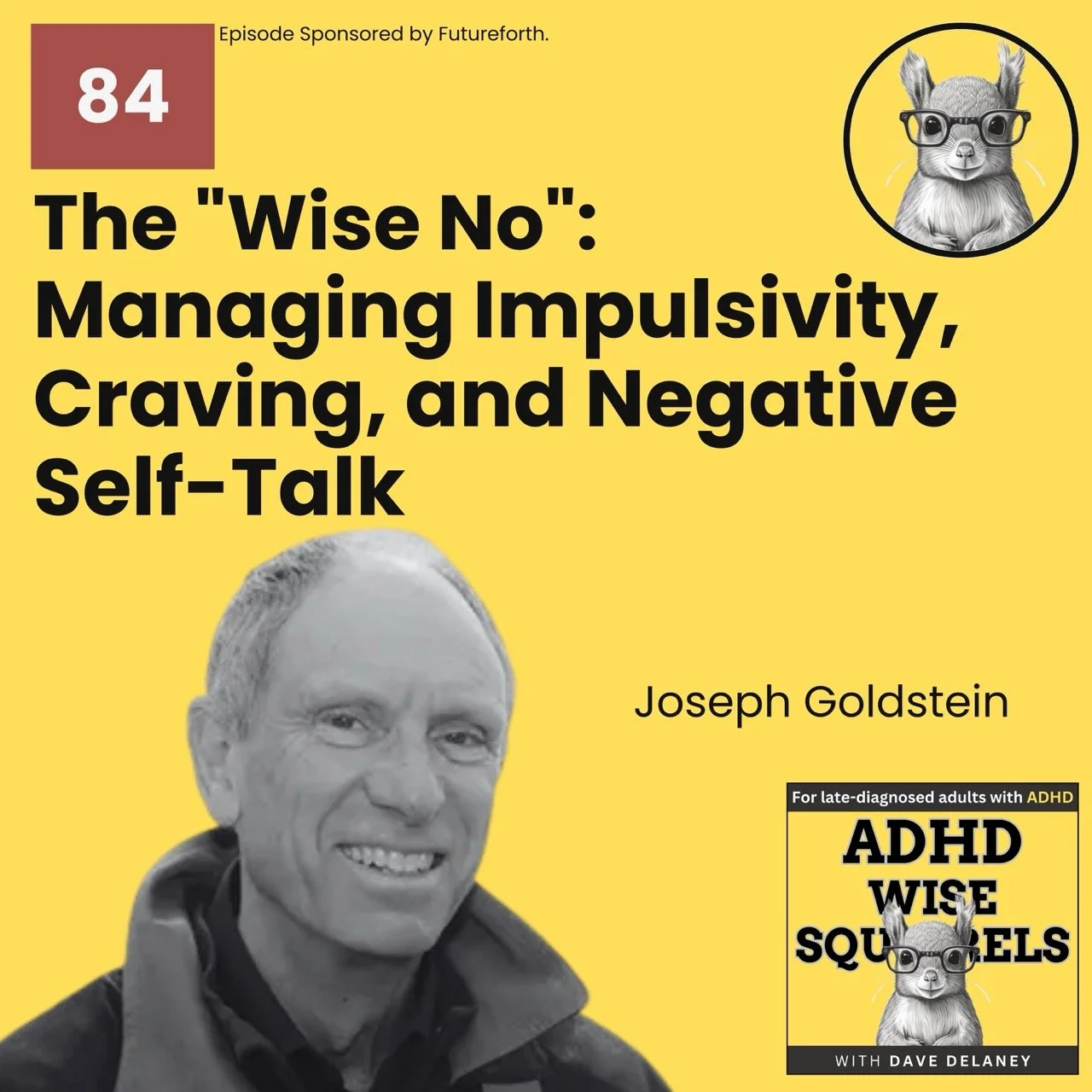
Joseph Goldstein is a renowned American Buddhist teacher and author, known as a co-founder of the Insight Meditation Society (IMS) and a key figure in bringing Vipassana (Insight) and loving-kindness meditation to the West, emphasizing present-moment awareness to cultivate wisdom and compassion. It’s an honor to feature him on Wise Squirrels once again!
Ever feel like your mind is running a relentless marathon of overthinking, sudden impulses, and harsh self-criticism? In this deeply insightful episode, I sit down with world-renowned meditation teacher Joseph Goldstein to explore how ancient Buddhist psychology offers surprisingly practical ideas for Wise Squirrels.
Whether you are navigating a late-in-life ADHD diagnosis, battling an overactive inner critic, or trying to break impulsive habits, this episode delivers practical strategies to help you stop fighting your brain and start relating to it with clarity and humor.
What You’ll Discover in This Episode
How to Drop the Weight of Rejection Sensitivity: Learn why you aren't responsible for what goes on in other people's minds, and how grounding yourself in basic ethical living can help shield you from shame and RSD.
A Humorous Trick for Harsh Self-Talk: Meet "Albert"—Joseph’s playful technique of personifying your inner critic to instantly unhook from self-judgment and laugh off repetitive negative thoughts.
Containing Emotional Tsunamis: Discover the "Jackson Pollock" framing technique—using full-body awareness as a spacious canvas so intense anger or overwhelm can decompress without taking you down.
Giving Restlessness a "Bigger Pasture": Why forcing yourself to sit still can backfire, and how brisk walking meditation or noting elements (Air, Earth) calms a hyperactive nervous system.
Building the Neural Pathway of the "Wise No": How to start small—saying a gentle "no" to minor cravings—to build up the mental muscle needed to help you interrupt major impulsive habits and addictions.
Understanding Anatta (Not-Self): Why your intrusive thoughts and executive function struggles don't define who you are. They are simply passing phenomena conditioned to arise and fade.
Key Insights from Joseph Goldstein.
1. You Can't Manage Other People's Minds
When dealing with Rejection Sensitivity Dysphoria (RSD), we spend immense energy trying to control how others perceive us. Joseph shares a foundational lesson from his early teacher, Munindra-ji: you can only take responsibility for your own mind. When you rest on a firm foundation of your own basic goodness, what happens in someone else's head is their business, not yours.
2. Personifying Your Inner Critic
If you constantly beat yourself up, try assigning a cartoon personality to those repetitive thoughts. Calling your internal judge "Albert" turns a crushing narrative into a minor visitor ("Oh, Albert’s back again"). Counting your judgments throughout the day exposes the sheer absurdity of the pattern until you can't help but smile at it.
3. The "Bigger Pasture" Strategy for Restlessness
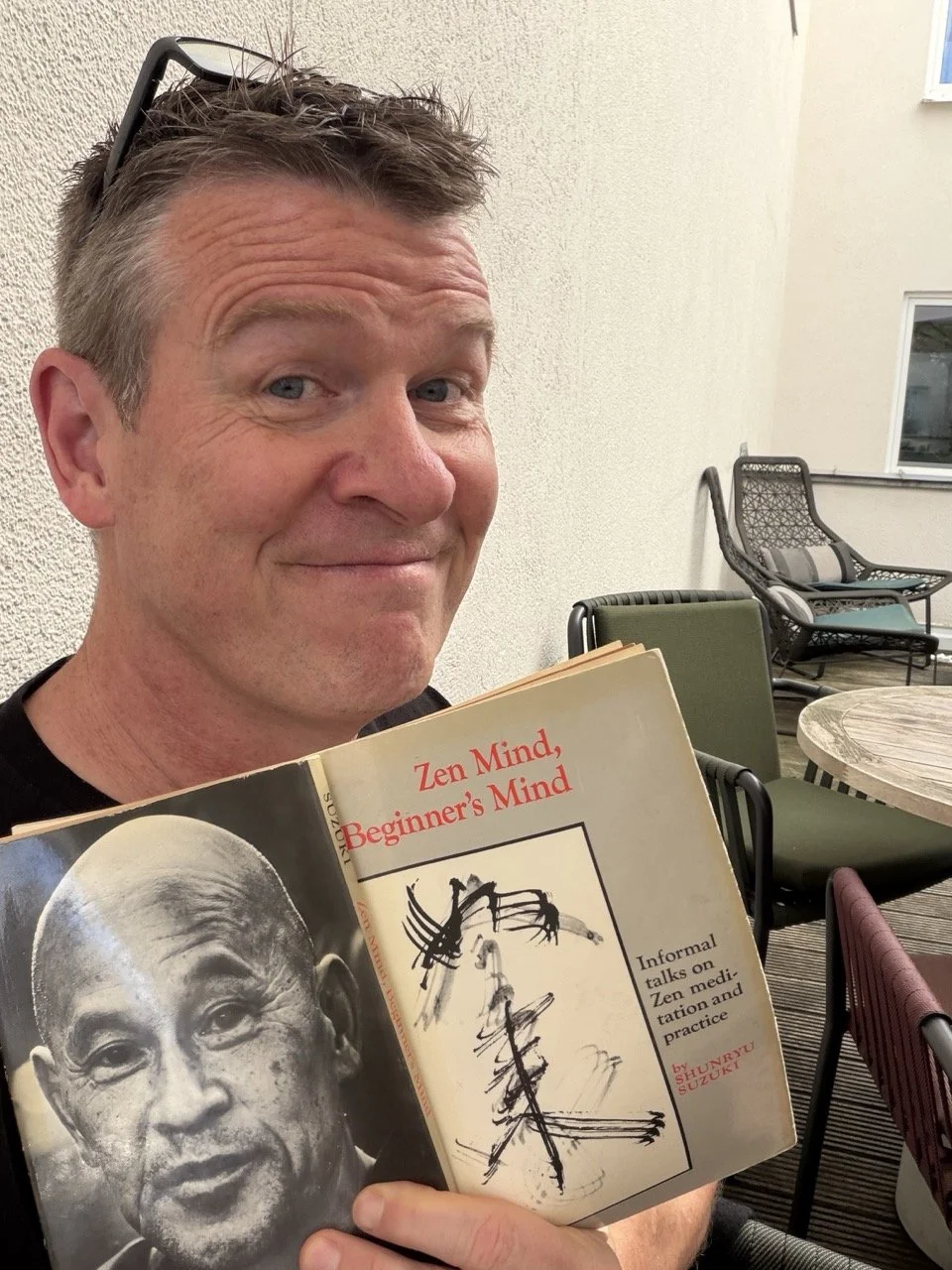
When Joseph Goldstein recommends a book, you buy it!
Citing Zen master and author of Zen Mind, Beginner's Mind by Shunryu Suzuki, Joseph notes that "the best way to control a cow is to give it a big pasture." Trying to force a restless, high-energy ADHD mind into a narrow box only breeds agitation. Learn how brisk, mindful walking and labeling physical sensations (Air on the lift, Earth on the step) grounds you without forcing unnatural stillness.
4. Training the "Wise No"
While mindfulness often emphasizes "yes" and acceptance, overcoming impulsive habits or addictions requires cultivating a "Wise No." By practicing saying "no" to small, innocuous urges (like an unnecessary mid-afternoon treat), you gradually strengthen the neural pathways required to resist bigger impulses when high-stakes temptations strike.
Whether you want to tame your inner critic, regulate emotional high-voltage moments, or simply build a kinder relationship with your thoughts, this conversation provides an executive-grade roadmap for navigating the Wise Squirrel’s mind.
LINKS
Click here to support those affected by the tragic flooding and landslides in Tibet and Nepal.
Discover virtual guided meditations and in-person retreats at the Insight Meditation Society.
For more from Joseph, check out episode 50 of Wise Squirrels!
-
Dave: Jumping right into this, and of course folks can listen to our first conversation on the earlier episode. A lot of adults who are diagnosed with ADHD later in life—who I call "wise squirrels" like myself—reflect on their lives a bit, and they end up often feeling some shame. There is this phenomenon that occurs with ADHD called rejection sensitivity, or RSD, so you feel a lot of rejection and shame, ultimately. Let's talk about how we might address that when we're in these moments of feeling shame or regret or rejection.
Joseph Goldstein: Are you asking that in terms of how you're perceiving other people are perceiving you?
Dave: Yeah, in general—tapping into Buddhist psychology...
Joseph Goldstein: What I'm about to say is something that has saved me a lot of suffering over the years, not around this particular topic, but in the general arena of how these things can arise in the mind. It's something my first teacher, Munindra-ji, said to me very early on, and it really stuck with me. He said, "You can't take responsibility for other people's minds. You can take responsibility for your own."
That made me realize that there's no way we can control how other people will perceive us. That depends on their own conditioning, their own background, their own prejudices, biases, and all of that. But to the extent that we are really grounded in what in Buddhism they call the Five Precepts, or basic ethical behavior—if we're grounded in that, so there's no cause for remorse in terms of our actions—then what other people think of our energy or how we're operating in the world, we can't take responsibility for their minds, because they're going to just do what they do. Are you getting the gist of what I'm trying to say?
Dave: Absolutely, yeah. What I hear you saying is that we can't control what other people think, and who the hell cares what they think? Exactly. As long as we're being good people, good humans—if we're doing terrible things, then yeah, maybe we deserve the guilt and everything that goes along with that. But if we're being good humans, doing our best, and showing up well, then yeah, who cares what they think?
Joseph Goldstein: Well, yeah, not in a totally dismissive way, but realizing we don't have any control over what's going on in their minds. So it's useless trying to manage their minds and how they perceive us.
Dave: Yeah, and I like how you brought it back to that, because when I said who cares what people think, it's not so much about judging people for perceived thoughts they have about us. Non-judgmental awareness, right? It's about just knowing that we can't control what's going on in their noggins.
Joseph Goldstein: Exactly, exactly. And our refuge really is our own understanding of the Dharma, our own understanding of our ethical behavior, so that we're resting on a firm foundation, as you said, of basic goodness. If that's there, that's what we have to be responsible for. Everything else in their minds, they have to take care of their own minds.
Dave: That's right. I always tell people, it's stolen from every flight you've ever been on: you've got to put on your own mask first, right?
Joseph Goldstein: Yes, yes.
Dave: Yeah. So in Buddhist psychology also, there's a word—and I may butcher it—Anatta, I believe?
Joseph Goldstein: Right.
Dave: I believe instead of "no-self", you say "not-self", is that correct? Am I right about that?
Joseph Goldstein: Some people make that distinction; I don't particularly. Basically, it refers to the selfless nature of phenomena, so whether you call it non-self, not-self, or selfless. This is one of the deepest aspects of the teachings: that everything in the mind-body is arising out of conditions. In that sense, it's impersonal. It's not that there's some little self inside who's running the show.
But there is agency when we understand the laws governing the unfolding. So of course that has to do a lot with the understanding of karma—even though actions are impersonal, they do bring about results. So one wants to take care with what kind of results we would like to have in our lives. This is kind of the Buddhist path.
Dave: How can someone use mindfulness really to realize that an executive functioning struggle or an impulsive thought is just that passing phenomenon, right? It's not who I am if I have a thought about X, but rather... This is part of it that I sometimes struggle with, the thoughts around no-self or not-self.
Joseph Goldstein: Yeah, so it really has to do not so much with thinking we should necessarily have control over what thoughts are arising in the mind, but rather how we're relating to them once they arise. We could be having all kinds of thoughts, but if we're being mindful of them as a thought, then we can choose, "Okay, do I want to act on it or not act on it?" But it's not trying to control whether the thoughts come or not.
Again, you're more of an expert in ADHD—I have very little experience with that—but I would imagine that all kinds of thoughts will be arising. The mindfulness gives you some understanding that you can relate to them in different ways. You can either be lost in them, or you can be mindful: "Oh, this thought has arisen." That's really the training in mindfulness. That ability or understanding rests on the wisdom that the thought doesn't belong to you. The thought arises out of its own conditions. If we're not caught up in it, then it's really not a problem, regardless of what the thought is saying. If we're aware of it as just an arising in the mind—it arises, it passes—that takes being mindful. So that's the challenge.
Dave: Yeah, that's the kicker, yeah. So often when I speak about adults with ADHD—obviously it's a specific thing, but I find a lot of humans can be pretty cruel to themselves in their thoughts, right? I can't remember where I heard it from, but the line: "Would you speak to your child or friend in the same way that you internally or even externally talk to yourself?" I tend to beat myself up often, and I try to practice being compassionate to myself and being mindful. I do catch myself in it because I've practiced and I'm learning, and I always will be learning, of course. What are some ways that people can become more mindful in those moments of self-doubt or just being mean to yourself?
Joseph Goldstein: What I'm about to say is a mildly humorous way of working with it: if there's a deeply established pattern that you recognize—beating yourself up or self-judgment—I would create a cartoon figure and give it a name. I don't know what might come to mind... let's say Albert. I'm just making up a name.
Dave: Yeah.
Joseph Goldstein: So then, every time Albert appears in the mind, you say, "Oh, Albert, hi!" As soon as you do that, already you're not as identified with it. You're seeing it as this pattern, right? And if it's a cartoon figure, it adds a little humor; you can almost smile at it. "Oh, Albert's come to visit again."
A further little technique, which I've worked a lot with people on—because the judging mind, whether judging oneself or others, is really common whether you have ADHD or not—when people are on retreat and they report that, I'll often suggest: okay, take a day and count the judgments. Judgment 1, judgment 2, judgment 598, judgment 10,000. At a certain point, one is just going to start smiling, because we see how ridiculous it is. When you get up to judgment 10,000, you're going to start laughing.
Dave: Yeah, you have to!
Joseph Goldstein: So whether you call it self-judgment, or Albert, or whatever, the counting of them is a bit of a subterfuge to make you more mindful that they have arisen. Instead of them slipping in and carrying you away, if your exercise, your practice, is to count them each time they've arisen, that's going to make you more attentive. Some you'll miss, but with practice we can get pretty good at catching the pattern, because the pattern doesn't take that many forms. It would be interesting to highlight the specific form the self-judgment takes, almost like you could write out the sentence, like "I'm such a bad person" or "I'll never get over this" or whatever it is. If you can really precisely know the particular thought of this pattern, then it's easier to recognize. Every time it comes: "Oh, there's Albert."
Dave: Yeah, I like that. I love the idea, too, of labeling those thoughts as Albert, or as someone else in a sense, because it does help you realize it's not you necessarily having those thoughts, it's just...
Joseph Goldstein: No, it's a conditioned pattern. That's all. From who knows—childhood, a past life, or whatever—something has conditioned that pattern. The way of reducing its impact is not to personalize it. The way of not personalizing it is to be mindful in just the ways we've been talking about: naming it, counting it. It helps us just see, yeah, the thought is thinking itself.
Dave: Yeah, yeah. I don't know how this would be quantified, but there's this line in the ADHD space that a child before they're 10 receives something to the effect of 20,000 negative feedback comments from teachers or parents—more than a neurotypical child might—because you're forgetful, hyperactive, or whatever. You're constantly getting scolded. So the sooner somebody realizes this and embraces the idea of talking to Albert, I think that's a great idea.
Also, with working memory challenges, I do sometimes lose track of counting, so I like the idea more of the Albert thing for myself. But either way, I think that's a great strategy.
A lot of times, we have dysregulated emotions, so emotions tend to roll in like a massive tsunami rather than just waves. What does practicing equanimity actually look like in those first high-voltage seconds when an emotion—whether it's anger or whatever it is—arises? Is there a way to slow yourself down? It may be the same answer in a way, telling Albert, "Whoa, cool down!" Maybe it is, I don't know.
Joseph Goldstein: I think something that's pretty easy to do, if one remembers, is: strong emotions, as we know, are felt very powerfully in the body. There are a lot of bodily sensations triggered by the thoughts and the emotional states that are arising. So whether one is sitting, going for a walk, or just in the midst of one's daily activities, when the strong emotion is there, settle back into a full-body awareness. You're not trying to narrow the attention and find something subtle; it's just a full-body awareness.
In that, we will be feeling the roiling of the energy, but because we're putting it in the frame of a full-body awareness, it allows the energy to do what it does and to decompress. We're giving it the space to wash through, rather than being caught up in thoughts about it or reactivity to it. We're actually saying, "Okay, I'll just be open to this feeling." But to do that without the boundary of the full-body awareness, we could easily just get carried away. That body awareness grounds us, and it provides the container to feel the energy of the emotion. In the feeling of it in that way, it tends to dissipate over time. Everything is changing all the time; it's not going to stay there.
Dave: Let's say I'm driving and somebody cuts me off, and in that moment I'm angry. Is what you're saying sort of to slow down enough to think, instead of "I'm angry!", but think, "How do I feel this anger? Where... I'm angry in the moment, how? Is my jaw tight?"
Joseph Goldstein: I wouldn't even initially try to pinpoint where you're feeling it. The first step is just: okay, you're driving the car, somebody cuts you off, you feel all this anger—just feel the whole body in that sitting position. Full-body awareness as you're driving. Don't try to pinpoint anything within the body. But if you have that frame—so you're sitting there driving away and you're feeling the body, the whole body—then whatever sensations are going on will be felt even if you're not zeroing in on them.
I think that's the first step, because that provides the easiest and most balanced way of taking in the whole of it. Are you familiar with the paintings of Jackson Pollock?
Dave: Yeah, abstract art, yeah. I know them well.
Joseph Goldstein: These huge canvases just swirling with swirls of paint. If you're looking at it and trying to follow each of the brush strokes, it'll drive you crazy. There's just too much going on. But if you put a frame around the whole picture and then you step back, because of the frame, you can take the whole thing in at once. You don't have to be examining it brush stroke by brush stroke. So when there's a strong emotion that comes, the first step is putting the frame around the whole body, which is where we're feeling the emotion in the body. Just putting a big frame around it like around the Pollock painting, and just being open to that, however it's showing itself.
Dave: That's brilliant.
Joseph Goldstein: Then—I wouldn't do this when I was driving, but for example if you were at home—once you have that balanced openness to the whole of it, if circumstances allow, you could begin a more specific investigation: "Oh, where is the sensation most predominant?" Another helpful phrase in that first period where you're just beginning to feel overwhelmed by the emotion is: "Oh, anger feels like this." Anger feels like this, or rage feels like this. Immediately, we've stepped out of being identified with it and taken an interest in it. Just that change of perspective is hugely helpful. It brings us back to balance, which is allowing it to be there without being lost in it.
Dave: Yeah. So that gets into that mental noting, right?
Joseph Goldstein: Yeah, and the noting... you can do it in a lot of different ways, but I like the phrase, "Oh, this emotion feels like this." Because it's not just naming the emotion, but that very phrase brings us back to that full-body awareness of it.
Dave: I love that, yeah. And it's almost Albert at it again, in a way.
Joseph Goldstein: Exactly, right.
Dave: "Albert's angry again!" Yeah, right. I'm almost imagining sort of like... there was a Pixar film with the angry cartoons, right? It's like these different emotions.
Joseph Goldstein: Yeah. That's why I said half-humorously, but creating a cartoon figure to represent it can help lighten the whole thing.
Dave: I put it out to my community asking for questions ahead of time, and one question that came up—which also resonates with me because of my L5-S1, I have some back pain really. I remember last time we spoke, you spoke about some back pain on retreat. Chip and Darren, two great folks, asked virtually the same question, but part of it was about sitting and not being able to... because with ADHD, we get kind of itchy, we want to move. It's not so much hyperactive as an adult necessarily, but it's difficult to sit still. What are your thoughts on ways to help when you are sitting in practice?
Joseph Goldstein: A couple of things come to mind. One is: I'd do a little exploration of whether it gets worse or better depending on how you're sitting. Do some postures make that more likely?
For example, for me it's not about restlessness, but more if it's time for my daily sitting and I'm feeling low energy, sometimes I'll do that sitting in my recliner instead of the posture I usually use—which these days is not cross-legged in any case, as it used to be, but a little more formal. But when I'm feeling low energy and I just sit in the recliner, I can feel everything relax. It's easier to be with a little lower energy, but I imagine it might be easier also for restlessness if one is just in a really comfortable sitting posture. I don't know whether that would have an effect, but it's one thing that came to mind.
The other: I had one experience in my time in Burma. I was there for a few months doing intensive practice, and for some reason I went through one period—it lasted about a week—where every time I sat, I thought I was going to jump out of my skin. I could not sit still. It was amazing, because I had been going along fine. For whatever reason, in that week, that incredibly restless energy was so overpowering, I could not keep sitting. I would try to force myself for a little, but that was hopeless.
So what I did was—this was at a big Burmese monastery—I just got up, left my room, and walked really quickly around the whole perimeter of the monastery. I was using the energy for the walking, right? But I was walking quickly; I was not doing slow walking. In 15 minutes or so, things calmed down, and then I could sit for a while. The next time it happened, I would do the same thing.
So sometimes, instead of trying to sit still, actually do walking—walking at whatever speed feels appropriate to the energy, but doing it as mindfully as possible. That can be as much a meditation as sitting. Being aware of the whole body moving would be better than trying to narrow the attention.
There's a line from... I don't know if you're familiar with the book Zen Mind, Beginner's Mind by Suzuki Roshi?
Dave: I'm not familiar. I haven't read it, but it's on my list right now.
Joseph Goldstein: It's a really good book. He was the founder of the San Francisco Zen Center back in the '60s and '70s. Really popular, and he wrote this book, Zen Mind, Beginner's Mind. They're very short chapters, a page or two. One of the headlines of the chapters was: "The best way to control a cow is to give it a big pasture."
If you try to confine a cow in a small space, it gets agitated. Give it a big pasture, and it just roams freely. Sometimes restlessness means there's an imbalance between energy and concentration. There's too much energy and not enough steadiness to hold it, so it gets agitated. We give the mind a big pasture, and in this case the analogy would be: yeah, go out for a quick walk. Don't try to contain it; make the space big enough to hold it, and then the cow calms down, and the mind calms down.
We have to relate to what's going on appropriately. If you're describing that intense restlessness and you're trying to just stay with the breath, maybe it would work—maybe you'd click into a deeper concentration—but often not. Often the energy is just too powerful. So then you need to give it a bigger pasture, not try to confine it.
Dave: So when you're out walking around the monastery, are you doing so in a brisk way to get that energy out, as opposed to slow? Because I've practiced walking meditation and I know you're a huge proponent of it. But my understanding at least—correct me where I'm wrong, of course—is with walking meditation, typically you're going quite slowly, are you not? But when you're going quickly... well, I'll shut up.
Joseph Goldstein: Classically speaking, especially in this Burmese tradition, they recommend walking slowly. When you can do that, for periods it really does strengthen concentration a lot. But over all these years of practice, there are times when I would do countless hours of that slow walking, but also in more recent years, generally I do a little faster walking—just a more normal pace. What I described at the monastery was a very brisk walk. I mean, I thought the monks in the monastery probably thought, "This guy's crazy!" But that was fine with me. That was their mind! It worked, because that's what was appropriate for the energy that was going on. So there's no fixed rule of how fast or slow, and one can experiment.
Dave: How does that work when you are... because I go to a walking trail and there's not a lot of distraction really there, and I also have a forest nearby, a state park that I hike in quite frequently, and again, not a ton of distraction there. But I almost imagine, like I was just back home in Toronto and walking in a New York sort of setting where you're trying to get this energy off, so you go for that brisk walk down Broadway or whatever major city. What is that process like walking down the road? Because obviously you have to be aware of traffic and weirdos and God knows what other threats are around you, but also the temptations of food or sales or whatever tempts you. What's that process like as you're walking down Broadway? What's going on in Joseph Goldstein's head?
Joseph Goldstein: This is one of the benefits of having done a lot of walking meditation at all kinds of speeds—just having done a lot of it. Being mindful of the body in movement has almost become the default, just because of all the practice. I go visit friends in New York a few times a year, so just like you described, I can be walking down a busy New York street, and I'm aware of what I'm seeing, but I'm really feeling the body moving. I'm in the body feeling it moving. It doesn't take much at all; it's the most predominant aspect of our experience. One is aware, of course, of what one is seeing, but to the extent that we're grounded in the awareness of the body movement, I think there would be less tendency to get distracted by everything you see: "Oh, look at that! Oh, look at that!" And then all of a sudden, the mind's agitated again. So I think it's possible to see so we know what's around us, but we're centered in the feeling of the body moving, at whatever speed is appropriate.
Dave: And when you're talking about the feeling of the body moving, are you speaking more of, "My arms are swinging, the soles of my feet are feeling the pavement," or are you thinking more, "The heart is beating"—all of it?
Joseph Goldstein: No, I wouldn't get too subtle. I would be with the most apparent: the movement of the arms, the movement of the legs. Just super simple.
Dave: It's amazing, because I would almost imagine my mind thinking like, "My feet are moving, and then oh, they're getting sorer. Are these shoes the right ones I should be wearing for this walk? Maybe I should stop and buy some insoles, or..."
Joseph Goldstein: Albert! Yeah, Post-it!
Dave: Get out of my walk!
Joseph Goldstein: Albert, take a nap!
Dave: Yeah, right.
Joseph Goldstein: So what I'm about to say now... there is a way, actually, in that situation, of deepening the practice quite significantly. Probably for a beginner it would be hard, but for somebody who has some experience in meditation: when we're walking—anybody, whether they have ADHD or not—just walking and trying to be mindful, very commonly, even as we're feeling the sensation of the movement and the sensation of the foot touching the ground, very often there is a conceptual overlay of the image of foot or leg. Even though we're feeling the sensation, in the mind there's that overlay: "I'm moving my foot, I'm moving my leg."
But actually, we don't feel "foot" or "leg." There's no sensation called "foot." Foot is a concept, an image which we're putting on certain sensations. So as you're walking down the street, once the mind gets into that pattern, "Oh, my shoes are too tight, do I need an orthotic?", it starts spinning out. That is good feedback that you've lost the close connection to the actual sensation you're feeling, and you're back in the conceptual level of foot or leg and what should I do about it. So it's actually useful feedback, and to the extent that you could practice it, really feel closer.
It could be super simple. It could be just the awareness of the hardness when the foot touches the ground: hard, hard, hard.
I'll just elaborate one more thing about this. One way to help do that—and it's very effective, and it really leads to a deepening of the meditation, so this is not just remedial—in classical Buddhism, they talked about the different bodily energies in terms of the four elements: earth element, fire element, water, air. That's just a designation for different kinds of sensations. Let's just use that framework.
For example, when we're walking, the foot moving through the air is like the experience of the air element. When we touch the ground, it's the earth element—hardness. So movement, hardness. What I found to be incredibly interesting is to use the note of the elements. So you're walking in Toronto, your mind's going a little crazy, going "My shoes hurt, what do I do?" If you could remember, and just as you're walking, use the note with each step: "Air" or "air element", "earth element", "air", "earth", "air", "earth."
The reason this is so effective is because without that, as I said, there's often that overlay of the concept of foot or leg, and then very easily that goes to my foot and my leg, and then what do I do about my foot and my leg? It's building this whole story. When we're framing it in terms of the elements, there's almost no likelihood the mind is going to be thinking "my air element" or "my earth element." It would be seen really as impersonal, and that frees one from that whole proliferation of thought about "my"—my foot, my leg, my body, what do I do about it, it hurts—all of that is gone. Even if one did that for five minutes as you're walking down the street—air, earth, or air element—it would be very interesting to see the effect of that. For me, it's been remarkable, because it drops one directly into the selfless nature. We're not building the concept of self.
Dave: I love that idea, yeah, because it does in a sense sort of distract yourself from yourself, right?
Joseph Goldstein: Yeah, right.
Dave: And focusing on something like you said, you're not controlling it, it's just, "This is the air, this is the earth."
Joseph Goldstein: Yeah, and it's reflective of what is actually happening. Everything else is just in your head—"Oh, my foot, my leg, where's the nearest shoe shop?"
Dave: Right. That's absolutely true, yeah. I love that, that's so cool. Yeah, I'm going to definitely do that on my next walk.
Joseph Goldstein: Yeah.
Dave: Some of the stuff with ADHD, especially undiagnosed and untreated, we tend to be—and I'm generalizing of course—prone to excess or prone to addiction even. Partly my understanding at least—and I'm not a doctor—is that we crave dopamine. Even though we produce enough dopamine, our dopamine receptors misbehave and don't quite connect it. So we're craving ways for dopamine, and there are good and bad ways. I love standing on stages, delivering presentations and workshops and training, helping people, doing comedy and stuff like that, improv. But I love being on stages, and learning about myself through this lens of ADHD, I understand now that I receive this mass amount of dopamine from the audience as they laugh, and so on. So it's a positive experience and a good thing.
But unfortunately, the bad side of it is with addiction or overeating, things like that. Obviously addiction is a huge challenge. Are there strategies or tips using mindfulness to help one who does suffer from addiction to slow down in moments of maybe excess? Where for me personally, I will eat the entire pizza, and my friends will be like, "What the... Dave? Oh my God, you could take some in a box and take it home with you, you know." And I'll always be the one that eats the entire thing because I just can't stop myself eating it. Now, this is better than obviously drugs—I'm six years sober from alcohol—so tell me a little bit about your thoughts on addiction or addictive habits. They don't have to be hard drugs, it could be eating.
Joseph Goldstein: A couple of things... and a disclaimer: I'm not an addiction expert. But one certainly sees those patterns in the mind, however weak or strong they may be, because it's really just an extreme manifestation of desire. It's that very strong, compulsive desire.
One of the things that I've worked with at different times—and it's both amusing and a little challenging—I will start with really small things, small desires that have not risen yet to eating the whole pizza. For example—and this could be on retreat or off retreat—I'll have the thought just to fulfill some desire, something innocuous: "Oh, I'd like some tea and a cupcake," something like that. With something small, sometimes I will practice: "No, I don't need to do it." It's like realizing in that moment with something small: "Oh yeah, I can not do it."
In a way, it's learning about the "wise no." Because a lot of meditation language is about "yes"—open to, accept, allow—which of course is a big part of it. But the "wise no" is equally important. This is the energy of the precepts, where we take the precepts, and even if there's a desire to say something untrue or to kill an animal or something, if we've taken the precepts: "No, I don't need to do that."
With sensual desires, or in the category that captures one the most—so in your example, it's food—I think it would be interesting to just start training the "wise no" neural pathway with small things. It'll probably take a while till you can say no to the whole pizza, but you might be able to say no to some lesser desires. You're getting familiar with the ability to say, "No, this is not a good idea," or "I don't need to do this." So I see the potential of building up the strength of that pathway in the mind, and gradually working up to, "No, I'll take the rest of the pizza home," because that will have become familiar through practice. So that's one thing that comes to mind.
Dave: That's brilliant. So mini "wise no"s as dress rehearsals for the main event, whatever that event looks like.
Joseph Goldstein: Yeah, exactly.
Dave: And around things that you really feel that you're able to do this. It's not a desire that feels so overwhelming in the moment, but you're working your way up.
Joseph Goldstein: You're setting yourself up for success in a way.
Dave: I talk about a "minimum viable action" (MVA) for ADHDers to get started on something: just do five minutes on the thing, and that's all you have to do, and celebrate when it's done, and you can go do whatever now.
Joseph Goldstein: But don't celebrate it with a whole pizza!
Dave: Right! Exactly!
Joseph Goldstein: So the other thing... this probably would not be as effective as what I just said, so you'll have to tell me whether it fits into anything you're familiar with. I don't really know whether this would work: in the moment when it feels one is about to be carried away, to balance the energy of that desire and wanting—if it's possible, and maybe it's not—to have a few moments' reflection about the consequences of the action.
I'll tell you a story, and this again was not about... I was a kid, like 8, 9, 10 years old. I went to one of my friends' birthday parties, and they had one of these store-bought birthday cakes with tons of icing and the roses which are just all sugar. But in the moment, they tasted great, and I ate so many I got so sick from it. For me, that one time was enough, because I got so sick! And so when I... I do not like icing! When I see icing on a cake, I scrape it off, because I'm aware of the consequence.
So whether it's possible—and again, for me, that one time was sufficient, but mostly I think it probably takes many times—to become aware: "Oh yeah, I did this and this is what happened. I didn't feel good. I did the same thing and my stomach hurt." So whether that kind of reflection can be brought in... this is really a question for you, whether something like that might be helpful or not.
Dave: I think so. I reflect on my own life, and I drank like a fish in my 20s and around that time. I would be lying to say I had one hangover. No, I had hundreds of hangovers, and blacking out and all these things, where for whatever reason at the time—and there are lots of different reasons, probably—I didn't really learn the lesson, or I didn't want to learn the lesson, or I didn't feel a need to learn the lesson, and instead just carried on as usual with the same people doing the same bad habits, eating the same cake icing over and over again.
But I do think for me personally, it got to a point where with certain things... alcohol is a little different, because once I had kids, I realized, okay, smarten up. And very quickly smartened up. There were still occasions where I would drink too much, but never ridiculous like I did in my youth. It was only six years ago when I decided I'm going to take 30 days off, and then I found non-alcoholic beer has come a long way since O'Doul's! So I partake in those from time to time, and that has completely replaced it. I was just in Ireland and had Guinness 0.0 on tap, and I was like, "Oh my God, this is the real thing! This is Guinness Ireland!"
Joseph Goldstein: I'm moving to Ireland!
Dave: Exactly! If I can be in Ireland and be sober, then that's a big win! So, but I do think, yeah, like when I quit smoking—that's a better example—I was in a hotel room with my wife, then girlfriend, and I remember waking up and she was looking at me in horror. I woke up like, "What's the matter?" and she said, "Your chest, as you sleep, is crackling." Like she could hear my chest. At that time, we were about to fly back to our respective homes from London—we were living in Europe at the time—so she went back to the States and I went back to Canada. At the time, Toronto had already gone non-smoking in all the pubs and bars, and most of my friends, if not all of them, had already quit smoking. So it was easier for me, and I thought, okay, I'm going to be surrounded by people not smoking. At the time back then, the pubs were all smoking still in Ireland and England. So it was almost the circumstances that made it easier, and that wake-up call from my wife. So, I don't know.
Joseph Goldstein: Right. Okay, so this is just reminding me of one other little thing that might be helpful for some people. Back in my 20s and 30s, I was also smoking. I got hooked when I was in India on these bidis.
Dave: Oh yeah, bidis! I used to smoke those at head shops in Toronto when I was a kid!
Joseph Goldstein: Yeah, I really got totally addicted to them. Then came back to the States and that morphed into smoking cigarettes. Not that I was ever a super heavy smoker, but any smoking is ridiculous. But as we know, it's addictive. It's a really strong... and as Mark Twain said, "Stopping smoking is easy. I've done it thousands of times."
Which was my experience. I would stop, and then... so I finally came up with a mantra: "Not even one." Because the seductive thought was, "Oh, I'll just have one." If I had one, then I was gone again. So again, for some people at the right time, just that little reminder might be a help. It helped me at that time, when I really did want to stop. It just cut off that doorway to picking it up again.
Dave: And I think that's a kinder approach to it, because for me, I quit. For me, it's a hard and fast rule now: don't smoke anything. Because I know if I take a drag of a cigarette, I'm highly likely going to just start smoking again, so no, nothing.
Joseph Goldstein: Well, it's the same thing. Yeah.
Dave: So no more cake with icing!
Joseph Goldstein: That desire is long gone—uprooted!
Dave: I was just going to say, on my 50th birthday, my wife got me a cake, and it was similar to the one you described, from the grocery store. When we opened it, it said, "Happy 50 Days!" So ever since—my 54th birthday was "Happy 54 Days!" But it was the weirdest thing. So I have a weird thing with icing now, too.
Man, this has been just so great, seeing you and speaking with you again. I sincerely appreciate it. Do you have any questions for me about anything? Anything I didn't ask you that comes to mind, whether about ADHD, whatever?
Joseph Goldstein: No, I mean, as you know, I don't really know much about the whole thing, so... No, it was good. You're bringing out some of the questions and points that arise for people, and then seeing, okay, is there something in the Buddhist meditative world that can help address some of these questions?
Dave: What do you think should be said to people who are either on the fence about meditation, or they've tried a million times and it never works? Because I personally have found that meditation and mindfulness as a result have been the most impactful thing. What are your thoughts?
Joseph Goldstein: I guess I would ask a couple of questions. One is how they've tried—what did they actually do? My sense is that for many people, probably most people getting started, it's easier if there's a short guided meditation, rather than just hearing the instructions and then you're on your own. There are a lot of meditation apps, a lot of things online of guided meditations. So if one is sitting and somebody is continually guiding you and reminding you to come back, I think that's a much easier way to ease into the practice for people who have that kind of challenge. A lot of the meditation apps have a lot of guided meditations. I think keep it really simple: sit, feel the body, feel the breath, just super simple. If people start with 10 minutes, that would be good.
Dave: One thing I've learned in sitting practice—whether it's virtually guided, or more so actually in person I've found... there's a great meditation center, or several in Nashville, but one in particular, Wild Heart, that I go to every week or most weeks—where... and I spoke to Dr. Lidia Zylowska, who wrote a book about meditation and mindfulness for ADHDers, and she's a PhD and MD, so she really knows her stuff. But is belly breathing... because I feel like so often we walk around sucking our bellies in. I've got my little belly, and I'm always sucking it in. Often it's not until someone says it, you don't realize, "Oh, I'm doing this." So in focusing on an anchor like your breath, sometimes, especially for someone who's new to this, you don't think about your breath. You don't even know what it feels like. "What is a breath? That's my breath. Okay."
I know I rambled there a bit, but with belly breathing and ways to find the anchor that works best—we speak about the breath all the time—are there other anchors or ways for one to focus on something else, perhaps?
Joseph Goldstein: Yes, there are. But even with the breath, the instruction that we often give is just have people sit, feel themselves sitting, become aware of the body breathing, and then notice where in the body you feel it most clearly. Some people might feel it in the rise and fall of the belly, or the rise and fall of the chest, or the in and out of the nose. But you're not directing people to one place or another, you're just saying: sit, feel the body breathing, and notice where you feel it most clearly. So then they can settle on whatever that place is. So that's still using the breath.
This can be also really helpful: often when people get the instruction to be with the breath, they start controlling it in some way, in a subtle way. So one of the things that I do is start out just with this phrase: "There is a body." Just be aware there is a body, so people are just settling into that body awareness. It's super simple. But then instead of saying, "Okay, narrow your focus on the breath," I'll say, "Keep that larger frame of the entire body, and simply be aware of the body breathing within the larger frame." So the tendency is not to then narrow, it's to keep it like this, but within that frame, the body will be breathing. And so one can become aware of the breath. There's less tendency to control it if we give it a bigger framework within which it's happening. It's sort of like a wide-angle lens rather than a zoom lens—Diana Winston talks about that. So these are just some of the ways of helping people.
Dave: Yeah, and almost going back to what you were talking about with the Jackson Pollock painting, right? Don't be the cow wandering out, but rather focus on that frame of the body. I find that really helpful actually, just that note alone, that point about thinking of the body. If I'm sitting, I will notice my belly moving more than anything else probably, and that's it! That's the breath, it's hiding under there.
Oh my God, this is so great. Okay, I want to keep talking to you forever. Joseph, this is amazing. I saw on an IMS newsletter a new retreat, or like you're going to be in person doing some work, is that right, or...
Joseph Goldstein: I have been doing some online stuff. I'm doing a kind of... along with another teacher in September, I think, doing a weekend thing.
Dave: Okay, and I'll include links to everything so folks can find that.
Joseph Goldstein: The website is dharma.org, and that lists both in-person retreats and also online retreats.
Dave: Any tips as we wrap up here for folks who want to go on retreat? I've never done an in-person retreat and I would absolutely love it.
Joseph Goldstein: No, I mean, as you know, I'm a big fan! I would just jump in and do it. Come up to IMS. Retreats are being offered all year long, and there are lots of trails in the woods when you need to get out and do air element, earth element!
Dave: Yeah, for sure. Well, this has been amazing. Thank you so much again for your time, it was great.
Joseph Goldstein: You're very welcome. That was great.