PODCAST. Finding Your Through-line: How Storytelling Helps Adults with ADHD Connect Their Dots with Juliet Hahn.
EPISODE SPONSORED BY:
Littlebird. Littlebird is an AI assistant that already knows your work, so you can draft, plan, and stay on top of everything without having to catch it up on context. Get a free trial plus $20 off your first month of Littlebird Plus today at wisesquirrels.com/littlebird.
____________
Inflow. Inflow helps people make sense of how ADHD traits show up in their own lives, then points them toward the support that’s right for them. For some people, that means practical CBT-based tools in the Inflow app. For others, it may mean connecting them to specialized ADHD therapy through one of Inflow’s trusted partners. Take Inflow’s free ADHD traits quiz at wisesquirrels.com/inflow.
Ever feel like your life, career, and personal history are just a chaotic scatter plot of random pivots, hyperfixations, and unfinished chapters? You aren't alone, and you’re definitely not broken.
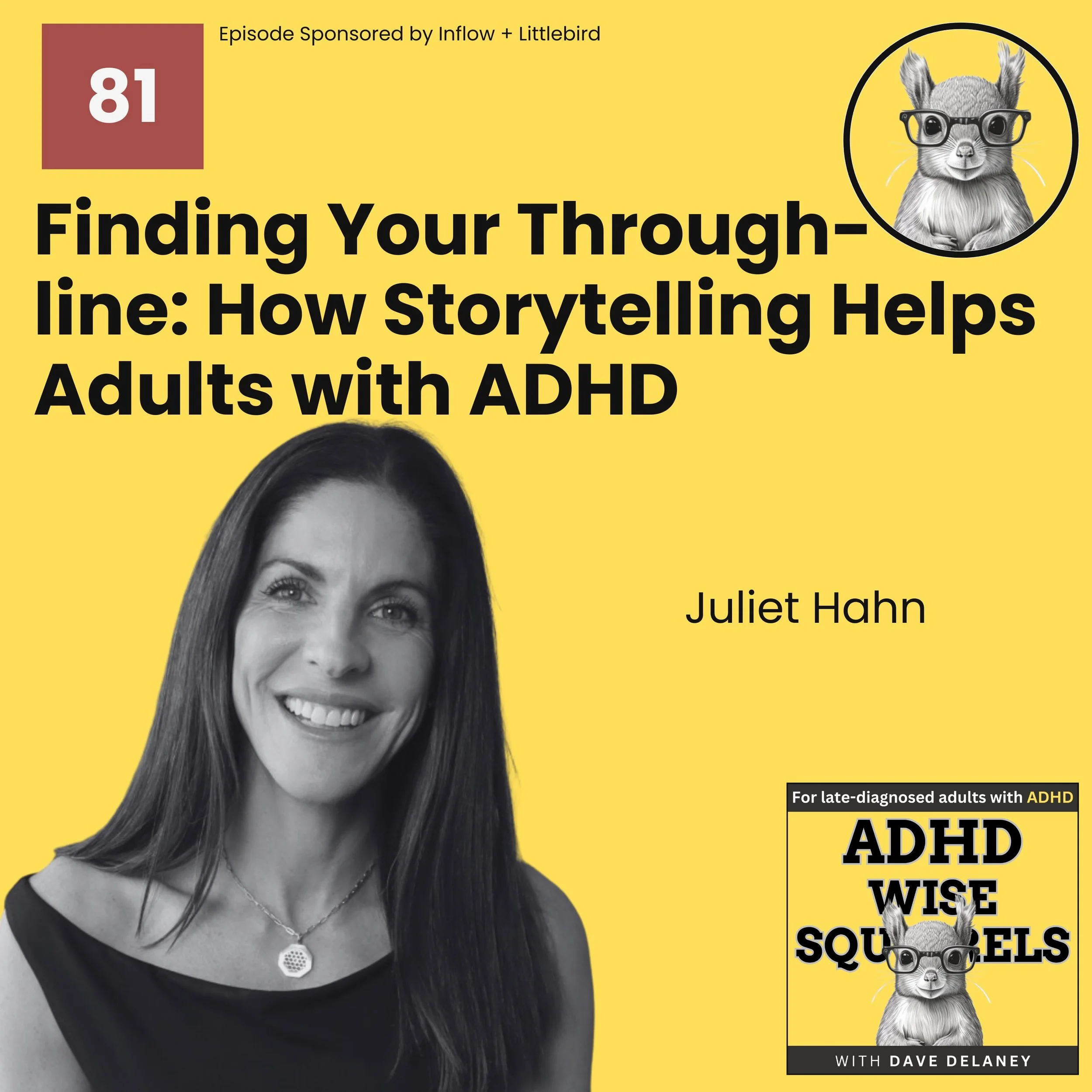
In this episode of ADHD Wise Squirrels, Dave Delaney sits down with Juliet Hahn. Juliet is a communications strategist, keynote speaker, and podcast host who serves as Chief Communications Officer at the regenerative medicine company FetTech. She hosts podcasts focused on personal growth and career pivots, including Don't Die Curious and Your Next Stop, while also actively advocating for dyslexia awareness as the co-host of Word Blindness: Dyslexia Exposed.
Juliet spent years believing she was "dumb" and "not creative" simply because traditional schooling wasn't built for her neurodivergent brain alongside what she calls the 5 D's (ADHD, Dyslexia, Dysgraphia, Dyscalculia, and Dyspraxia). Today, she uses those exact same traits her ability to spot hidden patterns, read emotional nuance, and hyperfocus professionally.
If you’ve ever felt stuck in your career, bogged down by childhood labels, or unsure of how to explain your multi-passionate journey with the world, this conversation is your roadmap.
In This Episode, We Cover:
Understanding the "5 D's": Juliet breaks down the differences between ADHD, dyslexia, dysgraphia, and dyscalculia, shedding light on why so many adults grow up misdiagnosed or completely overlooked.
Overcoming the "I'm Not Creative" Trap: How childhood schooling gives us false narratives about our intelligence and abilities and how to actively unlearn them.
Finding Your "Throughline": The 8-session storytelling framework Juliet built to help founders and professionals uncover their underlying Why and build deep, loyal connections with their audience.
The "You're Not a Tree" Philosophy: Why feeling stuck is often just stagnant energy, and why adults with ADHD need to give themselves full permission to pivot whenever a situation no longer serves them.
Modern Workarounds for Dysgraphia: How Juliet uses voice-to-text tools and ChatGPT as her personal editor to write her Substack without letting writing mechanics block her brilliant ideas.
The "It All Makes Sense Now" Moment: Dave and Juliet compare notes on late-diagnosed ADHD, navigating medication vs. intuitive health, and the profound relief that comes with finally understanding your personal operating system.
Resources & Links Mentioned
Juliet’s Website: iamjuliethahn.com
Dave Delaney’s “Three Why’s, Man” post.
Juliet’s Substack: I AM Juliet Hahn on Substack for her latest writings on mindset, storytelling, and neurodiversity.
Juliet’s Podcasts: Check out Don't Die Curious and Word Blindness: Dyslexia Exposed.
Connect on Social: Follow Juliet on Instagram (@iamjuliethahn) or connect with her on LinkedIn.
Books Mentioned: Driven to Distraction by Dr. Edward Hallowell and Dr. John Ratey; Big Magicby Elizabeth Gilbert.
Hit play to start connecting your own dots and learn how to share your story with clarity and confidence. If this episode resonated with you, share it with a fellow Wise Squirrel who needs a reminder that their brain isn't broken; it's just built for a different kind of story!
-
Juliet Hahn: So my name is Juliet Hahn. I am a mother, wife, and I'm also the chief communications officer for a biotech company called Fet Tech. I'm a dyslexia advocate, a podcaster storyteller, and the founder of The Throughline, which is a storytelling framework.
Dave Delaney: I know we connected a long time ago. Tell me about the ADHD piece, too. I know dyslexia is often—you know, comes hand in hand with ADHD. Not always, but sometimes.
Juliet Hahn: It's about 50, you know, I mean, it's a huge percentage. They believe it's right now—I've read some that are 40%, 60%—but it, you know, a lot of times it does go hand in hand. I'm one of the fortunate ones that got both, and dysgraphia and dyscalculia. So I have...
Dave Delaney: And what, what are the other two?
Juliet Hahn: Dysgraphia, which is the... So basically, some people look at it as the fine motor skill in the handwriting, but it also—if this helps kind of describe it—I can speak really, really well. That is my gift. But I cannot, right now if someone said, "Hey, can you write this down, what you're saying?", it does not go from my head to the paper. I have to voice text everything. So it's a different part of like the dyslexia-ADHD, which all comes together.
So you can imagine college and school in general was really difficult for me because of all the limitations. But I'm obviously a smart, intelligent person to be where I am, but had to go through a lot of hurdles.
Dyscalculia, some people call it dyscalcula, is the math portion. So that's all the numbers. I have no sense of math whatsoever. I also have no sense of distance, numbers, parking a car... there are things that are just not there. However, I was an athlete in college, so I knew how to get around it. But my brain just works completely differently, and the ADHD being in there too just adds a little bit more chaos.
Dave Delaney: That's interesting. Yeah, it's fascinating to me, too, because like with math, with like especially fast math, I'm borderline useless, I would go that far. It's ridiculous. And I have dementia and Alzheimer's in my family, so I have a cognitive test every year just to make sure things are all working still the way they're supposed to be. And yeah, just last year or this year I had one. She asked me like some question that I just could not answer. And then she's like, "Let's do something more simple," and she gave me this basic equation and I was laughing my head off. I was like, "I can't do this. Have I failed the test entirely?" And we were just laughing about it. She's like, "No, no, you're fine." So...
Juliet Hahn: Well, one of the things, Dave, and this is the work that I do in the dyslexic world—people, and none of it is talked enough about. ADHD, yes, that is one thing because there's a medication that can help with symptoms. Dyslexia, dyscalculia, dysgraphia, there's nothing that you can really do other than some remediation. But knowing that you have it, knowing how your brain works... traditional school, they say, "Oh, we can do all these things," but everyone's brain is different.
The majority of people—and that's one of the things that is really not diagnosed—is dysgraphia and dyscalculia. And a lot of times they go hand in hand with ADHD. I have three kids. My oldest has all of the D's that I have. And then my other two, who are really, really gifted in school—however, they do have dyscalculia and dysgraphia. They work differently, so they figured out how to work around their learning disabilities. But like, spelling's a part of it, the lefts and rights. People always think of it as, "Oh, it's one of those," but it's all-encompassing when your brain thinks different.
I was diagnosed with ADHD in college. I wasn't diagnosed with everything else until later in life when my son was. Because of the testing, the way it's done, you really need a neuropsychologist that is fluent in all of it. It's not just an educational evaluation in the schools; you need the diagnosis, not just the identification, to know how you work and how you learn. Throwing the ADHD in when you have learning disabilities complicates things, right? 'Cause then they're like, "Oh, well, they're not paying attention." Well, no, it's not that they're not paying attention. It's actually that they're learning differently and you're not teaching the way that they learn, so it seems like they're not paying attention. So what I was always told as a kid, you know, "You're really lazy," or "You're not focused. Stop talking to your friends. Stop thinking about the boys," and all these different things...
Dave Delaney: Yeah, yeah.
Juliet Hahn: And it wasn't that. I couldn't get what they were saying at the front of the room down into my head to be able to do it. Not until I was in college when I really understood, "Okay, now I have ADHD," and I really dove into that. But the other ones I wasn't diagnosed with until much later in life, until my son was.
Dave Delaney: And are those other things, are they recognized in the DSM? I mean, I know you're not a doctor and neither am I, so obviously including that, but you know, if they're included... 'Cause I know like misophonia, for example, the sensitivity to sounds and things like that, is thought to also be associated with ADHD or as a comorbidity perhaps, but because it's not in the DSM, it's not—at least not yet—it's not recognized as that. So are these other conditions in the DSM, and are they associated?
Juliet Hahn: Right. So it is... I have to look exactly where they are and where they fall in that. So I understand the educational side, do you know what I mean? So when I do all the advocacy work that I do, ADHD is a medical condition. The other D's—we call them the 5 D's. I don't like the word neurodiversity just because in education they start clumping things together. Like you have a specific learning disability, but then you give that to a teacher and a teacher doesn't... that's not fair to the teacher. There are so many learning disabilities. If you say, "This child has dyslexia," the teacher's going to be like, "Oh, okay, great. I know how to teach them." So they try to clump things in and they think it's inclusive or whatever, and it makes me insane.
So I call it the 5 D's because it's ADHD, dyslexia, dysgraphia, dyscalculia, and then there's something called dyspraxia, which is more body and muscle coordination. I don't have as much knowledge in that. But in education, ADHD is a separate category because you can take a pharmaceutical to adjust. With dyslexia and all those things, it's not in the same medical category. A pediatrician cannot diagnose that. You have to have a neuropsychologist to diagnose educational learning disabilities.
Dave Delaney: Yeah. Yeah, and that's got to be more challenging. So with ADHD, you were diagnosed, as you said, in college, but it sounds to me like maybe you were more of the—'cause I know there's three presentations of ADHD. It sounds perhaps that you were more in the inattentive, predominantly inattentive... no, or hyperactive-impulsive?
Juliet Hahn: I was the boy that—which I wasn't, I know people change genders, I did not change genders, I've always been female—I presented as extremely hyper, extremely impulsive. All of the things that are typical for the male. My sister was the hypo. She was the one that was leaving her shoes, she was daydreaming. I was the opposite.
However, in school... my mom was in education. She was never going to medicate us because that just wasn't our belief. We didn't take aspirin and stuff like that; we were more hippie-dippie, if you want to say. And so we did a lot of stuff with food dyes and all of that.
Once I was in college, I remember watching—it was my sophomore year—some sort of PSA. I was probably supposed to be studying. And this PSA came across and it started talking about attention deficit. I was like, "Oh my god, I have that." Called my mom and she's like, "Yes, honey, you know, we just didn't put labels on things." And I was like, "Well, I'm going to fail school, Mom. I'm drowning. If I can do something that can help, now I have a little bit more knowledge."
So I became obsessed. I went to every conference. I read—and I hated reading because of dyslexia, but I used to listen, but then I started just diving into it. There was a book called Driven to Distraction by Dr. Ed Hallowell and Dr. Ratey. They both were dyslexic and attention deficit and they went to Harvard. So I read that and I was like, "Yes, I love this," because growing up, my mom was a teacher and it was like the annoying boy had attention deficit, they were the close talker. So I had all this stigma around it and didn't want that, right? So I had to do a lot of unlearning around it, which is always fun.
Dave Delaney: Well, and usually—and often my understanding, too, is that if you're undiagnosed and then come college, the wheels kind of come off a little because you don't have your parents there to nag you to keep on top of things, and suddenly you have this freedom. And especially if you're undiagnosed, you really don't have the understanding of your operating system, as I like to call it, and how best to work at school. Is that what you found, too?
Juliet Hahn: Yeah. I mean, absolutely. But then also—which, you know, I did horrible in high school. I was a horrible student. I grew up in a town where everyone was really good at everything, and I was a horrible student, but I was a really good athlete. So that's the only reason why I went to college, 'cause I wanted to continue playing my sport. And I also didn't want my teachers who told me that I was dumb... I was a little bit of a feisty one. I was like, "Oh, really? I'm dumb? Well, guess what, I'm going to show you." And so I would put myself in situations just to prove them wrong and figure it out. And that's what I always did; I always figured everything out.
So, yes, I was drowning in college, and now I look back, I understand it was 100% the ADHD that was really almost preventing me from getting out from under myself. But because of the way I learned, it was difficult.
Then I did take meds for about 10 years. Again, the way my family was, we were very non-pharmaceutical, and I was really scared, really nervous about doing that. I had a sister that fell on drugs, and so I also was like, "I don't want to take anything that's going to change me." So I had a lot of shame around it, but I did take them, and I started doing really well in school. And there was a part of me that was like, "Oh my gosh, wait, I am smart," 'cause I always just thought I was dumb. Even though I was a very confident kid 'cause I had a lot of skills, there was a part of me that was like, "No, you're just not really smart here, so you're going to find other things."
I had to work through that shame for many years. I did stop after having kids, and my kids never went on meds because we found homeopathy that really works for us as a family. I never judge anyone when they're doing it. I do feel that there's not enough education around medicine when they're giving it to kids. I went through a lot to find the meds that worked for me. I'm very self-reflective, I'm very intuitive, and there was a lot that wasn't working and I had a lot of side effects and it was a really scary time. I can't imagine a little person going through that, not being able to articulate what they're feeling in their body. So when I work with families, I always try to go down this route. A lot of times teachers will be like, "It's just easier for us if they're medicated." And I have a huge problem with that. Parents need to give the skills to these kids who don't understand what's happening. They're just little people that just want someone to hear them and see them and understand, like, "Okay, this is hard."
So I've done a lot of work on that. But I did take meds in college, and really did well, but then I also started studying communications and taking classes that I was really good at and really interested in. So...
Dave Delaney: How did things change when you started taking medication in college? Did you... because I know with medication—and back in the day, it was like Ritalin or nothing at all—and perhaps teachers did think that because it would just quiet people down. But the truth is that now... it's interesting because when I've spoken to my doctor about this, and I hear of people online saying, "I took whatever ADHD stimulant, and oh my god, the clouds parted, and it was incredible." What I've learned, I think, is that a lot of people that experience it like that probably don't have ADHD, and somehow they've obtained an ADHD med. Where for ADHDers, I don't think it is like a light switch. It takes time to first start with one medication at a low dose, you increase the dose until it gets to a good place with the doctor, or if you have some side effects or it's not working, then you switch to a different medication, start low, gradually move up until you can find that sweet spot. At least that's my experience.
Juliet Hahn: Yeah. So I started with Ritalin and I could feel it go in my body and leave my body. And I was like, absolutely not, I absolutely hate this, this is awful. So then they put me on Adderall. I don't have a depressive... I'm very fortunate, I do have anxiety, but not off the charts. Mine was more of the inattentive. From what Adderall was back then, it was four salts, so it was like two inattentive salts, but then there was a mood salt and something else. And the mood... I woke up one day and I just couldn't stop crying. And I was like, "Okay, something's really wrong. I am the happiest human on the planet," and not fake, that's just how I'm built. I've had good days and bad days, but I was really worried. So I had to go back to the doctor, and then they had to adjust that, and they had to put me on something else to counteract that. And I was like, I don't like how this is feeling. Meaning, I don't like that I have to take something to then all of a sudden be good at school.
I'm going to say this: I also was on meds when I was in the city. I lived in New York City for 10 years, and I had friends that would take my Adderall and they were like on coke. They were like, "I can't believe you take this every day." And I took a really high milligram because I was doing a lot of high-level things at my job. I was not abusing it by any means, but I needed it at that. They could not believe it. So 100% what you're saying: ones that can feel it and feel the cocaine part of it, they do not have the brain chemistry that's off. When you have attention deficit, your brain chemistry is off.
So what mine did is it leveled my brain chemistry off, but then I had other things pop up because I didn't have the other issues. That's why for a child, try other things. Again, we have been so fortunate with homeopathy. I found a great person to work with, and Chinese medicine is what we do in my family and it works. I can't believe how well it worked.
But I have to say, when I was pregnant and I was breastfeeding, it was the best that I've ever been and I did not need anything. I was like, "Oh wait, can I have this? Whatever hormone's going through my body, my attention deficit is fantastic." When I stopped breastfeeding, I'll never forget, my husband was like, "What's going on?" and I was like, "Oh, you feel that." He didn't know me before non-meds; he knew me on meds, then getting pregnant right away. And I was like, "Yeah, my attention deficit is off the charts." And he's like, "Okay, I can feel that." And I'm like, "It's like a bouncy ball going from my toes to my head, and it's really uncomfortable." We ended up getting pregnant again right away, so I didn't have to deal with the situation 'cause I didn't want to go back on meds, but I didn't know what to do 'cause we knew we were still having kids.
And then we found homeopathy when my four-year-old... we started doing it for health reasons, and then that changed my whole scope on it. I never needed to go back. But if you don't have it, and that's how you can tell when people are like, "Oh, I think I have attention deficit," you give them an Adderall, or they're on speed and they're like, "I don't like this," and I'm like, "You don't have attention deficit."
Dave Delaney: Right. Right, right. Yeah, and really, I don't know enough about kids with ADHD, of course, because this podcast is really for late-diagnosed adults. And certainly, I wasn't diagnosed until I was 50, so learning along the way. As an adult to be diagnosed, you do have to have ADHD disrupting your life in several different categories or ways. And certainly, medication has been incredibly helpful for me.
But to your point about anxiety and depression, both are common comorbidities, probably the most common comorbidities that come along with ADHD often, not always. And so it is a bit of a challenge in treating both.
I know with women, too, especially the more predominantly inattentive girls in school who weren't really disrupting the class, bouncing off the walls like the annoying boy like me... they may or may not have done well grade-wise, but they were largely ignored because they weren't disrupting the class. Plus, there was less known about that in the '70s or '80s. I saw some study that women typically are diagnosed with ADHD about 5 years behind men. Again, I think that's because of that reason, too. Tell me about the dumb jock who conquered STEM.
Juliet Hahn: Right? I mean, self-proclaimed dumb jock, conquered STEM. It's so fascinating. But I do want to go back to what you said in there, and it is really important because women later in life—and it's usually when they start their families, I've talked to so many women—it's because you're now challenged with trying to raise kids and that's when all of a sudden it's like, "Wait, you have this," or their kid gets diagnosed.
Dave Delaney: Yeah, that's the most common one, yeah.
Juliet Hahn: Right, and that's when my dad got diagnosed, that's when my other sister got diagnosed, when I was like, "Wait, I think we have this." So that's really important.
As I said, I've been using homeopathy, but when I started going into late perimenopause into menopause... oh, that's a whole 'nother thing.
I started a podcast in 2019 really out of a creative outlet. My husband was working a ton, we had just moved, he was going into the city, we were out at the beach, and I liked him, so I was like, "Oh my god, you're not around, my kids are older, and I need to do something other than play tennis and drink wine. I want to do something." So I started a podcast, and then that led into a storytelling consultant company with the people that I had on the podcast. They're like, "I loved how you helped me with that. I don't know how you ask those questions, but no one's ever asked me those." I was interviewing people that followed a passion and turned it into a business. Little did I know that that ended up being what I started doing, which was really cool to now look back and see that.
Dave Delaney: Yeah.
Juliet Hahn: It turned into a storytelling consultant company, and one of my clients is the co-founder of a company called Fet Tech. We have two FDA-cleared products in the wound healing space, but we're doing incredible things like nerve regeneration for spinal cord injury—really innovative stuff. So she was like, "I need you to help me with my story, there's so much that I'm doing."
Funny enough, we had gone to high school together, played lacrosse. Another dyslexic—she's not as ADHD, but was diagnosed as a kid. So we always just saw the field correctly and the same, and we had a really good playing relationship. I'm older, so we lost touch, but about 10 or 15 years ago, social media got us back together. So I was watching her create this, we would chat here and there, she was watching me start the podcast. Then she was like, "Okay, I want to hire you." She was one of my first clients, I probably had two from the podcast, and she was like, "No, I want to pay you this." And I was like, "Oh, okay. Yeah, this is great." But I'm like, "I just love what I do, so I'm really excited to help you."
So I started taking her through The Throughline format and framework that I had created. And probably eight months into it, she's like, "I want to hire you as our chief communications officer. I want your brain in this world because everything is so 'this is how biotech needs to be,' and we are different." Her husband is on the autism spectrum, very highly functioning, you wouldn't really even know, and then she's dyslexic, so they really do things differently. But they do it the way I do it and the way I see the world. So she was like, "I need your vision to kind of help us grow this." So that's how I got into it.
And I mean, the calls that I was on in the beginning were PhD, triple PhDs, and the thing I will take you back a second... one of the things when I said I was a little feisty: because of all my struggles...
Dave Delaney: Yeah.
Juliet Hahn: ...I say yes to anything that lights me up. I'm very good at saying no if something doesn't light me up, but if something lights me up and I don't know how to do it, I'll figure it out 'cause that's how I lived my entire life. I figure anything out that I want. If I put my mind to it, I got it. So jumping into it and being comfortable with the co-founders—because I've also known them—they would have the grace for my learning curve. And so that's how it happened.
Dave Delaney: That's amazing. And for the podcasting stuff, how did you... You said 2019. How did you get into podcasting?
Juliet Hahn: So I was taking my boxers for a walk—it's what I do every day, it's my favorite thing—and I was daydreaming. We had just moved. I was not in the best time of my life; my best friend was dying of frontal lobe dementia, and I had just moved away from seeing her every Friday. I would go to the home and see her, and she was on the last six months of her life, and it was hard. My husband was going back to work—he was out of work for a little bit—so then he wasn't around, the kids were older.
And I was like, something's missing. I'm usually this happy person, as I said, and I wasn't, I was really struggling. So I started daydreaming, like what do I want to do? I was doing a fitness thing with women because of my athletic background and I always was pretty fit. People would hire me a little bit to help them with that, and I was like, this is fun, but it wasn't scratching the itch, right? It wasn't filling this kind of need that I wanted.
So I was listening to a book 'cause I did a lot of personal development around helping these clients, and it's Elizabeth Gilbert's Big Magic. It's not a typical book I would ever read because the thing is, with all my struggles in school, I never said I was creative. I didn't really call myself dumb, but I was like, "I'm not creative," because I couldn't draw. I'm creative in a very different way, but when the kids would be like, "Mom, can you help me with this project?", I'd say, "Go talk to Dad. If it's math or this project, talk to Dad, I'm not good at that."
So I'm listening to this and she said something and this light bulb went off and I was like, "What the hell? I'm so creative. I've been doing all this stuff on social media, getting clients from all over the world for this fitness stuff because of how I'm sharing my story. What am I thinking about? Have I lost my mind?" I can't believe I was giving myself that narrative. I'm a really positive, encouraging person, but I had this little piece of me that was like, "Nope, you're not good at that," because of the story that I was told my whole life, right?
So I listened to that, this light bulb went off, and I ran home with the dogs and my three kids and my husband were sitting there, and I was like, "I'm going to start a podcast." And they went, "Oh, do you know how to start a podcast?" and I was like, "No, but I love talking. I love connecting with people. I'll figure out how to start the podcast, I'll just do research."
I started it and it started to take off, and then Clubhouse came about. I got early on Clubhouse, which was social audio, and I got really into Podcast Magazine, who then I would host shows for, I was nominated for a bunch of awards in there. So it was this perfect timing, and then that led into stuff that I did with the NFL, and then the dyslexia stuff.
Dave Delaney: That's amazing.
Juliet Hahn: It's really fun. It's really fun.
Dave Delaney: Yeah, it's crazy when I look, yeah, when I think about... Well, Clubhouse, yeah, that... for almost... When you said that, I was like, "That sounds familiar," and I was like, "Oh god, I completely forgot about Clubhouse." Yeah, yeah, yeah. But it's interesting, too, because, yeah, I started... I'm old school, I started podcasting in '05. So, yeah, my wife and I had a parenting podcast called Two Boobs and a Baby.
Juliet Hahn: Oh, I love it.
Dave Delaney: Us being the boobs, of course. And yeah, back then, it was wild because you had to... I had to explain to people what a podcast was. For a while I was talking about it without realizing nobody knew what I was saying. And so I started calling it like an internet radio show. And then I would say it was—I mean, this is 20 years ago—so I'd say it was an internet radio show on demand, like, you know, like TiVo.
Juliet Hahn: TiVo, TiVo, plip-plip-plip.
Dave Delaney: Yeah, yeah, yeah, exactly. And so, yeah, I've had multiple podcasts. I always joke that I would have started a podcast about ADHD had I known I had ADHD. Of course, it would have been called ADD back then. So, yeah, it's funny how the journey kind of unfolds that way when you reflect on that. That's amazing. And so you've been podcasting now since 2019 and you have multiple shows, right? Or you did, or...
Juliet Hahn: I did. Well, the first one I started was called Next Stop Crazy Town. And Crazy Town was to me really endearing. It was my kids, it was my dog, it was the energy of just love. Staying home was what I always wanted to do. I had a choice to go back to work or stay home, and I was very fortunate, my husband was very supportive and financially we were able to, but just being a stay-at-home mom was everything to me. I just loved waking up and being with the kids and playing and immersing myself in them. I didn't care that I was losing myself and all these things; watching them see the world and being able to be there and guide them was everything to me.
So when they got older, I didn't realize... I was like, "Oh, okay, this hurts." Right as they were growing, I had to go through it.
It was called that, and then in 2020, when I started interviewing people because I did quarantine stories within Next Stop Crazy Town, I had a couple of big guests and they're like, "Okay, what is this crazy? What does Crazy Town mean to you?" And people would be like, "Mental illness and depression." And I'd be like, "Oh, right, I guess that does mean that to some people."
And as I was morphing it into "Okay, what are people's next stop?", I rebranded it 'cause I felt this needs to be rebranded. 'Cause at first it was personal journal stories, it was just me talking for 15 minutes about Crazy Town, things that parents... because I was so immersed in it and seeing women beat themselves up for not being perfect or having to go back to work or not being there for their kids or not knowing what to do. And I was like, I can talk on all this 'cause everyone's like, "You're such a good mom," but I also wanted them to know there's times I'm not a good mom. And if you open my front door, it's a fucking shitshow. Am I allowed to curse?
Dave Delaney: Oh yeah, sure, yeah, of course.
Juliet Hahn: Okay. You know, and they would be like, "Oh, you're always put together," and I was like, "Put together? I mean like spit up that my dog licked up because I didn't have a napkin and I was like, 'Oh, this is great!'" I am who I am. I cannot fake it. I am authentic, and I can't be anything else.
Dave Delaney: That's great, yeah, yeah.
Juliet Hahn: Yeah, and I think that is one of the ADHD things, the beauty of it: we can't fake it, it just doesn't work. So being able to share that with women, I felt so good just to be like, "Give yourself a breath. You don't have to be the room mom, and the attorney, and making the best cupcakes. Go buy cupcakes at Whole Foods or Kroger's, I don't know, it doesn't matter. Stop putting the pressure."
So that's what it was, and I loved that. But as COVID started happening, my stories... I really gave probably nine months of all my kids' stories, like how my kid fell out of a high chair right after I had judged Britney Spears, and then my kid fell and I was like, "Oh my god, who am I for judging? I really never do, but I did judge for that moment." You know, kind of letting that go.
The timing was just perfect. I remember interviewing my first two people, and the heavens opened up. I was like, "Oh my gosh, I am so good at this, and I am obsessed. I love it." I would skip downstairs, and everyone else in COVID either was liking it or not liking it, and I was like, "I just interviewed this person in England, and guess what, they can't go out of their garden!" So I was learning, and I was like that curious kid.
So I had that, and then I did a segment with the NFL Thread, that was a live one called YNS Live with Annabelle Thread. I did that on an app called Fireside, Mark Cuban. I was really big on that because right when it opened, I had just been on Clubhouse, so they pitched me to do that, so that was really fun.
And then Word Blindness, which is the dyslexia one, Word Blindness: Dyslexia Exposed with Brent Sopel, who's an NHL Stanley Cup winner who has ADHD, dyslexia, and all of that, so that's part of the foundation.
And then Don't Die Curious is like my baby now, that's my new one. Word Blindness is active and Don't Die Curious, which I'm in my second season. I put them out very differently because of my job; I want to be very intentional, I don't take too much on, I'm very good at being like, "Nope, that's too much." So I do eight per season. It's basically the whole longevity, mind, body, spirit, just how can we be the best, but not just on the outside, in the inside. So I interview a bunch of different people throughout that, from top doctors to spirituality people that are mediums and all these different things, really cool. And I put them all out at once, like a Netflix special.
Dave Delaney: Oh, cool.
Juliet Hahn: My production people were like, "Well, that's not going to..." and I was like, "Nope, this has come to me three times, this is how I want to do it. I want it all out, and then I can start in my brain what I want to do for season three. And it can come out in four months, it can come out in eight months, it can come out whenever I fucking want because that's how podcasting is." So that one I don't put as much pressure. Season three I want to be in person. So that's my goal. Because of the way I set it up, I do believe I'm going to be able to do that pretty successfully, but we'll see.
Dave Delaney: Is it video or audio or both?
Juliet Hahn: Both, mm-hmm.
Dave Delaney: Both, okay. So for fans, listeners, community people, how do you keep them engaged between seasons if you're taking a few months off?
Juliet Hahn: Yeah, so my production company does tons of shorts, so all through the in-between, there's a short going with each guest. I post like the trailers and then I'll post shorts, and then here and there I remind people. 'Cause that was one thing with Next Stop, I became so in love with what I was doing that I had so many episodes that I had to start doing two a week because I had so much content. And then as life got on, it went back to one a week, so I always had content. Word Blindness the same, I always have stuff. People always know if we take the holidays off before we go into the next season, we'll let them know.
There is a big block here, so as I get through some of the stuff, then I will just kind of leave it. I'm like, "You know what, this is how I'm going to do it, I'm not going to put pressure." This is my passion, and I'm not looking to monetize. With Next Stop I had advertisers, I was approached by a lot of things, and if I don't believe in the product or I don't like what it is, I don't care if you give me a million dollars, I can't have it part of me.
Dave Delaney: I'm the same, yeah.
Juliet Hahn: Yeah. So I'm like, "I don't want to monetize it." My other stuff that I do is where I make money, and this is my baby, this is my love. I could do this all day long, and that's how it is. So as the seasons go, I'll remind people like, "Hey, I'm coming out," but on YouTube it does have the shorts throughout.
Dave Delaney: Yeah, to keep people... yeah. As far as the storytelling framework that you mentioned, tell me a little bit about that, 'cause I do training on storytelling and communication, so I'm always curious to hear what other people have to say. I'm about to give my first TEDx talk tomorrow.
Juliet Hahn: Congratulations!
Dave Delaney: So pretty excited about that, thanks, yeah. So tell me about the storytelling framework.
Juliet Hahn: Doing it as something for fun that I loved, and then I really was like, "Okay, I'm going to put more structure," when people are like, "Hey, can you take me through what you're doing?" You need to have the structure, right?
So I do it in pretty much eight sessions. I break things up in people's chapters, is what I call it. And my gift is I listen differently. I ask curious questions, I ask great questions, but it's because of the way I listen and I can see patterns because of my dyslexia and my ADHD. I can see patterns that people don't realize, and then I take them through the throughline. So they basically get that throughline where they're connecting the dots, the red thread, however you want to put it.
Dave Delaney: Yeah, the red thread.
Juliet Hahn: Right? Yeah, so something that I see sticks with me, and then I'm able to bring it back up, ask some questions around it. I also can read people really well, so when someone gets excited or they're a little bit uncomfortable, I can see the slightest movement. Again, I believe from reading teachers, knowing how I can get out of things, what I can't do, all that stuff. I take that back to all the struggles and torture of school.
Dave Delaney: Yeah, yeah.
Juliet Hahn: That's basically what I do, and then I help them take those parts, because a lot of people—and you'll totally get this—a lot of people don't think about parts of their story that are significant. There's parts of people's stories that are so significant that are going to resonate with an audience, and they don't know it.
Right now, most of the people that I work with—and I take about two or three clients because of everything else that I'm doing, before I had many more clients—then I do speaking engagements on it just to keep it alive and keep it going, and people are still always curious about it.
There's a disconnect sometimes with a founder that has created something, and then when the brand comes out, they forget about their founder story and they lose sight of it. It's now just about the brand, it's about the bottom line, it's about this. But people forget about the why, why they started, and that's what connects with an audience.
Dave Delaney: Mm-hmm.
Juliet Hahn: And so I remind them and help them get back there. Sometimes the beneath of what the throughline is is where they're missing it. I would see it time and time again on my podcast, and that's how I got the aha moments, because every time I would interview someone, they would go, "Oh my god, I didn't think about that! I can't believe you just connected that dot for me!" And then they would text me on the side like, "I don't think you understand, you just gave me an epiphany."
In the beginning I didn't think anything of it. I was just like, "Oh, that was so fun." And then I realized, "Oh wait, that's your gift. You can make a business out of that," and then that's kind of how it rolled. I absolutely love that. That's like my gold, I love it.
Dave Delaney: I do similar work with my coaching clients, but what are... Are they typically facing some sort of problem when they reach out to you, or are they stuck, or tell me about that. What brings them to you? Is it the brand, 'cause you said revisiting the story that led to the founder's startup or brand or what have you. What are they looking to do when they reach out?
Juliet Hahn: Right. Sometimes it's the person that's stuck, that they're like, "I know that there's something more and I'm missing it, right? It just doesn't feel like it's completely connected. I feel like I'm on two different streets and they're not connecting here, and both are good, but there's a missing part."
I also have a lot of people that know that they're going to be going and speaking. So that's another one of my things, whether it's a founder or not, but someone that's like, "I'm on a speaking circuit and I need to sharpen something."
One of my clients—and I loved this story—I said to her, "When you're speaking, you're such a dynamic speaker, but do you ever have people that look at their phone or are looking through a bag and you lose them?" And she's like, "Oh yeah, there's always one or two." And I said, "Well, I want you to change your talk, and I'm going to give you all the tools to do it." She called me hysterical crying. She's like, "I cannot believe it, but literally everyone's staring at me with mouths open." And I was like, "You missed the part that connects." Like, you have all these great accolades, but there's people in the audience that don't give a shit about that.
Dave Delaney: And seeing somebody on their phone was kind of throwing her off, I guess, or is that...
Juliet Hahn: No, she just knows that they weren't completely connected to her. They were like, "Oh, this is great," but it wasn't... she's not going to get clients. But if you have the entire audience like, "Oh my gosh," you might get clients out of that or you might get another speaking engagement out of that.
A lot of times I would have people, especially in the medical world, doctors talk about all of their accolades, where they went to college, 'cause they think... I don't give a shit about any of that. I don't care because that's not important to me. I know in some worlds it is, but it's very superficial. In the medical world, there's so many people jumping to other doctors 'cause they're like, "Oh, well I saw this doctor on Instagram and they do the best this," and there's no loyalty.
What I always explain in the medical world is when you connect with someone because of your story, they're deeply loyal to you because of that first connection of why you became a doctor or what patient changed your whole life, right? And when you hear that, you're like, "Okay, I'm in." And then if you do things well, I'm staying. I'm not jumping because this guy does the best lip or does the best knee.
Dave Delaney: Yeah. Yeah, right.
Juliet Hahn: So that's something that's really important in this world altogether. People think they should jump on trends, they think they should do this, but no, it's really them, especially if they're the founder or the face of their company or the doctor. They need to talk about why, and it's not how or what. It's the why.
Dave Delaney: Yes. Yeah, Simon Sinek said it best, too, right? Yeah, yeah, yeah. Yeah, I wrote a blog post years ago and it was around the holiday season, and I called it "The Three Y's Men." It was the same sort of idea, it was before Simon Sinek came out, I think, but it was like three Y's—I'm not really religious, but it was kicking on the Christmas thing: "Three Y's Men," but W-H-Y-S, like asking the question, the three Y's.
So, but it's interesting, yeah, with just helping people tell that story. Like for me as a speaker, I always say I enlighten, empower, and entertain. So I enlighten audiences with new information, I empower them to give them what they need to actually use that information so it's actionable, and then entertain them 'cause I'm a goofball and I love sharing stories and getting the audience laughing. I trained with Second City a million years ago in Toronto, and so improv is near and dear to my heart.
But also what you were saying reminded me of a great book by Alan Alda called If I Understood You, Would I Have This Look on My Face?
Juliet Hahn: Mm.
Dave Delaney: It's the name of the book. And for a long time after MASH* and things... kids, look it up later. Alan Alda went on to Scientific American and he became a host on that. But what he realized was that these scientists, medical professionals, and so on, were un... they just were lousy speakers. And so they were unable to articulate very important information to maybe a room of investors, or to share the findings from whatever study and so forth. And because they weren't great speakers, the audience was sleeping and didn't even stay awake to hear the important information. And so he dedicated a lot of his work to teaching scientists how to better communicate. And so, yeah, I love doing that, too. It's kind of pulling it apart, to your point, like that threadline, that story, and making it in a way that's both entertaining, but also enlightening and empowering.
Juliet Hahn: Yeah, well, I'm brought on this earth to translate difficult conversations or difficult topics into where other people can understand it. So exactly what you're saying, like in the medical world, I can take what we do at... we're an extracellular matrix, I understand what it does in the body...
Dave Delaney: Yeah.
Juliet Hahn: ...not because I have a science background, because I understand how the body works because I'm so in tune to my own, so I can understand it. Because regenerative medicine is very subjective; the medical world was very linear. So everything you just said, I'm like... And first of all, Alan Alda... my dad looked like him, and we watched MASH* as a family, so that brought a smile to my heart.
Dave Delaney: Oh, nice. Yeah, that's great, yeah. Aw, that's awesome.
Tell me a little bit about the... and so I should preface this by saying like my framework and the one that I am working with folks on, I call it the Root Down, and it does follow sort of a forest motif as a keynote, and about knowing yourself, respecting yourself, and connecting with yourself—really these three pillars, and about roots and things like that. But without rambling on about that, I heard something from you about a "not a tree" philosophy. And it may contradict what I think, but tell me a little bit about that.
Juliet Hahn: So when I used to do some of the coaching with women, or you're miserable in a place... and this is where I used to do a lot of my walking, and I would call it daydreaming when people call it meditation. I do meditate, I actually... thank you for bringing this up 'cause I've evolved to meditation. Before I'd be like, "No, I have to move, 'cause my brain's always moving."
Dave Delaney: There's walking meditation, too.
Juliet Hahn: There is, yes. And so, but that's why I would daydream. And so that's why I would tell people that were like, "I don't know how to meditate." I'm like, "Listen, I was one of you, but I daydream." And so I would always say, "What do you want for your life? Look and think about what you want for your life and dream the biggest, it doesn't matter. You're not a tree. You can get up and move wherever you want, go wherever you want. You don't have to stay where you are if you are not happy."
I'm big on energy and all of that, so I think sometimes people land in places, they get stuck, but it's really they're stuck because the energy's stuck and they just need to move somewhere else and they're going to actually feel better. It's so much easier said than done, but I am big into that. So many people just are like, "Well, I have to stay here because X, Y, and Z." And no, you actually don't. You can do X, Y, and Z somewhere else, you just need to think about it and think out of the box because you're not a tree, you don't have roots deep in the ground...
Dave Delaney: You can move, yeah.
Juliet Hahn: You absolutely can when people say they can't. So, yeah.
Dave Delaney: Yeah. Something I share here on the podcast and for anyone listening if you're interested, it's called Stop/Start or Start/Stop, and I created it just as a one-page PDF. I have it on my wall right above here. The question is, "Where is my attention right now?" And then I have like a stop sign and a start sign. The stop says, "Stop and pause for a moment, take a breath, observe your thoughts, and then proceed." And then the start part, if you're stuck, is, "Don't ask why you feel stuck"—that's the first thing, no "why"—"Note three simple things you can do right now, and then pick one of them and just start." And "just" is a terrible word, especially for ADHDers, but...
Juliet Hahn: Right.
Dave Delaney: ...you know, setting a timer even five minutes of just starting something, working on something you've been neglecting, something you don't want to do... that's often a pickle for us. But just setting a timer for a few minutes and doing the bare... I call it the Minimum Viable Action, the MVA, really of just like what's the minimum viable action you could do right now? What's the minimum thing? And just do that for a few minutes, and then after doing it for a few minutes, you can celebrate that you did it for a few minutes. So go get a coffee or a beer or go for a walk, do whatever you want, celebrate.
But often what happens is you spend a few minutes and then it's like 10 minutes, 15 minutes, and then maybe you even become hyperfocused and suddenly your taxes are done, or the invoices are sent, it's like, "Holy crap!" So yeah, yeah, yeah.
Mindfulness and meditation are just such important things that I have found really helpful and I've had some incredible conversations. Dr. Lidia Zylowska has been on the podcast and she wrote a book called The Mindfulness Prescription for ADHD...
Juliet Hahn: Mm.
Dave Delaney: ...which is a fantastic book. And Diana Winston from the UCLA Health, she's incredible. And then Joseph Goldstein, who's one of three people that brought Insight Meditation from the East to the West. He's 81 now, almost 82, and just an incredible guy. So yeah, these are definitely things I encourage people to do.
Juliet Hahn: Absolutely.
Dave Delaney: Yeah. Oh my god, this has been so much fun, I'm looking at the time. What's a question I didn't ask you, or do you have a question for me at all?
Juliet Hahn: My question for you is when you were diagnosed—and I know you've talked about this, but sometimes things come up a little bit different—when you first were diagnosed, were you the type of person that jumped completely into it? Did you pause for a second, or like, "What the hell?" What was your preconceived image of an ADHD person?
Dave Delaney: Yeah, it's a great question, and it's weird. My experience was weird because first of all, my wife is a public school teacher, so she's been saying I have ADHD for years. The lesson today is listen to your spouse. But in 2015 or '16, I concluded, "Yes, I have ADHD probably," from what I had learned from her, really. I didn't know much, and I went to see a psychiatrist who had a few sessions with him, and my takeaway didn't involve ADHD at all. This was like 2015, 2016.
And then fast forward to 2023, I was in a mastermind group with a couple of entrepreneurial friends, one a close friend, the other I didn't know very well. And the one I didn't know very well, after a few months of knowing me, texted me out of the blue. He said, "Dave, do you have ADHD?" And I said, "No." And he said...
Juliet Hahn: "Yes, you do."
Dave Delaney: ..."Yes, you do. 'Cause I do, and I can see it in you." And I'm like, "What?" And he said, "Go talk to your doctor." So I went and talked to my doctor, and we did some testing and things, and he said, "Yeah." And then he said, "Hang on." And he looked up my charts from 2015 or '16, he said, "Oh yeah, you were a candidate for ADHD back then." And I was like...
Juliet Hahn: "Why didn't you tell me?"
Dave Delaney: ..."Why didn't you tell me?" Yeah, somehow I missed the memo, and I've never really sought to blame anybody 'cause what's a few more years?
And then after being diagnosed, of course, being the hyperfocused nerd that I am, I started another podcast and just dug right in, and so have learned a ton, plus my own coaching and therapy and things like that. But yeah, the line "It all makes sense" should be the tattoo we all get, 'cause once you're diagnosed and you start learning about ADHD, you're like, "Oh yeah. Okay, yep, yep, makes sense." Was that for you, too?
Juliet Hahn: Yes. I mean, my dad and I went to conferences, we went and heard Dr. Ratcliffe and Dr. Hallowell speak because it was this big opening. I was like, "Oh my gosh, okay, there's a reason why I do all this." But then all of my other learning disabilities I put under ADHD, so I was like, "Oh, I'm ADHD." But I still had that stigma of the annoying close-talking boy, so whenever I would tell someone I had ADHD, I'd be like, "I'm not the annoying one, I have the good one." And then I would be like, "Why am I doing that? That's so weird, stop doing that." But I couldn't stop doing it, 'cause I would see people's faces and I would be like, right, there's such a stigma to it, and that's ridiculous.
So that was really interesting. I couldn't stop learning. I've always been such a curious person, but because school was so hard and I hated it so much, and had such a resistance because I couldn't learn the way they were teaching me... when I started understanding in college when I was learning because it was communications, it was what I was good at, I stopped playing sports. I remember writing my team a note in hysterical crying. This was the thing I gave up. This was the thing that defined me. This was the thing I was good at—I was written up in newspapers, I was good—and I was giving it up to study? What has gone on? Where am I going? It was so crazy to me.
And college was, as much as I learned, it was hard. It was really hard. I had to face a lot of things, but I'm here now.
Dave Delaney: What sport was it? What sport were you...
Juliet Hahn: I played two sports in college. I played field hockey and lacrosse.
Dave Delaney: Okay, wow. Nice. Well, this has been absolutely awesome, and thank you for spending time with me. How can people get a hold of you and learn more about what you do?
Juliet Hahn: I'm literally everywhere! I am I AM Juliet Hahn, and it's J-U-L-I-E-T. That's my YouTube channel. You can find me on Instagram @iamjuliethahn or @juliet.n.hahn. My website is iamjuliethahn.com. I'm also on LinkedIn because of business, but I have a Substack that I'm obsessed with now because writing is something I am very gifted at, but because of my dysgraphia, I've never really been able to take my words other than typing and then transcribing, and that's difficult. But ChatGPT, me being able to speak what I want to say, and then just saying "correct the English" if my punctuation's off or my spelling's off, I use ChatGPT as my editor. So I've been doing a lot of really good insights on Substack, and that's my name. You can find all that on LinkedIn and Instagram.
Dave Delaney: Yeah, and I'll include links to everything in the show notes, too. Juliet, this has been so much fun.
Juliet Hahn: Thanks, Dave. Have a great one.