Is ADHD Over-diagnosed? ADHD Diagnosis, Trauma, and Getting Started with Dr. J. Russell Ramsay
It’s ADHD Awareness Month. Book your free ‘good fit’ coaching session with Dave today.
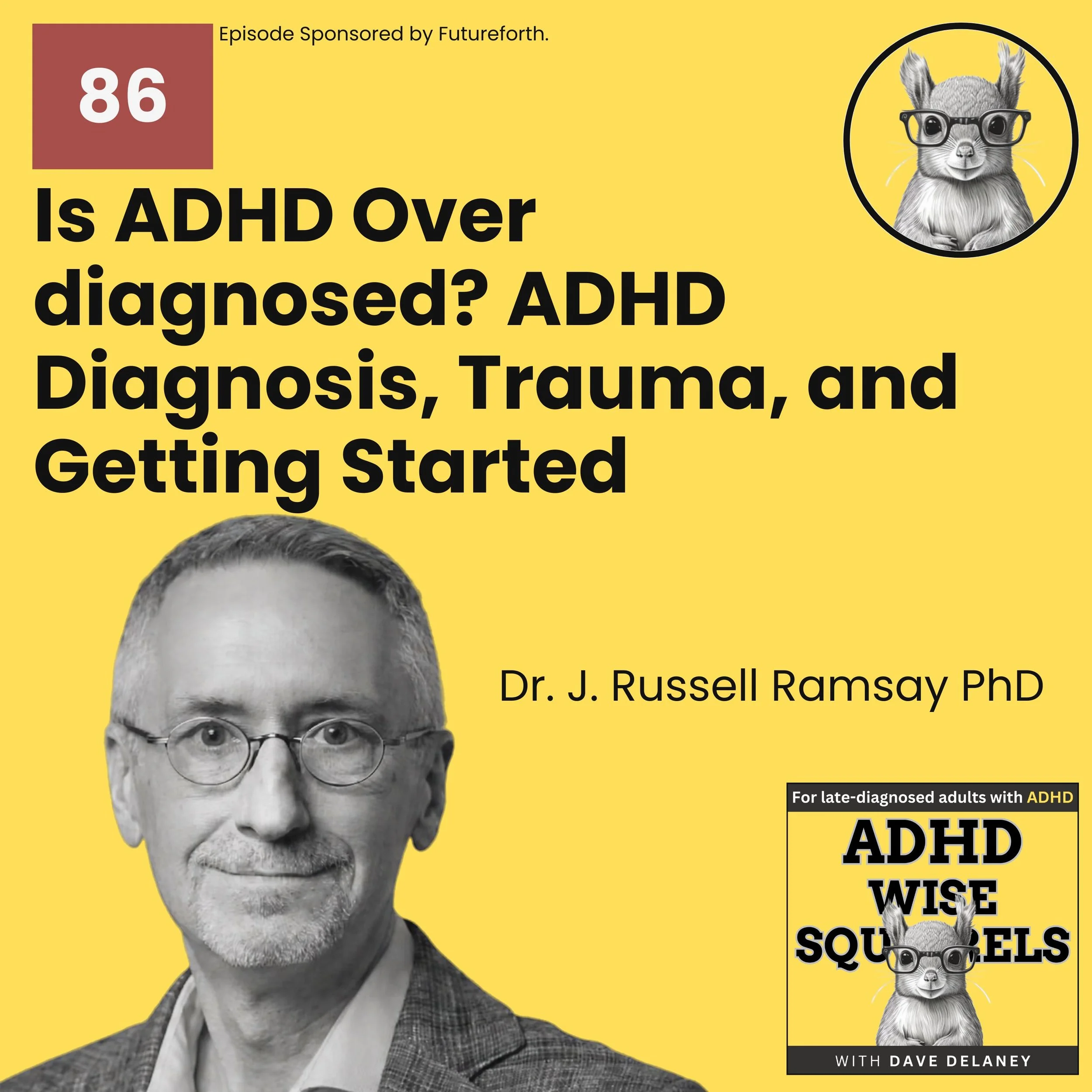
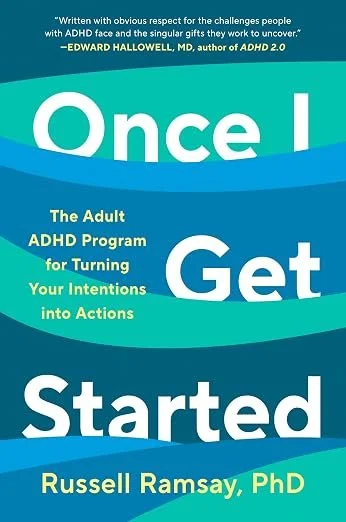
Dr. J. Russell Ramsay is a psychologist specializing in the assessment and psychosocial treatment of adult ADHD. He has lectured internationally and is widely published. He has written six books on adult ADHD, including his most recent, Once I Get Started : The Adult ADHD Program for Turning Your Intentions into Actions. Dr. Ramsay is a CHADD Hall of Fame inductee.
By his own account, he had no business starting an ADHD program. Penn asked him to, and he's been at it ever since.
Russ returns to Wise Squirrels since our first interview to take on the loudest talking points about ADHD right now, and he brings the data:
ADHD isn't overdiagnosed. It's catching up. ADHD has been the number two adult psychiatric diagnosis in the U.S. for twenty years, sitting between anxiety and depression. In the CDC's 2024 data, about half of adults with ADHD were first diagnosed as adults. Russ reads the recent rise as a correction after decades of people being missed.
Most clinicians were never trained in it. Russ compares it to a family doctor saying diabetes wasn't covered in medical school. That gap is why so many adults get treated for anxiety or depression while the ADHD underneath goes unnoticed.
Not environmentally caused, but environmentally bound. ADHD is about goodness of fit with your surroundings. The best job for someone with ADHD is whatever you find interesting that you can do, and yes, that includes accountants who love numbers.
ADHD, trauma, or both? Russ explains how a careful clinician separates ADHD from trauma, anxiety, depression, bipolar disorder, and OCD. Two questions do most of the work: when did it start, and what's still there when the other condition is quiet?
The trauma claim. Dave argues that celebrity doctors like Gabor Maté, who keep saying trauma causes ADHD, have moved from misinformation to disinformation. Russ is more measured, but agrees the claim is misleading.
The "medication stops working" myth. The largest treatment study of children with ADHD gets cited as proof that medication fades. Russ explains what happened: the study ended, and so did the free treatment. It's like taking away someone's gym membership and concluding that exercise doesn't work.
ADHD IS AN UNCERTAINTY GENERATOR
Russ's explanation for why ADHD and anxiety travel together may be the most useful idea in the episode. Anxiety feeds on uncertainty, and ADHD produces it daily: you know you can do the thing, but you don't know if you will do it when you intend to. He calls that consistent inconsistency a central feature of ADHD.
That is also where the book title comes from. For years Russ told clients that if he ever wrote a popular book, he'd call it Once I Get Started. Dave shares his Reverse Pomodoro timer and his idea of a minimum viable action, and Russ offers his own question: what's the smallest step that moves you from not doing to doing? As he puts it, "Those five minutes have to come from somewhere."
Also in this episode:
Why women are diagnosed later and what happens when a parent recognizes themselves in their child's evaluation, ADHD through postpartum, perimenopause, and menopause, what the pandemic did to diagnosis rates, where AuDHD fits and what the DSM-5 changed, how you can have eight of eighteen symptoms and still not qualify, and the time Dave got in trouble at his kids' school for doing magic tricks at lunch.
Resources mentioned
Once I Get Started by Dr. J. Russell Ramsay: cbt4adhd.com
Russ's workbook on adult ADHD and anxiety.
We've Got Issues by Judith Warner.
Dr. Margaret Sibley's work on first-time adult ADHD diagnosis.
Dr. Andrea Chronis-Tuscano's research on supporting parents with ADHD.
Dr. Sandra Kooij and Dr. Lotta Borg Skoglund on women, hormones, and ADHD.
Dr. Kathleen Nadeau and Dr. Patricia Quinn's new book for professionals on women with ADHD.
Find Russ and Once I Get Started at cbt4adhd.com.
-
DAVE: A lot has happened since we last spoke.
DAVE: Yes.
DAVE: Um, you know, we have a, a, a new administration, uh, so without getting all political, but, uh, you know, I think it's important to, to point out, and this is something I've talked about too.
DAVE: Um, you know, right now there's these talking points about dietary determinism, I think it is versus science.
DAVE: Um, what are you seeing from RFK Jr and his cohort as dangerous talking points these days and how best can we address those?
RUSS: Well, I'll just say in general, I mean, in terms of looking at healthier dietary options, exercise, you know, even looking at employment, having a wider array of things, especially for individuals who, you know, for whom college isn't a good fit and, you know, both technical school and high schools.
RUSS: I think, you know, giving better coverage for overall health, well-being and opportunity is,
RUSS: are really good things apart from any diagnostic category.
RUSS: Now, bringing it back to my field of adult ADHD,
RUSS: Yeah, the line I've used, and I'll still use it, ADHD is not environmentally caused, but it is environmentally bound.
RUSS: You know, it's a goodness of fit with surroundings, academically, occupationally, other situations.
RUSS: And they're not infinite, the types of accommodations we can do.
RUSS: I'll go back with the not environmentally caused.
RUSS: There are things like lead levels and some things here and there, you know, that are associated with ADHD sometimes.
RUSS: But I'm thinking in terms of the classic neurodevelopmental syndrome.
RUSS: And, you know, there again, oh, what are good jobs for somebody with ADHD?
RUSS: Well, whatever you find interesting that you can do.
RUSS: And I've heard accountants with ADHD say, well, I really like numbers, even though that is usually held up as numbers.
RUSS: Oh, wouldn't that be really boring for somebody with ADHD?
RUSS: But if numbers are interesting and like a puzzle, that's great.
RUSS: And but, you know, usually a lot of hands on things with scaffolding are better, but it's not, you know, we have a lot of people successful in those fields, but also successful in other fields that might not at first blush seem like.
RUSS: ADHD friendly.
RUSS: But, you know, people people find a way.
DAVE: So what do you say to reports or discussion talking points that we hear, whether it's on social media?
DAVE: And, you know, first point is don't believe everything you hear on social media would be a great point there and perhaps the news as well.
DAVE: But or definitely the news as well.
DAVE: But what like
DAVE: like when it comes to you know we hear adhd is being over diagnosed and and medication is being over prescribed because of the you know the money hungry uh pharmaceutical pharmaceutical companies yes and and obviously there are track records that are not positive for these but not i would argue in the space that we're discussing about adhd specifically so what you know medications over prescribed we don't need to be drugging our kids what do you say to that
RUSS: You know, I recall and I'm going to blank on her name, but she wrote a book called We've Got Issues.
RUSS: I have it in my closet, so I will resist getting up and getting it.
RUSS: Yeah, but she presented that at one time and she said she started the book.
RUSS: She was going to write about, like, the over-medicalization of childhood and, you know, too many meds are being prescribed.
RUSS: But as she interviewed families, she was finding, no, we don't have enough practitioners helping these kids and these families.
RUSS: So that's why she said, we've got issues.
RUSS: It's about childhood psychiatry and psychology and, you know, that we actually can do a better job, even though she was open about this.
RUSS: She was writing the book, and I'll get you.
RUSS: her name to you later on.
RUSS: So, yeah, but my answers are one, and there's actually some studies looking at like that.
RUSS: It's not over-diagnosed.
RUSS: Now we can have levels like, you know, I think for the most recent international prevalence for adult ADHD, 6.76%, so about six or 7%.
RUSS: So maybe a little higher than the three to 5%, but I think one of the things that we're finding is
RUSS: the increased rate of diagnoses is a correction because it has been under diagnosed so long and we don't hear the the the headlines about oh this condition is under diagnosed and you know giving that some data
RUSS: Back in 2000, and this is something I've been talking about more in my, you know, all my lectures, you know, the past year.
RUSS: Back in 2004, there was the National Comorbidity Study in the US.
RUSS: Ronald Kessler was the lead author on it.
RUSS: And that was the study that found 4.4% of US adults likely have ADHD.
RUSS: So whatever that was like 8 million with that, the population at the time.
RUSS: And colleague and consider my friend David Goodman had a slide on this showing that, guess what?
RUSS: Number one diagnosis is depression at that time, early 2000s.
RUSS: Number three is anxiety.
RUSS: Adult ADHD was the number two most common psychiatric diagnosis in the U.S.,
RUSS: And so when the U.S., the CDC data came out, the revised data, not revised, the updated data on the prevalence of ADHD in the U.S. population, and this is October 2024, it was published.
RUSS: Lifetime history of ADHD was 8% estimated for the adult population in the US, 6% in the last year.
RUSS: So I used the 6% because I had data from the CutSource study.
RUSS: It was 4.1% ADHD and I had it.
RUSS: And these were like about 2023, 2024 data.
RUSS: This time, anxiety was number one, depression number three, ADHD still number two.
RUSS: So it has consistently been for 20 years the number two psychiatric diagnosis.
RUSS: But among my psychology colleagues, and I hear this from psychiatry colleagues, and I would imagine other mental health clinicians, nobody gets exposed to it in training.
RUSS: So we're talking about the number two psychiatric diagnosis.
RUSS: And I liken this to going to a family physician, let's just say a screening for diabetes, which is somewhere around the number two most common medical complaint.
RUSS: And not only do they say, I don't specialize this, we didn't cover that in medical school.
RUSS: I don't know what I'm doing with it.
RUSS: So and I say this respectfully of all the colleges, as I didn't, I got asked to start
RUSS: an ADHD program at Penn.
RUSS: I had no business doing that, but here I am sitting talking here about it.
RUSS: But anyway, coming back to, so in terms of the over-diagnosis, I still say I'd still question that conclusion based on some other studies out there.
RUSS: Now, in terms of, because even when I'm taking on some new clients and they're, oh, I want some help for my ADHD, but then I hear, well, I was never formally diagnosed.
RUSS: And that's part of my job is to make the diagnosis.
RUSS: And if somebody says I procrastinate, I'm disorganized.
RUSS: But I say, well, this isn't due to ADHD.
RUSS: I'm not kicking them out.
RUSS: It's just like, hey, the behavioral strategies still work.
RUSS: So all this coming back to, you know, with the up now, there was an increase of diagnoses over the pandemic.
RUSS: But one, all of a sudden, mental health issues were prominent during the first couple of years.
RUSS: And secondly, there was increased access to accurate diagnostic protocols and follow-up support, psychiatry, psychology, whatever it was, and loosening of some of the state licensing restrictions.
RUSS: That way, people like students who might have gone to Philadelphia and gone to Penn, but
RUSS: they lived in, say, New Jersey or Virginia, there was not 100%, but more access where people could still get treatment across state lines.
RUSS: So there were probably more diagnoses then because people finally had time to seek out and get an accurate diagnosis.
RUSS: And the pandemic itself, like many of my clients already diagnosed and getting treated for ADHD, now people understand what it was like for me my whole life.
RUSS: Even with the pandemic, most people after the lockdown, two or three weeks in, even though might have been foundering, struggling with work and school from home, afterwards it's then, okay, we figured things out, intact executive functions, we're doing okay, we're okay, or doing well enough.
RUSS: There might have been other things like anxiety or mood issues or whatever.
RUSS: But a lot of people, that's what kicked it over.
RUSS: Like, I've been struggling with this for so long.
RUSS: And now, you know, Humpty Dumpty fell and isn't going back together again because I got to deal with this now.
RUSS: So that was probably a correction for so many people being undiagnosed for so long.
RUSS: But this is this essay, this essay answer I gave.
RUSS: This takes longer to explain it here as opposed to, well, everybody online seems like they have ADHD.
RUSS: TikTok is diagnosing everybody, so it must be the case.
RUSS: And a lot of people who identify with ADHD may not have gone through an accurate diagnosis.
RUSS: You know, ADHD is a tricky one.
RUSS: So, you know, it takes a thorough evaluation and there are protocols that work and increase the accuracy.
RUSS: But I still have people coming in and it makes sense why they came in.
RUSS: But some of the issues they're dealing with look like ADHD, but they end up not being that's not the core source of it.
RUSS: So there's there's a lot that goes into the diagnosis.
RUSS: Are the rates going up with the pandemic?
RUSS: Yes.
RUSS: But it's probably settling into still around that within, you know, within the rounding of that three to five.
RUSS: It's probably like five to six for adults.
RUSS: But a lot of that, you know, and that was the interesting thing about the CDC data from twenty twenty four is of the sample.
RUSS: Fifty percent of the sample was first diagnosed in adulthood.
RUSS: So that was huge because so many people struggle for so long and get by.
RUSS: But then the demands of adulthood are where, all right, now I'm not keeping up.
RUSS: And and we were talking about parenthood before.
RUSS: Not just this is not just me keeping up with my homework.
RUSS: This is me keeping up with my child's homework.
RUSS: making sure the pets are taken care of, you know, tending to my spouse, my employer, my employees.
RUSS: It's, you know, adulthood, if you're not familiar with it, we have multiple roles and multiple responsibilities.
RUSS: And that's a lot to juggle.
DAVE: Yeah, adulting is definitely hard sometimes.
DAVE: But no, I think, yeah, you said a lot there, but I think you nailed it, of course.
DAVE: I find it interesting too with like you said, anxiety first, ADHD second, depression third, right?
DAVE: But I think that's interesting because it's kind of like an ADHD comorbidity sandwich, right?
DAVE: Because you've got...
DAVE: these comorbidities like anxiety and depression being like the most common ones that the strange bedfellows that come along with ADHD.
DAVE: And so to have these,
DAVE: that represented in there is is interesting as well um and also like how women were missed over you know over the years because of inattentive presentation and because that was another finding like 61 of the um adult diagnosed the first time adult i diagnosed 61 percent were women yeah yeah and they're much less likely to be diagnosed in in childhood yeah
DAVE: Yeah.
DAVE: And I'd rather they were, they are diagnosed about five years after men, you know, traditionally speaking, at least.
DAVE: And I think also with, with, I mean, I've said it so many times on the show too, but like when, when somebody takes their kids or child to see if they have ADHD, because whatever reasons, and oftentimes that's the mother, not always, but oftentimes it's a mother.
DAVE: And that's when the mother realizes, like, as they're going through it, oh my God, this is me.
DAVE: Right.
RUSS: Well, you know what, Andrea Kronis-Toscano at University of Maryland, she's done a lot of work on helping the mothers, you know, with their ADHD or other organizational issues, because as we're both parents and as much as we may be contributing, you know, mothers are still the, you know, default, the primary, I shouldn't say default, but
RUSS: often end up as the primary caregivers taking care of the appointments.
RUSS: Not 100% do, but still.
RUSS: And I think that was a really useful line of research she and her team do, like looking at how do we help the parents put your oxygen mask on first.
RUSS: Yes.
RUSS: And take care of the kids.
DAVE: Something you just mentioned that I hadn't thought about before with postpartum depression and whether those women might, you know, obviously if you have undiagnosed ADHD, one would assume that's going to make depression or anxiety way worse or even bring it on.
DAVE: So that would be an interesting thing.
DAVE: I don't know if there's been studies there.
RUSS: No, I think there is that women with ADHD are probably more prone to have the postpartum mood issues, anxiety, whatever else.
RUSS: And with perimenopause and menopause, women without ADHD, there's been at least one study on this, can look and feel like they have ADHD.
RUSS: And there was a study at Penn, the late Tom Brown, when he was alive, and Kay Neal Epperson when she was at Penn,
RUSS: And they did a study and found that, you know, stimulants for ADHD help those women, even though they didn't have ADHD.
RUSS: It was used off label.
RUSS: But, you know, there's a lot of emerging research.
RUSS: Sandra Coy and the Netherlands.
RUSS: I'm going to get the I know I'm going to get their first name right, but I hope I pronounce the last name right.
RUSS: Skoglund, I think also from S-K-O-G-L-U-N-D, has a couple of really good books on menopause and just women with ADHD.
RUSS: And actually, Kate Nadeau and Patricia Quinn and a third author, I apologize for not knowing your name, have a whole book for professionals about the diagnosis and treatment of women with ADHD just out.
DAVE: No, that's great.
DAVE: Okay.
DAVE: I have, yeah, I've got my pecking orders now.
DAVE: I've got to start doing some outreach to folks.
DAVE: I had Dr. Maggie.
DAVE: I'm really good at promoting everybody else's books.
RUSS: I'm happy.
RUSS: But I'm happy to do that.
RUSS: People are doing good work.
RUSS: You're never going to go broke if you give other people credit for doing good work.
DAVE: A hundred percent.
DAVE: Yeah.
DAVE: And we'll do our best to promote yours as well.
DAVE: So yeah.
DAVE: But I spoke with Maggie Sibley and her work showing how closely trauma and PTSD can mimic ADHD, like an attentive and attention.
DAVE: How do you help readers of like your book discern, you know, whether they're starting friction, like whether it's executive dysfunction or a trauma response or like, or how does that all kind of,
RUSS: Well, no, I actually covered that in the book.
RUSS: I don't know if I called it this there, but I say this is like the 85% rule.
RUSS: There's always going to be that complex case, but this will help about 85% of the time.
RUSS: But just running through a couple of the common ones that can coexist with ADHD, but that can overlap.
RUSS: Very often, though, it is what is the onset?
RUSS: I'll just call it the other thing.
RUSS: This could be trauma.
RUSS: This could be mood, anxiety.
RUSS: And when did ADHD first appear?
RUSS: Now, it's probably there with somebody who fulfills the diagnostic criteria for ADHD.
RUSS: And Maggie Sibley has a wonderful article for professionals about what are the complications.
RUSS: components of a first-time adult ADHD diagnosis um and it really emphasizes you know get the self-report forms but interview is the best way to get the actual to verify the symptoms and the onset um now by the DSM onset by age 12 but there's strong evidence to say 16
RUSS: So when I use a self-report scale or other report scale, I go by the 12.
RUSS: But when I do the interview, I ask, well, let's extend this up to 16 just to see.
RUSS: Because sometimes those middle school years, the early adolescent years are where there's more expectations for some self-regulation.
RUSS: But all this going back to...
RUSS: Having worked with some people with a coexisting trauma or sometimes cases where it seemed like the quote unquote attention problems were more trauma based.
RUSS: But if somebody has a clear onset of ADHD and maybe even diagnosed before, but even retrospectively, you say, yeah, there were things identified by middle school or that somebody was struggling.
RUSS: Then the trauma happens at 22.
RUSS: Hmm.
RUSS: Well, then you have a coexisting.
RUSS: It's trauma on top of.
RUSS: But there can be very early childhood traumas, molestations.
RUSS: It's not the most inspiring thing, but it's what happens in clinical work.
RUSS: But it seems like a key differentiation is whether we're seeing the executive dysfunction.
RUSS: Because there can be the attentional issues that can look like somebody's depersonalizing.
RUSS: Or it's sort of not there for a little bit.
RUSS: And that can...
RUSS: That can look like cognitive disengagement syndrome.
RUSS: It can look like the inattention features.
RUSS: But usually in situations where there can be complex trauma, but if somebody's not activated, but then they're generally they have these pockets where they can do really well, if not maybe overachieving a little bit.
RUSS: And sometimes that can be the compensation for trauma.
RUSS: But, um, a lot of times if somebody is doing okay in school and whatnot in other areas, but there are distinct like trauma features and you know what, people are pretty good.
RUSS: Clients are pretty good.
RUSS: If you ask them, does this feel more like it was a trauma reaction or is this more of the procrastination from ADHD or something else?
RUSS: They're usually pretty good at differentiating them.
RUSS: Now, again, if the early childhood trauma is not there, but if there's an absence of those executive functions, which I will qualify and I do in the book, when I talk about that,
RUSS: executive functions aren't really represented in the official diagnostic criteria as outlined.
RUSS: So, but I add that in as I typically get, you know, assess it in my evaluations.
RUSS: And same thing with depression.
RUSS: If somebody has ADHD going on, but they're depressed, like in high school after, you know, it was pretty clear ADHD was onset, we can see the combination.
RUSS: But sometimes even earlier on.
RUSS: But again, in between mood episodes, if there's this ongoing executive function, I'll just refer to it as the executive functioning or these other ADHD issues.
RUSS: And similarly, if like with a mood issue like bipolar disorder, if somebody does have clear manic episodes, but in between.
RUSS: where it's clearly not mania or depression.
RUSS: They still have the executive functioning issues.
RUSS: You can be pretty confident that, you know, it's ADHD in addition to the other things.
RUSS: Yeah, period, end of sentence.
RUSS: I'm sure that's some comment.
RUSS: So covered in trauma, that's usually the big one.
RUSS: One other one that comes by me sometimes is obsessive compulsive disorder.
RUSS: Because sometimes somebody's internal obsessions, the intrusive unwanted thoughts, this could be like a religious leader and the thought in their head going, oh, I could just hurl out a spring of expletives right now.
RUSS: And they're not going to do it, but they worry, oh, am I going to do this?
RUSS: I have to undo it with like some sort of cognitive ritual.
RUSS: Well, that's really distracting.
RUSS: or having to wash your hands a certain way out of fear of contamination.
RUSS: But again, outside of that, in between when those things aren't activated, how is the person doing in terms of their self-regulation, their executive functioning?
RUSS: And they can coexist, but sometimes I've had people, it's more the internal, what's distracting is the internal intrusive thoughts.
RUSS: It's not really the external distraction.
RUSS: Oh, I'm hearing other people tapping their pen or things like that.
RUSS: It's more the internal, and then they're locked into the neutralizing behaviors in there.
RUSS: And now this is really getting into the diagnostic weeds.
RUSS: But again, people are pretty good at being able to tell, well, no, that's my obsession, but then my distraction over here or my procrastination is coming from another source.
DAVE: Yeah.
DAVE: So what you're saying is like you have, you can, you know, before perhaps diagnosis, like seeing a physician or something, but like you could have like what appears to be depression or anxiety or OCD or bipolar or others that maybe I'm not as familiar with, but you can have what you feel could be anxiety.
DAVE: Let's say the clinician's job is to really is to
RUSS: first determine whether it is anxiety let's say and maybe they diagnose you with anxiety and they discuss treating that but also in that diagnosis there should be that executive function kind of checklist that adhd i would say or at least the asrs or something like that see that's i think that's what's missing and going back to this is why i'm mentioning about like you know adhd being the number two adult 80 adult psychiatric diagnosis is uh clinicians aren't getting trained in it
RUSS: So they're not even looking for it in the first place because, you know, it could be just anxiety, but also and anxiety can interfere with attention.
RUSS: So can, you know, depression.
RUSS: But it's also usually more tied in with when somebody's like if somebody's socially anxious.
RUSS: But they're doing their homework at home and they don't have to worry about socializing and then they're distracted and not doing things or procrastinating.
RUSS: Well, that could be and there can be social anxiety with ADHD because ADHD, a lot of it is public facing snafus and whatnot.
RUSS: So.
RUSS: But this is, you know, if there is a history of ADHD, yeah, you're going to be more likely to see even subthreshold, even if not diagnosed, because it doesn't meet the full criteria for, well, at least two weeks in a row for at least the past six months.
RUSS: It could just be very often diagnosed.
RUSS: ADHD creates the anxiety, and I have a whole workbook on that, ADHD and adult ADHD and anxiety.
RUSS: And for me, the common factor, and there are some data on this, yes, anxiety is about the perception of risk or threat, but even more so the intolerance of uncertainty.
RUSS: I know you're welcome to anybody with a flying phobia right now, but I know this airplane probably won't go down, but you can't 100% guarantee it, which is true.
RUSS: It's a non-zero risk.
RUSS: But most of us can tolerate that anxiety, but that is a core feature of anxiety.
RUSS: And my phrase is, well, adult ADHD and ADHD in general is an anxiety, is an uncertainty generator.
RUSS: I know I can do it.
RUSS: But I don't know if I will do it when I intend to do it.
RUSS: And that consistent inconsistency, I view as a central feature of ADHD.
RUSS: And depression on the other side is generally associated with a sense of loss, loss of opportunity.
RUSS: It could be the loss of a loved one.
RUSS: But, you know, sometimes that frustration like, oh, I had all this time and I didn't prepare the way I wanted to.
RUSS: I never got around to it or I missed the application.
RUSS: And those things are gut punches.
RUSS: They're downers.
DAVE: Yeah, I think so.
RUSS: Yeah, they can talk with each other.
DAVE: Yeah.
DAVE: And sorry to interrupt.
DAVE: I think like in my own personal experience, at least through through therapy,
DAVE: like through actual therapy with someone who is a specialist in ADHD as well, or in CBT, but also medication, stimulants and so on.
DAVE: But in addition to that, meditation and mindfulness I have found incredibly helpful.
DAVE: And I think even, I wouldn't say more so necessarily because obviously I think therapy and medication are probably the most important things in my opinion, but with learning
DAVE: to, you know, having medication also to help and being mindful and slowing yourself down in those moments of beating yourself up or even reframing, you know, cognitive reappraisal.
DAVE: There you go.
DAVE: Yeah, there you go.
DAVE: But like reframing those negative thoughts so that if you did miss the job interview because you slept in, you know, obviously that's too bad, but, you know,
DAVE: Or you're worried about the plane crashing, you know, when in reality, you know, you survive.
DAVE: I mean, you're less likely to survive in the car on the way to the airport than you are.
DAVE: Anyway, so I find that thinking to be extremely helpful.
DAVE: One thing, well, we did talk about trauma and I have talked about that a fair amount.
DAVE: And I do think it's really important.
DAVE: there are these self-proclaimed experts out there on the internet or in books or on television.
DAVE: I continue to throw Gabor Mate under the bus for this because, and you can stop me if you want, but in my opinion, to say that trauma causes ADHD is just false, unless it's the sliver percentage of people that suffer head trauma possibly, but that's my understanding at least.
DAVE: But for the most part, like psychological, emotional trauma,
DAVE: does not cause ADHD, how, and you can correct me if I'm wrong, but how I have learned and something I'm excited about in the work that I've been doing with this and others is the more adults, especially parents now who are being diagnosed and understanding ADHD for themselves and being treated for ADHD, the better parents they're going to be for their children.
DAVE: And thus, the less likely they will...
DAVE: I mean, obviously, trauma will unfortunately always exist to some degree.
DAVE: But I think so many people of our generation who perhaps had...
DAVE: If we have ADHD, there's a very high likeliness one or both of our parents did or do as well.
DAVE: And thus...
DAVE: With their untreated ADHD, that could lead to a fair amount of trauma, whether it's impulsivity, whether it's drinking addiction.
DAVE: So the more aware that parents learn about this now, the better parents they're going to be and the less trauma that's going to occur in families moving forward.
DAVE: How about that?
RUSS: No, I agree with you.
RUSS: You know, I actually made a point because I was like reading somebody rather than, you know, repeating what they say and reading Galbraith's Scattered book.
RUSS: He's he's on the mark with a lot of ADHD stuff.
RUSS: So I want to give that context.
RUSS: It wasn't as it is in this total out there.
RUSS: Um, type of thing.
RUSS: Um, and I, I would say, I, I think he might just give more emphasis to, you know, some of those childhood experiences.
RUSS: It seems like it, it comes from a more, maybe, and I don't want to misrepresent, misrepresent this, but more of psychoanalytic bent, um,
RUSS: Now, I've read some articles early on, because that's what I do, looking at some psychoanalytic approaches for ADHD.
RUSS: And there are some interesting things, like they'll talk about one of the defenses being escape into action, which I've talked about.
RUSS: That could also be like when I talk about procrastivity, I'm going to do something else.
RUSS: I know I should be studying for my GREs, but let me catch up on laundry.
RUSS: I'm sure I have to do, but it's a lower priority than getting it.
RUSS: grad school or stuff like that.
RUSS: So I, you know, and, and, you know, I think maybe in some of the memes about Mate, there's this, you know, trauma causes everything, but, and there is that line in there that a lot of that is what is maybe considered more of a core of ADHD.
RUSS: So there is that element to it, but it's also not coming from this totally, you know, off the wall place.
RUSS: There's a lot of it.
RUSS: He, you know, about the,
RUSS: you know, all the science of ADHD, but you know, that, that just like some other people who are probably good doctors, but they might, um, have certain diagnostic evaluations that I wouldn't, I don't think hold water and maybe have a little more faith into some of the alternative treatments that are warranted.
RUSS: Um, but yeah, I think like mindfulness and certainly I'm a psychologist, I can't prescribe, but yeah, I think medications should be at least considered as a trick option, right.
RUSS: Of self-determination always, um,
RUSS: But and and, you know, this sort of dovetails what you were saying about Andrea Cronus Toscano's research about like helping particularly with the mothers.
RUSS: But like you said about the parents and the understanding because ADHD in the household, there have been studies both directions.
RUSS: It can be difficult for parents, but also kids growing up.
RUSS: with parents with ADHD.
RUSS: Some narrative reports like, I didn't want to bring my friends over, the place was always disorganized, they'd forget to pick us up, stuff like that.
RUSS: Yeah, I'd say it's both ways.
DAVE: My wife once got a call when my kids were in elementary school,
DAVE: I would go sometimes and have lunch with them in the lunchroom.
DAVE: And, you know, so I'd be sitting at the tiny round table with all the little kids and their classmates and things.
DAVE: They were in the same class.
DAVE: And one time I started doing like a couple magic tricks.
DAVE: And of course, the kids were like enthralled.
RUSS: And all the other kids- When's your dad coming back?
RUSS: And all the other, yeah, they actually called me Mr. Magic.
DAVE: But all the other kids at the lunchroom joined the table to see
DAVE: The lunch lady's looking at me like, what the hell are you doing?
DAVE: My wife, we had a great rapport with the kid's teacher.
DAVE: My wife gets a call later saying, we had a problem, an incident today at the school.
DAVE: And my wife's like, what happened?
DAVE: What's wrong?
DAVE: Are the kids okay?
DAVE: And she's like, yeah, yeah.
DAVE: And she explained what had happened.
DAVE: And she said, can you please tell Dave...
DAVE: not to do magic tricks he's disrupting the the flow of lunch hour right right lunch minutes or whatever it is and it was just so funny so like i yeah i got reprimanded by my kids school teacher and in trouble with my wife and i got to save that you got detention yeah yes yes so uh yeah yeah
DAVE: um yeah the gabar mate and i'm not trying to throw him under the bus i understand i understand but the reason why i mentioned him and i do like appreciate him i'm a fellow canadian so of course i have to you know represent um but the reason why i mentioned him like others who i i
DAVE: think of sometimes is the difference between even in a book, perhaps, but the difference between making a mistake on something you said in a book or something you said online or in an interview or what have you.
DAVE: And I've done this before.
DAVE: I've made a couple of mistakes on here.
DAVE: Luckily, they haven't been big.
DAVE: But like I used to say, there are three types of ADHD.
DAVE: Now I know there is one type of ADHD with three presentations.
DAVE: And as the science changes, maybe I'll change that.
DAVE: And so with that caveat that science changes, so things change.
DAVE: But there's a difference between misinformation and disinformation.
DAVE: And I believe that if you are sharing something untrue, that's, and there's a certain, especially when you have so many fans, followers, listeners, readers, and so on, like a celebrity doctor like Mate, it is your responsibility to correct your mistakes and not continue them.
DAVE: And yet he continues, I hear it in interviews all the time, still, he talks about trauma causes ADHD, right?
DAVE: Right.
DAVE: And so at that point, to me, that's disinformation and it's dangerous and it takes a lot of guts and you have to be honest, especially if you're a physician.
RUSS: What do you think?
RUSS: No, I agree.
RUSS: It's misleading.
RUSS: But also what the studies, 80% of TikTok posts on ADHD are misleading because the algorithms, I mean, it's the personal testimonies are what are most, which that can be somebody coming forth with ADHD and describing it to somebody else.
RUSS: And they go, oh, that's helpful for me to hear.
RUSS: Thank you for sharing.
RUSS: So it can be a positive bent.
RUSS: But see, that's the thing with ADHD.
RUSS: There are a lot of things that get presented out there as part of it.
RUSS: And so the whole trauma issue and early childhood things and that get put out there, which we just know are there.
RUSS: They're not reflective of ADHD, even though that that's the line that gets drawn is these things are stemming from that.
RUSS: Now, that could be.
RUSS: Well, I guess that would be, like I was saying before, part of a good thorough diagnosis just to try to differentiate the two.
RUSS: And, you know, the... Well, sorry, I won't go off on a tangent uncharacteristically, but... No, you're right.
RUSS: One...
RUSS: It stokes the flame of, oh, everybody says they have ADHD because if everybody has ADHD, well, then no one has it.
RUSS: Now, I'll bring this back to a point where the myth, but I'll put that in air quotes for the moment of, well, doesn't everybody have ADHD?
RUSS: The executive functions and many of the features are ADHD are dimensional.
RUSS: They're part of our factory settings.
RUSS: I'll just use the attention, the restlessness or the ability to be still and impulsivity or impulse control, but probably better the wider executive function.
RUSS: So we all have them.
RUSS: So just like other qualities like height, there's some people really tall, some people really short, most of us bundle in the middle.
RUSS: And I'm on the shorter end of average.
RUSS: So if you're, let's just say you're 6'4 and I stand next to you, people will tell a difference.
RUSS: Let's bring that down like 6'2.
RUSS: But that they both fall in the average range.
RUSS: But once we got to about 6'4 or let's just say 4'10, now we're talking about statistically tall or small, small or shorter, I should say.
RUSS: and there are some of these things like blood pressure or whatever where at an upper end and maybe even sometimes and at the lower end they we draw a line that we say all right these are problematic you know something needs to be done and the same could be said for you know if our mood's too low that's depression if it's way too high that's mania but you know most things and i i'm
RUSS: Some of these might fall apart a little bit, but they're sort of clunky.
RUSS: But, you know, that's how we think about ADHD and why why this is important.
RUSS: Diagnostically, there can be one.
RUSS: People can have many features of ADHD, but not be impaired.
RUSS: And so like I people come to me for an evaluation where I determine it's not ADHD and they say, well, my friends and colleagues tell me I seem really ADHD and they might be really energetic or.
RUSS: quick thinker, quick talker, but they're getting everything done.
RUSS: And it's not like sacrificing sleep or relationship or family time or things like that.
RUSS: It's okay.
RUSS: I just thought I should get this checked out.
RUSS: And I say, I can't call you disordered or your, your symptoms as disordered.
DAVE: Sorry to interrupt, but that's challenging too, isn't it?
DAVE: It is very challenging.
DAVE: Because it could be during that period where the scaffolding's in place, things are going well, and so it's not disrupting their life.
RUSS: That's part of the evaluation is you're going over time because there can be these things like in a certain job and then somebody gets promoted and now they have to manage other people, including themselves.
RUSS: And that's where it goes off the cliff.
RUSS: And then we can look back and see those.
RUSS: So this is this is thoroughly checked out like, hey, did it cause these problems, those problems?
RUSS: Now, also, what's important here, you could have somebody who's a little bit subthreshold.
RUSS: So this is really geeking out.
RUSS: But the 18 symptoms of ADHD and the DSM, the Diagnostic and Statistical Manual, are equally divided of nine inattention, nine hyperactive impulsive.
RUSS: And so the diagnostic threshold is endorsing five out of nine of either or both.
RUSS: So if it's only one of them, it would be five out of nine of the attention, but nothing hyperactive impulsive.
RUSS: OK, then you're predominantly inattentive.
RUSS: But this means somebody could have four of nine of both.
RUSS: Well, it's not ADHD.
RUSS: You never hit five, even though with eight out of 18, they have more than somebody with a predominantly inattentive type.
RUSS: So but the thing is, is going back to the impairment.
RUSS: Yeah, but this is I'm still late with things or I'm on a performance improvement plan.
RUSS: So the other side of it is there can be these subthreshold features of ADHD that warrant treatment.
RUSS: Now, most people, like we say, going back to the bell-shaped curve, the normal distribution, most people would be falling in the middle, if not maybe a little above average, maybe even annoyingly above average.
RUSS: They're always on time.
RUSS: But, you know, so, I mean, there's no wrap up to that, but it's just but it's the complexity and why the lack of the training in this and the actual clinical experience it for the number two psychiatric diagnosis in the U.S., adult psychiatric diagnosis.
RUSS: uh diagnosis in the us is so pivotal and hopefully with the forthcoming u.s guidelines and you know things like this and some other things going on uh hopefully 2026 and all of 2027 will be about maybe getting adult adhd into these you know clinical training programs so that we have we have more trained clinicians to fulfill the need
DAVE: But on the patient side or potential patient side, I would be concerned that even if that comes out under the current administration, if it contradicts what
DAVE: you know, scratchy voice thinks, like, why do we have, sorry, why do we have somebody representing the country's health who sounds like he's dying?
RUSS: All I will say is when I read through the first, I forget, Maha or whatever the first report was, the MTA findings, the multimodal treatment of ADHD in children, the largest study ever, largest treatment study ever done with children.
RUSS: Peter Jensen was the lead author there.
RUSS: And I actually had a meeting with Peter later that same day after I read it.
RUSS: The takeaway point in the report was medications stopped working after the study ended.
RUSS: Well, what happened is the study was a randomized control.
RUSS: These kids were randomized into the best behavioral treatment available, the best medication treatment available, or combined.
RUSS: And the takeaway from the study, so while they're in the treatment, they got free treatment on both sides, medical and non-medical.
RUSS: So when the study wrapped up, well, there's no more funding.
RUSS: So those treatments stopped.
RUSS: So later on studies looking at maybe more symptoms or things like that.
RUSS: It wasn't necessarily that the medications didn't work.
RUSS: It's that treatment as usual stopped.
RUSS: And then we're looking for, you know, that was really speaking to the need for ongoing treatment for the same benefits from the medications and to a degree for the behavioral treatments.
RUSS: So it was that, you know, that was like one of those wrong interpretations of the outcome.
RUSS: It would be similar to, OK, we're doing a study on exercise and people's fitness.
RUSS: And so they get.
RUSS: A personal trainer, four days a week in the gym, whatever, for 18 weeks.
RUSS: Then the study stops.
RUSS: Sorry, you don't have access to the gym anymore.
RUSS: Oh, exercise doesn't work because at the end of this study, people's health started to revert.
RUSS: They started gaining weight.
RUSS: Blood pressure started going up.
DAVE: Exercise doesn't work.
RUSS: No, it's that, you know, you have to, spoiler alert, you have to keep up with some degree of exercise to maintain the gains.
RUSS: And it's similar to many of the behavioral treatments, especially with ADHD and, you know, medications, too, even though that's an individualized choice with the clinician.
RUSS: But I hear what you're saying about, like, these are the sorts of things that, you know, if I wasn't doing this, I wouldn't be reading these studies.
RUSS: And it's a more nuanced view and also hearing all the other studies out there.
RUSS: So there's a lot of information out there and it's really confusing.
RUSS: And, you know, it just...
RUSS: ADHD is like one of those, because I think it's really hard for people to get their head around because in many ways, and that's that consistent inconsistency.
RUSS: And like Maggie Sibley, I don't know if this came up in your discussions with her, but as follow-up to those MTA studies, they would do follow-up thorough evaluations
RUSS: And sometimes the kids became teens, became young adults, and every other year they'd have another evaluation.
RUSS: And sometimes they'd fall somewhat below diagnostic thresholds, but then two years later above.
RUSS: And overall, there was 91% persistence from childhood to adulthood, but there were sometimes these up and downs, these spikes and troughs, because it could have been
RUSS: Oh, the scaffolding, or I had a really good teacher that year or whatever it was.
RUSS: But, but that even showed, and it's more persistent than we thought.
RUSS: Oh, and, and, you know, it's somebody maybe getting into a vo tech program or a really good summer job or things like that.
RUSS: So yeah, there's a lot, there's a lot, there's stories behind, there's data behind the data.
RUSS: Um, and sometimes this is, it can get framed any way you want to frame it sometimes.
DAVE: The topic of autism seldom comes up on this podcast only because I'm at least not diagnosed.
DAVE: I don't believe I have autism.
DAVE: I don't know.
DAVE: I know very little, if anything, about autism specifically.
DAVE: I once had a listener reach out and say, you know, you do a great job, Dave, but I'd love to hear you talk about autism.
DAVE: And I'm like, I can't because this podcast is for ADHDers, right?
DAVE: For late diagnosed folks like myself.
DAVE: And then, you know, I said, like, you should start your own autism podcast.
DAVE: Like, this is why I'm doing this, to learn but to share with folks.
DAVE: That said, you know, AWADHD, acronym, A-U-A-D-H-D, is quite prevalent, I see, at least online.
DAVE: So, you know, I've got a position.
DAVE: Right, right.
DAVE: You know, not dwelling on the point and not talking about it too long, but what are your thoughts on this topic and its trend right now?
DAVE: And so many, again, not looking at the data because I don't know, but presumably assuming from social media, of course, you see that acronym a lot.
DAVE: What are your thoughts on is it as common as it seems online?
DAVE: Is it not?
DAVE: Yeah, that's a tricky one.
RUSS: In my own practice, and I specialize in adult ADHD, even though I do other things, but that's probably like 98% of what I do.
RUSS: I just haven't seen it as much.
RUSS: Now, that's a sample of one clinician.
RUSS: Now, the other thing is there's some of the studies that I've seen on this, and this goes back to some of the diagnosis, that you'll see some overlap, like where in terms of somebody with ADHD in children and also some adults who,
RUSS: where using some of the autism measures for social functioning, you'll see that a certain percentage of the individuals with ADHD will endorse it there.
RUSS: But also, interestingly, when they go down to the item, the question-by-question items, unless you say it's the 20-item scale, I don't think that's correct.
RUSS: They'll see that the individuals with autism are endorsing some of the more classic difficulties, reading social situations and the social reciprocity, where the folks endorsing high on that, but their items are more to things that could be attributed to ADHD, like missing social cues and things like that, which how do you have you reading social reciprocity and reading social cues versus it coming from distraction opportunities?
RUSS: or some other things like that, that are around the social side, and maybe not foreign to ADH, foreign to autism, but, you know, seem to seem to be like this ADHD likelihood cluster in there that not didn't call into question it overall, but just in terms of maybe the
RUSS: How it's assessed and, you know, and the actual overlap.
RUSS: So that's a very academic non answer.
RUSS: But I mean, it before the most recent DSM five, the fifth edition of the DSM, the guy, the comorbidity was disallowed.
RUSS: you can't have both so that that part of this might be a correction like for those people who it is both but um it's like i said i i just don't see it enough clinically i did you know for a while the sister program to the penn adult adhd program was called the social learning disorders program it was for like what would now be high functioning uh adult autism it was asperger syndrome is what um the name of it and and also also more extreme social anxiety and things like that so
RUSS: Um, it wasn't like I was unfamiliar with all Asperger's, but, um, and I was sort of involved with that side of the team for a little bit, but I just haven't seen it as much.
DAVE: Um, so I don't know what that says though, but you said something there and I know the DSM, you know, the DSM five is arguably a little out, not outdated, but you know, I, I, I, I speak to physicians and others who, who, you know, say like, we really need things updated.
DAVE: Um, but so, you know, with, with that grain of salt there,
DAVE: Pointing that out, are you saying that the DSM-5 doesn't identify ADHD as an actual condition?
DAVE: And if so, how are people... People are getting diagnosed, presumably, with ADHD.
DAVE: How does a physician diagnose them if it's not in the DSM?
DAVE: You can't say you have misophonia because...
DAVE: it's not in the dsm that's my understanding and it's not a comorbidity of adhd according to the dsm-5 right it may you know who knows what will be in the new the new updated version right and like well and also sluggish cognitive tempo renamed as cognitive disengagement syndrome is not an official thing even though there's some evidence you know that it might be like sort of
RUSS: you know, a cousin of ADHD, but not ADHD was ADD.
DAVE: Not that long ago.
DAVE: I'm not hyperactive.
RUSS: So I don't know.
RUSS: Yeah.
RUSS: I think it was 1994.
RUSS: Oh yeah.
DAVE: That's just because ADHD rolls off the tongue.
RUSS: Oh no.
RUSS: But so a, you ADHD is not in DSM.
RUSS: Now, however,
RUSS: adhd is in there and autism is in there just like there's not angst adhd like anxiety with adhd so it's you know they're both there it was just before that it was it it was stated in the uh diagnostic criteria you know what adhd and autism can't be a comorbidity or maybe it was asperger's whatever it was it's just with dsm-5 it was moving more towards and it was more setting the stage for the awe
DAVE: So it's like the Reese's peanut butter cup.
DAVE: Like there's chocolate in there and there's peanut butter in there.
DAVE: Perhaps you have chocolate and peanut butter.
RUSS: Perhaps you have a Reese's peanut butter cup.
RUSS: Right, right, right.
DAVE: Right, exactly.
DAVE: But we just can't call it a Reese's peanut butter cup.
DAVE: Right, right.
RUSS: I mean, just like people still say ADD or, you know, whatever or Asperger's, you know, the old nicknames.
RUSS: And so the AUDHD is out there as a thing.
RUSS: And it is a possibility, even though it wouldn't be called that or, you know, there's not a diagnostic code for AUDHD.
DAVE: you know, DHD or however they put it together.
DAVE: Right.
DAVE: And, and I don't believe autism is, it's not like, at least it's a neurotype, right?
DAVE: Like ADHD.
RUSS: It's not a, they're both, they're both within the neurodevelopmental diagnosis.
RUSS: Yeah.
RUSS: Yeah.
DAVE: okay great yeah this is oh my god man time is flying by i love time blindness we both manifest there how about that that's right that's right i know i've had ari on twice and he's given me so many tips for time blindness and yet here we are right
DAVE: What have I not asked you about or what questions you have for me in these last few minutes because I want to make sure that I cover everything.
DAVE: And I know you've been doing the rounds promoting the book.
DAVE: And so, you know, I also want to be careful not to just reiterate what you've already said out there because I think that's available to folks.
DAVE: Right.
RUSS: No, I would just take the last couple of moments just to say that the most recent books is called Once I Get Started.
RUSS: And a lot of these things get covered in there a bit.
RUSS: Like I cover the whole superpower thing.
RUSS: And, you know, I talk about some of like some of these tricky diagnostic.
RUSS: How do you tell it apart or whether they go together as best I could?
RUSS: You know, it's, you know, clinical work is really humbling.
RUSS: And people ask how I came up with the title.
RUSS: And I said, over the years, as I was working with my clients on procrastination or getting started on things, which sometimes is the hardest part.
RUSS: I said, if I ever write a popular book on adult ADHD, it'll be entitled once I get started.
RUSS: And when the publisher was asking for what are some potential titles, it was last on the list because I said, well, I'm duty bound to put this in because I told my clients over the years.
RUSS: And it came back that the publication team said that was unanimously the top choice for
RUSS: And I've gotten a lot of positive feedback that it seems like it's I mean, it's accurate, but it's also sort of like it's almost like this action potential.
RUSS: It's like, OK, I'm going to get started.
RUSS: And that's I mean, it's about a whole bunch of things, but it is like that whole engagement and living well with ADHD.
DAVE: I've written about like in technology and entrepreneurship and things, there's something called a minimum viable product and MVP.
DAVE: And I wrote about what I call the NVA, minimum viable action.
DAVE: So what's the minimum thing you can do to get
DAVE: started on whatever project.
DAVE: I've also had a guest on, and I can't think of her name, Jennifer, it'll come back, a long time ago.
DAVE: And she talked about this idea around, if you're really struggling to get started, on this idea around a reverse Pomodoro method.
DAVE: And so I coded one on the site at wise squirrels dot com slash reverse RP reverse Pomodoro.
DAVE: But basically what it is, is it's a digital timer that that and the setup is this carries your thoughts.
DAVE: You get everything you need to do that thing you've been neglecting.
DAVE: So let's say it's like reports or invoicing or whatever.
DAVE: You have it.
DAVE: All you have to do is just get the things together so it's ready to go.
DAVE: You don't actually have to do it.
DAVE: Just get it together on your desk.
DAVE: And then you start the timer and it's the reverse Pomodoro.
DAVE: So the idea is that for the next 25 minutes, when you start it, you can do whatever the hell you want.
DAVE: You can watch YouTube, you can, you know, et cetera, as long as you're in the office or in front of your computer where you can hear it beep.
DAVE: And then when it, that 25 minute ends,
DAVE: You have five minutes to work on that invoicing.
DAVE: And you only have to do it for five minutes.
DAVE: And after you're done that five minutes, you can go eat a cupcake.
DAVE: You can go for a walk, have a coffee, celebrate the fact that you've done it.
DAVE: With the secret sauce in there, that five minutes of just getting started sometimes is the starting point that suddenly you're like, well, shh.
DAVE: That was fast.
DAVE: I can do five more minutes.
DAVE: Let me just, and then suddenly you're like hyper-focused on knocking it out.
RUSS: I love it.
RUSS: No, a hundred percent.
RUSS: I mean, that's like my, a lot of my clients will talk about, yeah, so you're helping me trick myself into doing it.
RUSS: And I say, absolutely.
RUSS: I am because we trick ourself out of doing it because we can imagine 83 different ways.
RUSS: This won't go well.
RUSS: And it's probably something effortful and whatever, but like the, once we get started or the, once we touch it or we, or, you know, in addition to the reverse Pomodoro, I'd say there's this synapse.
RUSS: What is the smallest step that would move you from not doing to doing?
RUSS: And that could just be pulling up a blank word document and save as rust documents, you know, seven, 24, 26.
RUSS: And if that's all I do, okay.
RUSS: You didn't procrastinate, but most likely once we're started, we'll keep going.
RUSS: So, yeah.
DAVE: And I think, as I said, like, and that's great.
DAVE: I really do think that like, it's that minimum viable action, as I said, but like setting that and then doing that minimum thing.
DAVE: And then after doing that, celebrating, give yourself grace and say like, yes, I did it.
DAVE: And if you only do it for five minutes, great.
DAVE: That's, that's what you plan to do.
RUSS: Those five minutes, those five minutes have to come from somewhere.
RUSS: Right.
RUSS: Eventually.
RUSS: So why not knock some out now?
RUSS: Yeah.
DAVE: OK, I'm dying to read your book and I apologize for not reading it ahead of time.
DAVE: Oh, no worries.
DAVE: But I would love to have you back anytime.
DAVE: And if you see something in the news, you're like, oh, my God, Dave, we got to talk.
RUSS: Please just just reach out because I will reach out to you and respect you.
RUSS: And that's very kind.
RUSS: So, no, you ask great questions, too.
RUSS: I mean, it's really stuff that I think people will appreciate and maybe get angry with me for.
RUSS: So we'll see.
DAVE: They'll be more angry at me, but that's okay.
DAVE: How can people get ahold of you, reach out and learn more about what you do and get your book?
RUSS: Easiest way.
RUSS: And there's links to buy the book online and it's also available in Europe as well.
RUSS: There's interest over there.
RUSS: So that's really encouraging.
RUSS: But my website, www.cbt4adhd.com.
RUSS: So that's CBT, like cognitive behavioral therapy, not CBD, because people hear that and they get excited, but-
RUSS: www.cbtforadhd.com.
RUSS: And there's a contact page if you want to reach out to me and stuff like that.
RUSS: And podcasts, and I'll post this there.
RUSS: I think our previous one from oh so many years ago is on there too.
RUSS: That's great.
DAVE: Well, thanks again for joining me, Russ.
DAVE: It's been great.
DAVE: It's a pleasure.