PODCAST. What Joseph Goldstein Taught Me About Mindfulness in a Distracted World.

Joseph Goldstein is a pioneering American mindfulness teacher and author, renowned for bringing Vipassana (insight) meditation to the West and co-founding the Insight Meditation Society.
When I first scheduled a conversation with Joseph Goldstein, I was giddy with anticipation. As one of the most respected Western teachers of insight meditation, co-founder of the Insight Meditation Society (IMS), and author of multiple foundational books on mindfulness, Joseph has been a guiding light for generations of meditators. But nothing prepared me for the depth of presence and clarity he brought to our conversation.
Even with technical glitches (Zoom went down right before we began!), his calm presence reminded me of one of his teachings: everything is workable.
Mindfulness Is Not About Stopping Thoughts
One of the most powerful takeaways from our conversation was Joseph’s reminder that the goal of meditation is not to stop thinking. In fact, trying to stop thoughts can become a trap. “The nature of the mind is to think,” he said. “But with mindfulness, we become aware that we’re thinking—and that awareness itself is what brings freedom.”
This is especially powerful for those of us with ADHD, where the idea of “quieting the mind” can feel impossible. Joseph reframes the practice not as a fight with thoughts, but as a friendlier relationship to them. The key shift is realizing that you are not your thoughts—you are the awareness that knows them.
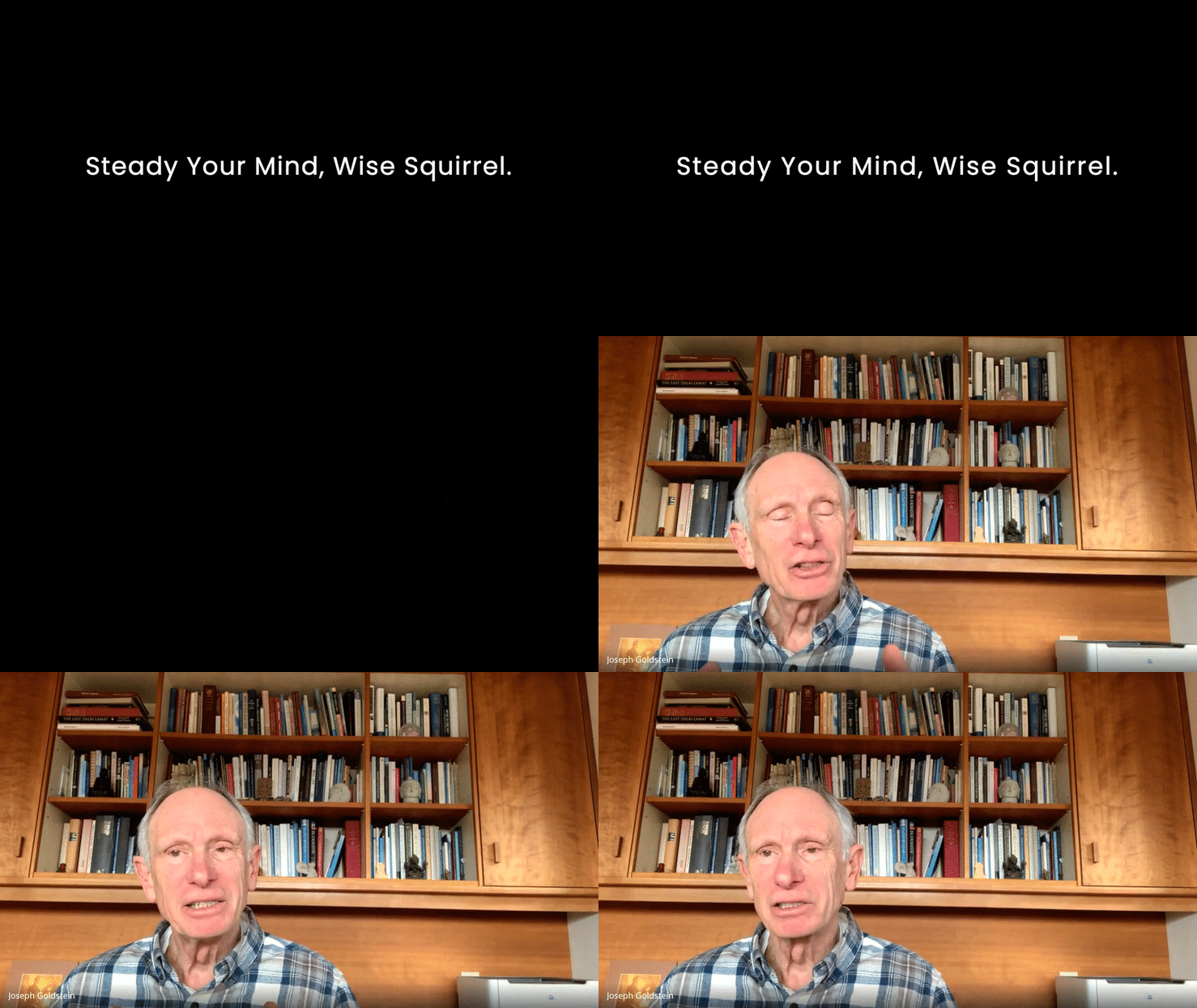
As a Thank You and belated Happy 81st Birthday, please join me here.
Returning, Over and Over Again
Joseph spoke beautifully about the act of returning to the present moment. He shared that the most important moment in meditation is not when you’re focused, but when you realize you’ve wandered and return—because that moment of return strengthens the muscle of mindfulness.
For Wise Squirrels’ minds, this is incredibly liberating. You don’t need to stay still or perfectly focused. You just need to notice when your attention drifts—and come back, with kindness. That returning is the heart of the practice.
Mindfulness Is a Radical Act of Self-Knowledge
Throughout the conversation, Joseph emphasized that mindfulness allows us to see clearly—not just the world around us, but our own habits, reactions, and conditioning. He quoted the Buddha: “Nothing whatsoever is to be clung to as I or mine or self.”
Mindfulness, he explained, helps us recognize how often we identify with our thoughts, emotions, and impulses, and how that identification creates suffering. With practice, we can relate to experience with more spaciousness, less reactivity.
Practice Is Simple, But Not Easy
Joseph kept coming back to the simplicity of the practice: sit, notice, return. And yet, he acknowledged, that’s not always easy—especially in our hyper-distracted, dopamine-driven world.
I asked him what keeps people from sticking with meditation, and he shared something profound: we underestimate the power of habit. Our minds are conditioned to seek novelty, stimulation, and escape. So the discipline to sit and be with what is—without distraction—is a radical shift.
But we can start small. Joseph encouraged even just a few minutes a day. “What matters is consistency, not duration,” he said. A few mindful breaths while standing in line. A pause before opening a new browser tab. These are acts of mindfulness too.
A Teaching That Stuck with Me
Near the end of our conversation, I asked Joseph what he wished more people understood about mindfulness. He paused, then said:
“Awareness is always here. We don’t have to create it. We just need to recognize it.”
That hit me like a lightning bolt.
So often we think we need to “achieve” mindfulness, as if it’s something we don’t already have. But what Joseph is pointing to is the natural clarity of our own awareness—which is always available, always accessible, no matter how distracted we feel.
Closing Thoughts
For those of us navigating ADHD, anxiety, or simply the chaos of modern life, Joseph Goldstein’s teachings are not only relevant—they’re essential. He offers not a technique to fix us, but a path to understand ourselves more deeply, to soften our judgments, and to remember that returning to the moment is always possible.
As I reflect on our conversation, I’m left with a deeper appreciation for what mindfulness really is: not a performance, but a practice of kindness, curiosity, and coming home—again and again.
If you're curious about Joseph Goldstein’s teachings, his books such as Mindfulness: A Practical Guide to Awakening and his talks on platforms like Dharma Seed and Ten Percent Happier are excellent places to start.
And if you’re someone with a busy brain like mine—know this: there’s room for you in this practice. In fact, it might be exactly what you’ve been looking for. I encourage you to consider his compassionate challenge to try meditation for just ten minutes a day for thirty days.
-
[00:00.000 --> 00:03.080] I've been very excited about speaking with you.
[00:03.080 --> 00:07.440] I, yeah, I mean, first of all, I want to thank you
[00:07.440 --> 00:12.440] for your dedication and perseverance with mindfulness
[00:13.240 --> 00:17.040] and as a teacher, I mean, I've been, yeah,
[00:17.040 --> 00:20.120] just kind of giddy and of course today,
[00:20.120 --> 00:21.340] excited to speak with you
[00:21.340 --> 00:23.920] and then having some technical difficulties there
[00:23.920 --> 00:26.880] with Zoom going down just moments before,
[00:26.880 --> 00:28.600] like literally I took a screenshot
[00:28.640 --> 00:31.440] and I checked on and sure enough, yeah, it was down
[00:31.440 --> 00:34.880] and it is still down and then just as we were like
[00:34.880 --> 00:38.320] almost ready, I heard a chainsaw or a lawnmower
[00:38.320 --> 00:41.440] and I'm like, come on, please people,
[00:41.440 --> 00:46.120] but I'm happy that we're connecting here.
[00:46.120 --> 00:46.960] Where are you today?
[00:46.960 --> 00:47.780] Where are you based?
[00:47.780 --> 00:49.040] I'm in Barry, Michigan.
[00:49.040 --> 00:50.020] Okay, yeah.
[00:50.020 --> 00:50.860] At home.
[00:50.860 --> 00:52.980] Yeah, yeah, I hope hopefully I'll get there
[00:52.980 --> 00:54.760] one of these days.
[00:54.760 --> 00:57.520] Well, yeah, so I don't know if you had a chance
[00:57.520 --> 00:59.560] to take a look at what I'm doing with Y Squirrels,
[00:59.560 --> 01:01.400] but I can give you the quick lowdown.
[01:01.400 --> 01:04.720] Yeah, yeah.
[01:04.720 --> 01:07.760] Yeah, so what happened was a couple of years ago,
[01:07.760 --> 01:10.680] I was diagnosed with ADHD at 50
[01:11.760 --> 01:15.840] and so I started a podcast to share my journey
[01:15.840 --> 01:17.320] because that's what I do.
[01:17.320 --> 01:20.240] I've been podcasting for 20 years almost
[01:20.240 --> 01:24.520] and yeah, so I was excited to kind of share my journey.
[01:24.520 --> 01:26.000] So I created this podcast
[01:26.000 --> 01:28.800] on this website called Y Squirrels,
[01:28.800 --> 01:31.800] wise for the wisdom that we accrue through our lives
[01:31.800 --> 01:34.240] by developing coping mechanisms,
[01:34.240 --> 01:38.440] really unknowingly to treat our ADHD
[01:38.440 --> 01:41.600] and to kind of succeed however we can.
[01:41.600 --> 01:46.600] And so I started the podcast and it really took off
[01:47.240 --> 01:49.400] and during this experience,
[01:49.400 --> 01:52.260] I've learned that with late diagnosed
[01:52.260 --> 01:57.260] and excuse me, with undiagnosed and untreated ADHD,
[01:57.620 --> 02:00.660] your life expectancy can be up to 13 years less.
[02:01.820 --> 02:03.820] And when I learned that,
[02:03.820 --> 02:06.300] it changed this little passion project of mine
[02:06.300 --> 02:10.740] into a mission of getting more people,
[02:10.740 --> 02:12.180] if they feel they could have ADHD
[02:12.180 --> 02:16.680] to get diagnosed and treated and if need be.
[02:17.660 --> 02:22.180] And one of the not best, like the best,
[02:23.100 --> 02:25.740] by far treatment in my humble opinion
[02:25.740 --> 02:27.660] beyond like medicinal stuff
[02:27.660 --> 02:30.620] and certainly in addition maybe to medicinal
[02:30.620 --> 02:35.100] and therapeutic is mindfulness and meditation
[02:35.100 --> 02:40.100] and what better person to speak to about this than yourself.
[02:40.620 --> 02:42.660] So I will do your intro after
[02:42.660 --> 02:44.740] because we don't need to do that now.
[02:44.740 --> 02:47.440] But I do wanna jump in and say that,
[02:48.440 --> 02:53.440] yeah, you started your practice when you were 23, right?
[02:55.040 --> 02:55.880] Is that right?
[02:55.880 --> 02:57.320] Yeah, basically.
[02:57.320 --> 02:58.160] Yeah.
[02:58.160 --> 03:00.400] I just wanna reiterate something I mentioned to you
[03:00.400 --> 03:01.840] in our first. Oh, yes.
[03:01.840 --> 03:05.520] I don't have experience in working much
[03:05.520 --> 03:07.060] with people with this,
[03:07.060 --> 03:11.120] but I can share my meditative understandings.
[03:11.120 --> 03:12.000] Thank you, yes.
[03:12.000 --> 03:13.520] And I meant to mention that as well.
[03:13.920 --> 03:18.880] Yeah, the most common, and I'll get into some of this,
[03:18.880 --> 03:22.920] the most common effects of ADHD
[03:22.920 --> 03:25.800] and comorbidities associated with ADHD
[03:25.800 --> 03:28.900] are all things that very much mindfulness and meditation
[03:28.900 --> 03:32.480] play a major role in treating and helping.
[03:32.480 --> 03:35.760] So you probably unknowingly have treated a lot of people
[03:35.760 --> 03:36.720] without, yeah.
[03:36.720 --> 03:40.280] And so, yes, we'll definitely preface it with that for sure.
[03:41.240 --> 03:46.240] So, yeah, so you started your mindfulness practice at 23,
[03:46.560 --> 03:50.160] and I was curious, what led you to that point?
[03:50.160 --> 03:51.620] Like, what led you there?
[03:51.620 --> 03:52.640] Right.
[03:52.640 --> 03:56.000] So when I finished college,
[03:56.000 --> 03:58.440] I went into the Peace Corps in Thailand,
[03:58.440 --> 04:00.920] and that's where I first connected with Buddha
[04:00.920 --> 04:02.520] and the Buddhist teachings,
[04:02.840 --> 04:07.840] but I was not doing much intent,
[04:09.360 --> 04:11.080] no intensive practice at all.
[04:11.080 --> 04:14.480] It was just, it was the beginning introduction.
[04:14.480 --> 04:17.320] And then right at the end of my Peace Corps stay,
[04:19.040 --> 04:21.760] somebody was reading from a Tibetan text.
[04:23.280 --> 04:24.440] It was just a friend and I,
[04:24.440 --> 04:29.440] and my mind, for some reason, just got quite concentrated,
[04:30.200 --> 04:34.280] and kind of, there was a real kind of opening of some kind
[04:34.280 --> 04:35.440] just from listening.
[04:37.680 --> 04:41.080] But I didn't have much meditative experience at that point.
[04:43.080 --> 04:47.760] But it was so, it was so really a profound experience.
[04:47.760 --> 04:50.240] I realized I needed a teacher.
[04:50.240 --> 04:52.800] You know, because I didn't know what to do with it.
[04:54.580 --> 04:57.080] So this was right at the end of my Peace Corps time.
[04:57.320 --> 05:02.320] I went back home and then decided to go back to Asia
[05:02.520 --> 05:03.480] to find a teacher.
[05:05.040 --> 05:08.480] And I stopped on the way, I stopped in India.
[05:08.480 --> 05:10.240] I thought I'd go back to Thailand,
[05:11.360 --> 05:12.920] but I stopped in India, you know,
[05:12.920 --> 05:15.800] traveled around a bit looking for different teachers,
[05:15.800 --> 05:17.840] and ended up in Bodh Gaya,
[05:17.840 --> 05:20.360] the place of the Buddhists in London,
[05:20.360 --> 05:22.240] which is where I met my first teacher.
[05:23.120 --> 05:28.080] And he said something from the very beginning,
[05:28.080 --> 05:30.460] which completely captured me.
[05:32.040 --> 05:35.400] He said, if you want to understand your mind,
[05:35.400 --> 05:36.720] sit down and observe it.
[05:38.880 --> 05:42.560] And I just loved it, it was such common sense.
[05:42.560 --> 05:44.320] How else can we understand our minds
[05:44.320 --> 05:47.400] except by observing it?
[05:47.400 --> 05:49.600] So there was no, at that point, there was no ritual,
[05:49.600 --> 05:53.000] there was no ceremony, there was nothing to join.
[05:53.000 --> 05:58.000] He just taught the basic mindfulness practice for Pasana.
[05:58.000 --> 06:00.140] And it was love at first sight.
[06:01.120 --> 06:03.720] It was exactly what I was looking for.
[06:03.720 --> 06:08.720] So almost 58 years of practicing and teaching for 51 years.
[06:09.600 --> 06:10.600] It's incredible.
[06:10.600 --> 06:13.800] What did your parents think about these travels?
[06:13.800 --> 06:15.820] I mean, you know, pretty...
[06:15.820 --> 06:19.360] Well, my father died when I was quite young,
[06:20.080 --> 06:20.920] when I was 12.
[06:21.680 --> 06:26.040] But my mother, she had a very adventuresome spirit.
[06:26.040 --> 06:31.040] And so she was traveling around, even as I was growing up.
[06:33.600 --> 06:35.040] We lived in a really small town,
[06:35.040 --> 06:39.000] so there was nothing there for her after my father died.
[06:40.560 --> 06:44.040] So she would go on these long freighter trips
[06:44.040 --> 06:45.440] around the world.
[06:45.440 --> 06:48.320] And I would stay with my aunt and uncle.
[06:48.320 --> 06:50.120] So she was in India before I was.
[06:51.520 --> 06:52.960] That's amazing.
[06:52.960 --> 06:55.520] Yeah, so she was very supportive,
[06:55.520 --> 06:59.360] even though my other relatives were not so supportive.
[07:00.400 --> 07:04.640] I would get letters from my uncle or aunt,
[07:04.640 --> 07:08.000] you're killing your mother, come home.
[07:09.360 --> 07:11.120] But my mother was not like that at all.
[07:11.120 --> 07:13.200] In fact, she visited me in India
[07:13.200 --> 07:17.440] and she stated where I was staying, the Burmese VR.
[07:17.680 --> 07:22.400] So very primitive, but she was like that.
[07:22.400 --> 07:24.080] That's amazing.
[07:24.080 --> 07:25.680] What was her background?
[07:25.680 --> 07:28.680] Was she from the States or did she...
[07:28.680 --> 07:29.800] What was her journey?
[07:30.960 --> 07:32.360] To say the last thing?
[07:32.360 --> 07:33.360] What was her journey?
[07:33.360 --> 07:35.360] Was she just born and raised in the States
[07:35.360 --> 07:39.280] and decided to travel after your father passed away?
[07:39.280 --> 07:40.920] I think she...
[07:41.820 --> 07:43.080] I mean, when she started traveling,
[07:43.080 --> 07:45.920] it was not like a spiritual journey.
[07:45.920 --> 07:47.640] She just wanted to get out of the small town
[07:47.640 --> 07:48.480] and meet people.
[07:50.160 --> 07:53.280] I mean, she was relatively young when my father died.
[07:53.280 --> 07:54.400] She had two kids.
[07:56.720 --> 07:58.160] But she had that spirit.
[07:58.160 --> 08:02.400] She loved that kind of traveling and exploring
[08:02.400 --> 08:04.720] and just meeting people.
[08:04.720 --> 08:05.560] I love that.
[08:05.560 --> 08:06.720] I mean, that's what ended up...
[08:06.720 --> 08:09.680] I mentioned before, like I'm from Toronto originally
[08:09.680 --> 08:13.280] and moved to Nashville in 07,
[08:13.280 --> 08:14.960] and raised both our kids here,
[08:14.960 --> 08:19.840] but moved to Nashville from Toronto by way of Ireland,
[08:19.840 --> 08:22.720] which is where I met my wife backpacking and traveling,
[08:22.720 --> 08:24.680] and she's from Tennessee.
[08:24.680 --> 08:27.520] So yeah, small world.
[08:27.520 --> 08:30.520] I love the quote from St. Augustine,
[08:30.520 --> 08:33.200] who said, something like the world is a book
[08:33.200 --> 08:34.720] and those who haven't traveled,
[08:34.720 --> 08:37.440] her only one page I think is the line,
[08:37.440 --> 08:39.840] which yeah, and I mean,
[08:39.840 --> 08:43.080] you're just a shining example of the power of travel
[08:43.080 --> 08:44.760] because if I do not left...
[08:44.760 --> 08:45.600] Yeah.
[08:45.600 --> 08:46.440] No, absolutely.
[08:46.440 --> 08:48.360] I'd probably be a lawyer.
[08:48.360 --> 08:49.720] Yeah, yeah.
[08:49.720 --> 08:52.040] What are the things that I really appreciate
[08:52.040 --> 08:56.080] about your guided meditations
[08:56.080 --> 08:59.400] through all the different apps that you appear in?
[08:59.400 --> 09:01.200] And I'm a big Sam Harris fan.
[09:01.200 --> 09:02.360] I really enjoy his work
[09:02.360 --> 09:06.440] and I've really enjoyed your deep conversation
[09:06.440 --> 09:07.680] with Dan Harris as well,
[09:07.680 --> 09:11.680] or with Dan as well recently.
[09:13.320 --> 09:17.200] And I get a lot out of just listening
[09:17.200 --> 09:19.400] and learning from you.
[09:19.400 --> 09:21.320] But one thing that you do,
[09:21.320 --> 09:23.840] for a lot of people who haven't practiced mindfulness
[09:23.840 --> 09:25.520] or for meditation,
[09:26.840 --> 09:30.160] or they've tried and they get kind of overwhelmed.
[09:30.160 --> 09:33.400] And some of the guides that I've kind of gone through
[09:33.400 --> 09:36.760] in different apps or on YouTube or whatever,
[09:36.760 --> 09:40.360] the teachers were like, yeah, they're okay.
[09:41.560 --> 09:42.800] And some even in person,
[09:43.640 --> 09:45.000] I've done a little bit of meditation in person
[09:45.000 --> 09:47.320] at a local Buddhist temple here in Nashville.
[09:48.920 --> 09:50.520] But what I love about your approach
[09:50.520 --> 09:53.720] is you bring this warmth
[09:53.720 --> 09:57.640] and this charming wit about you.
[09:57.640 --> 10:01.920] You laugh, you crack jokes when you least suspect it.
[10:01.920 --> 10:05.680] But I love that warmth because it makes the practice
[10:05.680 --> 10:09.160] so much more inviting and embracing.
[10:09.160 --> 10:10.960] Yeah, tell me about that.
[10:10.960 --> 10:12.280] How did you tap in?
[10:12.280 --> 10:13.880] Was this something you realized along the way?
[10:13.880 --> 10:16.520] Did you take it much more seriously in your youth
[10:16.520 --> 10:18.560] and then kind of tell me about that?
[10:21.120 --> 10:22.920] There are two things.
[10:24.680 --> 10:27.240] One, I grew up in the Catskill Mountains.
[10:27.240 --> 10:28.560] I know they're familiar.
[10:28.560 --> 10:32.400] It was a Jewish resort area near New York.
[10:32.400 --> 10:33.800] It was called the Borsch Belt.
[10:35.640 --> 10:38.800] My family had, it was like a summer resort
[10:39.800 --> 10:43.960] where we would have entertainment on Saturday nights.
[10:43.960 --> 10:48.960] So all these Jewish comedians were every week.
[10:49.680 --> 10:53.280] And a lot of them were terrible, but some were good.
[10:54.680 --> 10:56.240] But I think it tapped in
[10:58.200 --> 11:00.600] to the whole element of Jewish humor,
[11:02.160 --> 11:03.800] which is just part of it.
[11:03.800 --> 11:05.120] So that's just part of me.
[11:06.200 --> 11:07.680] That being said though,
[11:08.840 --> 11:10.520] when I first started teaching,
[11:12.000 --> 11:13.480] I was much more serious.
[11:14.360 --> 11:19.360] In fact, I recently had an online 80th birthday party.
[11:23.000 --> 11:25.000] Happy birthday, happy belated.
[11:25.000 --> 11:27.120] And so you're 81 next month, right?
[11:27.120 --> 11:28.760] Yeah, yeah.
[11:28.760 --> 11:31.240] So the person who's organizing it
[11:31.240 --> 11:36.240] found this old film, video of me teaching
[11:36.800 --> 11:41.200] at Naropa Institute with Ram Dass and Trungpa Rinpoche.
[11:41.200 --> 11:42.880] That was in 74.
[11:42.880 --> 11:44.080] It was like a Buddhist Woodstock.
[11:44.080 --> 11:45.400] It was a big event.
[11:45.400 --> 11:46.240] Yeah, that's amazing.
[11:46.240 --> 11:47.480] But when I saw that video,
[11:47.480 --> 11:49.400] I was teaching eating meditation.
[11:50.280 --> 11:52.400] I was really serious.
[11:52.400 --> 11:54.440] I mean, at first I was very young.
[11:54.440 --> 11:55.800] Yeah.
[11:55.800 --> 12:00.800] And so my whole persona was very different in teaching
[12:02.400 --> 12:03.360] over the years.
[12:03.440 --> 12:08.440] And this ties into my new favorite definition
[12:08.440 --> 12:12.280] of enlightenment, which is lightening up.
[12:15.600 --> 12:17.920] So a lot of the time it's just lightening up,
[12:17.920 --> 12:21.080] not taking ourselves so seriously
[12:21.080 --> 12:24.440] until we see through the illusion of self altogether.
[12:24.440 --> 12:25.280] Yeah.
[12:25.280 --> 12:27.800] And I can see over the many years of my teaching,
[12:28.960 --> 12:32.200] I've definitely lightened up a lot over the years
[12:32.200 --> 12:34.520] from those beginning years.
[12:34.520 --> 12:37.320] And a lot of it is just getting more comfortable teaching.
[12:39.560 --> 12:42.040] Yeah, but there's definitely a trajectory
[12:42.040 --> 12:44.320] towards more relaxation, more humor,
[12:45.320 --> 12:47.240] connecting in that way.
[12:47.240 --> 12:48.080] Yeah, and I think-
[12:48.080 --> 12:49.640] I enjoy it a lot more.
[12:49.640 --> 12:51.840] Yeah, and I think it does.
[12:51.840 --> 12:56.720] Yeah, I think it does make the experience better.
[12:56.720 --> 12:59.840] And yeah, I saw, I've mentioned this on the show before,
[12:59.840 --> 13:02.080] but I saw an interview with Dr. Gupta
[13:03.040 --> 13:04.800] with His Holiness the Dalai Lama,
[13:04.800 --> 13:08.000] and it was a video of some segment from something.
[13:08.000 --> 13:09.400] And they were meditating together,
[13:09.400 --> 13:11.360] and Dr. Gupta had written about this
[13:11.360 --> 13:14.440] of how nervous he was.
[13:14.440 --> 13:18.440] And then I think his eyes were closed
[13:18.440 --> 13:20.120] and he was following along.
[13:20.120 --> 13:22.360] And then it got awkwardly quiet.
[13:22.360 --> 13:25.640] And he opened his eyes and the Dalai Lama was laughing.
[13:25.640 --> 13:26.480] He was giggling.
[13:26.480 --> 13:28.440] And he's like, what's happening?
[13:28.440 --> 13:29.280] Am I doing something wrong?
[13:29.280 --> 13:30.800] And he's like, no, I was just thinking of something
[13:30.800 --> 13:31.640] and I couldn't.
[13:31.640 --> 13:33.520] And he was like, wait, wait, wait, wait, wait.
[13:33.520 --> 13:36.120] You can't focus.
[13:38.640 --> 13:42.160] But I always loved, that example really stood out to me
[13:42.160 --> 13:44.040] as bringing a humor to it.
[13:44.040 --> 13:46.000] And also understanding that like,
[13:46.000 --> 13:48.600] that you can't completely stop your thoughts.
[13:48.600 --> 13:50.720] That's like such an important point.
[13:51.560 --> 13:53.880] I heard something recently where you,
[13:53.880 --> 13:55.480] or it might've been recent, might've been older.
[13:55.480 --> 13:58.640] I don't remember, but you talked about how thoughts,
[13:58.640 --> 14:00.720] you called thoughts, it might've been something recent.
[14:01.640 --> 14:03.120] You called thoughts little dictators of the mind.
[14:03.120 --> 14:03.960] Right.
[14:03.960 --> 14:06.040] Yeah, yeah.
[14:06.040 --> 14:10.280] So I know that like to practice,
[14:10.280 --> 14:13.000] to close in a sort of traditional sense
[14:13.000 --> 14:16.440] and a first time novice sense of closing your eyes,
[14:16.440 --> 14:19.920] focusing on, let's say your breath,
[14:19.920 --> 14:23.480] you start to, obviously your mind starts thinking
[14:23.480 --> 14:26.000] of things you have to do and so on.
[14:26.000 --> 14:27.040] One thing I've learned,
[14:27.040 --> 14:30.760] I think it was from Sam Harris's guidance through his app
[14:30.760 --> 14:34.080] of allowing that thought to play out like a short film.
[14:34.080 --> 14:36.280] And I found that really works well.
[14:36.280 --> 14:39.800] And so like, if I think I have to walk the dog later,
[14:39.800 --> 14:42.800] I'll imagine myself walking Peggy,
[14:42.800 --> 14:45.440] doing exactly like taking her out, putting her on the leash,
[14:45.440 --> 14:48.160] picking up her poop, bringing her home.
[14:48.160 --> 14:49.240] And then like seconds later,
[14:49.240 --> 14:52.320] that thought has played out like a short film and it's done.
[14:52.320 --> 14:54.120] And now I can return to the breath.
[14:54.120 --> 14:57.520] And that is something that I've been sharing with friends
[14:57.520 --> 14:59.440] and something that I have found really helpful.
[14:59.440 --> 15:03.720] However, I heard you talk about the idea of,
[15:04.960 --> 15:08.520] there's that moment when you come out of that thought,
[15:09.560 --> 15:11.800] but you start to beat yourself up about thinking
[15:11.800 --> 15:14.080] about that thought in this judgmental way.
[15:14.080 --> 15:16.520] And I know you're a big believer,
[15:16.520 --> 15:19.360] obviously in non-judgmental awareness.
[15:19.360 --> 15:23.800] So are there strategies or ways to deal with that?
[15:23.800 --> 15:25.120] Yeah.
[15:25.120 --> 15:30.120] So it's whether or not one plays the thought out,
[15:30.160 --> 15:34.960] as you said, or one doesn't do that.
[15:34.960 --> 15:37.680] And the thought is there for as long as it's there.
[15:37.680 --> 15:38.520] Yeah.
[15:38.520 --> 15:41.200] Comes out, you come out by itself, you know,
[15:41.200 --> 15:44.400] at a certain point, but to,
[15:45.560 --> 15:50.360] I encourage people to pay attention to that moment
[15:50.360 --> 15:54.000] when they've gone from being lost, however long,
[15:54.920 --> 15:56.920] to waking up from being lost.
[15:58.000 --> 16:01.040] Because right in that transition moment,
[16:01.040 --> 16:05.040] there's tremendous insight that can happen in that moment
[16:05.040 --> 16:09.400] because in that moment we see kind of the quality
[16:09.400 --> 16:14.400] of delusion for all the time we're lost.
[16:14.440 --> 16:15.480] It's like we're lost in a movie,
[16:15.480 --> 16:19.360] we're not aware even that we're thinking.
[16:19.360 --> 16:21.200] We just lost in the story.
[16:21.200 --> 16:22.120] Yeah.
[16:22.120 --> 16:25.000] But then in the moment of coming out from the thought,
[16:25.000 --> 16:29.840] we've gone from really delusion to awareness,
[16:29.840 --> 16:31.280] to wakefulness.
[16:31.280 --> 16:35.520] And it's very apparent the difference in that moment
[16:35.520 --> 16:38.280] because we've just gone from lost to awake.
[16:39.160 --> 16:41.800] And so what I suggest for people,
[16:44.600 --> 16:46.920] especially when they notice that their tendency
[16:47.080 --> 16:49.360] is to judge the fact that they've been lost,
[16:50.480 --> 16:55.480] to change that and to delight in the fact of being awake.
[16:56.040 --> 16:57.000] That you're back.
[16:57.000 --> 16:59.520] That you're back and not only back,
[16:59.520 --> 17:04.520] but with insight into the nature of wakefulness
[17:08.560 --> 17:13.560] or awareness, untrusted to the experience of being lost.
[17:14.120 --> 17:15.880] It's all very apparent that you've just gone
[17:15.880 --> 17:18.400] in that moment from one to the other.
[17:18.400 --> 17:19.240] Yeah.
[17:19.240 --> 17:21.360] So it's really easy to see,
[17:21.360 --> 17:23.960] oh, this was like being asleep, this is awake.
[17:25.400 --> 17:29.360] And to really in a way, not investigate with thought,
[17:29.360 --> 17:33.360] but just paying attention to the quality of wakefulness.
[17:34.360 --> 17:35.200] Yeah.
[17:35.200 --> 17:39.200] Because that reinforces one's understanding
[17:39.200 --> 17:41.520] of the nature of awareness.
[17:42.480 --> 17:44.360] So it's not just some mysterious thing
[17:44.360 --> 17:47.720] that sometimes happens and sometimes doesn't happen.
[17:47.720 --> 17:48.560] Yeah.
[17:48.560 --> 17:52.160] We're really connecting with what it is in that moment.
[17:53.080 --> 17:57.440] And so I usually close that little wrap.
[17:57.440 --> 17:58.280] Yeah.
[18:01.000 --> 18:04.240] For as many times as we get lost,
[18:04.240 --> 18:07.160] that many times do we awake.
[18:07.160 --> 18:09.280] Waken, right?
[18:09.280 --> 18:10.120] Yeah.
[18:10.200 --> 18:13.360] So why not delight in the wakefulness
[18:13.360 --> 18:15.440] rather than judge the being lost?
[18:16.640 --> 18:17.680] Yeah, I love that.
[18:17.680 --> 18:20.720] So yeah, you're celebrating in a sense,
[18:21.960 --> 18:24.120] yeah, the fact that you've,
[18:25.160 --> 18:27.680] well, first of all, the fact that you're even sitting
[18:27.680 --> 18:31.000] and attempting to meditate in the first place,
[18:31.000 --> 18:34.080] and let's say it's the very first time you do it,
[18:34.080 --> 18:36.800] and the very first time you sit and you focus on your breath
[18:36.800 --> 18:38.560] and your eyes are closed, let's say,
[18:38.560 --> 18:40.560] and you have some thought,
[18:40.560 --> 18:42.760] and this is the point that I talk to friends
[18:42.760 --> 18:46.040] and even my daughter sometimes about their frustration
[18:46.040 --> 18:48.080] with like, I can't do it, I can't, right?
[18:48.080 --> 18:53.080] And to your point, it's the fact that you've realized,
[18:53.600 --> 18:56.080] and so you have a choice right then,
[18:56.080 --> 18:59.840] give up, this doesn't work, or return to the breath.
[18:59.840 --> 19:04.840] Yeah, and to keep delighting in the moments of awakening,
[19:05.840 --> 19:07.360] which will happen many times,
[19:07.360 --> 19:09.920] it will happen as many times as you get lost.
[19:09.920 --> 19:10.760] Yeah.
[19:10.760 --> 19:14.880] So one other kind of thing,
[19:14.880 --> 19:17.280] which I generally highlight with all this,
[19:17.280 --> 19:18.680] especially for beginners,
[19:21.520 --> 19:25.520] is really being the first insight of insight meditation,
[19:27.800 --> 19:30.680] is seeing how often the mind gets lost,
[19:31.640 --> 19:34.040] because most people don't know that about it,
[19:34.040 --> 19:36.600] don't know that about their minds.
[19:36.600 --> 19:41.600] So instead of treating it, oh my God, I can't do this,
[19:41.800 --> 19:46.400] it's like, oh, I'm seeing what my mind is doing.
[19:46.400 --> 19:49.720] So that's an important insight.
[19:49.720 --> 19:51.120] So people shouldn't,
[19:53.600 --> 19:56.000] they should feel encouraged by the fact
[19:56.000 --> 19:59.360] that they're seeing how often the mind wanders.
[19:59.360 --> 20:00.200] Yes.
[20:01.480 --> 20:03.000] That's actually an insight.
[20:04.560 --> 20:08.840] And so that could give a little encouragement.
[20:08.840 --> 20:10.360] Yeah.
[20:10.360 --> 20:14.480] Because for everybody, the mind is gonna want to, you know?
[20:14.480 --> 20:15.720] Yeah.
[20:15.720 --> 20:17.080] Oh, sorry, I didn't mean to interrupt.
[20:17.080 --> 20:17.920] No, I was just gonna say,
[20:17.920 --> 20:20.600] if you go up to someone in the street who's never meditated
[20:20.600 --> 20:23.160] and you ask them, does your mind wander?
[20:23.160 --> 20:26.080] They'd probably, no, no, no, no, my mind doesn't wander.
[20:26.080 --> 20:26.920] They have no idea.
[20:26.920 --> 20:29.320] They have no idea what their minds are doing.
[20:29.320 --> 20:30.240] Right.
[20:30.240 --> 20:33.960] So for people beginning practice who begin to see this,
[20:34.880 --> 20:37.080] that's really important.
[20:37.080 --> 20:40.520] And that should be reinforced.
[20:40.520 --> 20:41.480] Yeah, yeah.
[20:41.480 --> 20:44.720] And I've heard people talk about like reference,
[20:45.920 --> 20:47.800] like the example of like driving from,
[20:47.800 --> 20:51.640] like driving from point A to point B for like however long
[20:52.480 --> 20:55.360] and either missing your exit as you're driving.
[20:55.360 --> 20:56.240] No, exactly.
[20:56.240 --> 20:59.040] Or even asking someone who's done a long drive,
[20:59.040 --> 21:00.200] how was your drive?
[21:00.200 --> 21:01.040] Right.
[21:01.040 --> 21:01.880] Oh, it was fine.
[21:01.880 --> 21:02.720] Yeah, yeah.
[21:02.720 --> 21:04.720] What happened during those two hours?
[21:04.720 --> 21:07.000] Right, non-stop thinking.
[21:07.000 --> 21:08.600] Yeah, yeah.
[21:08.600 --> 21:11.320] And yeah, so it is, it is, yeah,
[21:11.320 --> 21:13.640] this idea of waking up in that sense.
[21:13.640 --> 21:14.480] Yeah.
[21:17.560 --> 21:19.520] The thing with ADHD,
[21:19.520 --> 21:23.600] there's like a bunch of fun stuff, air quotes fun,
[21:23.600 --> 21:26.720] that come along with ADHD, which really is,
[21:27.480 --> 21:29.920] you know, earlier on.
[21:29.920 --> 21:32.400] And again, I always, I always preface it also
[21:32.400 --> 21:34.960] that I'm not a doctor nor do I play one on the internet.
[21:34.960 --> 21:37.640] So I don't, I don't pretend to be.
[21:37.640 --> 21:38.960] And in the last couple of years,
[21:38.960 --> 21:41.440] I've learned a ton by speaking to folks
[21:41.440 --> 21:45.400] and my own treatment, but that we, you know,
[21:45.400 --> 21:48.640] obviously there's the stereotypical hyperactive boy,
[21:48.640 --> 21:49.760] you know, the Bart Simpson,
[21:49.760 --> 21:51.760] but there's also inattentive type,
[21:51.760 --> 21:55.040] which is more someone getting lost in thought,
[21:55.040 --> 21:57.400] daydreaming, you know, that kind of thing,
[21:57.400 --> 21:58.320] especially as children.
[21:58.320 --> 22:02.440] And then even this combined presentation of ADHD,
[22:02.440 --> 22:05.200] where it's sort of a bit of both in a sense.
[22:05.200 --> 22:08.160] But the things that come along with ADHD,
[22:08.160 --> 22:10.720] things like time blindness.
[22:10.720 --> 22:14.040] So like time management becomes a real challenge
[22:14.040 --> 22:17.480] and self-doubt is a big one as well.
[22:17.480 --> 22:21.720] They say that an average 10 year old with ADHD
[22:21.760 --> 22:25.560] has heard 20,000 plus negative things
[22:25.560 --> 22:28.800] from parents, school teachers, et cetera,
[22:29.680 --> 22:31.320] until by the time they've reached 10.
[22:31.320 --> 22:35.040] And so that's gonna give you some trauma
[22:35.040 --> 22:38.360] and give you kind of a rough upbringing,
[22:38.360 --> 22:40.600] even if you're in a loving home.
[22:40.600 --> 22:43.880] But in addition to this, because it's highly heritable,
[22:43.880 --> 22:46.560] there's a good likeliness that one or both of your parents
[22:46.560 --> 22:50.760] also have ADHD, which can account for all sorts of things
[22:50.760 --> 22:54.480] like addictions and because that's also part of this.
[22:54.480 --> 22:55.600] And I've said a lot of stuff there,
[22:55.600 --> 23:00.600] but maybe focusing on like that idea of time management
[23:02.040 --> 23:06.320] and how time goes so quickly and we lose track of time.
[23:06.320 --> 23:08.160] And again, as we said at the beginning,
[23:08.160 --> 23:11.720] you're not an ADHD expert or anything,
[23:11.720 --> 23:14.400] but I think mindfulness and meditation
[23:14.400 --> 23:17.600] certainly can help with time management, let's say.
[23:17.600 --> 23:18.440] Any thoughts?
[23:19.440 --> 23:23.400] Well, I don't know how relevant this will be,
[23:23.400 --> 23:28.400] but I'll just share my own strategy for time management.
[23:34.760 --> 23:36.840] So I always have a million things going on
[23:36.840 --> 23:39.840] that I have to do in different projects and talks
[23:39.840 --> 23:41.680] and all kinds of stuff.
[23:42.960 --> 23:47.920] And I see my mind
[23:47.920 --> 23:49.520] can do two things with that.
[23:51.840 --> 23:56.840] Sometimes it can just feel a little overwhelming.
[23:58.640 --> 23:59.960] Oh my God, I have so much to do
[23:59.960 --> 24:01.880] and how am I gonna get all this done
[24:01.880 --> 24:04.880] and kind of spin like that.
[24:06.040 --> 24:08.320] But what I found helpful,
[24:10.040 --> 24:14.080] and again, I don't know how applicable this will be or not,
[24:14.080 --> 24:17.960] but what has really helped me a lot is
[24:20.280 --> 24:23.520] basically laying out a timeline,
[24:23.520 --> 24:26.120] maybe in my mind, but it could be written down,
[24:27.360 --> 24:29.880] for when things need to be done.
[24:31.880 --> 24:35.080] Because it's always, it's very rare
[24:35.080 --> 24:37.560] that everything needs to be done at the same time.
[24:37.560 --> 24:41.560] It's like, so if I have in my mind the timeline
[24:41.560 --> 24:43.560] of when things need to be done,
[24:44.600 --> 24:47.760] and how much time I'll need to do it,
[24:48.960 --> 24:53.960] then I know, oh, I have to begin working on this tomorrow.
[24:56.360 --> 25:00.720] Or maybe, no, I can begin work on this next week because,
[25:01.880 --> 25:04.080] and that just kind of orders everything.
[25:04.080 --> 25:06.320] So instead of it being a big jumble,
[25:07.680 --> 25:12.360] trying to figure out in that big mix,
[25:12.560 --> 25:13.400] oh, well, what do I do?
[25:13.400 --> 25:15.800] Do I work on this or work on that?
[25:15.800 --> 25:20.720] It's really laid out pretty systematically
[25:20.720 --> 25:23.440] and it creates a lot more space.
[25:23.440 --> 25:28.440] I'm not overloading myself in any one moment or one day
[25:31.560 --> 25:33.200] because I've seen, oh no,
[25:33.200 --> 25:38.200] I'll take care of this in three days or whenever.
[25:38.240 --> 25:40.640] So again, I don't know whether that is something
[25:40.640 --> 25:45.640] that's feasible for people to do.
[25:46.320 --> 25:50.200] Yeah, I think having, whether they're your own
[25:50.200 --> 25:51.840] or whether they're from someone else,
[25:51.840 --> 25:53.320] often from someone else helps,
[25:53.320 --> 25:56.360] but having that deadline, having those dates,
[25:56.360 --> 25:58.120] those hard dates and times that you need
[25:58.120 --> 25:59.880] to have deliverables done.
[25:59.880 --> 26:03.200] So like when I wrote my first book,
[26:03.200 --> 26:04.320] it was very much that.
[26:04.320 --> 26:06.080] I had an advance for my publisher.
[26:06.080 --> 26:09.840] I had a legal contract to deliver the chapters on time.
[26:09.920 --> 26:12.560] So yeah, and I know you've written
[26:12.560 --> 26:14.360] multiple excellent books, by the way.
[26:15.560 --> 26:20.560] So yeah, and as far as self-doubt goes,
[26:21.160 --> 26:24.200] because that overwhelm piece of it
[26:24.200 --> 26:28.960] and certainly the trauma from negative things
[26:28.960 --> 26:33.520] over your youth especially can leave you
[26:33.520 --> 26:35.920] with a crushing self-doubt and getting stuck
[26:35.920 --> 26:38.640] a lot of the time, it's into that overwhelm.
[26:39.560 --> 26:41.120] I believe it's, is it called?
[26:41.120 --> 26:42.520] Okay, I'm gonna try to do this.
[26:42.520 --> 26:43.640] Karuna?
[26:43.640 --> 26:46.080] Is that like a negative self-doubt?
[26:46.080 --> 26:47.960] No, Karuna is compassion.
[26:47.960 --> 26:49.840] Oh, maybe that's what I was thinking about
[26:49.840 --> 26:52.160] when I jotted it down was the idea
[26:52.160 --> 26:55.240] of being more self-compassionate for yourself
[26:55.240 --> 26:57.560] in order to treat that self-doubt.
[26:57.560 --> 26:59.160] I think that's where I was going with it.
[26:59.160 --> 27:00.000] I was kind of.
[27:02.000 --> 27:04.520] What are, yeah, what are your thoughts on self-doubt
[27:04.520 --> 27:06.880] and that kind of thing?
[27:06.880 --> 27:10.600] So I'll tell the story just from my own experience
[27:10.600 --> 27:15.600] that I don't know if it fits exactly into ADHD,
[27:16.920 --> 27:19.960] but it's related to what you just asked.
[27:22.080 --> 27:27.080] So this goes back many years, I don't know, 15, 20, 25 years.
[27:28.840 --> 27:31.880] I was on a self-retreat, a two-month self-retreat.
[27:33.360 --> 27:34.680] And that was a time when I was having
[27:34.680 --> 27:38.920] a lot of back trouble, nothing too bad,
[27:38.920 --> 27:41.520] but it was, so in the middle of the retreat,
[27:41.520 --> 27:43.000] my back was bothering me.
[27:44.240 --> 27:46.400] And I thought, oh, maybe I'll just go
[27:46.400 --> 27:49.720] for chiropractic adjustment, which I had done many times.
[27:51.680 --> 27:54.160] So I did that, but I had already been sitting
[27:54.160 --> 27:55.200] for about a month.
[27:56.160 --> 28:00.840] So right in the middle of this, I go, it was disaster.
[28:01.840 --> 28:06.280] I went, and it was just, it was a kind of adjustment
[28:06.280 --> 28:08.800] I had a million times, but I don't know,
[28:08.800 --> 28:11.680] either because my energy system was so open
[28:12.520 --> 28:16.640] and so any kind of forceful, my body went into shock.
[28:19.000 --> 28:21.320] It was incredible, it's like it froze.
[28:23.480 --> 28:27.520] It was terrible, it was really terrible.
[28:28.480 --> 28:31.320] So then I go back to where the retreat,
[28:31.320 --> 28:35.400] but everything had changed, I was just dealing with this.
[28:37.400 --> 28:40.880] And the thought that kept coming in my mind,
[28:40.880 --> 28:44.200] and this is where it could be related to the self-doubt,
[28:46.760 --> 28:49.400] the thought that kept coming to my mind was,
[28:50.480 --> 28:54.480] how could I have been so stupid to leave the retreat
[28:54.480 --> 28:58.720] and go get a chiropractic adjustment?
[28:58.720 --> 29:00.680] How stupid?
[29:00.680 --> 29:03.880] Because I was really, I was really suffering.
[29:05.120 --> 29:10.120] The thing is that that how stupid was so seductive,
[29:10.600 --> 29:14.920] I totally believed it because it was so stupid.
[29:18.920 --> 29:22.600] And anyway, it was completely seductive.
[29:22.600 --> 29:26.440] So when that thought, even just those few words
[29:26.440 --> 29:29.840] came up in my mind, I was gone.
[29:29.840 --> 29:34.520] Like half an hour later, I'd still be ruminating about,
[29:34.520 --> 29:37.520] what are these stupid things are doing, dah, dah, dah, dah.
[29:38.920 --> 29:43.120] So I was struggling with this for quite a while.
[29:44.280 --> 29:47.520] And then at a certain point, I realized,
[29:47.520 --> 29:52.520] I absolutely cannot give that thought any airtime,
[29:53.800 --> 29:57.760] not even the first three words.
[29:57.760 --> 29:59.720] They were just too seductive.
[29:59.720 --> 30:00.560] Yes.
[30:00.560 --> 30:05.560] I immediately believed it, and that would carry me off.
[30:07.080 --> 30:09.120] So I developed something,
[30:09.120 --> 30:11.480] and I'm not sure this is politically correct,
[30:11.480 --> 30:15.480] but I'm not sure this is politically correct.
[30:15.800 --> 30:20.800] But I developed something which I called Cowboy Dharma.
[30:23.320 --> 30:28.320] So whenever I saw just those few words of that thought,
[30:30.040 --> 30:31.800] like I take out my six shooter,
[30:34.200 --> 30:37.000] knock it out of the sky, knock it out of the mind.
[30:37.000 --> 30:38.080] I love that.
[30:38.080 --> 30:43.080] And it was miraculous for a variety of reasons.
[30:43.640 --> 30:48.640] One is that I kept an eye out
[30:48.680 --> 30:52.760] for the arising of that particular thought pattern.
[30:53.680 --> 30:56.360] Because I recognized, okay, this is the thought pattern
[30:56.360 --> 30:59.200] that's catching me again and again.
[30:59.200 --> 31:04.200] So first I recognized whenever the thought would start.
[31:05.400 --> 31:06.480] Oh, how stupid.
[31:07.240 --> 31:12.000] And then having this little gesture of Cowboy Dharma,
[31:12.000 --> 31:14.600] brought some humor into it,
[31:14.600 --> 31:17.600] which also is very helpful.
[31:17.600 --> 31:19.320] So I was actually,
[31:23.440 --> 31:27.400] I was taking effective action,
[31:27.400 --> 31:30.640] but not with aversion, not with judgment.
[31:30.640 --> 31:32.640] It became like a game almost.
[31:32.640 --> 31:33.480] Yes.
[31:33.480 --> 31:36.480] So I just would not let that thought,
[31:38.320 --> 31:39.920] I didn't give it any airtime.
[31:41.240 --> 31:42.880] And it was amazing.
[31:42.880 --> 31:46.320] The whole situation changed in terms,
[31:46.320 --> 31:48.840] I mean, the condition of my body was the same,
[31:49.800 --> 31:52.720] but instead of all that self judgment
[31:52.720 --> 31:56.560] and being lost for long periods of time in it,
[31:56.560 --> 31:58.720] that that was all gone.
[31:58.720 --> 32:01.480] And then I realized that I was wrong.
[32:02.280 --> 32:03.720] That was all gone.
[32:03.720 --> 32:05.040] Are you still doing that today?
[32:05.040 --> 32:07.560] You stubbed your toe.
[32:07.560 --> 32:12.560] No, most things don't have that, didn't have that.
[32:13.720 --> 32:15.400] It was that, yeah.
[32:15.400 --> 32:18.080] It was so into the experience was so intense
[32:19.560 --> 32:22.960] that that's why that thought had such power
[32:22.960 --> 32:25.400] because what did I do?
[32:25.400 --> 32:29.080] I was happily on a retreat and I just messed everything up.
[32:29.920 --> 32:30.760] How stupid.
[32:34.720 --> 32:37.480] So this is kind of an interesting
[32:40.720 --> 32:42.880] take on mindfulness.
[32:42.880 --> 32:46.920] And again, whether this is generally applicable
[32:46.920 --> 32:49.680] to ADHD or not, I don't know.
[32:49.680 --> 32:54.680] But most of the language of mindfulness
[32:55.080 --> 33:00.080] is the mindfulness of basically, yes,
[33:01.040 --> 33:06.040] allowing, accepting, being with.
[33:08.200 --> 33:12.280] And people don't realize that there's an equally important
[33:12.280 --> 33:15.400] value in a wise knower.
[33:16.640 --> 33:20.600] That if there are unskillful patterns in the mind,
[33:20.600 --> 33:21.800] of course suffering,
[33:25.680 --> 33:28.840] it's not that we just want to drown in them
[33:28.840 --> 33:31.120] or wallow in them or feed them.
[33:31.120 --> 33:33.360] No, and the Buddha in the text,
[33:34.360 --> 33:36.240] he used very strong language
[33:36.240 --> 33:39.800] to cut through unwholesome patterns.
[33:41.200 --> 33:44.680] The key is, and this is what could be challenging.
[33:47.880 --> 33:49.800] So whether it's cowboy dogma
[33:49.800 --> 33:53.000] or sometimes I would just use the phrase,
[33:54.000 --> 33:54.840] enough.
[33:57.000 --> 33:59.800] I would do that a lot with sensual desire.
[34:01.360 --> 34:03.360] This goes back in my youth.
[34:04.600 --> 34:06.680] There was a lot of sexual desire.
[34:06.680 --> 34:08.200] You have all these fantasies.
[34:09.280 --> 34:12.600] And those were enjoyable as opposed to the,
[34:15.160 --> 34:18.360] not enjoyable, but it was the same seduction.
[34:19.720 --> 34:22.160] And so at a certain point I realized
[34:23.080 --> 34:24.720] these are not going any place.
[34:26.120 --> 34:30.800] And so I came up with a few ways of addressing that
[34:30.800 --> 34:35.800] and it might apply on the more negative side
[34:35.840 --> 34:36.880] to the self doubt.
[34:41.040 --> 34:45.200] One phrase I used when I would see these fantasies arise,
[34:45.200 --> 34:46.400] again and again and again.
[34:46.400 --> 34:48.520] I mean, it was not just once or twice.
[34:50.160 --> 34:51.760] I would say, didn't.
[34:53.000 --> 34:54.720] This is not going any place.
[34:56.240 --> 34:58.520] I'll get to the end of whatever this thought pattern is
[34:58.520 --> 34:59.680] and then I'm right back.
[35:02.120 --> 35:05.840] And so putting dead end at the front of it
[35:05.840 --> 35:07.240] rather than at the end of it,
[35:08.720 --> 35:11.560] it reminded me, no, this is not going any place.
[35:13.520 --> 35:17.200] And sometimes I would use, enough.
[35:19.000 --> 35:22.520] It's like the sword of Manjushri, the sword of wisdom.
[35:23.520 --> 35:28.520] So it's interesting to learn how to play
[35:29.560 --> 35:32.440] with both the accepting, allowing side
[35:33.520 --> 35:38.520] and also, no, we could say the sword of wisdom side.
[35:41.720 --> 35:45.400] Where we're not just indulging or being carried away.
[35:45.400 --> 35:48.840] Sometimes it's like a no.
[35:48.840 --> 35:52.160] And I'm not a parent, but I'm sure you've experienced it.
[35:53.880 --> 35:57.240] I mean, if you raised kids without ever saying no,
[35:57.240 --> 35:58.560] it'd be monstrous.
[35:58.560 --> 35:59.400] Yeah.
[36:01.560 --> 36:03.920] So no is not a bad word.
[36:03.920 --> 36:04.760] Right.
[36:04.760 --> 36:09.280] But when it's used lovingly, that's the key.
[36:10.120 --> 36:14.160] Because people, if they're not doing it in that way,
[36:14.160 --> 36:16.680] it could just exacerbate the problem.
[36:16.680 --> 36:19.800] And in a sense, when you're saying no to your child
[36:19.800 --> 36:22.960] in a loving way, as you're saying,
[36:23.920 --> 36:24.760] it's also important getting back
[36:24.760 --> 36:25.920] to that self-compassion piece, right?
[36:25.920 --> 36:30.480] Of like, if you're saying no to yourself or enough,
[36:30.480 --> 36:34.560] then that's also practicing love for yourself.
[36:34.560 --> 36:35.400] Yes, absolutely.
[36:35.400 --> 36:39.960] To prevent you from going down that rabbit hole of self-doubt.
[36:39.960 --> 36:44.240] One indication of whether it's loving or not
[36:45.560 --> 36:50.120] is watching the tone of voice in the mind
[36:50.560 --> 36:53.160] of the words you're using.
[36:53.160 --> 36:55.520] So it could be enough.
[36:58.120 --> 36:58.960] Enough.
[37:00.040 --> 37:04.320] Just the tone of voice will change the quality of mind.
[37:04.320 --> 37:06.400] So one wants to pay attention to that.
[37:07.280 --> 37:10.640] Because if we're doing this with aversion,
[37:10.640 --> 37:12.760] that is just locking the problem in.
[37:13.800 --> 37:14.680] Not helpful.
[37:15.560 --> 37:20.560] But used wisely, it can really save us a lot of suffering.
[37:23.440 --> 37:26.080] Because we're letting go of the patterns
[37:26.080 --> 37:28.880] that cause suffering quicker.
[37:28.880 --> 37:29.720] Yeah.
[37:29.720 --> 37:34.720] And so just, this is, I could go on and on and on.
[37:35.280 --> 37:38.280] Something that's really helpful for people to remember.
[37:38.280 --> 37:42.480] And this probably is more applicable for people
[37:42.480 --> 37:45.560] who have a little bit of practice experience.
[37:49.560 --> 37:52.920] When they're relating to these thought patterns,
[37:52.920 --> 37:56.000] whether it's self-doubt or self-judgment or whatever,
[37:56.000 --> 37:59.080] it's important to remember that there's a lot of thought
[37:59.080 --> 38:00.920] that's going on in the mind.
[38:01.000 --> 38:04.000] So it's not just the thought patterns,
[38:04.000 --> 38:07.160] whether it's self-doubt or self-judgment or whatever,
[38:10.880 --> 38:14.160] just the remembrance that it is just a thought.
[38:15.480 --> 38:16.560] That's all it is.
[38:16.560 --> 38:19.280] It's not, I mean, people,
[38:19.280 --> 38:21.840] because people identify with the thought,
[38:22.840 --> 38:27.840] they tend to build a whole sense of self around that thought.
[38:28.440 --> 38:29.280] Yes.
[38:30.240 --> 38:31.640] Instead of seeing, yeah,
[38:31.640 --> 38:34.120] this is a conditioned thought pattern
[38:34.120 --> 38:36.880] and not so hard to see where it comes from,
[38:37.720 --> 38:40.000] but it is just the thought.
[38:40.000 --> 38:41.080] Yeah.
[38:41.080 --> 38:41.920] So,
[38:44.520 --> 38:45.360] well, that,
[38:46.960 --> 38:49.720] and what I'm about to say now is probably
[38:49.720 --> 38:51.880] for more experienced meditators,
[38:52.840 --> 38:56.320] one of the things that I have found super interesting
[39:00.040 --> 39:04.040] when there's some degree of mindfulness there
[39:05.720 --> 39:07.720] and there are a lot of thoughts happening
[39:08.880 --> 39:13.600] to actually ask the question, what is a thought?
[39:14.680 --> 39:16.440] Not what is the thought saying,
[39:17.320 --> 39:19.920] but what is the thought as a phenomenon?
[39:21.720 --> 39:23.800] And so if there are a lot of thoughts happening,
[39:23.800 --> 39:26.200] that's an opportunity to do that.
[39:26.200 --> 39:27.560] So we're watching these thoughts,
[39:27.600 --> 39:30.240] well, what exactly is a thought?
[39:31.240 --> 39:34.880] And when you look, again, it's not the content.
[39:34.880 --> 39:35.720] Yes.
[39:35.720 --> 39:37.400] It's the nature of thought.
[39:37.400 --> 39:41.160] You see, it's a little more than nothing.
[39:42.840 --> 39:46.120] The nature of thought, it's so ephemeral and
[39:47.960 --> 39:49.080] there's almost nothing there.
[39:49.080 --> 39:51.680] It's a little like a little energy blur.
[39:51.680 --> 39:52.520] Yeah.
[39:52.520 --> 39:57.360] But it's the content that solidifies
[39:58.200 --> 40:01.680] the experience, not the fact that the thought is arising.
[40:01.680 --> 40:05.360] So when people can get some insight
[40:05.360 --> 40:07.160] into the nature of thought,
[40:08.440 --> 40:11.080] then they don't take their thoughts so seriously.
[40:12.280 --> 40:14.640] They say it's just, it's like a sound,
[40:14.640 --> 40:17.640] sound arises and passes, we don't generally react.
[40:17.640 --> 40:18.480] Yeah.
[40:18.480 --> 40:20.000] But thought is like that.
[40:21.160 --> 40:22.000] Yeah.
[40:22.000 --> 40:23.760] So there's a whole range of ways
[40:23.760 --> 40:26.800] of relating to these thought patterns.
[40:27.520 --> 40:28.760] No, I love that.
[40:28.760 --> 40:32.000] And I have to ask with the Dharma Cowboy,
[40:33.120 --> 40:37.360] are we talking like John Wayne or Clint Eastwood?
[40:37.360 --> 40:39.360] Who's popping in your head when you're...
[40:42.240 --> 40:43.880] Amy Oakley.
[40:43.880 --> 40:44.880] Nice, nice.
[40:44.880 --> 40:46.120] Good choice, good choice.
[40:46.120 --> 40:47.800] Yes, yes.
[40:47.800 --> 40:49.080] Really, whatever.
[40:49.080 --> 40:51.720] Each person will have their own kind of image.
[40:51.720 --> 40:54.520] Or it could be like an amusement park.
[40:54.520 --> 40:55.360] Yes.
[40:56.360 --> 40:57.560] Yeah, yeah.
[40:57.560 --> 40:59.680] The important thing is the humor.
[40:59.680 --> 41:00.520] Yes.
[41:00.520 --> 41:04.680] Which allows for not taking the content so seriously.
[41:06.760 --> 41:08.280] Because you realize it's a thought.
[41:08.280 --> 41:09.520] Exactly, exactly.
[41:09.520 --> 41:10.360] That's all it is.
[41:10.360 --> 41:12.600] So this is tremendously freeing.
[41:13.960 --> 41:16.120] And of course it takes practice.
[41:16.120 --> 41:20.040] Because as I expressed in that experience,
[41:21.040 --> 41:23.400] for deep, deep patterns,
[41:24.480 --> 41:26.160] they can be very seductive.
[41:26.160 --> 41:30.000] The content can be super seductive
[41:30.000 --> 41:31.200] where we just believe it.
[41:33.760 --> 41:37.800] So this could be a gradual practice for people
[41:40.880 --> 41:45.720] in the best way they can to just begin exploring this.
[41:45.720 --> 41:46.760] Oh, just a thought.
[41:47.880 --> 41:48.960] Just a thought.
[41:48.960 --> 41:49.800] Yeah.
[41:50.800 --> 41:51.640] Yeah.
[41:51.640 --> 41:56.440] Well, it ties back to anxiety and depression in a sense.
[41:56.440 --> 41:58.040] Because anxiety and depression
[41:58.040 --> 42:02.440] are really the most common comorbidities from ADHD.
[42:02.440 --> 42:04.880] And a lot of the ADHD doctors and experts
[42:04.880 --> 42:06.920] would say that you need to,
[42:07.960 --> 42:10.240] if you are treating anxiety, let's say,
[42:10.240 --> 42:12.680] it doesn't mean that anyone with anxiety
[42:12.680 --> 42:14.120] has ADHD or anything.
[42:14.120 --> 42:17.240] But it's commonly, they're common bedfellows.
[42:17.280 --> 42:20.960] And if you have ADHD and you're not treating the ADHD,
[42:20.960 --> 42:24.640] but you're treating the anxiety or the depression or both,
[42:25.720 --> 42:28.400] the core issue is the ADHD.
[42:28.400 --> 42:30.400] And so if you're not treating that,
[42:30.400 --> 42:33.840] there's a chance that you're gonna slip back to that way.
[42:33.840 --> 42:36.160] And so addressing that.
[42:36.160 --> 42:39.120] But I think, and certainly self-doubt,
[42:39.120 --> 42:42.880] any thoughts around addiction, depression, anxiety?
[42:42.880 --> 42:44.640] Because addiction is another one of these things
[42:44.640 --> 42:46.760] that comes along with,
[42:46.800 --> 42:48.720] because we lack dopamine,
[42:48.720 --> 42:50.720] we're trying to find dopamine
[42:50.720 --> 42:53.480] in ways good or bad sometimes.
[42:53.480 --> 42:55.960] And addiction is often the bad way,
[42:55.960 --> 42:57.720] or excessive eating and things,
[42:57.720 --> 43:00.160] talking too much, clearly.
[43:00.160 --> 43:04.200] But then also, there's positive things, right?
[43:04.200 --> 43:06.160] Like for me to stand on stages,
[43:06.160 --> 43:07.240] which is a lot of what I do
[43:07.240 --> 43:09.400] is presentations and keynotes and workshops.
[43:09.400 --> 43:12.160] And I love networking and being with people.
[43:12.160 --> 43:13.000] I love people.
[43:13.000 --> 43:14.240] I'm a extrovert.
[43:14.240 --> 43:15.440] I drive my wife crazy.
[43:16.360 --> 43:17.200] I love that.
[43:17.200 --> 43:20.080] And I know now that I receive so much dopamine
[43:20.080 --> 43:21.600] from those experiences
[43:21.600 --> 43:24.320] that I'm just naturally in my happy place.
[43:24.320 --> 43:25.640] Right, right.
[43:25.640 --> 43:27.320] But of course, you can get that dopamine
[43:27.320 --> 43:30.800] in negative ways, drinking, drugs, smoking, et cetera.
[43:31.720 --> 43:33.480] Any thoughts about that?
[43:33.480 --> 43:34.320] Yeah, yeah.
[43:35.680 --> 43:37.520] I have thoughts about almost anything.
[43:37.520 --> 43:38.360] I'll take them.
[43:38.360 --> 43:42.880] Whether they're useful, that's another question.
[43:42.880 --> 43:46.040] And I'm rarely at a loss for.
[43:48.720 --> 43:50.000] So.
[44:03.640 --> 44:06.400] I'm assuming that what I'm about to say
[44:06.400 --> 44:11.400] is related to dopamine, but I don't know.
[44:11.400 --> 44:14.160] I'm not a doctor either, so we'll, yeah, I'll play along.
[44:14.160 --> 44:17.800] But what brings that sense of,
[44:19.720 --> 44:24.720] you could say enjoyment or fulfillment or contentment
[44:27.960 --> 44:29.640] with regard to the practice
[44:30.560 --> 44:33.680] is the quality of concentration.
[44:36.040 --> 44:38.440] And obviously for people with ADHD,
[44:38.440 --> 44:40.640] concentration may be difficult.
[44:41.880 --> 44:46.880] However, I think there are ways to develop it gradually.
[44:49.720 --> 44:54.720] And once the mind begins to be able to access
[45:00.040 --> 45:01.960] some level of concentration,
[45:01.960 --> 45:04.760] it doesn't have to be super whatever,
[45:05.720 --> 45:10.640] but some level of it, it's like everything changes
[45:10.640 --> 45:13.240] because the body feels comfortable.
[45:13.240 --> 45:15.280] The mind feels more restful.
[45:16.360 --> 45:18.680] It's an enjoyable experience.
[45:19.520 --> 45:23.000] And so I had an interesting experience with this
[45:23.000 --> 45:26.600] when I first started meditating, when I went to India.
[45:28.440 --> 45:31.480] When I started, I had zero concentration.
[45:31.480 --> 45:33.480] I studied philosophy in school.
[45:33.480 --> 45:34.720] My mind loved to think.
[45:36.000 --> 45:39.400] And so I'd sit and meditate and I'd think for the hour
[45:39.400 --> 45:40.400] and I'd enjoy it.
[45:40.400 --> 45:42.000] And then the hour went quickly.
[45:46.160 --> 45:48.720] But I realized that wasn't getting in place.
[45:48.720 --> 45:50.640] I was just getting lost in thought all the time.
[45:50.640 --> 45:54.640] So for me, and different people will find different ways,
[45:56.160 --> 45:59.680] I did a six week intensive retreat
[45:59.680 --> 46:01.840] doing the loving kindness meditation.
[46:03.840 --> 46:08.440] And this may be a good practice for people
[46:08.440 --> 46:13.440] because as we're doing the different phrases,
[46:17.840 --> 46:21.200] there's a certain activity to engage the mind,
[46:21.200 --> 46:23.600] which might be easier than just the breath.
[46:24.720 --> 46:26.920] But people would have to experiment with that.
[46:28.000 --> 46:32.600] But what I saw after doing some time of the matter,
[46:32.600 --> 46:36.920] it was the first time that my mind
[46:36.920 --> 46:39.960] actually became somewhat concentrated.
[46:39.960 --> 46:42.120] And I remember the thought I had,
[46:43.080 --> 46:45.800] oh, this is why people like to meditate.
[46:47.160 --> 46:49.400] So instead of it being the chore or thinking,
[46:49.400 --> 46:50.880] oh, this will be good for me,
[46:51.880 --> 46:54.360] it was through the concentration.
[46:54.360 --> 46:57.840] Oh yeah, this feels good.
[46:57.840 --> 46:59.680] Which then reinforces, of course,
[47:00.880 --> 47:02.600] the inspiration to keep doing it.
[47:03.520 --> 47:06.400] So then the question would be for different people,
[47:07.920 --> 47:12.920] even ADHD, what would be some of the more skillful ways
[47:15.120 --> 47:18.960] of beginning the training in concentration?
[47:20.320 --> 47:21.760] And so there are a few.
[47:25.400 --> 47:27.320] Is there a time limit for you?
[47:27.320 --> 47:28.160] I'm good.
[47:28.160 --> 47:29.640] I mean, you tell me whenever and-
[47:29.640 --> 47:31.080] No, no, I'm fine.
[47:31.080 --> 47:31.920] I'm fine.
[47:31.920 --> 47:33.000] I know how long you want this to go.
[47:33.000 --> 47:34.040] No, yeah, I'm fine.
[47:34.040 --> 47:34.880] Thank you.
[47:34.880 --> 47:35.720] Okay.
[47:37.720 --> 47:42.400] So one thing that I found really helpful
[47:44.000 --> 47:45.720] in developing concentration
[47:47.480 --> 47:49.920] is changing the vocabulary a little bit.
[47:50.960 --> 47:53.360] Because very often it'll be taught
[47:53.360 --> 47:56.760] and I'll make an effort to concentrate.
[47:56.760 --> 47:59.120] Yeah, and some of that's the frame.
[47:59.120 --> 48:00.400] Yeah.
[48:00.400 --> 48:02.640] I found that's not that helpful.
[48:03.080 --> 48:04.640] Mm-hmm.
[48:04.640 --> 48:06.400] I found what's more helpful
[48:07.600 --> 48:12.080] was instead of framing it in terms of effort,
[48:13.160 --> 48:16.560] just using the frame of intentionality.
[48:17.600 --> 48:19.280] I'll give you an example.
[48:19.280 --> 48:23.280] So when I was doing the meta and the meta phrases,
[48:26.320 --> 48:30.400] I would realize that, yeah, may you be happy,
[48:30.400 --> 48:33.760] may you be sad, whatever the phrases are.
[48:33.760 --> 48:36.760] But I would notice that even within one phrase,
[48:37.720 --> 48:39.320] I would start it and then halfway through,
[48:39.320 --> 48:40.400] my mind would wander.
[48:41.360 --> 48:42.200] Yeah.
[48:42.200 --> 48:44.880] And so at a certain point when I saw that so clearly,
[48:45.840 --> 48:49.720] I just started at the beginning of each phrase,
[48:49.720 --> 48:51.160] which is a short phrase.
[48:52.840 --> 48:56.240] I just reminded myself of the intention
[48:57.200 --> 49:01.440] to stay steady for that one phrase.
[49:02.880 --> 49:03.720] That's all.
[49:05.920 --> 49:07.800] May you be at ease.
[49:10.920 --> 49:13.360] And then before the next phrase,
[49:13.360 --> 49:16.720] where the intention was to stay steady
[49:16.720 --> 49:19.840] for the duration of that short phrase.
[49:21.000 --> 49:23.040] That's what builds concentration.
[49:24.040 --> 49:27.480] People often mistakenly think,
[49:27.480 --> 49:29.800] okay, I'm gonna sit and I'm gonna be concentrated
[49:29.800 --> 49:30.640] for half an hour.
[49:31.760 --> 49:33.440] That's way too much.
[49:34.560 --> 49:36.280] But we can be steady
[49:38.440 --> 49:42.280] for something very short, a short duration.
[49:42.280 --> 49:43.680] But it has to be,
[49:45.080 --> 49:49.000] we have to renew our intention each time.
[49:49.840 --> 49:51.840] And what that does,
[49:55.760 --> 49:57.800] I don't know if this is the right,
[49:57.800 --> 50:00.360] we're creating new neural pathways
[50:01.360 --> 50:02.960] for that steadiness.
[50:04.400 --> 50:06.200] Yeah, and so we're getting familiar
[50:06.200 --> 50:09.000] with what steadiness means,
[50:09.000 --> 50:13.920] but it has to be for a very short duration.
[50:14.800 --> 50:16.480] And that could be done with the breath as well,
[50:16.480 --> 50:21.480] instead of holding on to the breath for dear life.
[50:23.200 --> 50:26.080] You sit down and before each in-breath,
[50:27.480 --> 50:30.960] we call that intention, okay, steady for the in-breath,
[50:32.440 --> 50:34.400] steady for the out-breath.
[50:34.400 --> 50:36.960] And even if one did that for five minutes,
[50:41.080 --> 50:42.640] the effect would be noticeable.
[50:44.720 --> 50:46.280] So that's one way.
[50:46.480 --> 50:47.320] Yeah.
[50:49.160 --> 50:54.160] Another way is understanding that that steadiness of mind
[50:55.800 --> 50:59.440] can be developed either through
[51:01.400 --> 51:03.960] a narrowing of the attention
[51:03.960 --> 51:05.880] onto the breath or the metaphors,
[51:07.200 --> 51:09.880] but we can also develop steadiness of mind
[51:09.880 --> 51:11.920] with a more open awareness.
[51:12.920 --> 51:17.600] So we're not trying to fix the mind on any one object,
[51:18.680 --> 51:22.120] but we're staying steady in the awareness
[51:22.120 --> 51:24.080] of whatever's arising in the mind.
[51:25.240 --> 51:27.560] So it's like the image I use,
[51:29.600 --> 51:32.200] so you stood by the side of a highway
[51:32.200 --> 51:34.360] and you wanted to see all the cars go by,
[51:35.720 --> 51:38.200] mostly people would be doing this.
[51:38.200 --> 51:40.360] Oh, turn to the left, turn to the right.
[51:41.360 --> 51:43.560] Of course, get a headache.
[51:43.560 --> 51:45.000] Yeah.
[51:45.000 --> 51:49.800] The great enlightenment moment is when you realize
[51:49.800 --> 51:54.800] if you just stay with your eyes open and still,
[51:55.240 --> 51:58.880] you'll see every car that passes your field of vision.
[51:58.880 --> 51:59.840] As far as you're doing the work,
[51:59.840 --> 52:01.200] you don't have to do the work.
[52:01.200 --> 52:02.040] Yeah.
[52:02.040 --> 52:03.840] You're just there and the eyes are open.
[52:04.720 --> 52:06.560] So there's something analogous.
[52:07.560 --> 52:10.400] For example, if one started with the breath,
[52:11.400 --> 52:15.400] instead of zeroing, narrowing the attention
[52:15.400 --> 52:17.640] or zeroing in on the breath,
[52:17.640 --> 52:20.200] one could be aware of the whole body sitting
[52:21.520 --> 52:25.800] and feeling the breath within that larger context,
[52:27.440 --> 52:31.520] but that larger context allows for being aware
[52:31.520 --> 52:36.280] of anything else that may arise within the frame.
[52:37.560 --> 52:41.400] Like different sensations or even thoughts arising
[52:41.400 --> 52:43.080] within that larger frame.
[52:43.080 --> 52:43.920] Yeah.
[52:43.920 --> 52:47.000] So instead of all these different objects
[52:47.000 --> 52:51.600] jerking us around, like looking left, looking right,
[52:51.600 --> 52:55.560] no, we're stable in the awareness of the whole body sitting
[52:56.920 --> 53:01.000] and then noticing whatever it is that arises.
[53:01.000 --> 53:04.520] Could be a breath, could be a sensation, could be a sound.
[53:04.920 --> 53:07.760] And the noting could be very helpful there
[53:08.640 --> 53:13.640] because whatever arises, oh, in, out, hearing, pressure.
[53:17.360 --> 53:19.920] But the mind is actually becoming steady,
[53:19.920 --> 53:21.240] but unchanging objects.
[53:21.240 --> 53:25.080] The mind is very open rather than narrowly focused.
[53:25.960 --> 53:27.800] So that might be helpful for people
[53:27.800 --> 53:32.800] whose minds tend to go to a lot of different things
[53:35.080 --> 53:39.040] and instead of trying to force it onto a single object,
[53:40.200 --> 53:42.840] one's just giving the mind a bigger frame
[53:43.760 --> 53:46.480] and allowing whatever arises to arise,
[53:46.480 --> 53:51.480] but with mindfulness, with connection for each thing.
[53:53.360 --> 53:54.200] That's amazing.
[53:54.200 --> 53:59.200] So what you're saying is like imagining being on that highway
[53:59.440 --> 54:02.680] and rather than watching the cars go back and forth
[54:03.640 --> 54:07.520] sitting straight, pardon me, and just looking straight
[54:07.520 --> 54:09.440] and you're able to see every car going by.
[54:09.440 --> 54:10.360] Exactly.
[54:10.360 --> 54:13.620] But then also I would imagine that in doing that,
[54:13.620 --> 54:16.520] you might also start to notice a bird in the distance
[54:16.520 --> 54:20.600] or a mountain that you maybe wouldn't notice
[54:20.600 --> 54:22.320] because you're just looking at the cars.
[54:22.320 --> 54:23.160] Yeah, exactly.
[54:23.160 --> 54:24.480] So if you're looking straight,
[54:24.480 --> 54:26.600] it's almost- You'll see everything.
[54:26.600 --> 54:30.080] You'll see everything that arises within that space.
[54:30.080 --> 54:31.000] And it's something to be said.
[54:31.040 --> 54:33.520] It's like you're seeing more with stillness in a sense.
[54:33.520 --> 54:34.360] Yes, yes.
[54:34.360 --> 54:36.200] Like you're, ah, that's interesting.
[54:36.200 --> 54:37.040] Yeah.
[54:38.160 --> 54:39.600] Huh.
[54:39.600 --> 54:40.560] Yeah.
[54:40.560 --> 54:44.560] And again, for people maybe who are just more
[54:44.560 --> 54:46.580] in the beginning stages of this,
[54:50.880 --> 54:53.160] I would start very short, 10 minutes.
[54:54.960 --> 54:56.880] So it doesn't get overwhelming.
[54:56.880 --> 55:01.880] And if it can be framed in some of these ways,
[55:03.840 --> 55:08.000] hopefully it could inspire some interest.
[55:08.000 --> 55:08.920] Oh, that's interesting.
[55:08.920 --> 55:10.720] Let me see.
[55:10.720 --> 55:11.840] Yeah.
[55:11.840 --> 55:13.520] So I think that's really important
[55:13.520 --> 55:17.560] so it doesn't become too much or overwhelming.
[55:17.560 --> 55:18.400] Yeah.
[55:18.400 --> 55:20.880] But as people get a little more familiar with it,
[55:20.880 --> 55:23.600] then of course they can extend the time.
[55:23.600 --> 55:25.980] Yeah, I love, you know, love and kindness,
[55:25.980 --> 55:27.260] as you mentioned, Metta,
[55:27.260 --> 55:30.740] and it's definitely a practice I do and I love to do it.
[55:32.500 --> 55:35.100] One thing that I struggle with sometimes doing it is,
[55:35.100 --> 55:37.820] and for those not familiar,
[55:37.820 --> 55:39.180] and you can correct me if I'm wrong,
[55:39.180 --> 55:41.700] but my understanding, at least the way I understand it,
[55:41.700 --> 55:46.220] is at first you're focusing on,
[55:46.220 --> 55:49.700] of focusing first on someone close to you
[55:49.700 --> 55:51.460] and wishing them well.
[55:51.460 --> 55:55.820] And then the second part is imagining someone in your life
[55:55.820 --> 55:58.620] who you don't really know well or a stranger or someone.
[55:58.620 --> 56:01.060] I always think of this guy at the grocery store.
[56:03.060 --> 56:05.620] And then the third is yourself.
[56:06.900 --> 56:08.900] That's my understanding, is that right?
[56:10.060 --> 56:12.580] I've heard both, like, I don't know.
[56:14.580 --> 56:17.140] So there are two different frames here.
[56:17.140 --> 56:17.960] Okay.
[56:17.960 --> 56:19.900] One is how it's traditionally taught.
[56:19.900 --> 56:20.820] Okay, yeah.
[56:20.820 --> 56:25.820] One is how Western teachers have modified us.
[56:28.820 --> 56:30.700] So traditionally,
[56:34.100 --> 56:37.580] we start with oneself, but very briefly,
[56:38.380 --> 56:40.020] and it's almost by way of,
[56:41.380 --> 56:44.380] just as I want to be happy, so may you be happy.
[56:45.460 --> 56:48.140] Just as I want to be safe, it's like that.
[56:48.140 --> 56:50.580] So basically using ourselves as a witness
[56:50.580 --> 56:55.500] of connecting our feeling for the other
[56:55.500 --> 56:58.060] based on what we feel for ourselves.
[56:58.060 --> 56:59.060] Okay, yeah.
[56:59.060 --> 57:00.900] So this is the traditional way,
[57:00.900 --> 57:03.020] but they don't really emphasize
[57:03.020 --> 57:05.180] spending a lot of time with that.
[57:06.060 --> 57:08.980] So that could be like a few minutes or,
[57:10.340 --> 57:14.580] then going to a benefactor or friend
[57:15.580 --> 57:19.940] and then a neutral person, then a difficult person.
[57:20.820 --> 57:22.260] Oh, oh, interesting.
[57:22.260 --> 57:26.380] Yeah, so however, in the West,
[57:27.180 --> 57:31.020] because there is so much self-judgment
[57:31.020 --> 57:33.460] and self-hatred and all of that,
[57:33.460 --> 57:37.060] a lot of Western teachers make,
[57:37.060 --> 57:42.060] give more emphasis to sending matter towards oneself.
[57:46.660 --> 57:49.660] And generally, people who teach like that,
[57:49.660 --> 57:54.660] generally we'll start with that and then move on.
[57:57.020 --> 58:00.020] The third person you said, someone difficult.
[58:00.020 --> 58:00.860] Right.
[58:01.860 --> 58:03.660] Can you elaborate a little bit on that?
[58:03.660 --> 58:05.620] Yeah, I think that's a good question.
[58:05.860 --> 58:07.340] Can you elaborate a little bit on that?
[58:07.340 --> 58:10.740] Is that like you're wishing you're not enemy,
[58:10.740 --> 58:12.580] but let's hope we don't have enemies,
[58:12.580 --> 58:17.580] but wishing somebody, politician, let's say.
[58:18.940 --> 58:21.220] In the text, they do use the word enemy.
[58:21.220 --> 58:22.940] We soften it a little bit.
[58:22.940 --> 58:23.780] Oh, okay.
[58:23.780 --> 58:24.980] Difficult person.
[58:24.980 --> 58:26.740] Yeah, it's somebody who's just,
[58:28.060 --> 58:30.220] who you don't have good feelings about.
[58:30.220 --> 58:31.060] Yeah.
[58:31.060 --> 58:33.140] You know, have been really problematic
[58:33.140 --> 58:34.500] in your life or whatever.
[58:35.700 --> 58:37.100] But here's where that,
[58:39.260 --> 58:44.260] oh, just as I want to be happy, so may you be happy.
[58:44.260 --> 58:47.900] You know, and one could do a little psychological,
[58:50.620 --> 58:52.420] there's a potential downside to this,
[58:52.420 --> 58:55.700] but it could be helpful.
[58:55.700 --> 58:56.540] Yeah.
[58:56.540 --> 58:57.380] So,
[59:05.260 --> 59:06.100] what I'm about to say,
[59:06.100 --> 59:08.260] I'm going to be exaggerating a little bit,
[59:08.260 --> 59:12.540] but may you be free of all those obnoxious qualities
[59:14.300 --> 59:16.020] that are so problematic.
[59:16.020 --> 59:16.860] Yes.
[59:18.180 --> 59:23.180] So, I mean, the wish, it could be a genuine wish.
[59:23.460 --> 59:24.300] Yeah.
[59:24.300 --> 59:25.500] If there's the understanding, yeah,
[59:26.180 --> 59:29.140] those are really causing that person suffering.
[59:29.140 --> 59:29.980] Yeah.
[59:29.980 --> 59:34.420] But it could also be not so skillful.
[59:34.420 --> 59:37.060] It's like, it's not really, that's not really meta.
[59:39.060 --> 59:41.540] You know, it's just, stop bugging me.
[59:42.620 --> 59:44.100] But it's interesting, because I've never heard,
[59:44.100 --> 59:47.900] yeah, I've never heard the version, as you're saying,
[59:47.900 --> 59:52.740] of that last person being someone, you know,
[59:52.740 --> 59:55.100] your enemy, so to speak.
[59:55.100 --> 59:58.180] And I think there's power in that too, just because,
[59:59.100 --> 01:00:00.460] yeah, if you can bring yourself
[01:00:00.460 --> 01:00:03.980] to wish someone you don't like well,
[01:00:03.980 --> 01:00:06.900] and also if you're, correct me where I'm wrong,
[01:00:06.900 --> 01:00:11.180] but like, if you're, let's say you're doing this practice,
[01:00:11.180 --> 01:00:14.380] and then let's say you're going to end the practice
[01:00:14.380 --> 01:00:16.580] on this person, because that's the order,
[01:00:16.580 --> 01:00:20.420] then it's almost more positive in a sense,
[01:00:20.420 --> 01:00:22.300] because you go about your day,
[01:00:22.300 --> 01:00:26.460] the last part of it that you can recall is giving your-
[01:00:26.460 --> 01:00:30.060] Well, yeah, except that one thing I left out,
[01:00:30.060 --> 01:00:34.860] was generally in the sequence, one would end with,
[01:00:35.700 --> 01:00:38.100] so it goes, begin with self, and then in fact,
[01:00:38.100 --> 01:00:40.500] a friend, new person, difficult,
[01:00:40.500 --> 01:00:44.940] but generally then we end with sending that to all beings.
[01:00:44.940 --> 01:00:45.780] Ah, okay.
[01:00:45.780 --> 01:00:48.180] So that's where it would end up, grabbing.
[01:00:48.180 --> 01:00:53.180] But to show the, I had a very interesting experience
[01:00:56.500 --> 01:01:01.500] of teaching Metta, so I was teaching a course
[01:01:02.460 --> 01:01:06.380] just outside of New York, right after 9-11,
[01:01:07.540 --> 01:01:11.060] so you can imagine it was very intense,
[01:01:11.060 --> 01:01:13.140] and we started doing the Metta practice,
[01:01:14.580 --> 01:01:17.140] and there were a lot of New Yorkers at the retreat,
[01:01:18.140 --> 01:01:22.500] and basically the message was, there's no way
[01:01:22.500 --> 01:01:27.500] I can send Metta to these guys who flew into the towers.
[01:01:28.540 --> 01:01:31.820] I mean, it was just incomprehensible to them
[01:01:31.820 --> 01:01:34.660] that they could possibly do that,
[01:01:34.660 --> 01:01:35.820] and it really made me think,
[01:01:35.820 --> 01:01:40.820] because I could totally understand that on one hand,
[01:01:41.380 --> 01:01:43.540] and on the other hand, the Buddha taught of these
[01:01:43.540 --> 01:01:48.540] as being universal and boundless, including all.
[01:01:48.860 --> 01:01:50.940] So I was trying to reconcile that,
[01:01:52.260 --> 01:01:54.060] and I realized there was a way,
[01:01:55.580 --> 01:01:59.180] but depending on the circumstance,
[01:01:59.180 --> 01:02:02.860] we need to adjust the phrases,
[01:02:02.860 --> 01:02:07.860] so to wish for them to be happy, that's not gonna fly.
[01:02:08.860 --> 01:02:09.820] Yeah, yeah, yeah.
[01:02:09.860 --> 01:02:14.620] But one could wish, may you be free of hatred,
[01:02:17.060 --> 01:02:20.540] may you be free of fear, whatever,
[01:02:20.540 --> 01:02:24.620] and is there anybody that we would exclude from that wish?
[01:02:26.660 --> 01:02:28.780] Even people who do horrible things,
[01:02:28.780 --> 01:02:31.460] we're wishing them to be free
[01:02:31.460 --> 01:02:34.380] of the causes of them doing horrible things,
[01:02:34.620 --> 01:02:35.620] yeah.
[01:02:35.620 --> 01:02:40.620] And so sometimes we need to adjust the words
[01:02:41.260 --> 01:02:45.060] so that they make sense to us in terms of-
[01:02:45.060 --> 01:02:48.060] I was gonna say, I think I think of like,
[01:02:48.060 --> 01:02:51.820] let's say like a killer who's still out,
[01:02:51.820 --> 01:02:54.740] like they haven't been captured yet,
[01:02:54.740 --> 01:02:57.220] but in a sense, it's almost selfish,
[01:02:57.220 --> 01:02:59.420] well, I don't know, but in a sense that like,
[01:03:01.260 --> 01:03:03.500] if you wish them these good thoughts
[01:03:03.700 --> 01:03:06.100] and that they become healthy,
[01:03:06.100 --> 01:03:08.580] in theory, they won't murder somebody else,
[01:03:08.580 --> 01:03:09.820] because they'll really, you know what I mean?
[01:03:09.820 --> 01:03:12.820] Like, so in a sense for humanity, I suppose.
[01:03:12.820 --> 01:03:15.780] Yeah, no, I think, and,
[01:03:23.140 --> 01:03:27.140] yeah, and then this may take a little maturity,
[01:03:29.540 --> 01:03:31.540] but at a certain point,
[01:03:31.540 --> 01:03:34.540] it is also genuinely wishing it for them.
[01:03:36.260 --> 01:03:37.940] You know, so it's not just,
[01:03:37.940 --> 01:03:40.540] oh yeah, this is gonna be good for everybody else.
[01:03:40.540 --> 01:03:41.660] Yeah, sure.
[01:03:41.660 --> 01:03:44.860] But especially in situations like that,
[01:03:45.980 --> 01:03:47.340] it takes some nuance
[01:03:48.260 --> 01:03:52.780] of how we're doing it and the phrases we're using.
[01:03:52.780 --> 01:03:53.620] And,
[01:03:59.900 --> 01:04:01.020] there's also,
[01:04:02.660 --> 01:04:05.540] there are different ways of practicing meta,
[01:04:05.540 --> 01:04:07.740] and again, I don't know whether this would,
[01:04:09.580 --> 01:04:11.220] unpacking them a little bit,
[01:04:12.260 --> 01:04:16.580] whether people with ADHD would find one or another
[01:04:16.580 --> 01:04:18.660] of these ways more effective.
[01:04:20.060 --> 01:04:21.620] So for example,
[01:04:22.940 --> 01:04:25.340] there are basically, in the meta practice,
[01:04:25.340 --> 01:04:27.660] there are three things generally going on.
[01:04:28.820 --> 01:04:30.820] There's the person we're sending it to,
[01:04:33.020 --> 01:04:35.140] there are the phrases that we use,
[01:04:36.780 --> 01:04:40.860] and there's the feeling of meta that arises of goodwill.
[01:04:42.620 --> 01:04:44.100] For different people,
[01:04:44.100 --> 01:04:48.740] one or another of those three may be easier
[01:04:48.740 --> 01:04:53.740] to stay steady on.
[01:04:54.580 --> 01:04:56.180] So for example,
[01:04:57.500 --> 01:05:01.500] for some people may be holding the image of the person,
[01:05:01.500 --> 01:05:03.060] just comes easily.
[01:05:03.060 --> 01:05:05.300] You can imagine the person.
[01:05:05.300 --> 01:05:08.340] So then that could be their main object,
[01:05:09.220 --> 01:05:12.300] and then the phrases could just be dropped in,
[01:05:14.260 --> 01:05:15.100] you know, to,
[01:05:15.780 --> 01:05:17.780] to reinforce the feeling.
[01:05:17.780 --> 01:05:18.620] Yeah.
[01:05:18.620 --> 01:05:21.620] But the main part, rather than the phrases,
[01:05:21.620 --> 01:05:22.700] would be the image.
[01:05:26.700 --> 01:05:28.180] Other people have a hard time
[01:05:28.180 --> 01:05:30.900] keeping an image steady in the mind.
[01:05:30.900 --> 01:05:31.740] So for them,
[01:05:31.740 --> 01:05:35.500] the repetition of the phrases is really a good way.
[01:05:35.500 --> 01:05:38.300] It's like a mantra of loving kindness.
[01:05:38.300 --> 01:05:39.900] You know, and so we're just repeating the phrase,
[01:05:39.900 --> 01:05:41.380] and so that's easier.
[01:05:41.380 --> 01:05:43.220] For some people,
[01:05:43.540 --> 01:05:45.380] for some people,
[01:05:45.380 --> 01:05:48.500] the feeling of meta comes quite naturally,
[01:05:48.500 --> 01:05:50.220] that they hardly need
[01:05:52.420 --> 01:05:53.740] much.
[01:05:53.740 --> 01:05:55.940] So I had this experience.
[01:05:57.460 --> 01:05:58.420] For me,
[01:06:01.540 --> 01:06:03.540] I'm a great dog lover.
[01:06:03.540 --> 01:06:05.460] I just have to think of a dog.
[01:06:07.020 --> 01:06:07.860] My heart,
[01:06:10.340 --> 01:06:11.180] Yeah.
[01:06:11.180 --> 01:06:12.580] They amuse me.
[01:06:12.660 --> 01:06:15.980] I just feel all of this kind of loving energy.
[01:06:15.980 --> 01:06:16.820] Yeah.
[01:06:16.820 --> 01:06:19.220] So it doesn't take much at all,
[01:06:19.220 --> 01:06:21.100] if I'm doing it that way.
[01:06:21.100 --> 01:06:22.100] Yeah.
[01:06:22.100 --> 01:06:25.340] I'll just call some image of a dog I know,
[01:06:25.340 --> 01:06:26.420] come to mind.
[01:06:26.420 --> 01:06:27.260] Yeah.
[01:06:27.260 --> 01:06:28.900] And then,
[01:06:28.900 --> 01:06:31.260] once that feeling is established,
[01:06:31.260 --> 01:06:34.340] oh yeah, I can feel my heart opening.
[01:06:34.340 --> 01:06:36.660] Then what I sometimes do
[01:06:36.660 --> 01:06:39.420] is just rest in the feeling,
[01:06:39.420 --> 01:06:41.940] and let different beings walk through the field.
[01:06:42.980 --> 01:06:44.020] Oh, that's interesting.
[01:06:44.020 --> 01:06:44.860] Yeah.
[01:06:44.860 --> 01:06:46.580] You know, so quite spontaneously,
[01:06:46.580 --> 01:06:48.580] you know, not in any plan.
[01:06:48.580 --> 01:06:49.420] Yeah.
[01:06:49.420 --> 01:06:51.340] What I think of is just walking through this field
[01:06:51.340 --> 01:06:54.620] of meta first generated by the dog.
[01:06:56.100 --> 01:06:57.380] That's really interesting,
[01:06:57.380 --> 01:06:59.820] because that is one of my challenges
[01:06:59.820 --> 01:07:03.460] is like even in that first,
[01:07:03.460 --> 01:07:04.740] or maybe second step up,
[01:07:04.740 --> 01:07:06.660] but that focus of the first person
[01:07:06.660 --> 01:07:08.220] you're really focusing on,
[01:07:08.220 --> 01:07:09.140] which is someone you love,
[01:07:09.140 --> 01:07:10.500] someone close to you,
[01:07:10.500 --> 01:07:11.860] you know, nine times out of 10,
[01:07:11.860 --> 01:07:13.460] I imagine my wife.
[01:07:13.460 --> 01:07:15.140] But then I think,
[01:07:15.140 --> 01:07:16.100] oh, what about my son?
[01:07:16.100 --> 01:07:17.220] He's off of college right now.
[01:07:17.220 --> 01:07:18.100] I should think about my son.
[01:07:18.100 --> 01:07:19.500] So I switched to my son.
[01:07:19.500 --> 01:07:21.500] And then I think of my daughter,
[01:07:21.500 --> 01:07:22.780] she's in high school and her senior.
[01:07:22.780 --> 01:07:25.700] So like, then I start flipping from person to person,
[01:07:25.700 --> 01:07:26.780] and I'm like,
[01:07:26.780 --> 01:07:28.060] Right, right.
[01:07:28.060 --> 01:07:28.900] Like, oh.
[01:07:28.900 --> 01:07:30.020] Right.
[01:07:30.020 --> 01:07:31.380] You can just stay in the field
[01:07:31.380 --> 01:07:33.580] and let them walk through.
[01:07:33.580 --> 01:07:34.420] Yeah.
[01:07:34.420 --> 01:07:36.020] So I'm not doing it wrong.
[01:07:36.020 --> 01:07:36.860] No, no.
[01:07:36.860 --> 01:07:39.020] You know, to me though,
[01:07:39.020 --> 01:07:40.860] because I always think that I'm doing it wrong,
[01:07:40.860 --> 01:07:41.700] because I'm like,
[01:07:41.700 --> 01:07:42.700] oh no, focus on the,
[01:07:42.700 --> 01:07:44.700] like, I think about the guy at the grocery store,
[01:07:44.700 --> 01:07:46.260] but then there was that like great server
[01:07:46.260 --> 01:07:47.540] at the restaurant the other day.
[01:07:47.540 --> 01:07:48.900] I need to think about her.
[01:07:50.220 --> 01:07:51.820] I'm always doing it for the grocery store.
[01:07:51.820 --> 01:07:53.540] He's got enough.
[01:07:53.540 --> 01:07:54.380] I think that,
[01:08:02.900 --> 01:08:03.740] I have to say,
[01:08:04.260 --> 01:08:05.100] Yeah.
[01:08:10.020 --> 01:08:14.660] If you're doing the meta in a general way,
[01:08:14.660 --> 01:08:16.380] just for cultivating the feeling,
[01:08:18.980 --> 01:08:19.820] then,
[01:08:20.820 --> 01:08:21.660] whatever works.
[01:08:24.300 --> 01:08:27.820] If you're doing it really as a way
[01:08:27.820 --> 01:08:30.980] of strengthening concentration,
[01:08:31.980 --> 01:08:34.780] then I think what you just described
[01:08:34.780 --> 01:08:36.340] wouldn't be that helpful.
[01:08:36.340 --> 01:08:37.460] Yeah.
[01:08:37.460 --> 01:08:40.620] Like it would be better to stay focused on one person
[01:08:41.620 --> 01:08:42.460] for a while.
[01:08:43.420 --> 01:08:48.220] You know, and so the Samadhi can deepen,
[01:08:48.220 --> 01:08:51.100] but another way of the Samadhi deepening
[01:08:51.100 --> 01:08:52.780] could also happen,
[01:08:54.100 --> 01:08:55.180] as I just said,
[01:08:56.820 --> 01:08:59.580] not so much with the words as with the image,
[01:09:00.500 --> 01:09:01.940] or,
[01:09:01.940 --> 01:09:04.340] I'm just looking at my window there.
[01:09:04.340 --> 01:09:06.300] It's three, four.
[01:09:06.300 --> 01:09:08.620] There's a whole of big birds.
[01:09:08.620 --> 01:09:11.180] I have a big open window.
[01:09:11.180 --> 01:09:12.020] Yeah.
[01:09:12.020 --> 01:09:13.340] They're beautiful. Beautiful.
[01:09:14.660 --> 01:09:16.580] There could also be the steadiness
[01:09:17.780 --> 01:09:19.500] for concentration purposes
[01:09:20.460 --> 01:09:23.020] of just resting in the feeling.
[01:09:24.860 --> 01:09:27.500] If somehow the feeling comes strongly
[01:09:27.500 --> 01:09:31.380] of just goodwill and connectedness and openness.
[01:09:32.500 --> 01:09:35.900] So that could be the main object of the concentration,
[01:09:35.900 --> 01:09:39.660] even as the objects change.
[01:09:39.660 --> 01:09:40.660] Yeah.
[01:09:40.660 --> 01:09:41.900] So it depends,
[01:09:41.900 --> 01:09:42.740] it depends,
[01:09:43.620 --> 01:09:44.980] again, whether you're doing the meta
[01:09:44.980 --> 01:09:48.220] as a concentration practice,
[01:09:48.220 --> 01:09:50.780] or just to kind of general,
[01:09:52.740 --> 01:09:54.740] you know, development of that feeling.
[01:09:54.740 --> 01:09:55.580] Yeah.
[01:09:55.580 --> 01:09:56.420] And I love it.
[01:09:56.580 --> 01:09:59.820] I mean, I think it's a great point about,
[01:10:00.700 --> 01:10:03.140] yeah, using it in that sense of,
[01:10:03.140 --> 01:10:06.140] especially for wise squirrels,
[01:10:06.140 --> 01:10:08.900] you know, to focus on,
[01:10:08.900 --> 01:10:11.180] to help them with focusing on someone.
[01:10:11.180 --> 01:10:14.140] And also getting back to what we were talking about
[01:10:14.140 --> 01:10:14.980] at the beginning,
[01:10:14.980 --> 01:10:17.220] which is like about being nonjudgmental
[01:10:17.220 --> 01:10:19.780] when you do think of that second person, third person,
[01:10:19.780 --> 01:10:20.860] it's okay.
[01:10:20.860 --> 01:10:22.180] Right.
[01:10:22.180 --> 01:10:25.020] So one thing also that I found helpful
[01:10:25.020 --> 01:10:26.220] in meta practice
[01:10:27.180 --> 01:10:30.180] is also giving emphasis
[01:10:31.900 --> 01:10:36.900] or dropping into the meaning of the words,
[01:10:41.700 --> 01:10:45.460] because it can be pretty easy
[01:10:45.460 --> 01:10:47.460] for the phrases to become mechanical.
[01:10:48.580 --> 01:10:50.380] You know, where we're repeating the phrases
[01:10:50.380 --> 01:10:53.660] and there's some connection with them,
[01:10:53.660 --> 01:10:58.660] but they're not necessarily generating the feeling.
[01:11:01.940 --> 01:11:06.940] So I found that when I'm doing different phrases,
[01:11:08.060 --> 01:11:12.900] if I really, I know the right word,
[01:11:12.900 --> 01:11:15.140] dropping into or understanding
[01:11:16.460 --> 01:11:19.420] actually the meaning of what I'm wishing,
[01:11:19.700 --> 01:11:23.100] it's almost like imagining people
[01:11:24.660 --> 01:11:27.860] experiencing what I'm wishing.
[01:11:27.860 --> 01:11:28.700] Yeah.
[01:11:28.700 --> 01:11:30.180] So if I'm saying, may you be happy
[01:11:30.180 --> 01:11:31.580] or may you be peaceful,
[01:11:31.580 --> 01:11:35.940] it's almost like embodying that in myself
[01:11:35.940 --> 01:11:37.860] as I'm saying it.
[01:11:37.860 --> 01:11:38.700] Yes.
[01:11:38.700 --> 01:11:40.580] So there's an actual connection
[01:11:40.580 --> 01:11:42.660] between the words and the feeling.
[01:11:45.540 --> 01:11:46.860] And I'm being mindful of the time,
[01:11:46.860 --> 01:11:48.380] so I don't wanna take up too much of your time.
[01:11:48.820 --> 01:11:50.100] You've already been very gracious
[01:11:50.100 --> 01:11:50.940] and I appreciate that.
[01:11:50.940 --> 01:11:51.780] I'm fine.
[01:11:54.180 --> 01:11:55.020] Thanks.
[01:11:56.380 --> 01:12:00.100] When I spoke to Diana Winstone,
[01:12:00.100 --> 01:12:03.460] I mentioned something that I tend to try to do
[01:12:03.460 --> 01:12:05.380] and I was just curious,
[01:12:05.380 --> 01:12:06.660] I'm curious what your take is,
[01:12:06.660 --> 01:12:09.780] which is ultimately like in an,
[01:12:09.780 --> 01:12:11.620] but when I'm meditating by myself,
[01:12:12.660 --> 01:12:13.900] I try to smile
[01:12:15.420 --> 01:12:17.580] and obviously like not with a teacher
[01:12:17.580 --> 01:12:18.500] because that would be weird,
[01:12:18.500 --> 01:12:22.340] like if everybody's smiling at them or perhaps,
[01:12:22.340 --> 01:12:24.940] but for me personally, like I try to smile
[01:12:24.940 --> 01:12:26.900] and it came from like many years ago,
[01:12:26.900 --> 01:12:29.300] I had this telephone sales type job,
[01:12:29.300 --> 01:12:31.580] which was terrible and I hated it
[01:12:31.580 --> 01:12:34.900] and I was miserable and one of my colleagues said,
[01:12:34.900 --> 01:12:37.220] hey, try smiling when you're on the phone.
[01:12:37.220 --> 01:12:40.100] And so I was like, all right, whatever,
[01:12:40.100 --> 01:12:41.820] what the hell and I'll just do it.
[01:12:41.820 --> 01:12:44.380] And sure enough, it actually did work well.
[01:12:44.380 --> 01:12:48.940] And so I'm always trying to be mindful of smiling.
[01:12:48.940 --> 01:12:53.140] What are your thoughts on smiling actually during practice?
[01:12:54.700 --> 01:12:57.380] Well, it depends on
[01:12:59.740 --> 01:13:01.180] how big a smile.
[01:13:05.060 --> 01:13:09.300] So there is one teacher, do you know Lee Grayson?
[01:13:09.300 --> 01:13:10.140] No.
[01:13:11.100 --> 01:13:16.100] So he teaches a particular form
[01:13:17.100 --> 01:13:20.980] of concentration practice, genre practice.
[01:13:22.900 --> 01:13:26.620] And the way he learned it was
[01:13:27.660 --> 01:13:32.100] you have to sit with a slight smile on the face.
[01:13:32.100 --> 01:13:33.900] So it's not a big grin.
[01:13:33.900 --> 01:13:34.740] Yeah.
[01:13:34.740 --> 01:13:35.580] It's a,
[01:13:37.340 --> 01:13:42.220] and there is something physiological that happens with that.
[01:13:44.900 --> 01:13:48.740] So I think it's fine.
[01:13:50.980 --> 01:13:55.980] You know, one of my favorite go-to mantras for meditation
[01:13:57.620 --> 01:13:59.660] is whatever works.
[01:14:01.500 --> 01:14:02.340] Yeah.
[01:14:02.340 --> 01:14:04.180] And so with things like this,
[01:14:04.220 --> 01:14:06.340] it's like to try it and see,
[01:14:07.580 --> 01:14:09.540] does it bring about more subtleness
[01:14:09.540 --> 01:14:11.740] or more ease or whatever?
[01:14:11.740 --> 01:14:12.740] Yeah.
[01:14:12.740 --> 01:14:16.460] And if I'm going to say, well, does it, doesn't?
[01:14:16.460 --> 01:14:17.300] Yeah. Yeah.
[01:14:17.300 --> 01:14:19.300] And that's a great, that's a great point.
[01:14:20.220 --> 01:14:21.620] Well, this has been incredible.
[01:14:21.620 --> 01:14:23.740] Was there anything I didn't ask you that you thought,
[01:14:23.740 --> 01:14:27.300] ah, I would love to, or about ADHD or anything like that,
[01:14:27.300 --> 01:14:30.820] you know, or someone who is, you know,
[01:14:30.820 --> 01:14:32.500] I started my practice.
[01:14:32.500 --> 01:14:34.380] I mean, I dabbled for many years,
[01:14:34.380 --> 01:14:35.460] but never really seriously.
[01:14:35.460 --> 01:14:38.620] And in 2020, when the world was imploding
[01:14:39.820 --> 01:14:44.820] and my dad was on his latter stages of dementia and Alzheimer's,
[01:14:45.060 --> 01:14:46.860] I started taking my health more seriously.
[01:14:46.860 --> 01:14:51.340] And I decided, you know, several different things.
[01:14:51.340 --> 01:14:52.860] I got a sleep apnea test.
[01:14:52.860 --> 01:14:55.940] Turns out I had sleep apnea, so CPAP time.
[01:14:55.940 --> 01:14:58.420] I quit drinking and I'm five years,
[01:14:58.420 --> 01:14:59.700] almost five years sober.
[01:15:00.700 --> 01:15:03.500] I started exercising more,
[01:15:03.500 --> 01:15:06.420] although I could be doing a better job at that.
[01:15:06.420 --> 01:15:09.220] But the mindfulness, mindfulness and meditation,
[01:15:09.220 --> 01:15:10.980] not medication, meditation,
[01:15:10.980 --> 01:15:14.820] I started taking seriously in 2020
[01:15:14.820 --> 01:15:17.220] and have like a daily practice and have tried to,
[01:15:17.220 --> 01:15:19.020] and I'm dying to do a retreat.
[01:15:20.100 --> 01:15:21.580] Gosh, one of these days.
[01:15:23.500 --> 01:15:27.060] Any, yeah, any thoughts or questions or anything?
[01:15:29.700 --> 01:15:31.500] I mean, it seems to me that
[01:15:38.500 --> 01:15:40.500] sort of underlying direction
[01:15:42.900 --> 01:15:46.380] would be training the mind.
[01:15:50.180 --> 01:15:51.580] I actually like the word,
[01:15:51.580 --> 01:15:55.780] sleep apnea, sleep apnea, sleep apnea, sleep apnea,
[01:15:55.780 --> 01:15:58.300] sleep apnea, sleep apnea, sleep apnea.
[01:15:59.700 --> 01:16:01.980] Steadyness rather than concentration.
[01:16:02.980 --> 01:16:06.140] Because concentration, it feels too forced in a way.
[01:16:06.140 --> 01:16:08.380] Just the word, the connotation in English.
[01:16:08.380 --> 01:16:09.500] Yeah.
[01:16:09.500 --> 01:16:11.860] But steadiness, to me,
[01:16:11.860 --> 01:16:13.820] and maybe people who find their own word,
[01:16:13.820 --> 01:16:17.100] it just feels softer and more settled back.
[01:16:17.100 --> 01:16:19.140] So it's just settled back, steady.
[01:16:21.780 --> 01:16:23.980] So that seems to me,
[01:16:23.980 --> 01:16:27.700] strengthening that ability of the mind
[01:16:27.700 --> 01:16:28.980] would be super helpful.
[01:16:29.700 --> 01:16:34.700] So I'll just share one last thing.
[01:16:36.700 --> 01:16:40.500] Periodically, since I've spent many years of practice
[01:16:40.500 --> 01:16:42.460] and I do a long retreat every year,
[01:16:44.380 --> 01:16:47.340] each year, different aspects of the practice
[01:16:47.340 --> 01:16:49.900] are just pulling me to do it, you know?
[01:16:49.900 --> 01:16:54.900] So recently, and this was true even before the retreats,
[01:16:55.740 --> 01:16:58.220] and this was true even before the retreats,
[01:16:58.220 --> 01:17:00.100] my daily practice, I thought,
[01:17:00.100 --> 01:17:05.020] oh, I want to just strengthen the steadiness,
[01:17:05.020 --> 01:17:07.100] strengthen the concentration.
[01:17:07.100 --> 01:17:10.660] So it was, I mean, it's infinitely better
[01:17:10.660 --> 01:17:12.580] than it was when I began,
[01:17:12.580 --> 01:17:15.980] but it could be deeper.
[01:17:17.980 --> 01:17:20.220] So it was really interesting.
[01:17:20.220 --> 01:17:22.420] So just in my daily practice,
[01:17:23.420 --> 01:17:28.420] I just started steadying on the breath.
[01:17:29.700 --> 01:17:34.700] So the whole aim was just that.
[01:17:36.700 --> 01:17:40.980] And for the first few weeks in doing that,
[01:17:42.140 --> 01:17:43.460] I didn't really see much difference.
[01:17:43.460 --> 01:17:44.860] So it was just my usual,
[01:17:45.860 --> 01:17:50.860] but I was really surprised that just from a daily practice,
[01:17:53.340 --> 01:17:56.100] by committing myself to do that for a period of time,
[01:17:57.620 --> 01:18:01.380] I began to notice a significant level shift
[01:18:02.620 --> 01:18:04.980] in the ability to stay steady.
[01:18:06.140 --> 01:18:08.100] And I was surprised.
[01:18:08.100 --> 01:18:09.500] I would have thought,
[01:18:09.500 --> 01:18:12.820] oh, I need to be on an intensive retreat in order to do it.
[01:18:13.700 --> 01:18:17.580] But I said, no, if it's consistent daily
[01:18:18.420 --> 01:18:22.260] within the capacity of those that are doing it,
[01:18:25.020 --> 01:18:27.900] over time, and it might be over some months,
[01:18:30.980 --> 01:18:34.420] I think it will be noticeable, the improvement.
[01:18:34.420 --> 01:18:37.100] So it's, I think sometimes people think,
[01:18:37.100 --> 01:18:38.300] oh, this, I can't do this.
[01:18:38.300 --> 01:18:40.580] This is beyond me, right?
[01:18:41.900 --> 01:18:44.220] But being consistent, and again,
[01:18:44.220 --> 01:18:49.220] for short periods of time that will work for the person,
[01:18:51.660 --> 01:18:55.620] but then doing it consistently for some period of time,
[01:18:57.100 --> 01:18:59.220] and understanding what their intention is,
[01:19:00.620 --> 01:19:03.340] and working with what I said, the intentionality,
[01:19:03.340 --> 01:19:04.900] rather than the holding on,
[01:19:05.940 --> 01:19:08.140] whether it's with the breath or with the meta.
[01:19:08.980 --> 01:19:12.980] For me, it would be an interesting experiment
[01:19:12.980 --> 01:19:17.980] with people who are really struggling with ADHD,
[01:19:19.060 --> 01:19:24.060] just to see whether that actually has a positive effect.
[01:19:25.220 --> 01:19:29.300] So what you're saying is like being consistent every day,
[01:19:29.300 --> 01:19:33.020] spending 10 minutes, let's say, of sitting practice,
[01:19:33.140 --> 01:19:34.700] of sitting practice,
[01:19:35.820 --> 01:19:39.140] and focusing on the steadiness of one's breath,
[01:19:39.140 --> 01:19:42.420] or on your breath specifically
[01:19:42.420 --> 01:19:45.420] in order to become more steady, just so I'm clear.
[01:19:45.420 --> 01:19:47.700] No, steadiness on the breath.
[01:19:47.700 --> 01:19:51.220] But it's one breath at a time, and that's the thing.
[01:19:51.220 --> 01:19:56.220] And that's what I was talking about before each breath,
[01:19:56.260 --> 01:19:59.900] calling up the intent, remembering the intention
[01:19:59.900 --> 01:20:02.580] of stay steady for this one breath.
[01:20:03.940 --> 01:20:06.020] Because that's within people's capacity.
[01:20:06.020 --> 01:20:07.940] That's not long.
[01:20:07.940 --> 01:20:11.020] That's like, you know, seconds.
[01:20:11.020 --> 01:20:12.740] Yeah, yeah, yeah.
[01:20:12.740 --> 01:20:14.660] But then the next breath.
[01:20:15.860 --> 01:20:18.380] So with each breath, we're starting again.
[01:20:19.860 --> 01:20:21.900] Starting again and starting.
[01:20:21.900 --> 01:20:26.420] But if you do that for 10 minutes, 15 minutes, 20 minutes,
[01:20:27.420 --> 01:20:29.380] you will be training the mind.
[01:20:33.260 --> 01:20:34.340] Yeah, so.
[01:20:34.340 --> 01:20:35.180] I love it.
[01:20:35.180 --> 01:20:36.020] I love it.
[01:20:36.020 --> 01:20:37.660] Joseph, this has been such a pleasure
[01:20:37.660 --> 01:20:39.220] and an honor to speak with you.
[01:20:39.220 --> 01:20:43.180] And thank you so much for putting up with Zoom.
[01:20:45.460 --> 01:20:47.820] It worked out thanks to your tech skills.
[01:20:47.820 --> 01:20:49.420] Yes, yes, I still got them.