How to Slow Down to Overcome ADHD Dysregulation and Overwhelm with Jenna Free
It’s ADHD Awareness Month. Book your free ‘good fit’ coaching session with Dave today.
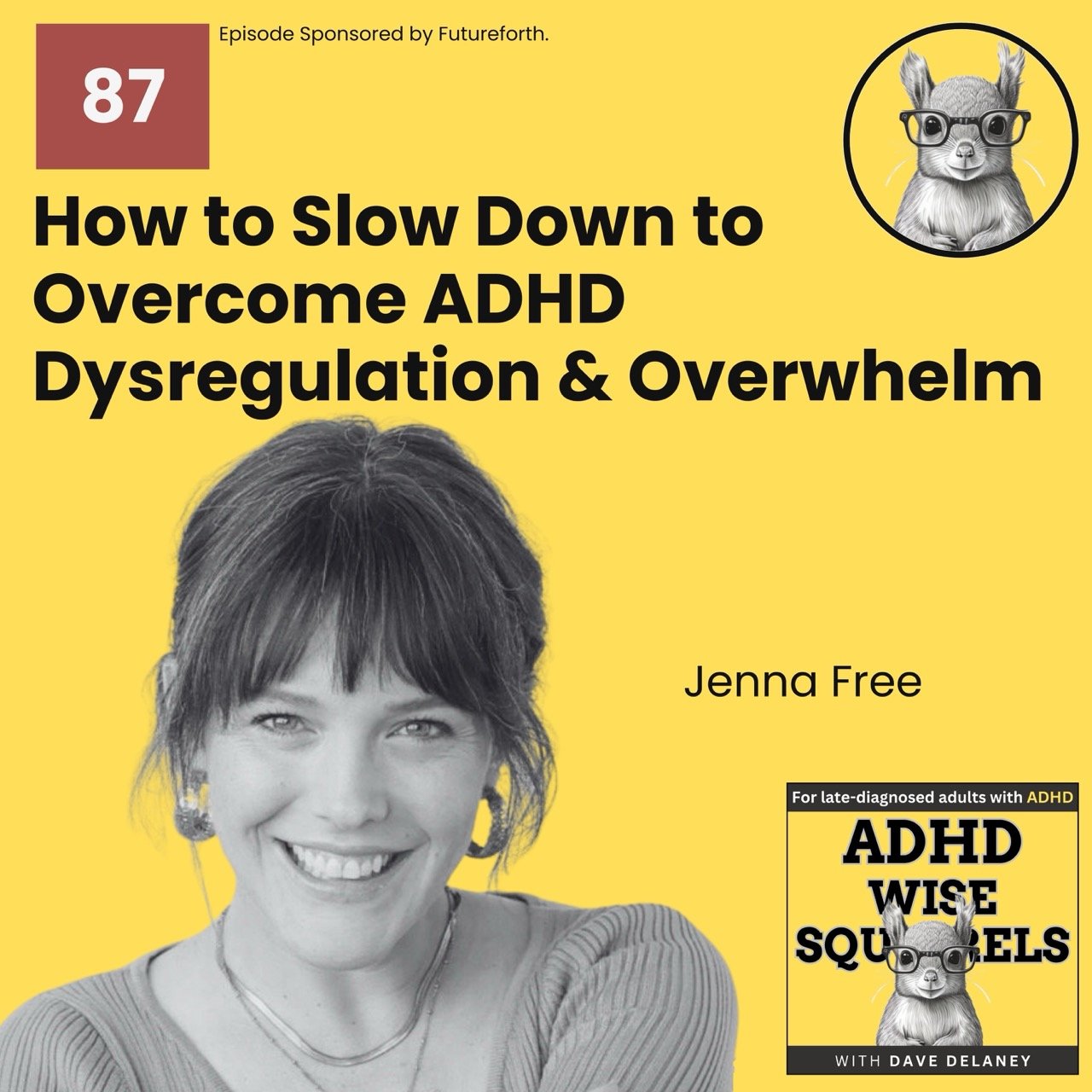
Out of Survival Mode: Jenna Free on ADHD Regulation
Ever felt so wiped out at the end of the day that taking your socks off felt like too much? Jenna Free has. Jenna is a Canadian Certified Counsellor, ADHD therapist and coach based in Calgary. She was diagnosed with ADHD at 32, after having two kids in two years. In her work, she’s seen how living in constant fight or flight can make ADHD symptoms feel much worse, and how learning to regulate your nervous system can bring real relief. You’re going to love this episode of ADHD Wise Squirrels!
Free download: Decatastrophizing Worksheets. When your brain jumps to the worst-case scenario, these worksheets walk you through catching the thought, checking how likely it really is, and reframing it. They pair perfectly with Jenna’s advice on calming the thoughts that keep us stuck in survival mode. Get the free worksheets
Shoulds and shame never work
In this episode, Jenna and I talk about the difference between ADHD as a trait (the brain you have) and dysregulation as a state (the mode that brain gets stuck in). She walks through her three-layer regulation process and explains why “shoulds” and shame never work. She also shares why the most important first step is simply noticing when you’re rushing.
In this episode of Wise Squirrels, you’ll learn:
Why chronic overwhelm feels like constantly treading water, and what it feels like to finally be “on land”
Trait vs. state: how ADHD and dysregulation overlap, and which part you can change
How fight, flight, freeze and fawn show up in common ADHD struggles like irritability, procrastination, paralysis and people-pleasing
Jenna’s three layers of regulation: physical, thoughts and beliefs, and behavior
Why you shouldn’t stop a task to regulate, and should slow down while you keep doing it
Why tools picked for dopamine and novelty fizzle out, and how to choose ones that last
How cortisol affects dopamine receptors, and why cravings for scrolling, snacking and spending can ease as you regulate
Using time and space as your container, so you can follow your interests without burning out
Why regulation works alongside diagnosis, therapy and medication, not necessarily instead of them
As always, if you’re struggling, talk to your doctor or a licensed professional about diagnosis and treatment. Regulation is a powerful tool to add to your toolkit, not a replacement for care.
Your takeaway
-
DAVE: So you are a Canadian certified counselor, ADHD therapist, coach and author of The Simple Guide to ADHD Regulation, which I'm holding in my hand for listeners.
DAVE: And it's a great book.
DAVE: I love it.
DAVE: I definitely want to dig into that.
DAVE: But you really specialize in helping neurodivergent adults, particularly those with ADHD symptoms through like nervous system regulation and all that good stuff.
DAVE: So I definitely want to get into talking about those things.
DAVE: Before we do that, I am curious, a couple of things.
DAVE: One, first of all, you were diagnosed at 32.
DAVE: Is that right?
DAVE: Yes, I was.
DAVE: Okay, cool, cool, cool.
DAVE: So how the heck did you write a book?
JENNA: I wrote a book by doing what's in the book.
DAVE: Right, right, right.
JENNA: Good news.
JENNA: Yes, that's what has been really interesting.
JENNA: So I was diagnosed at 32 after having two kids in two years.
JENNA: It just all became enough where I saw something's really going on here.
JENNA: And then with a little research thinking, I think this is the answer.
JENNA: So I went and got my assessment.
JENNA: It was a yes.
JENNA: Just like so many adults.
JENNA: Oh, it explains so much.
JENNA: And I felt just completely positive.
JENNA: I know some people also have grief with that.
JENNA: But I just felt like, thank God, I knew it was something.
JENNA: I knew something was going on.
JENNA: And this feels good.
JENNA: This feels right.
JENNA: And I'm feeling positive about that diagnosis.
JENNA: Then from there, I was in grad school to become a therapist.
JENNA: So that became my special interest.
Yeah.
JENNA: And I got a little obsessive about how does this brain work?
JENNA: How can we function well with this ADHD brain?
JENNA: And that's kind of where I started.
DAVE: Yeah.
DAVE: And were you able, I recall reading or hearing that you, I think it was in college where you were so exhausted at the end of the day that you couldn't like take your socks off.
JENNA: Yes, when looking back, you just like laugh at yourself.
JENNA: Like I was just in survival mode, just scraping by.
JENNA: And my favorite quote is when I asked my roommate, do you ever not want to take your socks off at night?
JENNA: Because then you have to put them back on in the morning.
JENNA: Like life is so...
JENNA: hard and I can't she's like what the hell are you talking about like that's not a normal feeling um and so that was just one of those little glimmer of moments where I could really see uh yes I was really in survival mode where I didn't want to do anything I didn't absolutely have to do so overwhelmed um just keeping my head above water
DAVE: Was it like, cause I know, and I know firsthand, um, our kids are 11 and a half months apart and yours are 18 months.
DAVE: So I understand your pain.
DAVE: Um, yeah, just as one was beginning to walk like the other, they were both still in diapers too.
DAVE: So it was just like, we had another baby as soon as the first started walking.
DAVE: So it was just insane.
DAVE: Yeah.
JENNA: We also had the COVID shutdown when they were six weeks and one and a half years old.
JENNA: So it was like six months on our own, really drowning, seeing that something's going on with me.
DAVE: Yeah.
DAVE: Yeah.
DAVE: But like, I was going to ask, would that overwhelm that naturally comes like for any new parents or parents with, with kids that close in age, what what's and also, and correct me where I'm wrong, but as I'm, as I've learned, you know, you were more of a,
DAVE: sort of the inattentive presentation, you know, child.
DAVE: So you were, you were, you did well sat in the front of the classroom, you know, and, and just kind of flew under the radar, like so many women tend to do, or those who have sort of that inattentive presentation.
DAVE: So like ADHD wasn't necessarily on the radar for a long time.
DAVE: What like, were you sort of self-diagnosing yourself as you're stressed out or was this for coming from the studies?
DAVE: Like how did ADHD pop on your radar as a possibility for your overwhelm, which again, as a new parent and with kids that close, everybody's gonna be overwhelmed, so.
JENNA: But the thing is, looking back, I was overwhelmed my whole life.
DAVE: Even when I had nothing going on.
JENNA: Like, oh, putting socks on was overwhelming.
JENNA: So I could really see that regardless of if I had a paper due this month in college or two kids and a business and a home to take care of and a spouse.
JENNA: Either way, I was drowning.
JENNA: So I could kind of tell it's not really about what's going on.
JENNA: It's about my chronic state of overwhelm.
JENNA: So, of course, though, if you turn the dial up to 100...
JENNA: then the cracks really show.
JENNA: I didn't have the skills to cover it up, cope, mask.
JENNA: you know, keep the head above water.
JENNA: So yes, if the water gets high enough, it's like, oh, I don't think this is typical.
JENNA: And what really stood out to me was the overwhelm of like sweeping the floor.
JENNA: Like, oh, I just can't fathom it.
JENNA: Like little things where I would get really easily confused, really easily overwhelmed, even thinking about a very small task.
JENNA: And that was the thing that really stuck out to me is I don't think this is typical.
JENNA: Yeah.
DAVE: Yeah.
DAVE: And you mentioned something there that I stood out to me, which is a metaphor you tend to use a lot, which is around water.
DAVE: And actually, strangely enough, and I don't know if other listeners might feel this way, too.
DAVE: I wrote a blog post a while back at Why Squirrels when my therapist recommended my taking a week off stimulants just to see.
DAVE: how they were working or not.
DAVE: And during that time, I ended up journaling quite a lot about the experience.
DAVE: And what I landed on in the post I wrote about the experience was that I felt like when I was off, that I was like happily treading water
DAVE: following the metaphor, but like treading water and at like a really nice resort pool, like just gorgeous place.
DAVE: And I was like, oh, this is awesome.
DAVE: And it's just, the weather's beautiful and the place is beautiful.
DAVE: And just, this is great.
DAVE: And then my arms started getting a little tired, but you know, I'm pushing through, I'm okay.
DAVE: And then my arms started getting really tired in my feet and my legs started getting crampy.
DAVE: And then next thing I know, I'm like drowning.
DAVE: And I'm like, oh my God, how did my wife not divorce me?
DAVE: Because I was diagnosed at 50, and we've just celebrated our 25th together, so 28 years, most of which I had undiagnosed ADHD, which God bless her.
DAVE: I don't know how she did it without drowning me.
DAVE: Maybe she still will.
DAVE: So yeah, tell me about the water metaphors.
DAVE: Are you aware of using these?
DAVE: Yes.
DAVE: Yeah.
JENNA: Yeah, I think it's just, I mean, survival mode, right, which my specialty is getting people out of survival mode, fight or flight.
JENNA: I've seen how that exacerbates ADHD.
JENNA: I've seen that I was in fight or flight and in survival mode my whole life, even though I didn't know I had ADHD.
JENNA: So it's a very natural response to, I think, just being different, being neurodivergent in a neurotypical world.
JENNA: We kind of get our defenses up.
JENNA: We're in this intense state just trying to keep up with everybody.
JENNA: And so we go into fight or flight.
JENNA: So drowning is that's the definition of survival.
JENNA: I just need to keep my head above water.
JENNA: I can't worry about, like you said, enjoying the resort, enjoying the scenery.
JENNA: Even if I'm in a beautiful place, my energy must go to not drowning.
JENNA: Right.
JENNA: by like how biology works.
JENNA: So that's our life can get quite small.
JENNA: We can cut off everything that's not absolutely essential.
JENNA: And we get into this place where all the energy is going to survival, not to pursuit, not to growth, not to expansion, not to productivity, even just getting by.
JENNA: And now that I'm more regulated, I've been doing this work with myself for over three, four years now.
JENNA: I feel like I'm on land.
JENNA: Things can get overwhelming and I'm not drowning because I'm not even in the water anymore.
JENNA: So it has felt like an entirely different way to live with this brain.
DAVE: Right.
DAVE: But you're in the water.
DAVE: I mean, surely you're in the water sometimes.
DAVE: We all are, right?
JENNA: I would say like maybe my legs are in the water, but I never feel like I'm drowning anymore.
JENNA: And I will say I have way more going on now than I did in the years when I didn't want to put socks on.
DAVE: Yeah, yeah, yeah, for sure.
DAVE: Tell me, and I started asking you about this too, because, you know, for my book, I wrote a book about professional networking, right?
DAVE: Like not icky gross networking, but actually like building genuine relationships and doing so, doing that both online and in person, being an early adopter in a lot of social before, you know, apparently the internet went evil and all the algorithms decided to try to kill us all or the people that behind the algorithms, but I digress.
DAVE: Yeah.
DAVE: And I wrote my book.
DAVE: I think I wrote the book successfully in part because I had a legally binding contract with my publisher.
DAVE: And I received it in advance and all the things.
DAVE: But I wanted to quit the project multiple times.
DAVE: And if it wasn't for that point, but also my wife really pushing me through and helping me along the way, I don't know if I would have been able to do it.
DAVE: And again, remember, this was pre-diagnosis.
DAVE: Yes.
DAVE: Even pre-sobriety and pre-like...
DAVE: taking mindfulness and meditation seriously.
DAVE: Like this was all years before all of this stuff.
DAVE: That's why I was asking you in part, like for somebody listening who would be an aspiring author or somebody who wants to write a book, do you have any tips or anything for them to avoid that drowning, overwhelmed feeling or staying focused on the task to the best of our abilities?
JENNA: Absolutely.
JENNA: So this is what, you know, regulation has done for me.
JENNA: And my friend the other day asked me, she's like, does your ADHD brain give you the ideas and the regulation helps you execute them?
JENNA: I said, that's exactly what it is.
JENNA: Right.
JENNA: I already I have other ideas in the back burner.
JENNA: I do have just signed my second book deal.
JENNA: Like I have three.
JENNA: So many things I want to do.
JENNA: And I was never able to execute any of them before I got regulated.
JENNA: So what regulation means is my system is no longer in survival mode.
JENNA: I have retrained my nervous system, my brain, my behavior to act as if I'm safe because I am, which allows me to be more present.
JENNA: be less hypervigilant, less anxious, more calm.
JENNA: I see things more accurately when we are in fight or flight.
JENNA: We have cognitive distortions, temporal distortions, meaning I'm not thinking clearly.
JENNA: I'm not perceiving time accurately.
JENNA: It's confusing.
JENNA: It's overwhelming.
JENNA: It's a chaotic place to live.
JENNA: So when we're more regulated, you're able to understand, and not that we don't cognitively understand, but biologically and primally understand, hey, I can only do one thing at a time.
DAVE: There's only so much time in the day.
JENNA: Writing a book is only writing one word at a time.
JENNA: Like, let me just focus on the tiny, tiny step in front of me, not worry about, you know, all the stuff I need to do after that.
JENNA: And it just allows you to function in what I call reality much better.
JENNA: Instead of being stuck in potential, which is where we live most of the time when we're dysregulated.
JENNA: The shoulds, the judgment, the negative self-talk, the anxiety, the regrets, the future, all of that takes so much energy, but it gives us no reward.
JENNA: So what regulation does is takes the energy from all these places where our body thinks it's helping, right?
JENNA: The hypervigilance, the overthinking, the rumination, the perfectionism, the negative self-talk, all of that is your brain trying to keep you alive.
DAVE: Yeah.
JENNA: But the reality is, and this is an assumption, you're safe.
JENNA: So when you're functioning as if you're about to die in a safe environment, oh, my God, it's such a waste of exhaustion, a waste of effort.
JENNA: It's not helping.
JENNA: And so that's really what this work is about, is getting that system back into the present and preserving all that energy so you can use it to move forward and execute instead of just keeping your head above imaginary water.
DAVE: Right, right, right.
DAVE: Yeah, I wrote a post a while back called the Minimum Viable Action, like MVA, and the need for us to focus on those minimal things that we can do to get started on whatever project we're working on, like you mentioned about just writing one word at a time and maybe limiting those times.
DAVE: So what are some tips for maybe take me through working with a client
DAVE: who is a middle-aged adult feeling overwhelmed with life, what are some of those strategies that you use to help folks, wise squirrels, as it were, regulate?
DAVE: Totally.
JENNA: So I have a process that I teach as opposed to strategies.
JENNA: The strategies is more, here's a hodgepodge collection, get your poison, versus a process is a very predictable way and things we need to cover to get to a regulated state.
JENNA: And that includes three different layers.
JENNA: The first being the physical regulation.
JENNA: If you are physically running around like a bear is chasing you,
DAVE: Yeah.
JENNA: Your body's not going to do anything different.
JENNA: So we have to get really good.
JENNA: And this is this takes time.
JENNA: And this is about consistency over time, which when we are dysregulated, we're impatient.
JENNA: We want to overhaul our lives by Monday.
JENNA: I don't have time for this.
JENNA: So that's the battle with this work is a dysregulated brain doesn't want to do regulation.
JENNA: But this is what I work with people on is kind of bringing those barriers down.
JENNA: But that would look like observing when you're rushing.
JENNA: Slow down.
JENNA: Physically interrupt the state you're in.
JENNA: When you are running around to the car, around the house, washing dishes at breakneck speed, you are telling your body, we are not safe.
JENNA: Let's go.
JENNA: Let's move.
JENNA: And so your nervous system will act accordingly.
JENNA: Blood flow will leave your brain.
JENNA: So executive functioning is even lower.
JENNA: We're ready to run, fight.
JENNA: We're reactive.
JENNA: We're irritable.
JENNA: We have to slow down.
JENNA: Now, that's super uncomfortable because some of the most common beliefs ADHDers hold that are dysregulating, I'm behind, I need to catch up.
JENNA: There's not enough time in the day.
JENNA: So when you marry the like, okay, I'm trying to slow down, but I also feel like I'm behind and need to catch up.
JENNA: It just creates this internal tug of war.
JENNA: So the first step is the physical piece.
JENNA: Slow down as much as you possibly can.
JENNA: And I don't mean move like a snail.
JENNA: This doesn't have to be ridiculous.
JENNA: Just don't rush like you're trying to get everything over with.
JENNA: So that's step one.
JENNA: And that takes time and exploration and it's going to be challenging.
JENNA: But then the next step is working on those thoughts and beliefs.
JENNA: Because if you are trying to slow down, but I'm behind, but I'm behind, but I'm behind.
JENNA: No sane person is going to slow down who believes they need to catch up.
JENNA: So then the second level is really working on our thoughts and beliefs and observing what is my belief system, because every single human being has a belief system, right?
JENNA: There's some core beliefs our brain has kind of implanted.
JENNA: It's like, okay, this is how we're going to function.
JENNA: This is how we see the world, regardless of...
JENNA: Seeing evidence either way, it's like our framework.
JENNA: Our framework for ADHDers, I haven't met anyone who isn't in fight or flight, so this is an assumption.
JENNA: But our framework is, I'm not safe.
JENNA: I need to go.
JENNA: I need to rush.
JENNA: I'm not enough.
JENNA: It's not enough.
JENNA: I'm not doing enough.
JENNA: And so we have to rewire those belief systems because without it, our system cannot get out of fight or flight.
JENNA: And so that's a really unique part of this work because most people will stop at the body when we're doing nervous system work.
DAVE: Yeah, that's interesting.
DAVE: With the body, are there ways, because I find it myself, like if I'm going a mile a minute, now I'm much more self-aware and much like I'm trying to practice what I preach.
DAVE: I covered some of this in my TEDx talk recently about knowing yourself, respecting yourself, and connecting yourself.
DAVE: Yeah.
DAVE: and so I'm getting much better at this.
DAVE: I'm not perfect, but nobody is.
DAVE: But as far as slowing yourself down in those moments, in those panic body moments, as you're, you're referencing, what are some strategies to remember to slow down?
DAVE: Because I think, you know, and I know you've done work too earlier on about in, in diet and nutrition and overeating and things like, or, you know,
DAVE: that's part of it i guess but like i'm guilty of that sometimes we're like i'll overeat i understand why now but i'll still do it almost like
DAVE: like a drug addict or or like you know you're not i really shouldn't be eating this big bowl of ice cream i should have made a smaller one now i made a big one but i'm gonna eat it anyway and i'm gonna keep eating it and i know i shouldn't be eating it or maybe i'm at the grocery store and i know i shouldn't be buying the ice cream and this may all be related to something that happened last night
DAVE: Tell me about how to self-regulate this way.
DAVE: Like, is it literally like writing something on your hand?
DAVE: Like, don't eat that or like pinching yourself or what is it?
DAVE: Like, what is it that stops you?
JENNA: Yeah, this work is really radical when it like compared to normal thinking.
JENNA: So, for instance, and it's actually quite informed by the work I did before with intuitive eating and like you were talking about, because I was a very dysregulated eater for 10 years.
JENNA: I was a dieter and I binge ate back and forth, back and forth, back and forth, back 10 years.
JENNA: Not realizing, girl, if you stop dieting, you'll stop binging.
JENNA: If you restrict, you will swing to the opposite end.
JENNA: So I repaired my relationship with food.
JENNA: I have absolutely no rules with food.
JENNA: I'm completely free with food.
JENNA: There's no shoulds.
JENNA: I genuinely fold food as neutral.
JENNA: And that has allowed me to, instead of fear or shoulds or shame, fuel my eating well.
JENNA: I just do it because it feels good.
JENNA: So that's kind of similar with regulation.
JENNA: I don't want people to slow down because they should.
JENNA: I don't want people to regulate because they should.
JENNA: If you're doing it because you feel you should, it's never going to work.
JENNA: You have to want to.
JENNA: And how do we learn to want to?
JENNA: You'll learn about what it's going to do for you.
JENNA: So that's the number one is you have to buy in.
JENNA: You have to want to regulate because if you see the effects or if you learn about, you know, what is dysregulation doing to me now and what could I experience if I regulate?
JENNA: which I can get into in a minute if that's valuable.
JENNA: But for example, in my groups that I run, we talk about the first session is just like, why would you want to be doing this?
JENNA: What is it going to give you?
JENNA: And then we start with the slowing down.
JENNA: When you want something, and I know at each years we can be relentless.
JENNA: We're like, damn, I really want that.
JENNA: Then when I'm rushing, I have a reason to slow down.
JENNA: It's not, oh, I really should.
JENNA: I shouldn't rush.
JENNA: Just like you said, oh, I shouldn't eat the ice cream.
JENNA: Will you do?
JENNA: Right.
JENNA: So it's the should won't work.
JENNA: Shame, guilt, pressure will never, ever work.
JENNA: So if you, you know, say you've learned about regulation, you realize, wow, I can see that I'm going to be more productive.
JENNA: Life will be more enjoyable, less stress.
JENNA: Like it sounds really good.
JENNA: I'd love to experience that.
JENNA: Then we learn about how rushing is triggering that nervous system and causing all these negative effects.
JENNA: Okay, when I spot it, when I'm aware of it, can I interrupt it?
JENNA: And now, yes, to be aware of it at first, you might need a visual reminder.
JENNA: So maybe it's one, one post-it note on your computer that says like rushing or on your car dashboard, on your fridge, something where it's just a tap of like, hey, remember, we're working on that.
JENNA: Um, but the more you start to do it, the more you will do it.
JENNA: So at this point when I'm rushing, it's like a slap in the face.
JENNA: Like it's feels very jarring, but at the beginning, that's your normal.
DAVE: Yeah.
JENNA: So it really is this specific thing we're doing is, okay, can I just spot when I'm rushing and slow down?
JENNA: And that's all we work on for a week.
JENNA: Because if you try to do multiple things at once, it's never going to happen.
JENNA: But it is a physical interruption of how you're doing things.
JENNA: So if you're writing an email...
JENNA: Try to get it over with.
JENNA: Okay, I'm dysregulated or I'm rushed.
JENNA: And I would continue with the task.
JENNA: Do not stop what you're doing to regulate.
JENNA: Sometimes people will do that.
JENNA: Like, oh, work is stressful.
JENNA: Let me go leave my computer and make a cup of tea.
JENNA: Well, now you've retrained your nervous system to only relax when you're not working.
DAVE: Right.
JENNA: So keep doing what you're doing, but physically slow down.
JENNA: And that's it.
JENNA: And you will start rushing again within less than a minute, probably.
JENNA: That's normal.
JENNA: That's the process.
JENNA: It is interrupting your rushing again and again and again and again and again to show your nervous system, hey, look.
JENNA: we're safe.
JENNA: Just like going to the gym.
JENNA: You do, you're not going to go do one workout and have big muscles.
JENNA: You got to get those reps in.
JENNA: But you just keep at it.
JENNA: And it's a really interesting thing to start observing how it feels to slow down, what worries come up, what prevents you from slowing down.
JENNA: And then that's kind of where the belief work comes in because it's going to feel uncomfortable.
DAVE: Yeah.
DAVE: And where did the, the, you know, one of the, the common things I've come across with ADHD years is our both craving and boredom from novelty, like our craving for novelty and doing things a different way, which is fantastic.
DAVE: And we find a great solution and, you know, you include some of those in the book, but at the same time, the novelty suddenly runs out.
DAVE: It's like, oh, I've got this like template or this form to fill out or, or post-it notes or whatever it is.
DAVE: Some strategy that suddenly is working until it's not.
DAVE: And then it just suddenly it's like, nope, my brain's bored of this.
DAVE: Now I got to find a different way.
DAVE: So it's like going from analog to digital or vice versa.
DAVE: Do you find that that happens?
DAVE: And how do you get folks back on track?
JENNA: Well, it's, you know, from a regulated perspective.
JENNA: viewpoint.
JENNA: And that's how I look at everything, including tools, patterns, routines.
JENNA: It's like, okay, how do I look at this through a regulation lens?
JENNA: I do not want to implement anything that I'm doing because it's fun.
JENNA: That feels fun to do this kind of planner.
JENNA: Okay.
JENNA: If I'm using it because it gives me dopamine, I know that's not going to last.
JENNA: So tools that I use are purely functional.
JENNA: Unfortunately, they're cropped under my computer right now, so I can't bring it up.
JENNA: But I have been using the same paper calendar system for five years, every single day, because it works.
JENNA: And purely because it works.
JENNA: It is not pretty.
JENNA: I don't spend a lot of time and effort on making it pretty to give me dopamine.
JENNA: It is purely functional.
JENNA: And because of that, the dopamine hasn't worn off because that was not the motivator.
JENNA: So I would just look at, am I using this because it feels fun and gives me dopamine?
JENNA: And I'm like being so careful and making it pretty.
JENNA: And if I don't do it perfectly, I don't do it at all.
JENNA: don't even start that because it will not last.
JENNA: So with regulation, it's very much a mindset of making your life work instead of fueling yourself with like hits of dopamine novelty.
JENNA: Of course we want that at times as any human does, but if that's the only thing keeping you going, it will be thin ice.
JENNA: So we really kind of create routines, uh,
JENNA: Ways of being is more about the inside than what you're doing.
JENNA: It's how you're doing it.
JENNA: Doing things in a way where, you know, this is not run by dopamine.
JENNA: This is not run by novelty.
JENNA: That way it lasts.
DAVE: And do you find that most of your clients are people that have been diagnosed and have received treatment for their ADHD?
JENNA: No, a lot of self-diagnosis, a lot of people who are on medication, but a lot of people who are not or don't want to be.
JENNA: So they're doing this work instead.
JENNA: Yeah.
JENNA: When I was first diagnosed, I was like, came home crying to my husband, like, I just want the medication, like, just give it to me.
JENNA: I need to not be drowning.
JENNA: But, you know, I sat with it for a bit.
JENNA: I was just about to finish schooling.
JENNA: So I was a little trepidatious of like starting medication right when I'm wrapping up like a couple important months.
JENNA: I'm like, I'll do it later.
JENNA: But then life became a little less stressful.
JENNA: So I didn't do it then.
JENNA: Then I started doing regulation work.
DAVE: I don't think I'll ever go on medication because this has completely flipped around my capacity.
JENNA: And I would just have no use for it.
JENNA: So that being saying that as in not medication is not greatly effective because for so many people it is.
JENNA: And with regulation work, it's like such a powerful duo.
JENNA: But it also is profoundly helpful without medication.
JENNA: other treatment as well so in and of itself it can really change your experience and therefore you can use tools long term you aren't seeking dopamine and those hits of course you want dopamine everyone wants dopamine um but we can we can what am i trying to say
JENNA: we can utilize that slow building, feel good, long-term dopamine, not the hits that result in a crash, which is why we kind of feel like we're on a roller coaster ride all the time.
DAVE: See, I'm always confused by that because I feel like we need the flush of dopamine to benefit from it because we have, my understanding is we have, it's not that we lack dopamine, it's our pesky dopamine receptors who don't behave properly.
DAVE: Yeah.
DAVE: So it's a funny thing because we have the same amount of dopamine as everybody else.
DAVE: But it's the rush.
DAVE: So like for me as a keynote speaker, when I get up on stages or when I'm performing, I know you do acting or take an acting class as well, which is cool.
DAVE: But I find that when I'm on stage, I studied improv at Second City and have done a lot of performance and keynotes and things like that.
DAVE: So I love being in front of audiences and getting them laughing or heads nodding and so on.
DAVE: But looking at my life through the lens of ADHD and realizing, you know, retrospectively, but realizing or after the fact that, oh, look, it's this excitement I'm feeling, this dopamine I'm getting from the audience.
DAVE: So it's like one of the positive ways.
DAVE: Overeating is another negative way or addictions and things like that.
JENNA: Yes.
JENNA: But what's so interesting is cortisol levels when that goes up, which when you're in fight or flight, that is just freaking pouring into you.
JENNA: Cortisol affects your dopamine receptors.
JENNA: So if you're on fight or flight, you need more of the flash in the pan hits, scrolling, eating, spending, all of that.
JENNA: If it's substance use, I have found with clients and with myself, all of that naturally goes down because you're like, Oh, I'm actually feeling much calmer, much better.
JENNA: I don't need that like fuel because you're not coursing with cortisol.
JENNA: So you're the receptors we do have.
JENNA: The function we do have is working much better.
JENNA: Is it,
JENNA: Is it impacted by ADHD zero?
JENNA: No, but put ADHD and dysregulation together and you're in absolute chaos.
JENNA: So that's why the regulation helps so much.
DAVE: And do you find, I'm not like some trying to sell people cold plunges or something, but there is something to be said about cold showers, cold plunges, jump in a lake because that does increase the cortisol, which to your point, like helps with that.
DAVE: So that's my understanding.
DAVE: Yeah.
JENNA: Yes.
JENNA: But and with that, it's like, sure, that's kind of icing on the cake, sprinkles on the cake, if you will.
JENNA: That's a lovely thing.
JENNA: But that helps you for maybe the hour.
JENNA: The work that I teach is the internal regulation, which is we are trying to we are working to retrain your nervous system from being in a chronic fight or flight state, meaning I wake up overwhelmed.
JENNA: Doesn't matter what I'm on the beach vacation.
JENNA: I'm anxious.
JENNA: Like I am chronically my survival mode switch is turned on.
JENNA: And I'm in this hypervigilant state all the time.
JENNA: The work that I teach is about consistently, over time, resetting that baseline to be like, oh, I'm okay.
JENNA: I'm now connected with the reality that I'm safe.
JENNA: Of course, I will get dysregulated.
JENNA: I'm a human being.
JENNA: But my baseline is much calmer versus a cold plunge is great momentarily.
JENNA: It's not going to retrain your system to function in a regulated state in the long run.
JENNA: So that's why the two can be really wonderful together as well.
DAVE: Now with anxiety, you know, this feeling of overwhelm, as you're saying, a lot of people with ADHD have comorbidities and those often the most popular are anxiety and depression.
DAVE: And we're talking not just moments of anxiety or moments of depression.
DAVE: We're talking about like clinical anxiety, clinical depression.
DAVE: So how do you handle that in how you communicate to your clients and or readers or podcast listeners as far as like,
DAVE: there is a point when without putting words in your mouth, but there should be a point at least where you should be receiving medical help for your, for anxiety or depression or, and certainly I would argue ADHD, but yeah.
DAVE: Tell me about that.
JENNA: Yeah, absolutely.
JENNA: Everyone should get support for whatever they're experiencing for harm reduction at the very least.
JENNA: Like, yeah, of course.
JENNA: And on top of that, aside from that, so I'm not saying don't get extra support.
JENNA: In the work that I do, I've worked with over 1,000 ADHDers with this approach.
JENNA: And in the work that we do, when we start, we go, okay, we are going to assume all of the symptoms you experience are dysregulation related.
JENNA: I'm not saying it's 100% the cause of that.
JENNA: So if you're like, well, is this my anxiety or is this dysregulation?
JENNA: Anxiety is dysregulation.
JENNA: That's your brain worried that you're not safe.
JENNA: So it's thinking about all the possible outcomes.
DAVE: Right.
JENNA: Right.
JENNA: Anxiety is a form of dysregulation.
JENNA: So how do we tease those apart?
JENNA: What's chemical?
JENNA: What needs to be treated and what will work with regulation?
JENNA: We don't know until you get regulated.
JENNA: OCD.
JENNA: I have a lot of clients ADHD, OCD.
JENNA: What's the OCD and what's dysregulation?
JENNA: OCD is a dysregulation rooted disorder.
JENNA: You feel unsafe.
JENNA: So you have thoughts or routines or repetitions.
JENNA: Have you acting as if you're unsafe when you are safe?
JENNA: So how do we know which is which?
JENNA: We don't until you're regulated.
JENNA: So the ADHD, what's what's ADHD?
JENNA: What's dysregulation?
JENNA: We won't know until you're regulated.
JENNA: So.
JENNA: saying that being, Hey, regulation is your best first course of action.
JENNA: And that is my, my dream would be when someone gets diagnosed, we go, okay, so let's regulate you first.
JENNA: Then we'll see what's left over.
JENNA: Of course, maybe with medication at the start, if someone desires that, but that would be like the therapeutic homework.
JENNA: Yeah.
JENNA: Okay, we got to get your system out of fight or flight because if that remains, we won't really know what's what.
JENNA: So that is what we do.
JENNA: And we look at, okay, everything's dysregulation for now.
JENNA: While we're working on this, see what we can play with, see what we can change.
JENNA: And people have found huge reduction in OCD symptoms, ADHD symptoms, anxiety, depression.
JENNA: Many people have found, oh, I think I was ADHD.
JENNA: And because I have ADHD, I am in the fight or flight dysregulation cycle, which is intensity,
JENNA: Negative self-talk, paralysis, overwhelm, rushing, frantic energy, and crash.
JENNA: Looks a lot like anxiety and depression, right?
JENNA: Those highs and lows.
JENNA: Not saying you don't also have a secondary diagnosis, but it's such powerful work to do up front to go, okay, well, what could we change here?
JENNA: What could be adjusted?
JENNA: What could be relieved with getting your system out of fight or flight?
JENNA: And people are finding like,
JENNA: Well, it's a lot.
DAVE: And I mean, I would I would push back gently and do I would encourage people to get clinically diagnosed first by a, you know, a physician and then get the treatment needed from that physician, be it therapy, medication if needed, or if they feel that way.
DAVE: which is the route I went and continue.
DAVE: And then also like tap into everything you're explaining, because I think the more that you understand what I call your operating system, the better.
DAVE: And so the content that you provide, the book, the podcast and so on are all great.
DAVE: And your group coaching are all beneficial that way too.
DAVE: What are the things that you experience personally?
DAVE: Because as we know, there's no cure for ADHD.
DAVE: There shouldn't be.
DAVE: ADHD is just how our brains operate.
DAVE: But obviously, you know, fitting into a neurotypical world, you know, I know for you, like in school, you know, sitting in the front row, as you said, being a people pleaser.
DAVE: Yeah.
DAVE: What are what are the things that you experience that are are still challenging?
JENNA: Absolutely.
JENNA: So I would say the biggest I'll talk about what the biggest changes have been in my personal experience and then what I still see as like I have to deal with separately.
JENNA: So in the regulation process, I do know I no longer experience paralysis.
DAVE: Hmm.
JENNA: I do have a strong hypothesis that paralysis is the freeze response.
JENNA: That is the nervous system freezing up.
JENNA: That is not an inherent and inevitable ADHD trait.
JENNA: That's my...
JENNA: hypothesis.
JENNA: That's a hypothesis, everybody.
JENNA: But that is something I want to do more research into.
JENNA: But I get overwhelmed, of course.
JENNA: But because I have the tools, I don't flip kind of tip over into paralysis, where I used to function as a self-employed person for seven years before I was diagnosed on the couch all day.
JENNA: I never made any money.
JENNA: I would work in fits and bursts and I would go hard for one week and then sit on the couch for a month.
DAVE: And it was absolutely painful.
JENNA: Since doing this regulation work for about four years as a self-employed person, I show up every single day in a way that's calm, sustainable, enjoyable.
JENNA: And so that change has been really cool.
JENNA: What I still see, memory still sucks.
JENNA: It's hard.
JENNA: So I do have, you know, a very strong calendar system.
JENNA: I am fully aware that if I do not write it down, it does not exist.
JENNA: It's going in one ear and out the other.
JENNA: That is still something I see really showing up.
JENNA: And also attention to detail.
JENNA: No matter how hard I try, I miss things.
JENNA: And those are the two biggest struggles I still see.
JENNA: So some of it I try to cope with, you know, calendars and things like that.
JENNA: And some of it I outsource.
JENNA: My husband does the grocery shopping.
JENNA: I find the grocery store so overwhelming.
JENNA: Like I can't see the details.
JENNA: I can't remember what I'm supposed to buy, even though it's the same thing every single week for years.
JENNA: Yeah.
JENNA: It's so taxing.
JENNA: So there's still things I work.
DAVE: And where the hell did I put my car?
JENNA: Oh, my God.
JENNA: I went to the gym the other day and I parked right in front.
JENNA: I got the best spot right by the door.
JENNA: And I laughed and wouldn't be like, I don't normally park here.
JENNA: I'm going to totally forget that I parked here.
JENNA: Went in, went to the gym, walked to the back of the parking lot where I normally park, started laughing so hard.
JENNA: I'm like, I knew that was going to happen.
DAVE: Yeah.
JENNA: Yeah.
JENNA: So that's still, you know, I still have my moments, but I just laugh it off because I'm, I'm functioning so well overall that like the things I have to deal with now, child's play compared to what I was dealing with before.
JENNA: But what's so cool is the strengths of my ADHD brain, I think have really come out.
JENNA: You know, when people talk about it being a superpower and we roll our eyes because we're like, I'm drowning.
JENNA: This is not a superpower, but I have seen like the connections I can make the cool things.
JENNA: analogies I can create for clients where they're like, I never thought of it like that before.
JENNA: Or the business ideas and all of the weird things my brain comes up with.
JENNA: I'm like, I love my ADHD brain, but I love it so much more now that it's just ADHD I'm dealing with, not ADHD in fight or flight.
JENNA: And that's why I'm so passionate about this work because I really believe this is an amazing opportunity
DAVE: holistic and accessible way for everyone to just find even if it's a bit of relief it's worth it yeah no you're spot on there as far as we talked a little bit about these body reminders and sort of you know post-it notes and things like you know in minimum you know not too many of them obviously by your book but besides that like what are some other steps people can take yeah absolutely
JENNA: And I also, you know, obviously I have my social media, tons of posts.
JENNA: I have a podcast and lots of people have done this work solely based on the free information I give.
JENNA: And they've messaged me saying, oh my gosh, this has changed things for me.
JENNA: So it's not like we can't do it unless we have someone like holding us accountable.
JENNA: Right.
JENNA: And this is why the number one thing is going to be an annoying answer because it's like, just tell me how to do it.
JENNA: But the number one thing is going to be buy in your conscious mind.
JENNA: So we kind of have two parts.
JENNA: We have the primal part, the nervous system.
JENNA: It has no logic whatsoever.
JENNA: It is simply reactive and trying to keep you from dying.
JENNA: And then we have our conscious mind.
JENNA: Your nervous system is not going to be into this work.
JENNA: Right.
JENNA: Your primal self is going to go, no, thank you.
JENNA: This is too hard.
JENNA: I'm comfortable in my dysregulated place.
JENNA: This has kept me alive.
JENNA: I haven't died yet.
JENNA: Keep me over there.
JENNA: I want to keep rushing.
JENNA: I want to keep my thoughts and beliefs.
JENNA: I want to keep my all or nothing behavior.
JENNA: I want to sustain what I've been doing.
DAVE: Yeah.
JENNA: Because that's kept my head above water.
JENNA: I don't want to risk drowning.
JENNA: Even though it could be amazing, I could die.
JENNA: So that part of you...
JENNA: It's going to hate this.
JENNA: So your conscious mind has to be super into it.
DAVE: So how do you get into it if they don't know what to do?
JENNA: Yeah.
JENNA: Well, I mean, like the reasoning behind it.
JENNA: So my podcast episode number one is the one that people go, oh, my God, I have never thought of it like this before.
JENNA: This makes so much sense.
JENNA: I see myself in what you're saying.
JENNA: I get it logically.
JENNA: I'm bought into the idea.
JENNA: And that's all I'm meaning is buying into the concept where I understand it.
JENNA: I get it.
JENNA: I think that that's something I want to invest time in because the other part of you that you're dragging along is not going to do it.
DAVE: So what are the points you make in that first episode?
JENNA: So what I talk about is seeing ourselves through a lens of dysregulation.
JENNA: So putting those goggles on and going, okay, instead of what I have previously been viewing myself through, which is for most people, ADHD content.
JENNA: And this is my small gripe with a lot of ADHD content out there.
JENNA: And it's to no fault of anyone's.
JENNA: It's just kind of what we're taught is a lot of slap a label on it.
JENNA: Call it a day.
JENNA: It is what it is.
JENNA: There's nothing you can do about it.
JENNA: Ha ha ha.
JENNA: Isn't it so hard?
JENNA: And so that's a lot of ADHDers.
JENNA: We believe paralysis is inevitable.
JENNA: Waiting mode is inevitable.
JENNA: Distraction is inevitable.
JENNA: All of my struggles, there's nothing I can do to make this better.
JENNA: I can simply cope with tools and strategies and hacks and tips and tricks.
JENNA: And so we're in this.
JENNA: So we're functioning from a place of this is static.
JENNA: There's nothing I can do internally.
JENNA: So I have to do it all externally.
JENNA: So what I go is, okay, well, let's just put that aside for a second, get a little curious and look under the hood and go, well, what are all these symptoms about?
JENNA: And if you look at the symptoms of ADHD and you look at the symptoms of dysregulation, they're almost identical.
JENNA: So if we have both, we are really exacerbating all of it.
DAVE: So for example...
DAVE: But dysregulation isn't a type of brain where ADHD is...
JENNA: Exactly.
JENNA: Being in fight or flight is a state you're in.
JENNA: ADHD is a type of brain.
JENNA: It's a brain difference.
JENNA: So it's like trait versus state.
JENNA: Trait, you're not doing anything with that.
JENNA: You have the brain you have and it's awesome.
JENNA: That's a great brain you have.
JENNA: It's simply the state that brain is in that is causing a lot more problems than we need to be dealing with and state can change.
JENNA: So that's what we're looking at is what's the changeable part of my experience.
JENNA: Because if you look at fight, flight, freeze, fawn, okay, we have fight, irritability, rushing, impatience, frustration, all of that that we hate, that we struggle with.
JENNA: Flight, avoidance, procrastination.
JENNA: Very good at that.
JENNA: Freeze, paralysis, waiting mode, overwhelm, and fawn.
JENNA: People pleasing, putting everyone's needs before ours, not being comfortable unless everyone else is, rejection sensitivity, dysphoria.
JENNA: We can really put the ADHD symptoms into those buckets pretty easily.
JENNA: So we go, OK, well, just for a while, let's assume it's fight, flight, freeze, fawn and work accordingly to start softening some of that.
JENNA: And so once you start seeing yourself through the lens of dysregulation, you go, oh, that's interesting why I'm doing that, as opposed to, oh, that's just how I am.
DAVE: So it just it opens the door to like, let's just be curious.
JENNA: Try some things out and see what happens.
JENNA: And so for a lot of people, they find, oh, that was a bit of an unlock that I didn't have access to before.
JENNA: Do I still have ADHD?
JENNA: Absolutely.
JENNA: But a lot of symptoms have been lessened or they're easier to cope with.
JENNA: And what a gift that is.
DAVE: So by beginning with addressing that fight and then moving on to flight and so on?
DAVE: No.
JENNA: So it's the three layers of the physical, the mental, and the behavior.
JENNA: So like I said, the physical is what's the physical state of your body?
JENNA: Is your heart racing?
JENNA: Are your shoulders up by your ears?
JENNA: Are you rushing?
DAVE: Yeah.
JENNA: Right.
JENNA: A lot of us have that TMJ trap tension.
JENNA: OK, my body's acting as if I'm getting chased by a bear.
JENNA: I start to get very aware of that through that lens.
JENNA: Not, well, it's just ADHD.
DAVE: We just rush.
DAVE: We're impatient.
DAVE: Right.
JENNA: Oh, I'm seeing that.
JENNA: OK. And then we work on retraining that.
JENNA: OK, I'm safe, safe, safe.
JENNA: And we do that through acting different.
JENNA: And that might be what if you're not safe?
JENNA: then you want to be in fight or flight.
JENNA: If you're literally getting chased by a bear, I want you to run faster than you've ever run.
JENNA: If your baby's under a car, I want you to be pulling that car up, right?
JENNA: If you're with someone creepy and you have to appease them to get away, I want you in fight or flight.
JENNA: You want to be in fight or flight.
JENNA: That's what it's for.
JENNA: So it's being self-aware.
DAVE: It's being self-aware enough to know this isn't an emergency.
JENNA: And I would say 99.9 knock on wood percent of the time, hopefully 100% of the time you are physically safe.
DAVE: Yeah.
DAVE: Although you're in Alberta, so those could be grizzly bears.
JENNA: Yes.
JENNA: If I'm in the forest and I see bushes rustling and a big paw come out, let's go and fight or flight.
DAVE: Let it rip.
JENNA: Any other time, it's only going to hurt.
DAVE: It's not going to help.
JENNA: So that physical piece is where we start.
JENNA: And then we go to the thoughts and beliefs.
JENNA: We have to get that brain on board with thinking in a way that aligns with I'm safe.
JENNA: There's no rush.
JENNA: I can only do one thing at a time, slowing down.
DAVE: So what's one way to remind ourselves of these things?
JENNA: So it's hard because I could tell you 10 things to remember, but then we're going to remember nothing.
JENNA: So I'm very deliberate.
JENNA: Even the book says, read this one chapter at a time.
JENNA: Do not skip ahead.
JENNA: Do not try to do it all at once.
JENNA: That's more all or nothing, which is a part of dysregulation, where we try to do so much that we do nothing.
JENNA: So for people just walking away from this episode, I would love them to stop at the physical.
JENNA: If I say more, you're going to do none of it.
JENNA: And that's a really important part about regulation.
JENNA: So that being said, start getting to know how does it feel to be dysregulated?
JENNA: And that's going to be stomach and knots, heart racing, any physical signs of anxiety, tense muscles, rushing, impatience, ruminating, overwhelm, anxiety.
JENNA: We'll put that in that bucket for now.
JENNA: I'm not saying that's not other things as well, but we'll put that there.
JENNA: Hypervigilance.
JENNA: We want to start seeing, oh, I'm dysregulated.
JENNA: And that's a retraining right there.
JENNA: It's like retraining myself to feel those things.
DAVE: Yeah.
JENNA: Because I've been in that state for 25 years.
JENNA: It's hard to notice.
JENNA: But that's why I give just that instruction at first.
DAVE: It's partly mindfulness too, right?
DAVE: It's about being self-aware enough, slowing yourself down.
DAVE: Like that's why I've had so many experts here on the show to talk about the power of meditation and mindfulness.
DAVE: Slowing yourself down enough can help you reframe those negative thoughts.
DAVE: This is what I've discovered for myself even before I was diagnosed.
DAVE: But when I tapped into mindfulness and meditation, the idea, the power of
DAVE: of reframing what I later learned is cognitive reappraisal and reviewing your thoughts in a moment to realize just as you're saying, like, that's not a grizzly bear.
DAVE: That's a cub.
DAVE: Get the hell out of there.
DAVE: No, no, it's, it's, it's okay.
DAVE: It's like a raccoon.
DAVE: Exactly.
DAVE: This has been great.
DAVE: Is there anything I haven't mentioned or haven't asked you or you wanted to ask me that I know I'm watching the time, so I want to be mindful of time here.
JENNA: No, I think that sounds good.
JENNA: Just, you know, for people listening, just observing the reaction even to this conversation of, yeah, but just tell me what to do.
JENNA: That's rushing right there.
DAVE: Like, slow down.
JENNA: It's okay for this to take time.
JENNA: It's okay to learn one little nugget.
JENNA: If you took one sentence away from this conversation where you go, that's interesting.
JENNA: I have thought, I thought rushing was just a part of who I am.
JENNA: Maybe that's my system thinking I'm in fear.
JENNA: Now I can see that differently.
JENNA: That's a win.
JENNA: That's enough.
JENNA: And so regulation is really about taking it all down a notch.
JENNA: You have time.
JENNA: It's okay for things to take time.
JENNA: Slow and steady wins the race.
JENNA: So just observing, even in your pursuit of regulation, I'm always having to call clients out of like, yes, I see you're in a rush to get regulated.
JENNA: Yeah.
JENNA: What's that about, right?
JENNA: Really just seeing, oh, I see I want everything now.
JENNA: I want to learn it all.
JENNA: I want to learn it all now.
JENNA: I want to have it overhauled by tomorrow.
JENNA: That is going to keep you stuck because you're going to stay in that hamster wheel, triggering the dysregulation every time we're rushing.
JENNA: So even that I think is a huge place to start.
DAVE: Yeah, no, that's really helpful.
DAVE: I have multiple interests too.
DAVE: Even doing this podcast is sometimes challenging because it's like, you know, we talked about it before hitting record is, you know, it's not my full-time job.
DAVE: So, but I love doing it because I love serving my fellow wise squirrels and helping them.
DAVE: So I've read, you know, you've taken some acting classes and yoga and things like that.
DAVE: What are, like, if you wanted to go all in on acting once and then you realize, oh, wait, I have a business to run and a family and so on.
DAVE: How do you kind of,
DAVE: come to Jesus with yourself to balance that all out.
DAVE: Do you abandon that altogether?
JENNA: That's what I love about regulation is it seeps in every single thing you do.
JENNA: Like you're going to do everything differently as a regulated person.
JENNA: So as a regulated human, I have so many ideas, right?
JENNA: The brain would I, which is like whole potential, right?
JENNA: All our thoughts, ideas, what ifs that is infinite, right?
JENNA: Time and space are linear, so they cannot be one in the same.
JENNA: And I have a really, really strong relationship with time and space being linear, linear reality.
JENNA: I understand I have a physical limitation called humanness and I can't do it all.
JENNA: And because of that, I'm able to.
JENNA: No went, okay, this seems realistic to add this in.
JENNA: And I'm just going to dip my toe in.
JENNA: So for example, tennis, I started playing tennis a year ago.
JENNA: I dipped my toe in.
JENNA: I'm going to take a little class, just see what it's like.
JENNA: I bought my $5 Goodwill racket.
JENNA: I'm not going to invest too much in it.
JENNA: Like slow and steady wins the race.
JENNA: Let me just dip my toe in.
JENNA: Well, this is kind of fun.
JENNA: Oh, I like this.
JENNA: I'm not a sporty person's first sport I've ever enjoyed.
JENNA: Eventually I bought real tennis shoes and a real racket.
JENNA: Now I play twice a week.
JENNA: I'm going up to three times a week.
JENNA: I'm really developing such a passion for tennis.
JENNA: I'm going to the US Open in New York in September.
JENNA: But this has like been a year of like, let me just inch my way towards this passion instead of diving in the first day, buying every single piece of equipment, going five days a week, trying to get amazing in a month and then quitting.
JENNA: So that's a big change that I've experienced.
JENNA: Instead of going gung-ho and everything in a really dysregulated way, I can build up to things which has them be so much more successful.
JENNA: And my next endeavor is also regulation for tennis players because I'm like, I want to be in that world more.
JENNA: So let's tie it together.
JENNA: So it's been a really cool experience to see how I can manage my many interests in a regulated way, which means they actually come to fruition.
JENNA: Not all of them.
JENNA: Time and space are linear, but the ones that matter that make the cut.
JENNA: I did do an acting class.
JENNA: It was amazing.
JENNA: I'm so glad I did it because I had to be very brave to do that.
JENNA: And it was so dysregulating.
JENNA: Like that is one of the hardest things I've done in a very long time.
JENNA: So I did a couple little classes after that.
JENNA: And I was going to do another one this summer and I went, nope, I'm at capacity.
JENNA: That is not one of my top, top priorities right now.
JENNA: So I canceled that class and I might get it back into it one day.
JENNA: But I'm like always able to ebb and flow like I'm pushing my limit here.
JENNA: Let's back off.
JENNA: What's important?
JENNA: Really good at prioritizing.
JENNA: That skill did not come until I was out of fight or flight.
DAVE: Because, you know, as ADHDers, we're, you know, as Russell Ramsey, Russ Ramsey was a guest on the podcast, talks about we're consistently inconsistent.
DAVE: How do you track the ideas and put them in order or eliminate them altogether?
DAVE: What's the process for you?
DAVE: Yeah.
JENNA: Well, time and space is my container.
JENNA: People often have the ideas or the tasks as the container.
JENNA: And then like, OK, how do I fit this into my day versus like, OK, here's my time.
JENNA: What can I fit into that?
JENNA: And just by nature, you have to cut things.
JENNA: So, of course, making an income and my base business is always going to be number one.
JENNA: If something is making that crumble, it's not worth it.
JENNA: And I'll be very quick to back off.
JENNA: Or even if I'm working in a way or adding things to my business that has me tipping over into dysregulation, I know that's going to hurt me so bad.
JENNA: So I will back off.
JENNA: For example, I suppose the last year I started my podcast, I'm like, OK, January, I'm going to launch it.
JENNA: January came.
JENNA: I'm like, this feels forced.
JENNA: This feels too much backing off.
JENNA: And I didn't start it till April.
JENNA: Like in real time, I can pull the reins and kind of move forward on things based on prioritizing my regulation.
DAVE: Sorry to interrupt.
DAVE: Is this also in a visual, because I know you have some of that in the book too, but is there like a visual chart of your time in order to visually see like, if I do this, then that's got to go, or if I do more of this, then this has to go, or I have to do less of this.
DAVE: So almost like time blocking in a way, right?
DAVE: Yeah.
JENNA: Well, I do have a calendar, so that does come into it.
JENNA: But it's also how I feel, right?
JENNA: If I'm writing a book and launching a podcast, you might technically have the time, but my brain can't hold it all.
JENNA: So I can also feel internally, this is too much for me.
JENNA: This is tipping my internal world over the edge.
JENNA: So it is less about what time do I have, because there's always those gross quotes like,
JENNA: If you have time to watch Netflix, you have time to start a side hustle.
JENNA: That is not the same thing.
DAVE: Okay.
JENNA: Cause it's capacity.
JENNA: It's, you know, regulation.
JENNA: It's a lot of stuff inside of us and our bodies and our brain that need to be factored.
JENNA: Not just, you know, how many hours in the day.
JENNA: Yeah.
DAVE: And there's nothing wrong with a little Netflix just to like power down.
JENNA: Love some relaxation time.
DAVE: Yeah.
DAVE: All right.
DAVE: Well, this has been awesome, Jenna.
DAVE: How can people get ahold of you and learn more about what you do and so on?
JENNA: You can find me at jennifree.com.
JENNA: I work with ADHDers to help them get regulated.
JENNA: And I'm also starting to work with companies.
JENNA: So if this feels like something you need in your workplace, that's also another thing I do, which I'm really excited about because I know a lot of ADHDers struggle at work.
JENNA: So having that regulated workplace helps a lot.
DAVE: And you're based in Calgary?
DAVE: Yes.
DAVE: Okay.
DAVE: Is that where you're from originally?
DAVE: It is, yeah.
DAVE: That's awesome.
JENNA: Cool.
JENNA: It's a great place.
JENNA: Thank you so much.
Start with the physical. This week, just notice when you’re rushing, and slow down. That’s it. If one idea from this conversation sticks, that’s a win.
Mentioned in this episode:
Jenna’s book: The Simple Guide to ADHD Regulation: The Secret to Finding Balance, Getting Things Done, and Enjoying Your Life
Jenna’s podcast, ADHD with Jenna Free. She recommends starting with episode 1.
Jenna’s website: jennafree.com
Instagram: @adhdwithjennafree
Dr. Russell Ramsay’s earlier Wise Squirrels episode, on being “consistently inconsistent”
Dave’s book, New Business Networking
Tune in to this and every episode of Wise Squirrels, the podcast for late-diagnosed adults with ADHD.
Wise Squirrels is Sponsored by Futureforth.