
ADHD Wise Squirrels Podcast · Episode 88
ADHD Misinformation, Diagnosis, and the Workplace with Dr. Jennie Byrne.
This episode is sponsored by Futureforth. Helping teams and leaders communicate with clarity, confidence, and connection. Featuring Dave Delaney's keynote presentation, The Root Down, the ADHD-inspired process to know, respect, and connect yourself. Now booking 2027/2028. Details at futureforth.com.
"You're too successful to have ADHD." If a doctor has ever told you that, this episode is for you. Psychiatrist and neuroscientist Dr. Jennie Byrne explains why that line is a myth, what a thorough adult ADHD assessment actually looks like, and why the modern workplace still runs on a design from the Ford factory floor. Getting evaluated soon? Pair this one with our Coach's Corner on what to bring to your ADHD evaluation.
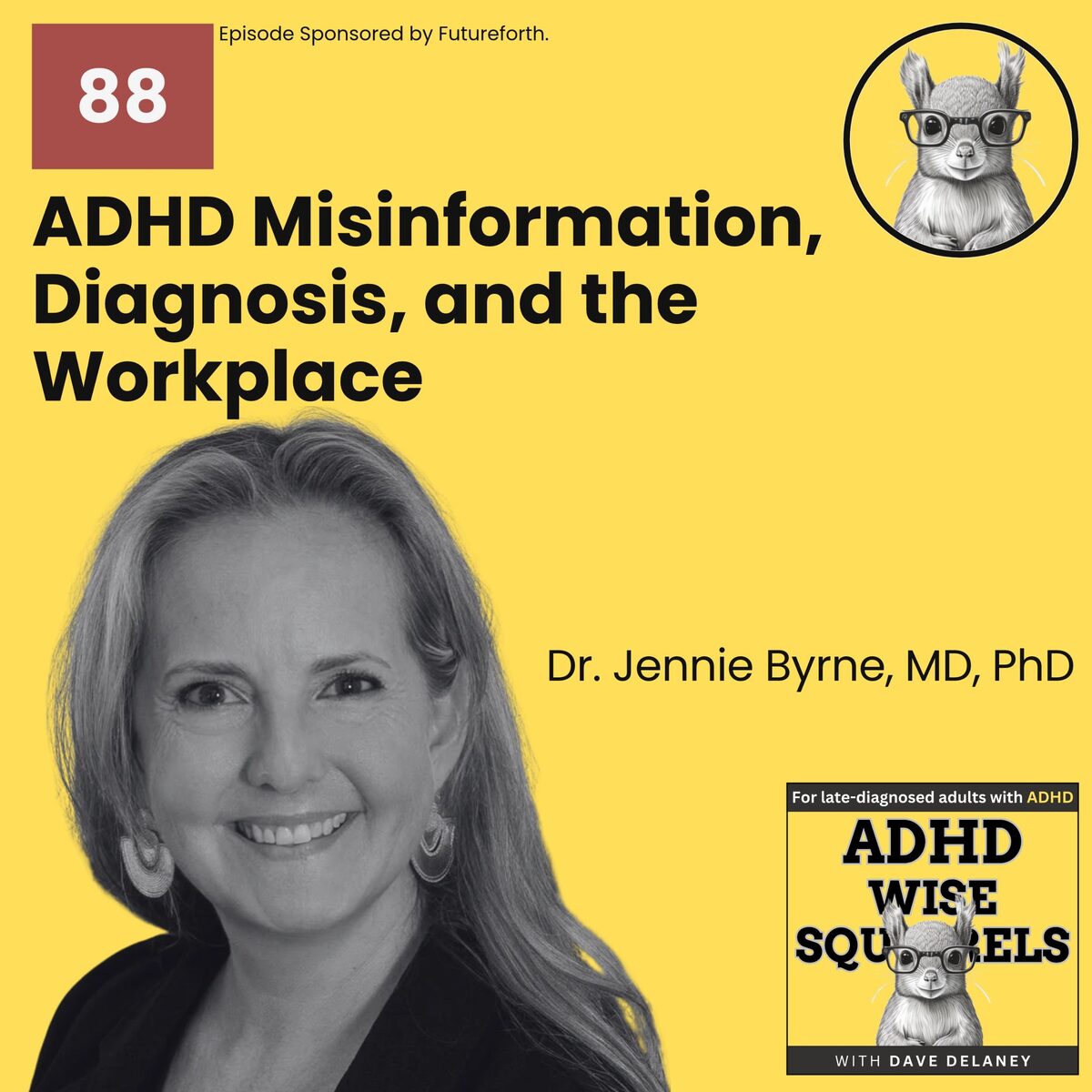
About Dr. Jennie Byrne
Dr. Jennie Byrne, MD, PhD ("Dr. B" to her patients) is a psychiatrist and neuroscientist who earned her PhD studying attention before trading academic research for clinical practice and entrepreneurship. She has treated adults with ADHD for more than 20 years, starting when the university down the road in North Carolina began sending her every ADHD referral it couldn't take. Today she assesses patients in 25 states, coaches clients anywhere, and advises healthcare companies.
She doesn't have ADHD herself, but she does have a neurodivergent college-age kid, so she knows the lived experience from the parent side too. Her third book, ADHD in Professionals: Embracing Your Brain, was written because she was alarmed that the stigma and misinformation around ADHD in high achievers is as bad today as it was when she started. Find her practice and her free ADHD resource list at constellationpllc.com.
The ADHD myths that keep adults from getting help
Dr. Byrne is encouraged that more people know what ADHD is, and that treatment now goes well beyond pills, with coaching and CBT coming a long way. But the misinformation still discourages her, especially three myths:
- "ADHD equals Adderall." Medication is one tool in the toolkit, and there are many medications and non-medication options people never hear about.
- "You're too high-functioning to have ADHD." Doctors, lawyers, CEOs and entrepreneurs have ADHD at least as often as anyone else. She estimates 5 to 10% of adults have it.
- "I can tell in five minutes." Whether someone says nobody has ADHD or everybody does, there is real science behind how to diagnose and treat it.
Dave shares how misinformation spreads from one big podcast to the next, from Gabor Maté's claim that trauma causes ADHD to Dr. Daniel Amen's brain-imaging claims. Dr. Byrne's antidote is simple: get high-quality information, stay curious, and fact-check what you hear.
How to use AI to fact-check ADHD claims
One of the most practical moments of the conversation is her AI prompt for anyone researching ADHD. Ask your AI tool for two things side by side: what high-quality scientific sources say (PubMed, and journals like JAMA or Nature), and what the popular press says. Sometimes they agree. Often they don't. She also recommends CHADD, books by Dr. Russell Barkley, Dr. Ned Hallowell and Dr. Russ Ramsay (a two-time Wise Squirrels guest: listen to Rethinking Adult ADHD), and, for the science nerds, the APSARD conference.
And a reality check: in four years of psychiatry residency, she received 45 minutes of training on ADHD, and it was about children. That's why she suggests seeking out a clinician with real ADHD expertise rather than assuming any primary care doctor will know.
The three-part ADHD assessment she trusts
Dr. Byrne explains the best-practice approach she uses to diagnose adult ADHD:
- A clinical interview covering your history and family history.
- A standardized rating scale, such as the Barkley executive function scale, completed by you and by someone who knows you well.
- An objective computer test of attention, such as QbCheck, which she also uses to see how well a medication is working, the way a doctor checks blood pressure.
If all three point to ADHD, she's confident. If only one does, it's time to dig deeper. Her story about a night-shift nurse who "had ADHD" (until they talked about sleep and eight hours a day of Instagram) shows exactly why.
She also explains why she sees ADHD as a lifelong brain variant rather than only a disorder, why a "mild" ADHD brain can still cause serious distress, and how perimenopause, illness and life stress can shrink your brain's capacity at any age.
Rethinking the workplace (it started at the Ford factory)
Dave believes the accommodations people with ADHD ask for would make work better for everyone (he wrote about it in Bridging the Gap Between the ADHD Brain and the Modern Workplace). Dr. Byrne says yes, with a qualifier. Movement, standing meetings, heads-down time and clear, step-by-step instructions help most people, but not everyone. She traces the open floor plan and the 9-to-5 back to the Ford factory and makes the case for blowing up the design altogether.
Her advice for leaders: don't rely on surveys, because people are notoriously bad at saying what they need. Observe your team instead. Have everyone, leaders included, share a "get to know me" page with their best hours and preferred ways to communicate. And try her keep, start, stop, improve check-in in place of "What can I do better?"
What you'll get from this episode
- The ADHD myths most likely to delay an adult diagnosis, and how to answer them
- A simple AI prompt for fact-checking ADHD claims against real science
- What a thorough adult ADHD assessment includes, so you know what to ask for
- Why so many doctors aren't trained in adult ADHD, and how to find one who is
- Workplace ideas for leaders: observation over surveys, "get to know me" pages, and keep, start, stop, improve
- Her answer to feeling stuck mid-career: start with a "destination postcard" of where you want to go
Questions this episode answers
Can you have ADHD if you're successful? Yes. Dr. Byrne works with doctors, lawyers and CEOs with ADHD and says it is at least as common in high achievers as in the general population. Success often hides how much effort it takes.
How is adult ADHD diagnosed properly? She recommends three parts: a clinical interview, a standardized rating scale completed by you and someone who knows you, and an objective computer test of attention. Agreement between the three gives the most confidence.
Is Adderall the only treatment for ADHD? No. Medication is one tool. There are several medications, plus CBT, coaching and changes to your environment.
Do ADHD workplace accommodations help everyone? Many do, like movement, focus time and clear instructions, but not all of them. She suggests observing your team and asking each person how they work best.
Links and resources
- Dr. Jennie Byrne: constellationpllc.com (sign up there for her free ADHD resource list)
- Book: ADHD in Professionals: Embracing Your Brain by Dr. Jennie Byrne
- Mentioned: CHADD, APSARD, PubMed, Dr. Russell Barkley's work (see his response to the MAHA report), and why your phone is so hard to put down (Phones Are Addictive: Here's What to Do About It)
- Wise Squirrels: wondering about yourself? Take our free ADHD test. Ready for a plan that fits your brain? Book a free good-fit coaching call with Dave.
Transcript
Dr. Jennie Byrne: So, I'm Dr. Jennie Byrne, or Dr. B is what most people call me. I'm a psychiatrist and a neuroscientist by training. And I've been interested in ADHD since my undergrad days and actually did a PhD in attention. It was more on the basic science side. Was planning to be an academic researcher and realized that I'm more of an entrepreneurial spirit. So I eventually left academia. And since then, I've really focused on brain and behavior in a variety of different ways, including clinical practice. And I've been seeing folks with ADHD since at least two decades now. When I moved to North Carolina at UNC, I'm down the road from the university and they weren't treating ADHD. So, they started sending me everybody and I quickly realized I better educate myself and learn more about the best way to help folks with ADHD. So, that's kind of how I got started. And full disclosure, I do not have ADHD myself. I do have a neurodivergent kid who, I've seen the lived experience a little bit more from the parent
Dave Delaney: Yeah, it's interesting. Like there's it's just a wild ride. You know, as I mentioned before, like being diagnosed at 50 and sort of, you know, being careful not to dwell on the past, of course. And and learning everything that I have about ADHD. And certainly with college and being so close there, I would yeah, I could see that because you know, one se one group at least of folks who I find are often young adults going to college when this the wheels fall off and they no longer have scaffolding and suddenly whether they know they have ADHD or not that is specifically a difficult time for a lot of people. And so of course there's anxiety and and depression and things that are common comorbidities along with ADHD. Of course you can have them without it but so all these things yeah happen. What are some of the things that you have learned in the in the last in in in your tenure doing this and and serving ADHDers?
Dr. Jennie Byrne: So, I think on the the sad side maybe or the bad side, I I feel that the stigma around ADHD for some groups of people in particular, I work with professionals typically has gotten worse. Which was one of the reasons I I wrote my third book on the topic this year because I was really alarmed at how much misinformation and stigma there was even you know I've been doing this for 20 years like I think it's just as bad if not worse now than it was back then. So that's kind of on the sad side. I think on the on the positive side, I've been really happy to see people be really more aware of ADHD, like at least understand what the word means and kind of have an interest in learning about it. And the science is starting to come along. Treatments are starting to come along, not just pills, but also other kinds of treatments and coaching. CBT has really come a long way. So, I'm encouraged by like the new tools in the toolkit and the interest level, but I'm really discouraged by the misinformation and stigma that's still out there.
Dave Delaney: What are some of the the misinformation pieces that you that jump out or that you think of right away that you hear about?
Dr. Jennie Byrne: I think one of the biggest ones is medication. Obviously, there's a lot of debate. People can have very strong feelings one way or the other about medicines. I'm a physician, so I do prescribe medicine. I see it as a tool in the toolkit. But what I'm discouraged at is that people just think about Adderall or Ritalin or like they they think that's the only treatment and then they get kind of caught up in the media press about controlled substances and all that, but in reality, there's a lot of medications and non-medication tools to treat ADHD. And I feel like people don't talk about that and and they don't know about it. And I think what I get discouraged is that when when adults maybe maybe like your experience when you're seeking help and maybe you go to your primary care or you go to a trusted therapist or psychiatrist even many people are told you're too high functioning to have ADHD or well you weren't diagnosed as a kid or oh you're a woman or like they're given all this misinformation and they're seeking help and so then that delays treatment even longer. Er and more stigma and and that's really discouraging. So I think that's a big myth is like ADHD equals Adderall. Like I don't know why that's still the myth but that's a big one. Also big myth around intelligence and achievement and ADHD. You know I work with doctors and lawyers and CEOs and entrepreneurs. I mean, ADHD is just as prevalent in these groups as in the general population, maybe even more for some of these high achieving people. You know, we think it's 5 to 10% of the adult population. So, that's a lot of people. So that, you know, kind of the two you're too high achieving to have ADHD. That's one I really get upset about. And then the other thing I think I get a little upset about is people saying either nobody has ADHD or everybody has ADHD or I can just tell if you have ADHD and oh I you know we do an ADHD assessment by just talking with you for five minutes and then I can tell like there's a science actually out there and I'm very discouraged that people don't know about the science of how to diagnose and treat ADHD.
Dave Delaney: Yeah, the it is I know it's it's challenging too because a lot of physicians are not trained on the topic too, right? So like that it's I know it's kind of like it's it's I don't know it's unfortunate that way but I also yeah I find a lot of the tips that I give people you know like when you you know and and by the way I always preface these conversations by saying I'm not a doctor and I don't pretend I'm one on the internet because there's plenty of people that already do that. And then there's people that that blatantly dispel, I would argue, disinformation even be because they know they're doing harm. They know they're wrong and they're doing it continuously. You know, Gabor Maté is like the name that always comes up in my mind. But there are, you know, Daniel Amen or whatever his name is, the brain imaging guy, who, you know, there's there's so many that are out there. Like I under I I understand if somebody is wrong, you know, like I like Mel Robbins. She's huge. But the problem is Mel Robbins, not to throw her under the bus necessarily, but and I was just talking about this on another episode, But Mel Robbins interviews Gabor Maté and Gabor Maté tells her disinformation that trauma causes ADHD and then she's not a doctor. So then she goes on like SmartLess another podcast with popular people and dispels this misinformation now because I don't know if she knows she probably doesn't or didn't at the time and and then the it just spreads and spreads and spreads like you're saying with TikTok and or with you know social media these days. H what are some ways that you think this misinformation can be combat? It can be you know like what are some ways that that we can help you know I I I've made a couple mistakes on the podcast in 80 episodes and I'm always keen to hear what mistakes I've made so that I don't so I correct them. Luckily the the only real big mistake I made, and it's not even a big mistake, is that I said there are three types of of ADHD, and I've learned that there is one type of ADHD and three presentations of ADHD. So, anyway,
Dr. Jennie Byrne: That's a Yeah, splitting hair is a little I wouldn't beat yourself up for that one. And and I would say, you know, as with any science and understanding, it changes over time. And so, sure, there'll be things I maybe am not even aware of that my patient will bring to me and we'll learn together. And so, I think the learning together and being open and doing your homework is really the key to giving good information. I wrote a book this year called ADHD and Professionals: Embracing Your Brain. And the reason I wrote it was because I feel like there's misinformation. So, one of the things you can do for high quality information, there are high quality books and I know people with ADHD, some people that's really hard to read and audio can be very helpful. I tried to make my book very like ADHD friendly where you can kind of like hop around. So there are good books. You mentioned Russ Barkley. I mean, some of the folks I recommend are Russ Barkley. Dr. Russ Ramsay is a good colleague.
Dave Delaney: He's been on twice. Yeah,
Dr. Jennie Byrne: He's awesome.
Dave Delaney: He's great.
Dr. Jennie Byrne: Dr. Hallowell's books. He's a psychiatrist who has ADHD, wrote some of the original. I think those are good lay press books. If you like books and then I try I on my website which is constellationpllc.com. I do have an ADHD resources so people can put their email. I'll send it to you and I do update it, you know, as I see things I think are good information. But for for folks out there listening who maybe are really into the AI tools to synthesize information, actually I you know I like to use AI in my practice, but it's of course how you use it. So what I would recommend to you when you're searching, if you're using an AI tool, what I would do is ask the tool to bring you two sets of information. Ask it to review high quality scientific literature using PubMed PubMed that's the national database of all scientific articles and you can say like the journal of neuroscience like nature like the journal JAMA so you can say use high quality reputable sources and then ask what's popular in the popular press and you can kind of see side by side like what does the literature tell you versus the popular press and they might agree and they might not agree. So even if you're not a scientist or a doctor, you can use AI tools to query high quality information sources. I also think that the CHADD website is generally a good place to get information. If you really want to nerd out and like go to a conference and see the science, APSARD is kind of the nerdier, more academic conference. I think anybody can go to that if they want. So if you're going to look for information, I would look for high quality information. I think podcast, like you were mentioning some of these folks, you know, everyone has a different point of view. People have lived experiences to share and those are all fine to listen to as long as you're clear on like you know am I getting scientific evidence or am I just getting popular press and and that and popular press has good stuff so it's not necessarily that it's all bad or good but just know what you're doing I guess is my my message to people and I'm happy to share my resource list with you and be open you know to like learning and being curious and if someone tells you go look it up. You know, again, we have AI tools now which make it very easy to fact check articles, right? Like just fact check it.
Dave Delaney: And even use like multiple LLMs. So you could use like Gemini, Google's Gemini, Open AI's ChatGPT, but then I I I love I'm I've been using Claude a lot and also Perplexity.
Dr. Jennie Byrne: Me too.
Dave Delaney: Perplexity is really great for research too. Because Perplexity will give you sources as well. But to your point, I think that's a great prompt idea as well so that people do get properly informed and don't and that that's the point like I I I think people share misinformation often unknowingly, right? Like they're they're but they're doing more harm by doing that because they're downplaying the severity of a life unknown with unknown ADHD and untreated ADHD.
Dr. Jennie Byrne: And I think you mentioned you know misinformation in physicians and training. So for example, so I'm a psychiatrist. Psychiatry is a specialty. So I do four years postmed school specialty training. In that four years I had 45 minutes on ADHD and it was in children. Now, that was a long time ago. Go. So, I'm not saying that's the case today. If you're primary care, it might be even less. So, I think some of the newer docs are getting more training, but it's still really minimal. So, you're correct that like your general primary care person is not going to be an expert in ADHD unless for some reason they have a personal interest and they've taken it upon themselves to become an expert. And I have a lot of colleagues in the ADHD world who came from, you know, primary care, developmental peds, neurology, like different backgrounds, but they just for whatever reason had a personal interest or a lived experience and so they've become an expert. So, I think another thing I recommend to people is like don't ask your primary care about ADHD unless they happen to be one of these people who are trained and experts in ADHD because they may in a very well-meaning and caring way send you astray.
Dave Delaney: I often recommend people actually I do the well what I say is like talk like ask your GP or your physician your family doctor like about ADHD but ask them not like set it up like hey what do you think about ADHD? Keep hearing about it in the news or something and see what they say because if they say, "Oh, you know, you you grow out of it or it's not real or it's, you know, overdiagnosed and blah blah blah," then you know right away go find a new doctor because they may not believe in
Dr. Jennie Byrne: Or if they say or if they say oh here's Adderall
Dave Delaney: Cancer, right?
Dr. Jennie Byrne: Same thing it can go either way they can say it's does it doesn't exist or they can say everyone has it or I don't care here's a prescription like Who knows? And or they might again be very well-meaning and just say, "Well, you're a successful person and like you're 50 years old and like I don't think you could have ADHD because you never would have been as successful as you are
Dave Delaney: Absolutely. Yeah.
Dr. Jennie Byrne: Today.
Dave Delaney: So, with your book, one thing that I I just wrote an article recently reflecting on my own career and everything I know about ADHD, and I feel like if more leaders of businesses, founders, CEOs, whomever, if they embraced ADHD accommodations without even thinking about ADHD so much, but if like my my premise here, my theory is that all the ADHD accommodations would make the workplace awesome for everybody. Like I don't know of things like you know for everyone. So like it's almost like this perfect if you if you want to like inc if you want to improve the culture at your business then like just yeah tick the boxes do everything like pro ADHD accommodations and and watch watch things improve. What are your thoughts?
Dr. Jennie Byrne: I would say yes with a qualifier. I I've done a couple LinkedIns on this with folks who are really deep in the weeds of of what you're talking about. And I would say yes, there's c there's some things that are currently considered accommodations that would benefit the majority of people. So, for example, allowing for more movement. So allowing people who work at home not to be doing this all day in front of a screen, allowing people who are in person in an office to stand up during meetings, allowing people to take walks, having standing desks, having you know all of these movement things. Yes, I think that would benefit anybody. I think an understanding of your brain and your body and when is like the most the best time for you to do certain tasks like my circadian rhythm. I work best from 8 to 10 a.m. I need heads down time. I don't want to be getting pinged. I want to go off my Slack or I work better 4:00 p.m. And like I want to do. So yes, that I think understand because everyone's different. So I think that kind of thing can help. Distractionfree environments I think help most people although there's some people out there who probably benefit from the social energy and buzz around them. So that one not everybody. The recommendation around giving instructions that are clear and broken down step by step. Most people would benefit from that. Some people don't like that and it would be feeling very micromanaged to them.
Dave Delaney: Let let me debate because I love I love what you're saying here. So like the o the when I had job jobs I've worked for myself for about 13 years but the last two companies I worked for had open concepts which I liked actually because I'm social and extroverted much to my wife's horror to drive her crazy but I digress. So but there were quiet areas rooms that you could go into if you wanted to just focus on something quietly. So for offices to be designed, assuming you're going to work, let's say like to an office, the office to be designed in a way that's open concept but also private or also quiet, right? So you can have a bit of both.
Dr. Jennie Byrne: I would take it to the next level. So, so okay, my my first book was on the modern workplace kind of post-pandemic and how to understand neuroscience to like optimize your work. So the entire floor plan of our offices, most offices today are central area with cubicles or open and then a ring of offices right around the Where did that come from? Do you know Ford factory baby?
Dave Delaney: I'm going to guess factories. Yeah,
Dr. Jennie Byrne: All of it,
Dave Delaney: Just like classroom like traditional classrooms.
Dr. Jennie Byrne: Everything goes back to the Ford factory floor. And that was an innovation at the time. And Ford had this crazy idea that he was not going to make people work 7 days a week, 10, 12 hours a day. He had this revolutionary idea which social scientists had been promoting for a long time to get to the 8 hour workday. So the Monday through Friday 9 to5 was born at Ford. Similarly, the Ford factory revolutionized how they built things by having a central area where they built the cars with the workmen in the middle working on the cars and then they had supervisors and the supervisors were not off in another building. They ringed the factory floor so they could be actively going out to the factory to help. That is where everything came from. If you look at office buildings, other buildings prior to the Ford factory, it was very different. So what you said, yes, having a central concept in the middle with quiet on the outside, yes, that would be an improvement, but but I would say if you really want to optimize, you probably blow up the whole concept as it exists. And you probably have outdoor spaces, you probably have sensory rooms, right, like you were saying. I know they call them lactation rooms or whatever, like things like bio rooms. I don't know what you want to call it. People have biological needs. Some people have colostomy bags. Some people, you know, there's a lot of disabilities that people need special physical time, right? So, I would say yes to what you're saying. If if that's what you're working with, having quiet rooms outside is helpful. But I would go a step further. If you could design the building from scratch, you might actually blow up the whole thing and think about how can I keep people physically active and moving in different ways.
Dave Delaney: I was a Yeah, that's great. I mean, I was a speaker for Google for about six years and so and I've worked for tech companies before that and also other traditional broadcasting and prom and entertainment companies before that. And so those spaces were always made with that in mind. Perhaps because to your point earlier, like perhaps the founders themselves were had ADHD whether they knew it or not. So I think, you know, even going to like Mountain View to Google's, you know, head offices there. And and just observing it. And even YouTube's offices have like a a slide, which okay, I mean, yeah, that's cute. So it's a Yeah, that's interesting. So, but yeah, I think Yeah, I don't know. Yeah, be I I like your idea though.
Dr. Jennie Byrne: And people other there are other you know there are other neurodivergencies as well right and
Dave Delaney: I like
Dr. Jennie Byrne: So some folks who have autism spectrum neurodivergencies they have slightly different needs as well even though ADHD and autism are commonly found together or like I mentioned there are physical disabilities that people have which have a different set of requirements. Or the you know the mom who's trying to pump. That's a physical need that she has that's not being met. So, I guess it's just like thinking about the t I always say like think about the team. Who is who are the humans on your team? And in our current day, who are the robots on your team? You know, we have probably AIs and other robots to help us. What are you trying to get done? How much time do you have to get it done? And then work backwards from that. And I find that people, it's not hard to figure out what the workplace should look like or when people should come to the office or blah blah blah. If you think about it backwards from like what's the task, who are the people, who are the robots, and what's the time frame, making those decisions is actually not as hard as you might think. But you have to start at the end and go backwards.
Dave Delaney: And so and with those goals, I would I would say like some of those goals as a leader of an organization would be, you know, employee like like having a reputable good culture, not just like, you know, you bought a a a badge from a newspaper or something saying, "Oh, best place to work, but actually like having your team members happy because that improves retention and it costs SHRM did a study, the Society for Human Resources Management, and it costs like between 60 or 30 to 40% % of someone's salary to replace them if they quit. So, and then you have what Adam Grant calls turnover contagion that occurs when one person leaves and then other people follow suit and suddenly you have this mass exodus on your hands and you've got to replace everybody. So doing things like stay interviews and finding out like what what your team members what makes them happiest regardless of their neurotype and then designing to your point like kind of assessing and then designing to meet those those needs because if you don't have the team then good luck.
Dr. Jennie Byrne: And again, I would say a slight caveat to to to the model is asking humans what they want and need does not always tell you what they want and need. We are notoriously bad at knowing what motivates us as humans, all of us, myself included. So surveying people and asking them what they want is often not helpful. And if you have a professional who is very high achieving, they may not actually want to tell you the accommodation that would make them successful for fear of stigma or other issues. So I think my my caveat to what you're saying, I would not recommend surveying people. Actually, what I recommend is observing people. So I work with a lot of healthcare companies as an adviser and I always say don't survey the doctors. Like whatever you do, don't survey them. You're going to get sent in a totally wrong direction. Just go to a doctor's office, shut up, sit there, and watch them. Watch them for a day. And that's going to tell you more about what they need and what their pain is than any survey you could. So, I think I have a little bit of a negative reaction to the like pool tables and slides and pizza days and because like that's an assumption about what's important to people based on your lived experience typically. Again, I'm a little biased. I work with a lot of Silicon Valley people. They often have a lot of assumptions about what people want that is not actually what the people want. And so, I am a little prickly about that. But sometimes it's just a very simple small thing like I want to pick my kid up every day after school. That's the most important thing to me. Or I want to have a lunch break or I want to have Wednesdays I need a half day on Wednesdays to work on my writing project. So like what people want is often not like what you assume they want. And so I guess that would be my other caveat is like sometimes just by observing people it's really helpful. The other thing you can do if you're a team leader is to just normalize the idea that we're all different and to say I let's do I want everyone to do like a get to know me page like my time of day is this. This is the best way to communicate with me. This is what's really important to me. And everybody does those including the leader of the team. And then you sit down and you say, "Oh, well, look at this. You like to work from 8 to 12. I like to work from 12:00 to 4:00. So maybe if we're doing a project together, like that's we hand it off or maybe we shouldn't do something if we need to synchronize." So I it always shocks me when I advise companies and and do this work that people always say they want to make everyone happy in retention, but when it comes down to the actual doing it, people get so uncomfortable. And it's really not that hard. It's really not hard, but is there something about it that makes most people really uncomfortable to say like this is what I like and this is what you like and we're different and like how do we work together instead of the Ford factory where we're just like a robot widget working on this car and so we're all the same and we're all replaceable, right? And we're just plugging people in and out, which is really the corporate America. Anyway, I digress, but you get the idea.
Dave Delaney: No, you're spot on. Yeah, I mean that's why I love stay interviews, right? Because that's when you you schedule or not even schedule, you just have informal conversations one-on-one with your top team members at first and then move along the the company and just like find out like how they're doing, what's what, you know, where they're at like and and set it up in a way that's not scary that they think they're going to about to be, you know, laid off or fired or whatever, but instead have a like just say like start by saying, "I love what you're doing. You're awesome. Like I I feel you know thankful you're here all the time like with the company and so on and I just want to check in and see like you know what could I be doing better what could we do be doing better as a company you know that kind of thing just to see and then if you have the guts or not the guts, but if you feel like and and the rapport is there, you could also ask and again maybe not for everybody, but you could ask like what would what would make you decide to leave here? Like I don't want you to go, but what would make you decide to leave if if you were and they may and that's when they may say well more money or better benefits or some of the stuff that you're talking about,
Dr. Jennie Byrne: I like all that. And I I the way I found it helpful is to use a framework of like keep doing start doing stop doing improve. So when you do it instead of jumping to the like what can I do better I I find a lot of employees people get like a little bit like oh they they kind of react to that right there's a little bit of so if I say look I want to kind of assess all all the what are we going to improve keep start stop and then you just kind of go through okay what are we doing that we should keep doing okay great what are we doing that should we could make it better great what should we stop doing that's a big one because like people don't typically tell you we should stop doing something because they don't want to look lazy or like they don't want to do their job. But if you prompt them and say look we need to aggressively stop doing things so that we can take on new things. What should we stop and then what should we start? And when I use that framework I think it makes people at e it puts people a little bit more at ease.
Dave Delaney: Yeah, I love that.
Dr. Jennie Byrne: And then the other thing you mentioned about like checking in with people I again this is where I think sometimes you just observe. I had a one doctor who was in her late 50s and I realized she had never taken an unplugged vacation. I was watching her on vacation and she was like responding to emails and things and and then so when she got back I was like hey I noticed you were checking in and she's like yeah it's just easier you know I get stressed. I was like, "Well, you know, there's a lot of science behind the background, you know, taking an unplugged vacation, and I would really love to see you be able to take one. Like, what would it take for us to like," and it took her six months to get comfortable with the idea, but I said, "Look, I'm just going to keep bringing this up, and it may be annoying, but like I I really think for your well-being and your ability to succeed at your job, like taking unplugged time is important, so I'm just going to keep bugging you." And and we did. And I kept bugging her and eventually she did it and she came back like a new person and she was like, I never thought I could do that. It was really just like her own mental construct that she couldn't do it. She actually could do it
Dave Delaney: Right. Right. Yeah. And I've I've done that too, like take breaks. I mean, being an early adopter and social and back before I went evil. And you know, so I've I've Yeah. I and and also not knowing first of all not knowing I had ADHD and and now understanding our prone and and potential to addiction and excess Then when the device itself is designed to be addictive, it it makes it a hell of a lot harder and the apps and so on to to put that thing away. So yeah, I do I do encourage people to do that. Like just shut her
Dr. Jennie Byrne: I have I have one one man I'm working with right now who I've known for a long time.
Dave Delaney: Down.
Dr. Jennie Byrne: He's ADHD and he keeps beating himself up because he gets sucked into YouTube videos and stuff like that. And you know I'm constantly trying to say look that these companies have spent I mean you know billions of dollars trillions of dollars designing these things to grab your attention and keep you stuck. So like expecting yourself to override trillions of dollars of research is like not very realistic. It's not kind to yourself. Like the reality is you just have to put it away somehow. Like you can't beat it. It's designed to do this and they've invested fortunes, right? You know, to get people to use their
Dave Delaney: I mean, absolutely. And I think also,
Dr. Jennie Byrne: Product.
Dave Delaney: You know, something I always talk about is like when you're because I get the question a lot like after you were diagnosed, what, you know, what were some of the first things you did? And and one big one is to learn what as I learned about it, realize that I need to give myself grace and just realize that like at a certain time of day, I might be out of steam or if I'm at a networking event and I'm talking too much or interrupt somebody, I'm like, damn it. Not to beat myself up again, but just that's what I love about the future after a diagnosis as you learn about ADHD because you understand what I call your operating system and you can start to look through your life through the lens not in the past because I don't think that's healthy necessarily unless it get into that but but just moving forward understanding that like oh that's you know that's why you know I or these are ways that I can kind of tweak things in how I show up at work or or elsewhere too.
Dr. Jennie Byrne: And I think for neurotypical quote unquote people as well, same thing. Like understanding how you work your mind, your brain, and your body brings you it makes it easier to give yourself grace. And ADHD my my approach to ADHD, I do take a strength-based approach, which is debated, right? Like there's a reason it's also framed as a disability. But but when I work with people, I like to take that strength-based approach because often the ADHD brain can do these like really cool things in the right environment. And so sometimes, depending on where you're at in life, you can actually make pretty big changes to your environment that will make your ADHD brain feel like really happy and good. Or if you're young at the beginning of your career, sometimes people can really like pick careers and jobs and situations that really make their brains happy. And so, seen people really thrive and and yes, medication helps and yes, therapy helps and all of it, but there's a difference between surviving and thriving. And it brings me great happiness to help people thrive and like paint that picture of like what things can be when you really like take a holistic approach.
Dave Delaney: Well, how do you handle folks who you know the big stuck word and maybe feeling midcareer that again not reflecting on the past as much although you do have to tap into some of that but but in in deciding which direction to go this is something I've worked with with personally with my therapists as well over the years, but it's something I still struggle with too, which is and the way I describe it is like not a fork in the road, but rather well maybe like a fork in the road, let's say, with multiple prongs and you you get to that the prong part and you go down one of the one of those lanes, one of those whatever to a point and then you realize like, oh, whoa, whoa. What am I doing down here? I need to go back. And then and then I should try this instead. So, I'll go up that one. And then I go down. I'm like a little bit and then I go back and then I'm like, "Wait a minute. What if I tried that and I go down that and and you you find that if you just stuck with one avenue and went all in and went straight. Let's just keep going this way that success would come in some professional stance. But again, sometimes you're wrong. So it's partly I don't know taking risk. It's I don't know. What are your thoughts on this?" And and have you heard this with other professionals that you that you work
Dr. Jennie Byrne: When you were talking,
Dave Delaney: With?
Dr. Jennie Byrne: I had this horrible image of rat mazes and rats. I was a rat researcher and imagining the rats. You made it sound like the rats going down the paths and then backtracking to go find the food. When I'm So, yes. I mean, the short answer is yes. I see this all the time. And this is the kind of one of the types of ADHD tax if you've heard that term right the tax one of them is in your career that you can either be so rigid and stuck on one path that you don't want to leave the path for fear like I don't trust myself to do something different or on the opposite side novelty seeking and impulsively making job hops and career hops and then not really getting to the full potential of any one thing. So I've seen both. And how do you decide what to do or where to start? I mean, what I like to do is architect the vision. So, I want people to have a destination postcard of what where they're going. So, in, you know, in your perfect world, if your brain was totally happy and your body was happy and everything's like, what would your day be like? When would you wake up? What would you do? Like what you know just start from the the vision because I find a lot of people actually don't have the vision and so then they're like the rat in the like oh well this path is here this path is here and so they're just kind of like you said trying different paths as opposed to being like oh well this is kind of where I want to go and I don't know the path to get there but like I know where I want to go and so a lot of what I do is I try to help people come up with that vision so that they aren't like the little rat kind of going down and then the other thing I do and this is part of my clinical practice when I assess people and I I currently assess people in 25 states, I really believe strongly in pulling in the science of objective measurement. And most clinicians don't do this yet, and I really hope they will. There are different objective measures of attention and ADHD features with computer testing. There are also standardized executive rating scales like the Barkley, which I really like. I use the Barkley rating scale, but I use a computer test of attention. And the reason I think it's so important is I need to know where your brain is at so I know where to start. If your ADHD brain is off the chart, you might need medicine even to take advantage of coaching and CBT and like you may not get anywhere until we have medication assist you and then maybe later you don't need it. But I need to know where you're at. So, if I were a doctor treating high blood pressure, I need to check your blood pressure, right? Like, I'm not just going to ask you, "How do you feel? Did the medicine help you?" No, I'm going to like check your blood pressure, right? So, we do have scientific ways to check for symptoms of ADHD in our brain. So, I believe strongly in doing that as part of the assessment. And I also use it to titrate medicine. So, if someone starts a medicine and they say, "How do I know if it's working? I'm 50 years old. I have I've never taken ADHD. How do I know? It's a great question. How would you know? So, I like to use the computer test as an objective measure to see what the medicine is doing to your brain the same way that I would check your blood pressure if I were giving you a blood pressure medicine. So, I hope people I don't know out there listening, you know, if you have access to a clinician who does objective testing for ADHD, I really would think about that in the holistic picture. Not necessarily. You are going to take meds, but if you're, like I said, if you're off the chart, you know, you're going to get very frustrated trying to do CBT or coaching or self-help because your brain is just not there yet. Like sometimes it's like anxiety. People whose anxiety is so severe they can't even go to therapy. Like you have to sometimes use medicine to get them to a place where they can do therapy and then sometimes they come off the medicine later. So, I guess that's a long answer to your question, but I, you know,
Dave Delaney: That's interesting.
Dr. Jennie Byrne: Two parts would be have a vision of where you're going instead of just making binary yes no choices all the time because humans are really bad at binary decisions. And then thinking about your ADHD as grounded in science and understanding like where your brain is at over your lifespan because spoiler alert, we get old and sick. Your brain has less capacity. If you're a woman in perimenopause, hey, your brain has way less capacity. You know, if you're in a traumatic situation in your life, you're getting divorced or your parents are dying or, you know, spoiler alert, your brain is going to be at a reduced capacity. So, your brain is a living part of you that changes over the lifespan. And so, I like the objective measurements as a way to really understand like where is my brain at?
Dave Delaney: And when you say like because you mentioned like ADHD being like off the charts and an example of that you know my understanding with ADHD is that we go through life like we always have ADHD obviously Okay. But there are periods of life that even a diagnosis would be difficult because everything's going hunky dory. And it's only until we can tick enough boxes in different categories of where things are going wrong or not or, you know, where things are not positive, let's say. And and family history and all that to then start to determine you know, whether you have or or whether it's anxiety or depression. And and not as a comorbidity but rather just as a standalone diagnosis. Is that
Dr. Jennie Byrne: It is. This is what's really interesting because there's different ways to understand what ADHD is. So I believe my personal belief based on the science that I've done in my years of experience, I believe it is a brain variant. It is a type of brain that you're born with. It's highly genetically controlled and it's with you your whole life. The term ADHD, attention deficit hyperactivity disorder to meet criteria for a disorder in our current way of diagnosing means you have to check boxes saying you're dysfunctional. Most of the people I work with are not dysfunctional. They're high achieving. They're doing okay. They're getting by. That doesn't mean they don't have an ADHD brain. So, I think about it as a brain variant that's probably very helpful to the human population to have people with this kind of brain in it. It's probably with you your entire life. It may not manifest as a disorder, quote unquote, unless under certain circumstances. But when I do the objective testing, that's your brain regardless. I mean, you could have I could test you for ADHD. You could be off the chart, but you could still be a professional legal litigator who's making a ton of money and has a family. Like I have people like that right now and they're doing great, but this but the effort that they are putting in to achieve what they're achieving is huge and it takes a toll and that's where the whole trickiness of it, you know, anxiety and depression and substances and gambling and like it all starts to get like in a tangled little knot that you have to unwind. But their brain may be off the charts and and they're functioning just fine. Or I get a lot of people whose ADHD their brain is actually on the mild side. They're actually their brain isn't off the chart, but they are highly distressed and highly dysfunctional. So the brain to me is separate from the level of distress, if that makes
Dave Delaney: Yeah, absolutely. Yeah. Dr. Jennie Byrne: sense.
Dave Delaney: So let me be a little more clarity on the on this process that you're talking about. So, it's a like a is it like software that kind of like a survey that the person takes to answer questions and sort of that kind of thing or is it like how like how does that how does that work? I mean,
Dr. Jennie Byrne: So the approach,
Dave Delaney: Obviously you're comparing it to family history and and all that stuff, too.
Dr. Jennie Byrne: Right? So, the simplest way to describe what I think is best practice is a three-pronged approach. The first is the clinical interview, which is what most people do where you say, "What's your family history? What was, you know, questions?" Right? The second is some sort of standardized rating scale that is evidence-based, standardized. We have gender and age norming. I like to use the Barkley executive function scale. There are other ones kids will sometimes use the Vanderbilt. The reason that's important is because you're getting the perspective of the person plus somebody who knows them well. So that observer rating is extremely important because the person may or may not observe in themselves what other people observe in them. So I believe that's critical. And then the third piece is the objective measure. There are different computer tests out there. The one I like to use is called the QbCheck. It's a 20-minute at home. It's a European company. They've been doing this for decades. Tons of evidence. There are other ones out there called like the Conners CPT. There's a new one called Moxo, which I don't know as well. There's Creos that does some attention tests. There's a lot of things out there. I personally like Qb the best. Their evidence base is really good. I've been using that test for decades. I'm really confident with it. But there are other ones out there, too. So, doesn't have to be that one. If I think the three-pronged approach is the best approach, if all three are strongly positive for ADHD, I'm like super confident in my diagnosis. If two out of three are consistent and one is not, probably still going to make the diagnosis. I'm I'm probably still comfortable. But if only one out of three is positive, you really should dig deeper. And a a good example I worked with a young woman who was a nurse. And when you interviewed her clinically, she I was, you know, you're like, "Oh, this is ADHD, right? She looked everything." But we did the other parts and they were not consistent. And so I was like, "Let's go deeper. Let me talk to you about your day." And we got basically to understand, first of all, her sleep was incredibly disruptive because of the shift work she was doing. She was working night shifts and then she was not sleeping. And then she told me, she said, 'Well, I've cut back on my Instagram use to eight hours a day. And I said, cut, wait, cut back to eight hours a day. She said it used to be 12 hours a day. And literally the treatment plan for her was get your sleep on schedule and stop looking at Instagram. And then she didn't have the symptoms anymore. So that's why this three-pronged approach I really truly believe is the best way for people to understand what's going
Dave Delaney: No. Yeah, that's great. When it comes to, you know,
Dr. Jennie Byrne: On.
Dave Delaney: We see the acronym all the time and I've had the question from listeners before about what Dave, why don't you talk about autism? And I'm like, because I don't have autism that I know of. I have ADHD and you know I wouldn't start a podcast about you know any topic that isn't relevant right and so it is relevant and but the acronym ADHD we see a lot AuDHD meaning a mix I guess of both autism and ADHD is this something that that and and you can admit you don't know too if you want but I always love that. Is I know that obviously Well, let me just shut up and get to the question, right? Like tell me what you're seeing there as far as is it as rampid as it seems. Is it maybe rampid's the wrong word because, you know, people are getting diagnosed more with ADHD now because we're diagnosing people. So, I'll shut up.
Dr. Jennie Byrne: So, you're right. So, AuDHD is an acronym. It's not a diagnosis currently. So, you're right. It's people who self-identify as having some features of autism and ADHD. And again, my my experience with this is actually more on the lived experience side as a parent because that's kind of my kid's experience who is a college student now. And so I have learned a ton about autism through the lens of a parent. And I was very surprised that the understanding of autism is so different from when I trained, like really different and rapidly evolving. And so like for my kid, if you would have said, "Is your kid autistic?" I would have been like, "No, my kid's not autistic. They don't have any of the symptoms of autism. What are you talking about?" But through the current lens of how we understand autism spectrum, it's quite clear they do have some of these more mild symptoms. So, I guess my answer is I'm still learning about it. I certainly don't feel that I know as much as I should as a clinician. So, I don't advertise specialty in it. But I would, one of my goals actually as I work on my my own practice in the next year is to learn more and to think about how I can better integrate screening for autism as part of my process without putting more questionnaires and burden on my patients. I want to try to figure out though how can I screen for it and if somebody screens positive like I'm trying to build out my network of other professionals and colleagues who treat this so that I can either treat it better myself or refer it out because as a parent I ended up having to
Dave Delaney: Sure. Yeah.
Dr. Jennie Byrne: Get parental coaching and oh my gosh that was so helpful. I mean, like I it I don't want to say it saved our family. That would be overly dramatic, but it made a big difference in just a short amount of time. So, I guess the short answer is I think I know enough to know that I don't know what I need to know. So, I'm trying to teach myself more and I certainly learned about it with my kid and I've watched them really start to like thrive and embrace who they are. That's obviously as a parent, you know, really
Dave Delaney: That's great. Yeah. Yeah. And thank you for the answer, too. Yeah,
Dr. Jennie Byrne: Wonderful
Dave Delaney: Because I I'm I'm quite curious about it just from, you know, I think of like the comorbidities that can come can come along. That doesn't mean they will, but certainly anxiety and depression being the most, you know, popular bad fellas. But, you know, OCD, bipolar, you know, a lot of other things that can come along with ADHD. It doesn't mean if you have any of those conditions, I guess it doesn't mean you have ADHD either. But yeah, I am curious about how autism kind of fits into that because obviously autism is a neurotype as well rather than a a condition, right? Like depression or anxiety. So yeah, it's it's interesting. It would be interesting too to learn like over time how the two kind of Yeah. This has been awesome and I know the clock is quickly ticking away here. Do you have any questions for me or is there something I didn't ask you about that you you'd love to share about your time learning about ADHD and treating treating
Dr. Jennie Byrne: Yeah, I guess I would just say for people listening, if you have ADHD,
Dave Delaney: Folks?
Dr. Jennie Byrne: If you think you might have ADHD, you know, even if you've not reached out to get assessed, like you're not alone. This is 5 to 10% of the population. That you could be super intelligent, high achieving. So, just validating like, you know, it's okay like there and there are people out here who know what they're doing, who want to help you. It's just a matter of like finding them. I'd say that's the first thing. And then the second thing is I think this is a little bit more philosophical I guess. I think our current society that we live in, you know, we live in like hustle culture and we live in this very binary world of black and white and I think we have a lot more control than we think we do in our lives. So if your workplace is not working for you, if your device is not working for you, if you're not getting good sleep, you know, whatever it is, like I really do believe we have a lot more control than we think. But sometimes it's hard to get out of our own social construct. And so having a clinician or a coach or a peer or listening to show whatever like helps you create the vision of where you want to go and what thriving looks like. I just really encourage people like yes, you need to survive the day. Yes. But once you're surviving, like what does thriving look like and who's going to help you get there? Because it's so sad when I see all these people just surviving and they have all this potential and like they almost don't know what they have. So I guess that would be my other
Dave Delaney: Is there another you know as I mentioned that fork in the road any quick tips
Dr. Jennie Byrne: Thought.
Dave Delaney: For like helping people you know hone in on on their talents and their strengths to figure out like which what direction they should be heading
Dr. Jennie Byrne: Yeah, I'd say know thyself.
Dave Delaney: In.
Dr. Jennie Byrne: So, if you need an idea, if you want a curated list of resources, go to my website under ADHD resources and I'll email it to you. If you if you're looking for assessment and help, I can work with people in 25 states clinically and I can coach anywhere. If I can't help you, I'll try to send you to someone who can. So, I think get good quality information and know thyself. That is really the foundation.
Dave Delaney: Yep. Yep. Know respect and connect yourself. That's what I always talk about. So, oh man, this has been incredible. Thank you so much. And you mentioned the link there and I'll make sure to include everything in the show notes so folks can find get in touch, download those resources and say hello. So, thank you again. This has been great.
Dr. Jennie Byrne: Yeah, this is a great conversation. Thank you, Dave. Appreciate
Work with Dave
Late-diagnosed and ready for a plan that fits your brain? Book a free good-fit call for ADHD-aware coaching.
Book a free call