PODCAST. Living with ADHD and Grief: Lessons from Dr. Jennifer Dall, Ed.D.
Episode Sponsored by Inflow. Try the free ADHD traits quiz and meet Quinn, your new AI ADHD companion. Get support when you’re stuck, overwhelmed, or just need to feel understood. Click here.
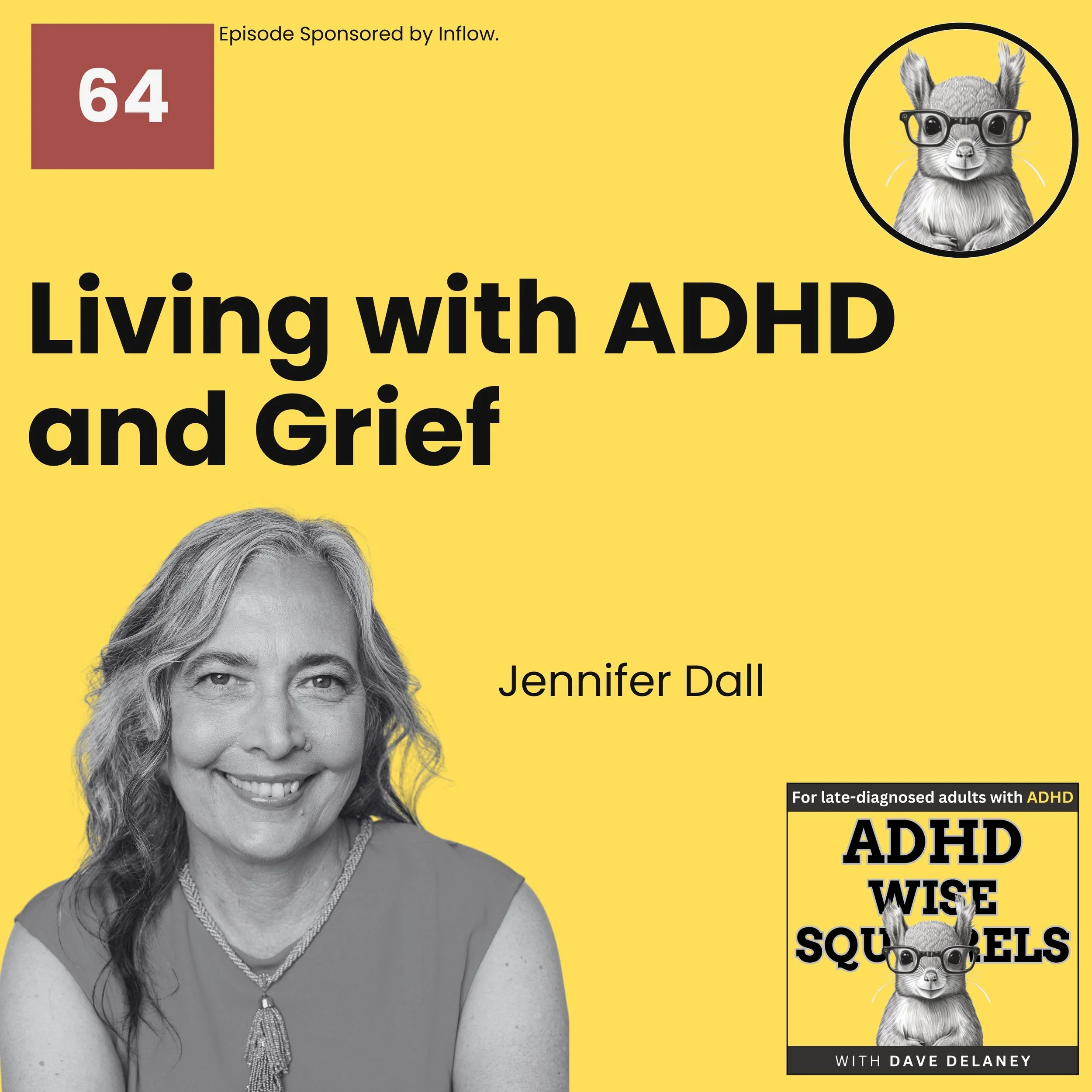
Dr. Jennifer Dall, Ed.D.
On today’s episode of our ADHD podcast, Dave kicks off with public speaking and presentation tips after receiving an email asking for his advice. Do you have questions for Dave? Submit yours here.
Jennifer Dall, Ed.D., is a grief-informed neurodivergence specialist and founder of ADHD Holistically. Jen empowers individuals with ADHD to transform daily struggles into opportunities for growth and self-discovery. With over 25 years of experience as an educator and a background in ADHD coaching, yoga instruction, and grief education, she brings a holistic, deeply personal approach to helping neurodivergent individuals thrive.
In a wide-ranging conversation, Jen shared how a lifetime in special education, a late ADHD diagnosis, and the sudden loss of her husband led her to the work she does now: helping late-diagnosed adults navigate ADHD, grief, and the complicated ways they overlap.
From Special Education to Supporting Late Diagnosed Adults
Jen spent more than 25 years in education, primarily in special education, working with students who had learning disabilities and ADHD. She also taught general education and later moved into district level administration supporting teachers.
Over time, she realized two things:
She was especially drawn to understanding ADHD.
She wanted to work more deeply with adults, not only kids.
Jen, a fellow Wise Squirrel herself, was diagnosed in her fifties, along with what she calls “plus one” (co-occurring conditions that tend to show up alongside ADHD). Then, shortly after returning to the classroom after the pandemic, her husband died suddenly. That loss made her step back and ask what she truly wanted to do with her time and energy.
She left the school system to build a practice focused on adults, especially people who are only now discovering they have ADHD and are trying to make sense of their past and their present.
Why So Many Women Were Missed
When Jen started teaching in the mid-90s, her ADHD classes were almost all boys. Girls were rarely diagnosed. ADHD was still framed as “that disruptive boy” who could not sit still. Women are diagnosed with ADHD an average of five years later than men, despite showing symptoms around the same time.
She and Dave talked about the three main ADHD presentations using their favorite cartoon shorthand:
Hyperactive/impulsive: the “Bart Simpson” type, bouncing off the walls.
Inattentive: the “Lisa Simpson” type, more inward, daydreamy, quiet.
Combined: a mix of both, which Dave compared to Calvin from Calvin and Hobbes.
For decades, schools mostly caught the “Bart” kids who were obviously disruptive. The “Lisa” kids who struggled internally, spaced out, or coped quietly often got good enough grades and were seen as “fine.” Many of them grew up to be women who were instead labeled anxious or depressed.
“Could this be ADHD underneath?”
Dave emphasized that:
There is one type of ADHD, with different presentations.
ADHD has nothing to do with intelligence.
People who are very bright often “ace” subjects they love and completely collapse in subjects they find boring, which confuses parents and teachers.
Jen has seen a pattern where women show up saying they are tired, emotional, distracted, or overwhelmed and are given medication for anxiety or depression without anyone asking, “Could this be ADHD underneath?”
If ADHD is the root condition and it goes unrecognized, treating only the anxiety or depression may not help as much as it could.
ADHD and Grief: When Two Invisible Struggles Collide
Jen’s specialty now includes the intersection of ADHD and grief: grief from bereavement, but also grief related to a late diagnosis.
She made a few key points:
ADHD and grief are both largely invisible. There is no cast or bandage. People around you often don’t see what you are carrying.
Emotion regulation challenges show up in both. With ADHD, emotional swings and intensity are common. With grief, that intensity is already dialed up. Together they can amplify each other.
It can be hard even for the person themselves to know, “Is this my ADHD today, the grief, or both?” The experience can feel like everything is swirling together.
This is where it really matters that therapists, coaches, and other helpers understand both ADHD and grief. A grief specialist might say, “Just go do something you enjoy” or “Just go tackle this project,” without realizing how “just do it” language often fails for ADHD brains.
Jen encourages:
Exploring what you actually have capacity for today.
Getting specific and flexible: “What is one small thing you could do that feels possible?”
Avoiding one size fits all lists like “Top ten things to do for grief” that ignore ADHD’s interest based nervous system.
She also spoke about a different kind of grief: the grief of finally getting an ADHD diagnosis later in life and looking back at years of struggle. The “What if I had known sooner?” spiral can be powerful and painful. Her approach is to:
Let people name and feel that grief instead of dismissing it.
Then help them reframe their story: yes, things could have gone differently, but the choices they did make also led to real good—relationships, experiences, growth—that matter.
Breaking the Chain of Generational Trauma
Jen and Dave talked about how many in previous generations likely had ADHD that was never identified. That could feed into addictions, risky choices, volatile parenting, and other experiences that left lasting scars on their kids.
They both share a hopeful view: as more adults get diagnosed and de-stigmatize ADHD, they can parent differently.
If you know you have ADHD and your child likely does too, you can bring empathy, structure, and informed support instead of punishment and shame.
That knowledge gives this generation the chance to interrupt cycles of trauma and create a kinder starting point for the next one.
The “Reverse Pomodoro” for ADHD Brains
One of the most practical tools Jen shared was her twist on the classic Pomodoro technique. If you’re familiar, you work for 25 minutes, take 5 5-minute break, and repeat. For many Wise Squirrels, even starting that first 25-minute work block can feel impossible. So Jen offers her solution, the “Reverse Pomodoro”.
Being the nerds that we are, we created this timer for you to try for yourself below.
Reverse Pomodoro Timer
Begin doing something you want to do for 25 minutes, committing to doing the important thing when the timer ends.
Commit to just 5 minutes of the important task you are resisting and get started when the timer goes off.
Do whatever you want for the next 25 minutes. Something fun, engaging, or low effort: scroll, read, pet the dog, sit outside, or meditate.
Repeat as needed.
Why the Reverse Pomodoro Timer helps:
It reduces the internal pressure. You are not asking your brain for a huge push, just five minutes.
You still create movement on hard tasks. A few five-minute blocks add up.
Often, once you are in motion, you keep going. Those first five minutes can turn into 15, 20, or more.
Jen likes this especially for very specific tasks: answering a few emails, making a phone call, doing a small bit of cleaning, or taking a bite out of a bigger project.
Holistic Experiments Beyond Medication
Jen is not anti-medication. She sees it as a personal decision between someone and their doctor. Her focus is on what else you can adjust in your life to support your brain.
She thinks in terms of experiments: small, low-pressure changes you can try and observe.
Some of the areas she focuses on:
1. Food and basic routines
ADHD can make eating really inconsistent: forgetting meals, living on snacks, or getting overwhelmed by the effort of turning groceries into actual food.
For herself, she found aiming for three meals a day was a surprisingly powerful baseline. On days she hits that, she notices an overall difference in how she feels and functions, regardless of whether the meals are “perfect.”
2. Sleep, water, and movement
The boring fundamentals matter:
Are you sleeping enough and getting decent quality sleep?
Are you drinking water?
Are you moving your body in some way?
These are standard wellness questions, but with ADHD they have an outsized impact on focus, mood, and capacity. Jen emphasizes taking tiny steps rather than trying to overhaul everything at once.
3. Understanding your energy curve
When she left the rigid structure of the school day, she suddenly had to manage her own time. With ADHD, that shift can be brutal.
Jen has learned:
She is not truly a morning person in personality, but her best work happens earlier in the day.
As the day goes on, she “turns into a pumpkin” and her energy drops sharply.
If she does not honor that, everything feels harder.
So she pays attention to when she is most capable of focused work and tries to align tasks with those windows.
4. Simple environmental cues: the shoes trick
One small but powerful cue for her is footwear. If she comes home and takes off her shoes, her brain decides the day is over. Work, chores, everything.
If she still needs to get things done, she keeps her shoes on as a signal: “We’re still in work mode.” For someone else, that cue might be different clothes, a certain workspace, or another physical marker. The idea is to use your environment to help your brain switch modes.
Attention Misallocation, Not Attention Deficit
Jen prefers to think of ADHD as a problem of attention misallocation rather than an inability to pay attention.
ADHD brains can focus intensely on things they find interesting, engaging, or urgent.
They struggle to stay with things that feel boring, unclear, or emotionally loaded, even when they want to care.
That is why an ADHDer can lose hours deep diving into a random topic yet feel blocked by a simple email.
To work with this, Jen sometimes writes on paper to avoid the pull of tabs, notifications, and online rabbit holes. You cannot open Instagram on a notebook. Removing options makes it easier to keep attention where you intended to put it.
Self-Advocacy, Education, and Relationships
Drawing on her education background, Jen is passionate about self-advocacy and better systems.
She believes change needs to happen in two directions:
1. Adults in charge need better information
Teachers, administrators, therapists, and doctors often get very limited training on ADHD, and what they do get may be outdated.
Awareness needs to improve around:
How ADHD presents differently across genders and ages.
The quieter, internalized, or “high achieving” versions of ADHD.
The overlap between ADHD and grief, anxiety, depression, and other conditions.
2. People with ADHD need tools to speak up for themselves
Whether it is a student talking to a teacher or an adult talking to a boss or partner, Jen wants people to be able to say:
“Here is what I struggle with.”
“Here is what helps me.”
“Here is something we could try together.”
That might look like:
Asking for instructions in writing instead of a long verbal list.
Breaking complex tasks into smaller steps with clear priorities.
Leaning into strengths in group projects while still practicing weaker skills.
She also points out that accommodations are not only for school. They matter at work and in relationships too. While employers may be legally required to provide accommodations, partners and friends are not, but healthy relationships involve mutual understanding and genuine adjustments on both sides.
The Heart of Jen’s Message
Throughout the conversation, Jen kept returning to three themes:
Advocacy: for yourself, your kids, your students, your clients.
Grace: recognizing how much you have been carrying and treating yourself with more kindness.
Curiosity: about what works for your specific brain and life, instead of chasing perfect systems.
She sees real progress in how openly people are talking about ADHD and grief, and she is determined to keep pushing that conversation forward.
-
[00:00.000 --> 00:10.000] I'm Dr. Jennifer Dall. I'm Jen. I'm a former educator and I'm a specialist with ADHD. I've been working with coaching and consulting and creating things.
[00:10.000 --> 00:16.000] I worked with students and kids for a long time and started realizing I wanted to work more with adults.
[00:16.000 --> 00:26.000] And so I've moved into that. I left education. I am a late in life ADHD diagnosed person plus some things that I call plus one.
[00:26.000 --> 00:36.000] So I'm really focusing on people who are figuring it out later that they have ADHD kind of like you do and working on what we can do.
[00:36.000 --> 00:40.000] Yeah, you know, just to get through.
[00:40.000 --> 00:49.000] Yeah, and now and I love that. I mean, you spent it was over 25 years as an educator. Is that correct?
[00:49.000 --> 00:58.000] Yes, yes. I don't like you. My wife is an educator. So yeah, yeah, yeah. What's what did you do in education?
[00:58.000 --> 01:04.000] I did mostly special education students with learning disabilities at ADHD. I also taught some general education.
[01:04.000 --> 01:14.000] And then I did some administration and special education. And then I reached a point where I just wanted to go out on my own and try my own thing.
[01:14.000 --> 01:16.000] Which your wife might understand.
[01:16.000 --> 01:31.000] Yeah, yeah. Well, it's interesting to you because I think, you know, it hasn't even been or I'm terrible at math. No, it hasn't even been 25 years or even 20 years since adults could even be diagnosed with ADHD.
[01:31.000 --> 01:49.000] You know, I think it was 2013. I believe was the year that adults could start being diagnosed. So, you know, at the earlier on and certainly back to whatever it was, like the 1700s or something ADHD was always recognize or ADD was this like nutty boy syndrome.
[01:49.000 --> 02:00.000] So like so often it was the maybe someone like me, the disruptive hyperactive boy in the class, the analogy I usually use as part Simpson in that case.
[02:00.000 --> 02:18.000] Yeah. So you must have had a lot of, when you started in education and especially in supporting kids, did you, what did you know at the time about, you know, at the time I said it was ADD?
[02:18.000 --> 02:28.000] Yeah, I didn't know what I didn't know. None of us did. My classes were primarily boys. Any girls were really not diagnosed ADHD.
[02:28.000 --> 02:39.000] So I can say it was it was primarily boys and the hyperactive outward kind of boys. You know, we looked at it behaviorally all of that kind of stuff over time.
[02:39.000 --> 02:47.000] I really started to learn more because it was my specialty of my interest. I learned more and gradually started to do more research and get more information out.
[02:47.000 --> 03:04.000] And I started to see some more girls in my class. And that was interesting because, you know, first the girls that would show up were more like the boys, but then as we learned more and understood more about how many of the girls show up, how it's internal, how they're quieter about it, that began to change.
[03:04.000 --> 03:11.000] But, you know, it's a lag in education in medicine everywhere. The information is just not really out there a whole lot.
[03:11.000 --> 03:24.000] Yeah, and it's a shame because, yeah, to your point, I mean, this is something I've heard countless times here on the podcast and also just out in the world talking with people that, yeah, women, women were missed.
[03:25.000 --> 03:35.000] Because in my understanding, at least, and you can correct me where I'm wrong, but I think what I know is that there is really one ADHD and three presentations.
[03:35.000 --> 03:52.000] And so you've got that Bart Simpson hyperactive and attentive kid, like me bouncing around the room, typically boys, not always, but typically boys. And then you also, and then with girls, I use the analogy of Lisa Simpson, the example of Lisa Simpson, who is more
[03:53.000 --> 04:00.000] inward, inattentive, there is, yeah, so the inattentive hyperactive, inattentive.
[04:00.000 --> 04:06.000] And then the mix, the combined, which I always say is more like Calvin from Calvin and Hobbes.
[04:06.000 --> 04:15.000] And I know we change kind of over over time, but I think more women certainly were more of that inattentive daydreamer playing with their hair.
[04:16.000 --> 04:25.000] You know, just not focus. And of course, not disrupting the class either, and not really a problem for at least for the educator.
[04:25.000 --> 04:36.000] And of course, grades don't really matter in this example entirely only because with ADHD has absolutely nothing to do with IQ or smarts.
[04:36.000 --> 04:44.000] So you could be a dumbass with ADHD and you can be a brilliant person with ADHD like Einstein or Steve Jobs, people like that.
[04:44.000 --> 04:53.000] I think some of the bigger differences we're seeing in people who were a little higher intelligence where like they could do really, really well in some things, like those areas that you were interested in.
[04:53.000 --> 05:04.000] People had a hard time understanding why you just could not pull it together for something else. And it wasn't that you were stupid there. You just, you know, ADHD and interest based on what was an interesting calculus, you know.
[05:04.000 --> 05:08.000] Yeah, I don't care that I don't care.
[05:09.000 --> 05:13.000] That would like parents, teachers, other people would be like, I don't get you, you know.
[05:13.000 --> 05:20.000] Right. And so what year did you do you start working to support ADHDers?
[05:20.000 --> 05:23.000] And I know you do work in grief as well.
[05:23.000 --> 05:29.000] I started teaching in 94. I think it was as a baby.
[05:30.000 --> 05:41.000] So all that, all that time, then I ended up going to district office and kind of work with special ed for supporting teachers and other people.
[05:41.000 --> 05:48.000] And then I went back shortly to the classroom for a little while. Right when we were coming back from the pandemic, because I missed being with kids.
[05:48.000 --> 05:55.000] And then I just, I wanted to be able to go out and do what I knew I needed to do and not be so constrained by other things.
[05:56.000 --> 06:03.000] Right. Yeah. So it was around like, I guess, 2021, 2022 or something when you went out.
[06:03.000 --> 06:13.000] Yeah, I went back and then my husband died suddenly and other things are happening and it was just like,
[06:13.000 --> 06:20.000] and this is just the sign. This is my sign to go out and take the chance and see what else I could do.
[06:21.000 --> 06:28.000] I think that's why I wanted to try and people I wanted to work with and all kinds of things.
[06:28.000 --> 06:37.000] Yeah, I'm sorry for your loss too. And I think is that what kind of put you down the road of supporting people with like grief in grief with counseling and so on.
[06:37.000 --> 06:41.780] sex, and how much people, if they understand one, they don't understand the other.
[06:41.780 --> 06:46.140] So therapists may know a lot about grief and be good at dealing with grief, but then
[06:46.140 --> 06:52.820] talking to them, trying to explain how ADHD impacts it, and the other way, you know, if
[06:52.820 --> 06:58.360] you're having trouble with, no, my brain's working, you're good.
[06:58.360 --> 07:04.620] The organization, emotional regulation, they both come up on both sides of it, and in some
[07:04.620 --> 07:07.860] ways they're the same at some point, they're not, but she's understanding that it kind
[07:07.860 --> 07:13.940] of makes it even worse, and so also then realizing it's not just ADHD and grief, but like all
[07:13.940 --> 07:19.420] kinds of things, like they all impact each other, and, you know, people who are working
[07:19.420 --> 07:23.980] with one group should know more about the other groups, too, and just simply that they
[07:23.980 --> 07:30.540] do impact, and like to trust us that, you know, my emotional regulation might be more
[07:30.540 --> 07:34.660] off, but I'm not even sure if it's because of ADHD today or if it's because of the grief
[07:34.660 --> 07:39.820] or if it's because of both, you know, they can all just swirl together, and I think we
[07:39.820 --> 07:44.860] want to put people into one category, but none of us are just one category.
[07:44.860 --> 07:50.140] No, that's true, and I mean, even, you know, speaking about women, like women typically
[07:50.140 --> 07:55.940] were, you know, if they were diagnosed with something, they were diagnosed with like anxiety
[07:55.940 --> 08:02.620] or depression or other things, which are common comorbidities that come along with ADHD,
[08:02.620 --> 08:07.220] and if my understanding, at least from Dr. Russell Barclay, is that if you don't treat
[08:07.220 --> 08:16.940] the root cause, if you will, or the root condition, like ADHD, then the work that you do on anxiety,
[08:16.940 --> 08:22.260] depression, and other comorbidities associated may or may not be as effective, certainly,
[08:22.340 --> 08:29.300] and so you're better off treating that ADHD first, and then, and then, you know, and again,
[08:29.300 --> 08:33.900] with women, they were just, they were just missed with the ADHD piece of things.
[08:33.900 --> 08:42.420] And say, you know, I'm feeling tired, I'm feeling distracted, I have a hard time focusing,
[08:42.420 --> 08:48.420] I'm emotional, and the jump is to, well, here, you must be depressed in an anxiety, here's,
[08:48.980 --> 08:56.660] there's a med for that without looking at anything else, right? Yeah. Yeah. Or if you turn into a pumpkin
[08:56.660 --> 09:02.580] around one o'clock, yeah, which I've heard, I heard in an interview somewhere, is that something
[09:02.580 --> 09:08.980] you mentioned? Yeah. Yeah. Yeah. Yeah. Yeah. Yeah. I mean, I'm like that too, like later the day
[09:08.980 --> 09:15.620] gets, I'm like, running, I run out of steam. Yeah. And you can, I can fight myself on it,
[09:15.620 --> 09:20.980] I mean, very critical of myself about it. And so it's taken a journey to, to realize,
[09:20.980 --> 09:25.060] you know, what your capacity, what your emotional and mental capacity is.
[09:25.940 --> 09:30.740] And I don't know, and it's already interrupt. The first thing I heard, or not the first thing,
[09:30.740 --> 09:37.700] but the first time I've heard of this, I thought, oh, my God, I love this idea. Tell me about,
[09:37.700 --> 09:43.940] because it's on that, on that point, tell me a little bit about the reverse pomodora. Oh,
[09:44.820 --> 09:50.820] okay. So I, I, I, I would say a pomodoro is, is an idea that you work for a certain amount of time
[09:50.820 --> 09:55.860] and then you take a break. And for some reason, 25 minutes seems to be this magical amount, but I know
[09:55.860 --> 10:00.820] when I do it, I have to sit down and like, figure out what that work, so for 25 minutes you work,
[10:00.820 --> 10:04.740] for five minutes, you take a break and then maybe you take a longer break. The first pomodoro is,
[10:05.780 --> 10:11.540] like, you don't even do in that 25 minutes. So I'm going to go do something else, whatever I want to do
[10:11.700 --> 10:16.420] for 25 minutes. And then I'm going to do my work for five minutes. And then I'm going to go back.
[10:16.420 --> 10:21.860] And sometimes you find, like, okay, I can do more than five minutes. And maybe sometimes all I
[10:21.860 --> 10:26.260] got today is doing this in a couple of five minute blocks, but maybe at least I got five, 15,
[10:26.260 --> 10:34.740] 20 minutes of that work done. So it's a benefit, you know, it's just a way of trying to look at it
[10:35.380 --> 10:41.140] and acknowledging what you can do today. And yeah, you know, the first pomodoro can be
[10:42.180 --> 10:46.260] great or something that you know will only take. Like, see, you have to make a doctor's appointment.
[10:46.260 --> 10:50.900] And hopefully it only takes five minutes if you're not on, you know, hold forever. But that kind of
[10:50.900 --> 10:55.700] I'm doing, I'm going to five minutes on this and then I'm going to go, I don't know, scroll or go
[10:55.700 --> 11:00.500] outside or read or put it in a dog or whatever it is you're going to do. Yeah, now I love that.
[11:00.580 --> 11:08.260] And especially with like, so just so I'm clear, you start in the case of this reverse pomodoro,
[11:08.260 --> 11:14.340] you start with the, do you start with the five minute thing you need to do and then the 20 minute
[11:14.340 --> 11:20.180] kind of reward or the other way around. Ask yourself. I mean, if it's just that, like, I don't
[11:20.180 --> 11:24.660] want to do a case so fine, I'm going to sit here and whatever it is I want to do for 25 minutes,
[11:24.660 --> 11:29.540] I'm going to set a timer, got a set of timer that timer goes off and I'm answering emails for five
[11:29.540 --> 11:36.500] minutes or I'm vacuuming the floor, whatever it is that I just do not want to do. And then I go back.
[11:36.500 --> 11:41.300] So yeah, starting with what you want to do, but if you mean if you can start off with that, okay,
[11:41.300 --> 11:45.220] I'm going to do five minutes of dishes and I'm going to do this, you know, if you can get yourself
[11:45.220 --> 11:53.540] going, that's just another five minutes. Yeah, that's great. Do you, do you, do you start with a goal
[11:53.540 --> 11:58.500] for those five minutes, Chris? Obviously, and I think a lot of us, this would resonate with, with
[11:58.500 --> 12:04.660] folks where it's great, like if you, if you start with like a five, five minutes or just, you know,
[12:05.540 --> 12:11.140] just getting started on something, just for a limited amount of time. Yeah, nine times or not,
[12:11.140 --> 12:16.260] nine times at a time, perhaps maybe, but if you're, if it's something that like you get a little
[12:16.260 --> 12:21.220] bit into the flow, like cleaning out your inbox, like email, then you're like, ah, hell, I'll just
[12:21.220 --> 12:25.460] do five more minutes or 10 more minutes. And then suddenly it's an hour later and you're like,
[12:25.460 --> 12:31.620] oh, look at that. I cleared not all my email. And awesome. Um, that's great. Yeah. And I,
[12:31.620 --> 12:37.300] I actually, at yscrolls.com under the resources tab, I created a digital Pomodoro time.
[12:37.300 --> 12:44.100] Right. People to use. Yeah. So I might experiment with like the idea of, of kind of repositioning
[12:44.100 --> 12:51.060] some of that to, uh, to the opposite because I love that idea. Yeah. Um, so I find it's useful.
[12:51.300 --> 12:55.540] The first of the reverse with like very specific tasks, very specific things.
[12:56.340 --> 13:00.900] Either I'm just taking the little bite of it at a time if it's to be something a little bit bigger
[13:00.900 --> 13:06.260] or, you know, I know, like, I could just do this in five minutes, but I'm just going to do something
[13:06.260 --> 13:12.420] else and I'm going to do it. So yeah. Now that's great. When, when getting back to the topic of
[13:12.420 --> 13:18.980] grief and, and ADHD, you know, you mentioned how, yeah, if a counselor or a therapist or someone is,
[13:18.980 --> 13:28.420] is, or coach understands grief, but doesn't understand ADHD, um, then some of their recommendations
[13:28.420 --> 13:34.580] or strategies or what have you may not be as effective, let's say, um, talk to me a little bit
[13:34.580 --> 13:41.060] about, yeah, how those two come together and maybe some strategies for a listener who may be
[13:41.060 --> 13:48.580] feeling grief right now, who has ADHD. Um, so I think it's important for the person and for the
[13:48.580 --> 13:53.380] therapist who have their working on to understand that they're both very big parts of their lives
[13:53.380 --> 13:59.300] and that they can fluctuate also. You can be feeling one more than the other. Um, and if the therapist
[13:59.300 --> 14:04.900] is looking at particular strategies for dealing with grief, like, like, we'll just go do something
[14:04.900 --> 14:12.660] you like or just tackle this project. Um, sometimes people with ADHD have a time, hard time with that,
[14:12.660 --> 14:18.980] you know, people say, just do it to you. That, that never works out very well for me. Um, and so
[14:18.980 --> 14:24.340] understanding that you may need to really really look at it and talk about it. If it's sort of just
[14:24.340 --> 14:28.820] go do this, trying to work through and talk through it a little bit about, well, what is something
[14:29.540 --> 14:35.860] that you could do, that you will do, that you feel up to doing, that you have the capacity to do, um,
[14:35.860 --> 14:41.540] and being a little more flexible with that. And also, I think understanding the, the role,
[14:41.540 --> 14:46.500] and you may know this, how, like, interest-based things figure in. So, um,
[14:48.180 --> 14:54.020] find if, if the goal is to kind of get you out out of the depression, the anxiety, I'm sorry,
[14:54.020 --> 14:58.900] the, uh, grief, like, I mean, like out of the house, just like for a little while. Um, instead of
[14:58.900 --> 15:03.940] pulling up a list of the top 10 things, go for a walk, you know, do this, if someone with ADHD
[15:03.940 --> 15:09.380] and grief, maybe having a hard time figuring out what that really is. And so spending some time,
[15:09.380 --> 15:13.700] you know, people ADHD can come up with lots of ideas. So maybe you brainstorm all kinds of
[15:13.700 --> 15:18.580] things for five minutes, what you could do. And later on as you go through it, you get some
[15:18.580 --> 15:23.460] better ideas. And then that's what you can do. So it's not the typical, oh, why don't you go walk
[15:23.460 --> 15:30.500] down the end of the street and back that kind of thing. So understanding that, that is more
[15:30.500 --> 15:35.860] complicated and there's more to it, I think, can help both parties. Everybody involved with it.
[15:36.820 --> 15:43.620] Yeah. And when it's grief, that is so obvious, like the, the loss of a loved one or a friend or
[15:43.620 --> 15:53.460] someone, um, but there's also grief in a diagnosis of ADHD when you start. And, and this is this
[15:53.460 --> 15:59.700] point I make often, which is like, I feel it's a bit of a dangerous path to start reflecting too
[15:59.700 --> 16:04.820] much on the past and think about all the what if. So I could have done this. I could have done that.
[16:04.820 --> 16:12.980] And the trauma that you likely faced also, um, probably, like, I find that's interesting to you.
[16:12.980 --> 16:20.900] I, this is something that comes up a lot in the idea of, and a reason that gets me so excited about
[16:20.900 --> 16:26.100] doing this podcast, by the way, is because I was just having this conversation with a gentleman I
[16:26.100 --> 16:33.620] met the other day about ADHD. And he had ADHD and one of his kids has ADHD. And I was saying like,
[16:33.620 --> 16:41.460] what's so great about this generation right now as we remove, destigmatize ADHD. And as we,
[16:41.460 --> 16:46.900] you know, are more encouraged to take care of our own mental health. And that's part of the overall
[16:46.900 --> 16:56.660] health and fitness plans or it should be that we as parents who have ADHD. And if we have a child
[16:56.660 --> 17:06.260] with ADHD, which is likely given the, the heritability factor, we can be better parents because we've
[17:06.260 --> 17:15.540] learned about this in them and in ourselves versus our parents and their parents who, you know,
[17:15.540 --> 17:21.940] likely, highly likely never knew they had ADHD. And that could have led to things like addictions or
[17:22.020 --> 17:29.860] impulsivity or other ways that might have led to some sort of trauma for, for like my generation
[17:29.860 --> 17:37.620] for me, right? And so I feel like the future is so bright as we destigmatize things because if
[17:37.620 --> 17:43.460] our generation understand this and we treat our children well, and if they're diagnosed or,
[17:43.460 --> 17:49.620] you know, we can see that and be more empathetic, then they also will pass it along so that when
[17:49.620 --> 17:57.220] they have a child and if they have a child with ADHD as well, we can stop this history of trauma.
[17:58.420 --> 18:04.900] Yes, I agree completely. You know, we're learning so much more, we know so much more. One of the
[18:04.900 --> 18:09.940] things about both group ADHD is that they tend to be kind of invisible, you know, it's not like you
[18:09.940 --> 18:17.380] have a cast on your arm or something like that. And they both, what I've seen is people don't see it,
[18:17.380 --> 18:22.580] they don't see the grief, they don't see the ADHD and you hide it, you mask it, you hide it and hide it
[18:22.580 --> 18:28.340] and hide it. And so it gets gets to be a lot to deal with and then that all that does to you. So I
[18:28.340 --> 18:33.540] think the more that we talk about it, about both of them, how they interplay, all of that kind of
[18:33.540 --> 18:37.940] stuff and show that to our kids and show that to other people, you know, that these are things that
[18:37.940 --> 18:45.220] are there and helping them, like believe in themselves and trust themselves and, you know, they're
[18:45.220 --> 18:48.900] both hard, they're both hard and there's days when they're both hard to get through and
[18:49.460 --> 18:55.860] and there's days where you do a little bit better. Yeah, yeah. Do you find, so tell me about like maybe
[18:55.860 --> 19:00.740] an example without obviously divulging any personal information, but like people that you've
[19:00.740 --> 19:05.300] worked with or a person that you've worked with who was maybe recently diagnosed in their 50s,
[19:05.300 --> 19:12.500] also, I know we were both diagnosed in our 50s. Yeah, tell me a little bit about an experience with
[19:12.500 --> 19:21.300] someone who, you know, was going through that grief, maybe from trauma or from the past or
[19:21.300 --> 19:28.100] reflecting on this, like what are some strategies that you use to make them more present and more,
[19:28.660 --> 19:34.500] you know, just understanding that the past is just stories we tell ourselves and now we're in
[19:34.500 --> 19:38.980] the present and the future can be a lot brighter. But how do you, what are some strategies for that?
[19:39.780 --> 19:43.940] Well, we're talking about that about how these are stories. How did these stories come about,
[19:43.940 --> 19:49.220] you know, if they feel confident or they're aware enough to talk about one of the things. So this is
[19:49.220 --> 19:54.020] something that I used to do, the people used to say this about me and now I realize that it's about
[19:54.020 --> 20:00.660] ADHD and just not dwelling in it, but like seeing and owning it and seeing how the other people were
[20:00.660 --> 20:04.740] not correct, but they were probably doing the best they could and you were doing the best you could
[20:04.740 --> 20:10.660] taking it on and how to rewrite that story or how to rethink of that story moving on.
[20:11.700 --> 20:18.260] It's something that's really powerful. You know, I see that one of the things is for myself and
[20:18.260 --> 20:22.980] I know that the people I talk to and work with is every time they hear somebody else's story
[20:22.980 --> 20:29.620] or many times they hear another detail that is new or spoken in a new way and it hits them,
[20:29.620 --> 20:34.260] you know, close to home. And so just being able to just sit with that and realize that there are
[20:34.260 --> 20:40.580] other people out there and it's like, oh, I didn't realize that that was an ADHD thing until you
[20:40.580 --> 20:51.300] said it that way and getting better at, okay, okay, that's me. I'm okay and, you know, it's a lot of
[20:51.300 --> 20:56.980] work. You know, we've been told a lot of stories. We've had 50 years to be told a lot of stories.
[20:57.860 --> 21:07.940] Yeah, yeah, that's great. I love that. What about like, I guess if you're speaking with somebody who
[21:09.460 --> 21:18.180] yeah, who is kind of falling down that rabbit hole of grief, any strategies for getting yourself
[21:18.180 --> 21:24.820] up and out of it. And obviously, you know, and obviously some severe grief, like losing someone,
[21:24.820 --> 21:31.380] obviously, you know, there is a natural process. I, you know, I'm blessed I haven't had this too
[21:31.380 --> 21:38.340] much. I mean, I lost my father, but he was, he was 83 and had a great run, like he had a good life.
[21:38.340 --> 21:43.300] He'd actually died on his birthday. Yeah, yeah, worse party ever. No.
[21:46.660 --> 21:50.020] But what are your thoughts on that? Like kind of,
[21:50.420 --> 21:57.620] well, I say, don't be afraid to ask for any kind of help, whether it's professional help, you
[21:57.620 --> 22:04.180] know, because grief is something to be worked through. And sometimes having somebody, whether it's
[22:04.180 --> 22:09.220] for insurance, or you're paying that, that is really listening to you about the grief itself,
[22:10.420 --> 22:15.540] is very important. There can be support groups. You can find that you meet other people who,
[22:15.620 --> 22:20.180] and you can just kind of support each other and say, yeah, I hear you. I know it's hard and I
[22:20.180 --> 22:26.500] went through this too. You know, grief, whether it's grief over a diagnosis for something that we
[22:26.500 --> 22:31.940] didn't know or grief because of a death or some other sort of big loss, you also, you've got to feel
[22:31.940 --> 22:38.820] it, you know, you've got to feel it to heal it. And so, yes, moving on past it, yes, moving beyond
[22:38.900 --> 22:46.340] it, but also finding ways to process that grief to process, whether it's journaling or talking to
[22:46.340 --> 22:52.980] somebody or other things that you can do, where you're not diving deep and falling into a hole,
[22:52.980 --> 22:58.020] hopefully, but you're just able to really process all of it and think about it and reframe it
[22:59.380 --> 23:03.860] because I think the more we shove it in, then that's not good either. You know, if,
[23:04.660 --> 23:09.860] if you're feeling, if you've gotten this diagnosis for ADHD and you're feeling grief of what could
[23:09.860 --> 23:15.620] have happened, or if you'd had more help, where if people have had understood, well, own that, you
[23:15.620 --> 23:23.300] know, own it, say it, put it in words, and then think about, okay, but maybe so, but what other good
[23:23.300 --> 23:28.100] things have happened? You know, I didn't go on this path, but I went on this path, and this is the
[23:28.100 --> 23:33.220] path I'm on. So, what's good about it and knowing what I know now, is there anything else I can do,
[23:33.220 --> 23:38.340] is there anything I want to change, or this is just good anyway, because there's all kinds of
[23:38.340 --> 23:44.820] things you can have regrets about. I love that idea of reframing it to one thing that I've
[23:44.820 --> 23:51.860] gone through like in this, in my own sort of journey and with therapy and things is, is thinking
[23:51.860 --> 23:57.300] through kind of like to your point, like reframing, like the example I always think about is,
[23:58.020 --> 24:03.620] you know, back in the 90s, you know, I would drink a lot, and of course, you know, with undiagnosed
[24:03.620 --> 24:09.780] ADHD, yeah, that made sense for me. Yeah, self-medicating. So, but I would drink a lot, and you know,
[24:09.780 --> 24:14.180] it was kind of part of who I was, you know, drinking beer, hanging out with friends, going to the bars
[24:14.180 --> 24:22.020] and stuff. And so, I went to Ireland, backpacking Europe to find myself, as you do, and of course,
[24:22.020 --> 24:27.140] I fell in love with Ireland, I'm not a delineate, so go figure, and I love to drink, even though
[24:27.140 --> 24:35.060] I'm five years sober, I should add, but thanks, but had I not gone to Ireland, and it was sort of an
[24:35.060 --> 24:42.260] impulsive sort of move, I wouldn't have that my wife. And we wouldn't have the kids that we have now,
[24:42.260 --> 24:46.580] and the home that we have now, and my and the cute dog that we have now, and I wouldn't be talking
[24:46.660 --> 24:52.820] to you, and maybe I wouldn't even know I had ADHD still. So, yeah, it's important to look like,
[24:53.460 --> 25:00.260] yes, I maybe should have been more driven in my career, or I should have maybe not been, you know,
[25:00.260 --> 25:05.220] out so many nights drinking too much, and smoking too many cigarettes, and then all these things,
[25:05.780 --> 25:13.380] also, like, quit smoking like 25 years ago or so. But yeah, so it's reframing that, and looking at it
[25:13.380 --> 25:17.300] in the positive way, and I think what you just mentioned is a great, great strategy.
[25:19.460 --> 25:24.420] I read that you also have some holistic strategies, now, you know, and not
[25:25.700 --> 25:30.740] that sort of emphasize, you know, practical and kind of quick fix strategies beyond medication,
[25:30.740 --> 25:36.820] even though, you know, I don't want to say that we shouldn't be, or a listener shouldn't be
[25:36.900 --> 25:43.700] taking medication, because I believe that they do help. But what are some holistic strategies that,
[25:43.700 --> 25:49.540] that, you know, somebody newly diagnosed, or that they could do in a more holistic way?
[25:50.500 --> 25:55.620] So, more holistically, when I talk about that, I mean, medication, that's up to you, that's
[25:55.620 --> 26:00.340] that's your decision, maybe you're working on that with a doctor, but looking at all the other
[26:00.340 --> 26:05.060] parts of your life that you can investigate and do something about, I mean, there's the really
[26:05.060 --> 26:09.780] basic ones that we don't want to hear about, like, are you sleeping? Are you eating? Are you
[26:09.780 --> 26:14.900] drinking water? You know, are you moving your body? And, you know, we can get stubborn about that.
[26:14.900 --> 26:20.340] We don't want to be told what to do, but we need some structure. And so, finding, just starting
[26:20.340 --> 26:26.260] with little things, what's one little thing you can start doing, because I'm finding more
[26:26.260 --> 26:31.380] more with myself and more clients with people I talk to, that it's those little steps that we
[26:31.380 --> 26:35.300] take, the little subtle shifts, the little experiments, that's a word I've been using a lot,
[26:35.300 --> 26:42.180] these experiments, to just try something else and make one little part better, right? So, if it's,
[26:43.140 --> 26:50.900] you know, something like, ADHD can struggle with eating, right? Sometimes it gets boring,
[26:50.900 --> 26:55.860] or like, wait, I have food in the house, but now I have to make something with it. I don't know,
[26:55.860 --> 27:00.020] and I know everything about health. I know about nutrition. I know these things, it's not a
[27:00.180 --> 27:06.100] not knowing. So, what I've kind of developed is trying to make myself eat three meals a day,
[27:06.100 --> 27:11.700] which may sound really stupid, or really whatever, but for me, if I could just do that,
[27:11.700 --> 27:17.140] that it doesn't matter what else I eat or don't eat, the days that I can do that, I notice
[27:17.140 --> 27:24.740] there's just a difference in how I feel and act in general. That's one thing. I've also really
[27:24.740 --> 27:29.540] had to look at how I spend my time. I went from being in education, which, you know, your wife
[27:29.540 --> 27:34.820] probably knows if you are, I just secondary mostly. So, it's like, you are run by bells and calendars,
[27:34.820 --> 27:40.100] you are told wind to go to the bathroom, you are told windy lunch. You know, you know,
[27:40.100 --> 27:47.460] when your vacation is, and then all of a sudden not having that, right? So, that's a huge,
[27:47.460 --> 27:53.620] huge change with ADHD, and it has taken me time, and I'm continuing to work on really looking
[27:53.700 --> 27:58.660] honestly at what makes me do better. What time of day, you know, we need to, like I said,
[27:58.660 --> 28:03.940] I turned into a pumpkin. It's like, I've, I'm not a morning person, like I'm all happy in
[28:03.940 --> 28:07.700] Chipper, and like, yeah, yeah, in the morning, but like, if I'm going to get up and do work,
[28:07.700 --> 28:11.940] I've got to get up and do work. Because later in the day, it's just crashing.
[28:13.220 --> 28:18.740] And it's more crashing if I haven't had some food, and I haven't done certain things. So,
[28:19.300 --> 28:24.980] you know, holistically, I'm just talking about, what are some little things that you notice that
[28:24.980 --> 28:31.460] if you do or you don't do, makes you feel so much better? You know, yeah. And yeah,
[28:32.980 --> 28:37.860] yeah, and exercise, like you said, I mean, that's one big one that people need to do because
[28:37.860 --> 28:43.700] there's correlation for sure. Lots of studies about the value of exercise for all the obvious
[28:43.700 --> 28:51.860] reasons, but with ADHD, especially, it can, it can really help you. So, I like, I like that,
[28:51.860 --> 28:56.180] that approach to things. I think with my dad, when he passed away, he passed away from
[28:56.180 --> 29:04.740] Alzheimer's dementia. And, and this was like 2021. So at the time, I thought, okay, I'm going to do
[29:04.740 --> 29:10.260] everything I can not to get dementia in Alzheimer's because it does run in my family. And so,
[29:10.900 --> 29:15.380] I read a couple books and started doing some research on it. And of course, you know, there's
[29:15.380 --> 29:22.260] not, there's no definitive answer exactly yet. Or there's clues and things, and I'm not a doctor,
[29:22.260 --> 29:28.580] and I don't pretend I'm one here. So, or anywhere. But some of the things that I learned,
[29:28.580 --> 29:36.100] and this is pre-diagnosis of ADHD by a couple of years, one of the things I did was I quit drinking,
[29:36.180 --> 29:41.300] because of this. I thought, okay, alcohol is not great for the brain. I'm just going to cut it out
[29:41.300 --> 29:46.740] and quit meditation and mindfulness. I started a daily practice. That's also a very helpful thing.
[29:47.700 --> 29:54.340] Exercise, which I've just gotten more serious about, very serious about, again, and I'm,
[29:54.340 --> 29:59.700] I'll be damned if I'm going to stop. I'm really gung-ho about it. But I did, I was working with
[29:59.700 --> 30:08.100] a virtual trainer, and it was, it was great. Oh, and sleep apnea. Yeah, go figure. I did a
[30:08.100 --> 30:14.580] sleep apnea test, and sure enough, I had sleep apnea. So, got the old CPAP. And it's
[30:14.580 --> 30:22.420] funny too with food, because to your point, like, a couple points, like with, and with stimulants,
[30:22.420 --> 30:28.340] sometimes one of the side effects can be a lack of appetite. And I don't have that problem.
[30:28.340 --> 30:35.220] I eat, like, I've always been, I'm better actually now, but I've been more conscious of myself now.
[30:36.180 --> 30:42.020] But for the longest time, like, I would always overeat. I would, I would finish my kids all,
[30:42.020 --> 30:46.980] like, both my kids' meals and my wife's leftovers at the restaurant and all this stuff.
[30:46.980 --> 30:51.860] But this was pretty diagnosis. I always, I was taught by my parents to, like, clear your plate.
[30:51.860 --> 30:56.260] Like, you have to eat everything before you get off, get back, you know, get, leave the table.
[30:56.980 --> 31:01.140] And both my parents, my mom did a lesser degree, but my dad was like super, you know,
[31:01.140 --> 31:07.540] militant about that point. And so I would always have to eat everything. And I always just,
[31:07.540 --> 31:12.980] I always just thought that was why I overeat because I was raised that way. And it might have
[31:12.980 --> 31:17.700] been part of the reason, but the other part was because of the ADHD undiagnosed that, you know,
[31:17.700 --> 31:25.540] we tend to be excessive in some ways. And for my, for me, it was with food, certainly. So,
[31:25.540 --> 31:32.260] among other things, I guess, yeah. You've talked about attention, misallocation.
[31:34.500 --> 31:38.500] Talk about what you mean by that as it pertains to ADHD.
[31:39.700 --> 31:44.260] So, you know, sometimes I think people think that ADHD means that you can't pay attention.
[31:44.260 --> 31:48.660] You, you aren't able to, but you may have noticed this, like, I think there's more, there's more
[31:48.660 --> 31:52.420] of a tendency to be able to pay attention to certain things. And so that kind of goes back to that
[31:52.500 --> 31:57.540] interest-based thing, you know, you can hyper-focus on something, you can deep dive into something,
[31:57.540 --> 32:03.300] the things that you want to pay attention to, you do, and the things that are not interesting
[32:03.300 --> 32:09.060] is really hard to pay attention to. It's, it's really hard to. And, you know, I know in school,
[32:09.060 --> 32:13.700] I think I must have perfected some sort of facial masks that made it look like I was just so
[32:13.700 --> 32:18.980] interested because I would just be somewhere else. And then the teacher professor, like, they
[32:18.980 --> 32:24.020] obviously thought I knew the answer, so they would call on me and say, like, what? And then we
[32:24.020 --> 32:32.100] were to say something because, you know, words come out of your mouth. But it's more, your, your
[32:32.100 --> 32:38.500] attention goes certain places and it's harder to bring it back to other things that you may want
[32:38.500 --> 32:42.900] it somewhere else. And other people have a hard time with that, so if you're working on a project,
[32:42.900 --> 32:48.180] you're doing things like that that aren't really that interesting, it can be hard to stay with it.
[32:48.180 --> 32:53.220] And there's also why if you're working on something and, like, I find it's often much easier to
[32:53.220 --> 32:57.780] write on paper for small, like, old school, so I like to write on paper. But I can't open other
[32:57.780 --> 33:03.860] tabs in a notebook, you know, like, if I'm online and I'm trying to write on my Google docs and then,
[33:03.860 --> 33:09.220] oh, well, I'll just go look at this or, oh, hey, an email came in or, oh, I wonder, you know,
[33:09.220 --> 33:15.300] what's going on this weekend, you know, and you've just lost it because you just go through those
[33:15.460 --> 33:21.940] rabbit holes or, like, really deep diving into some factor. You're writing about whatever the topic
[33:21.940 --> 33:26.660] hamburgers and all of a sudden, you've, you've found out the history of hamburgers and the best place
[33:26.660 --> 33:34.020] to get them in Toronto and Berlin and, you know, like, that was fun, but I didn't do what I was supposed to do.
[33:34.980 --> 33:37.140] Yeah, and then you started researching French fries.
[33:37.940 --> 33:41.700] Yeah, the history of French fries or whatever.
[33:41.780 --> 33:47.140] Yeah, American fries or wouldn't they, like, after 9-11, they're like, see, we're doing it right now.
[33:47.140 --> 33:52.740] We are on another topic. Freedom fries, yeah, I remember.
[33:55.380 --> 33:58.580] That's hilarious. That's hilarious. Yeah, now you're absolutely right, though.
[33:59.780 --> 34:01.780] Where are you based, by the way, I forgot to ask you.
[34:01.780 --> 34:05.700] Oh, I'm in the Los Angeles area. Okay, cool. Yeah, cool. How about you?
[34:06.580 --> 34:13.140] Nashville. Oh, okay. Yeah, so Toronto, originally, Nashville for the last 18 years.
[34:13.140 --> 34:19.300] So yeah, yeah, yeah, yeah, but I love LA too. LAs are great.
[34:19.300 --> 34:21.300] Where are you from? Are you from LA originally?
[34:21.300 --> 34:25.860] I'm from the area. Yeah, yeah, and I live out here and I have a work space in an office over in
[34:25.860 --> 34:31.460] Pasadena, so the Rose Parade route, Colorado Boulevard is just right right there. I like it here.
[34:31.860 --> 34:37.780] I've always, I'm like, yeah, I like it. I love California. Every time I go to California,
[34:37.780 --> 34:42.420] I'm always like, this is my place. Like, you know, and then I'm like, I can't afford it.
[34:46.660 --> 34:51.940] There's that, yeah, but I know I absolutely, yeah, the food, the weather, everything.
[34:52.500 --> 35:00.020] Yeah, and people are all nice. Yeah, yeah, Nashville's great, but yeah, no, yeah, I love it out there.
[35:00.020 --> 35:05.460] I mean, I'm a bit of a film nerd. So, you know, the Hollywood attraction is, is, you know,
[35:05.460 --> 35:11.940] definitely in there for me. And then also, like, I'm big in a comedy. And so, you know,
[35:11.940 --> 35:16.740] obviously, LAs are an important place for comedians and comics and things.
[35:17.940 --> 35:23.300] So, and then, of course, you know, I finally convinced my wife to, I took her for our
[35:23.300 --> 35:31.700] anniversary a couple of years back to up to Pacific Highway, like Highway one. And I'll up around
[35:31.700 --> 35:37.780] Carmel and down to Santa Barbara all on the coast. And it was just like, oh, this is great as I
[35:37.780 --> 35:43.620] remembered when I was a kid. Also expensive, but beautiful. Yeah, I kept telling friends here that I,
[35:43.620 --> 35:49.140] yeah, we were there. Yeah, well, we looked at a house. We did. We looked at many houses as we
[35:49.140 --> 35:58.900] drove past them. Yeah, yeah, yeah, not there yet. Yeah, so tell me a little bit about this idea
[35:58.900 --> 36:07.220] that I've heard that you mentioned about keeping shoes on to stay in a work mode. As I'm barefoot
[36:07.220 --> 36:12.020] here, I shouldn't have mentioned it, but yeah, tell me about that. Yeah, so that's hard because I
[36:12.020 --> 36:16.100] also don't like to wear shoes, especially living in California, you know, I like to have them off,
[36:16.100 --> 36:21.700] but like if I come home and I still want to work and I take my shoes off, there's something
[36:21.700 --> 36:27.540] about taking the shoes off. It's made this like mode that that we're done, you know, we're done
[36:27.540 --> 36:32.820] for the day. That's that's all that's happening. Whether it's actually doing work or like cleaning
[36:32.820 --> 36:37.860] or anything that I need to do. So yeah, I've heard other people talk about this too, you know,
[36:37.860 --> 36:42.020] something about the taking the shoes off. Maybe for other people is changing your clothes out of
[36:42.020 --> 36:47.300] your work clothes, that sort of thing. Maybe because I was a teacher of my work clothes were basically
[36:47.300 --> 36:53.140] my clothes. Yeah, I didn't have like a really uniform. It's only about taking off my shoes and I just
[36:54.340 --> 37:01.540] it's just like we're done. We're done for the day. Yeah, that's a good point. Yeah, yeah, and so
[37:02.340 --> 37:08.420] if I know I have to, I have to leave those shoes on. That's great. Peter Shankman, who was on
[37:08.420 --> 37:14.580] the first episode of Why Squirrels way back when I started this podcast, talked about yeah,
[37:14.580 --> 37:19.220] I believe he said like going to sleep like he would sleep in his workout clothes. So they would be
[37:19.220 --> 37:28.020] on in the morning. I don't, I'm not quite that extreme, but lately I take, I have my like workout
[37:28.020 --> 37:34.660] shorts next to my bed. So like when I go to bed, I just, you know, dump my clothes on the floor
[37:35.620 --> 37:40.100] and then I'll just like in the morning, I'll put them back. I'll put the same shirt on,
[37:40.100 --> 37:47.140] the same, and then my workout shorts and then go out and do my thing and then and then get home
[37:47.140 --> 37:52.820] and shower and get changed and stuff for the day. But just by having the clothes there, I remember
[37:52.820 --> 37:58.420] he was talking also about, because my wife totally dresses me when I make a house. Thank God,
[37:58.420 --> 38:03.540] because I once came home from a speaking engagement and she was like, she's like, did you wear that
[38:03.540 --> 38:07.380] today? And I was like, yeah, she's like, oh my god, you look like a chocolate bar. It was like
[38:07.380 --> 38:12.100] all brown clothes, like brown shirt, brown pants, brown jacket, brown. She's like, what are you
[38:12.100 --> 38:17.620] doing? And I was like, oh god. So, you know, thank God she's, she's there for me. But Peter
[38:17.620 --> 38:23.140] Shankman talked about, he's got like a walk in closet and on one side, it's all like speaking
[38:23.140 --> 38:29.380] in media clothes. So it's like, but it's like the same few colored jackets and slacks and that kind
[38:29.460 --> 38:34.900] and shirts. And then on the left side is more like just anything else, like jeans and t-shirts.
[38:36.100 --> 38:42.820] So he knows, based on his day, which way which way to go. And I think I heard somewhere,
[38:43.540 --> 38:52.260] I have no idea at all if Obama has ADHD. I have no clue at all. If I thought about it, maybe,
[38:52.260 --> 38:59.780] but I'm not saying he does necessarily, at least I haven't heard. But he did talk about somewhere.
[38:59.780 --> 39:05.860] I remember him talking about having like the same colored suit, like multiple. I think I heard that too.
[39:05.860 --> 39:11.460] The same outfit. So like, he wouldn't, like, this is what you wear today. Like, this goes with this,
[39:11.460 --> 39:17.140] goes with this. And yeah, as I think about it, I'm like, man, I should probably start doing that.
[39:18.100 --> 39:24.820] Yeah. Yeah. This is then I get bored with it. But yeah, that pesky novelty curse, right?
[39:24.820 --> 39:29.060] When the novelty runs off for an ADHD or then it's like, okay, that doesn't work anymore.
[39:29.060 --> 39:32.580] Damn it. So they do have certain clothes like, okay, these are, I think I'm going to be on camera
[39:32.580 --> 39:37.700] today. And okay, this is at least from the way stuff looks a little bit better. And t-shirts.
[39:37.700 --> 39:41.940] And I used to put my running stuff like in the bathroom ready for when I get up. And like,
[39:41.940 --> 39:46.260] sometimes if I was going to go to like a yoga class later, I would put my yoga clothes on and wear
[39:46.340 --> 39:50.260] them all day because otherwise I would feel really stupid if I wore my yoga clothes all day and
[39:50.260 --> 39:57.780] it can go to a yoga class. I love that idea. Yeah. Yeah. So all of a sudden, I had another
[39:57.780 --> 40:07.300] button that I forgot. Yeah. As far as education goes, you know, and I was also having a conversation
[40:07.300 --> 40:14.100] with someone recently about education. And of course, I mean, the analogy I used right away was
[40:14.260 --> 40:21.060] I was thinking of like, okay, well, like teachers aren't always teachers. Like if you pretend
[40:21.060 --> 40:29.300] a teacher is a chef, let's say. And the chef has given like a mediocre food, quality food,
[40:29.300 --> 40:34.660] but they still have to cook something and make it really do it really well. And yes, they'll probably
[40:34.660 --> 40:41.380] have to use their own money to go and buy some ingredients because, you know, but I sometimes
[40:41.380 --> 40:50.180] think of this. I mean, use or share this with my wife, but, you know, teachers are, as you
[40:50.180 --> 40:55.300] said, like teachers are like taxed over like they're just busy, like extremely busy, overworked,
[40:55.300 --> 41:05.780] underappreciated, underpaid. And so it's easy to understand why maybe an ADHD or like a kid with ADHD
[41:06.340 --> 41:12.660] might get missed or might get just pushed along. Like I graduated, I graduated seven years of classes
[41:13.380 --> 41:17.780] because the teachers just didn't want to have to deal with me again. And I think that's how I got
[41:19.140 --> 41:26.660] to my seventh grade. And, and then was held back that year. Pat Riley, God bless him. He was a great
[41:26.660 --> 41:35.620] teacher. But are your thoughts on ways to improve public education to better serve? Yeah, just a small
[41:35.620 --> 41:42.420] and these few minutes left. Yeah, yeah, exactly. But are there other thoughts? I mean, like, I'll
[41:42.420 --> 41:48.980] give an example, like I enjoyed Sir Ken Robinson's TED Talk about do schools kill creativity.
[41:48.980 --> 41:54.500] And I read his book The Element. My kids went to Montessori School for the first,
[41:55.140 --> 42:01.940] you know, a few years. And I really loved that system. Just making it a little more accessible
[42:01.940 --> 42:08.100] for people and a little more fun, I think, in a way. Then just, you know, again, Peter Shankman
[42:08.100 --> 42:14.260] and I talked about this also on the first episode, I remember about sort of the, he's more critical
[42:14.260 --> 42:18.500] of the school system. But it's of course, it's easy to be critical when you're on the outside.
[42:18.500 --> 42:26.180] And you don't know what's going on. Are there ways that you think like small or big that could
[42:26.420 --> 42:34.180] improve education for neurodiversion people, especially age deers? So I want to protect my teachers.
[42:34.180 --> 42:42.660] I will buy on a hill for them. I think knowledge and information, I think teachers, just like doctors,
[42:42.660 --> 42:48.980] just like therapists, they're given this much of any training on ADHD. And it's probably quite
[42:48.980 --> 42:58.580] outdated. And they have so many things they have to learn and do and follow. And so, but just real
[42:58.580 --> 43:03.140] actual information. And I'd say administrators and the people in church too, because you know,
[43:03.140 --> 43:08.180] like often the people in charge make decisions that, you know, may not be that useful.
[43:09.460 --> 43:14.420] So I think just general knowledge, both on the teacher or the adult side,
[43:14.420 --> 43:20.100] having information about like just basically the different kinds of ADHD and that it's not all
[43:20.100 --> 43:27.460] the same. And what somebody might be doing that's actually kind of masking ADHD. And then for the
[43:27.460 --> 43:33.140] students and the kids, I mean, I've always been really big on self-advocacy. Having them know so
[43:33.140 --> 43:38.420] many didn't, they didn't know why they were in classes or they knew they had ADHD, but they didn't
[43:38.420 --> 43:43.140] know what it meant. And they didn't know what it meant for them or how to work with it or what to
[43:43.140 --> 43:48.740] ask for. And as we, as they grow up, that's what we want is them to be adults who can say to their
[43:48.740 --> 43:53.300] partners or their friends or their bosses or whatever. Look, I struggle with this and it would
[43:53.300 --> 43:58.900] really be great if we could do this to help it out. Like, like, don't give me five directions
[43:58.900 --> 44:03.940] verbally. Send me an email or let's write them down or let's talk about one at a time because
[44:05.060 --> 44:11.460] I lose track, you know, or just talking about like the things you use to go with with your ADHD,
[44:11.940 --> 44:15.300] for example, it's okay. And this is why it is. And it's not because you're bad or you're stupid or
[44:15.300 --> 44:22.260] you've gotten an attitude problem. But it's like how to work with that so that you then can be
[44:22.260 --> 44:28.980] the best you in school, out of school, your whole job, your whole life. That's what we want.
[44:29.700 --> 44:37.300] That's what I want. Yeah. It's almost, uh, I interviewed Melissa Urlaugh a while back who,
[44:38.260 --> 44:44.820] who whose specialty is really relationships and marriage with ADHD and whether both
[44:45.460 --> 44:51.380] people have ADHD or whether one is more neurotypical than the other has ADHD. But the way you're
[44:51.380 --> 44:56.740] speaking about this makes me think of like that obviously the parent and administrators too,
[44:56.740 --> 45:03.620] but the teacher, like, like in the in Melissa's example and others that I've heard, it's this parent
[45:03.620 --> 45:09.380] teacher sort of dynamic or excuse me, this parent child dynamic that happens when one
[45:09.380 --> 45:16.100] partner has ADHD and the other partner does not, some of the things that can can mess with a
[45:16.100 --> 45:22.500] relationship is that the neurotypical person who doesn't really understand the ADHD kind of takes
[45:22.500 --> 45:29.460] control of everything, like all the planning, all the everything. And then because it's just easier
[45:29.540 --> 45:37.300] for them to do it than have to rely on, you know, and then the ADHD partner takes not intentionally,
[45:37.300 --> 45:41.700] but takes this sort of child role where they're just like, okay, whatever, you do it fine.
[45:42.180 --> 45:47.860] But they end up presenting the person for that. They're their partner. And so this is a common kind
[45:47.860 --> 45:53.700] of thing. But the way you're explaining it, I almost think that like, you know, with as much,
[45:54.100 --> 45:59.380] depending on ages and things, but like if a child or, you know, a teenager, like, let's say a
[45:59.380 --> 46:07.060] later age teenager, perhaps, or mid-teen or college kid, of course, start to understand that they
[46:07.060 --> 46:13.940] have ADHD and exactly what accommodations they need and how best to communicate that to the
[46:13.940 --> 46:19.300] educator, who's also, you know, with all due respect to the educator, like part of their job
[46:19.780 --> 46:24.900] is to help to understand this. But again, to the best of their ability and, you know, given what
[46:24.900 --> 46:32.580] little resources they may get. But I almost think there's this almost dynamic between a teacher and
[46:32.580 --> 46:37.780] a child in a way. What do you think about that? I agree. And the more they can talk to each other
[46:37.780 --> 46:43.060] and understand, and you know, the teacher can understand basic things about ADHD and that
[46:43.140 --> 46:50.420] everyone with ADHD is different. And then, but the student, the person also needs to work on learning
[46:51.140 --> 46:57.140] what it means for them, like where there are parts, their struggles really are. And also what
[46:57.140 --> 47:02.180] they do really well, because sometimes we focus only on the struggles. But like, you're also really,
[47:02.180 --> 47:06.500] really good at this or that. So focus more on those kinds of assignments or in groups,
[47:07.140 --> 47:11.620] do that kind of role, not that you don't learn how to do other things. But, you know, work towards
[47:11.620 --> 47:17.140] your strengths, work on your struggles, and then figure out what doesn't matter. There's the other
[47:17.140 --> 47:24.340] thing too is like, does it really matter if you've done some specific part of the task? Because maybe
[47:24.340 --> 47:30.420] it doesn't. Yeah. Yeah. I mean, whether you're not going to school or at home, does it really matter
[47:30.420 --> 47:36.420] if I don't know the recycling bags are put in this one place. And if it matters that much to you,
[47:36.500 --> 47:43.780] then you just do it. Or yeah. Yeah. Yeah. Yeah. Yeah. It makes sense. Oh my gosh. This is,
[47:43.780 --> 47:50.580] this is the time is just flying by, Jen. I know. So great. Is there anything I didn't talk to you
[47:50.580 --> 47:58.580] about or ask you that maybe we didn't cover or? No, this was great. I mean, I love the conversation
[47:58.580 --> 48:05.060] and, you know, to ADHD people, we just go wherever it goes. Yeah. And we understand what each other
[48:05.060 --> 48:11.300] is talking about. But I really, you know, I really believe in advocacy, self-advocacy and figuring
[48:11.300 --> 48:16.340] you out and taking that time and just having that grace. But, you know, I think it's getting better.
[48:16.340 --> 48:19.940] I think people are getting better at that and learning more about it, which is really special.
[48:20.580 --> 48:27.140] I agree completely. I think, yeah, self-knowledge is so important and understanding your neurotype
[48:27.140 --> 48:34.660] and this example is so powerful because, yeah, you can, I mean, legally, by the way, like, you know,
[48:34.740 --> 48:41.780] legally, your employer has to provide accommodations. You know, there are actual like laws in place
[48:41.780 --> 48:45.940] to protect us, at least last I checked. Who knows? Maybe they don't exist anymore.
[48:47.780 --> 48:54.980] But that's not going there. And for students too, I mean, I think, you know, if you're diagnosed
[48:55.540 --> 49:01.620] and I think if you have a formal diagnosis, then you can actually communicate that to the administrators,
[49:01.620 --> 49:08.420] the administrators at the school and then get those accommodations needed in order to, you know,
[49:08.420 --> 49:14.260] to do better and to excel. And yeah, yeah. Yeah. And it's also your relationships, your friendships,
[49:14.260 --> 49:20.980] your, you know, anything from just casual acquaintances to partners, you know, they don't
[49:20.980 --> 49:27.220] legally have to accommodate you. But, you know, we're getting together and finding some people that
[49:27.220 --> 49:31.540] you're with that, that understand that you can ask for what you want. And they can ask for what
[49:31.540 --> 49:38.420] they want. I mean, it's kind of all of that too. Yeah. And that's great. Jan, this has been awesome.
[49:38.420 --> 49:44.100] How can, how can everybody get a hold of you, learn more about what you do? I know you're,
[49:44.100 --> 49:48.500] you're working on a look too, right? Yeah, I'm working on a book and I, I have a, an ADHD,
[49:48.500 --> 49:53.700] SOS department actually making one for a teen version because people were telling me, oh,
[49:54.340 --> 49:57.620] to school psychologists, I know, and what Matt were saying, they were using it with some of
[49:57.620 --> 50:02.420] their kids and I like, well, I'm going to make one that's more focused to teen issues. So it
[50:02.420 --> 50:08.740] gives little scenarios and little hints and that kind of thing. I'm on Instagram at ADHD.philistically.
[50:10.260 --> 50:15.620] My website, you can go on there and get on my mailing list for, you know, newsletter information,
[50:15.620 --> 50:23.140] things that are coming up. Get some good hints, some, some document about hacks and all the information
[50:23.140 --> 50:28.340] about one of my books coming and other things that I'm going to be doing and out, out in the world
[50:28.340 --> 50:33.140] doing. Yeah. Awesome. Well, Jan, this has been such a pleasure. Thanks again for, for joining me. Thank you.
🪹 Introducing The Nest. Join our community, learn, share, and support your fellow Wise Squirrels. Come see what's inside.
Looking for ADHD-aware communication or career support? Work with Dave at Futureforth.com.
Wise Squirrels is Sponsored by Inflow.